How Rare Is a 4x Multiple for an Amazon FBA Business?
The FBA Guys
June 10, 2026

The most crowded stretch in our database sits between 3.0x and 3.5x. Among 7,646 FBA valuations with usable estimate data, 2,094 businesses land in that one band, about 27% of the pool. No other band comes close.
That crowding turns out to be the answer to a question sellers ask us in a dozen different forms: how rare is a 4x multiple, really? In our valuation pool, 41.2% of businesses carry an estimate of 3x SDE or better (SDE is seller's discretionary earnings, the annual profit the business produces for one owner-operator). 2.21% reach 4x. That is 169 businesses out of 7,646, or about 1 in 45.
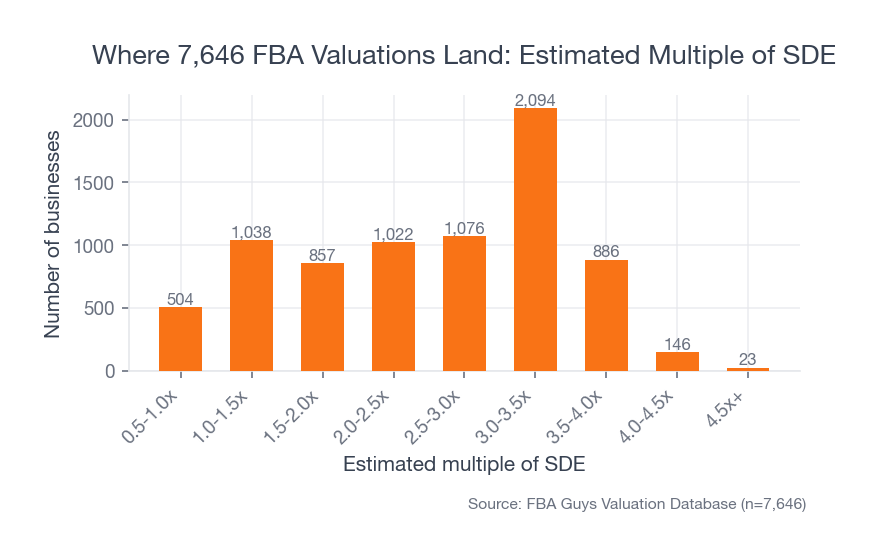 Source: FBA Guys Valuation Database (n=7,646)
The shape says more than the average does. The average estimate across the pool is 2.49x, and the midpoint is 2.68x: half the pool sits above that number, half below. Now rank every business by its estimated multiple and keep walking up the line. Beating three-quarters of the pool takes 3.29x. Beating 90% of it takes 3.6x. Beating 95% takes the same 3.6x, which means the entire stretch from "better than 9 in 10 businesses" to "better than 19 in 20" happens inside a single tenth of a turn. The top 1% starts at 4.2x.
One caveat before going further: these are estimated multiples produced from seller inputs to our valuation tool, not closed-transaction prices. We can show you where the estimates cluster. We can't tell you what a buyer actually wired for the business at the top of the range.
Size raises the typical outcome, not the ceiling
The obvious objection is that small businesses drag the numbers down, so we checked. Among businesses above $500K in SDE, 1,497 of them, the midpoint estimate rises to 3.25x. But the multiple it takes to beat 90% of that group, or 95% of it, is still exactly 3.6x.
The share reaching 4x climbs with size, but slowly: 1.0% in the smallest band, 2.2% at $50K–$150K SDE, 2.7% at $150K–$500K, and 3.3% above $500K. A bigger business earns a better typical outcome. The ceiling barely moves for anyone.
What the 1-in-45 actually look like
We pulled the 169 businesses at 4x+ and set them against the 2,980 businesses estimating between 3x and 4x, expecting to find the thing that separates them.
On the variables sellers usually obsess over, the two groups are close to twins. Average gross margin: 51.5% versus 50.9%. Average review score: 4.58 versus 4.54. Average age: 8.8 years versus 8.4.
The differences are small, and they show up everywhere at once. In the 4x cohort, 42.6% of owners reported under five hours of owner time per week, against 34.6% in the 3–4x group. Backup suppliers: 73.4% versus 65.2%. Brand registry: 95.9% versus 90.9%. Growing revenue: 72.8% versus 69.9%. Average SDE: $962K versus $701K.
We went in looking for the lever and didn't find one. The more likely reading is that the top of the distribution is what stacking looks like: every input slightly better, no input left behind. A business estimating at 3.2x can usually name its weak spot. The 4x cohort doesn't appear to have one to name.
What we can't tell from here is which of those small advantages does the work. They may all travel together with general operator quality, in which case "fix your backup supplier" wouldn't move anyone to 4x on its own. The data shows the profile, not the mechanism.
If your estimate is in the 3s
Our read: a seller estimating around 3.2x is usually better served preparing a clean exit in the 3s than spending a year chasing the 169 club. Getting there means becoming slightly better at everything simultaneously, including things that take years to change, like business age and accumulated review history. The 3.0x–3.5x band is where good FBA businesses live, and with 41% of the pool reaching 3x, an estimate that starts with a 3 is a normal outcome for a well-run business, not a consolation prize.
For buyers, the same numbers read the other way. A deal priced above 3.6x is priced higher than 95% of everything we see. Sometimes that is justified. The useful question is which of the stacked advantages the price is paying for, and whether they transfer with the sale.
Either way, the place to start is knowing which bucket you are in. The valuation tool takes about three minutes and benchmarks your inputs against the same 7,646 businesses in this distribution.
Curious what your business is worth?
Get a free, instant valuation and see how your Amazon business stacks up.
Get Your Free Valuation