Brand Registry Enrollment and FBA Valuation: What the Gap Looks Like in the Data
The FBA Guys
June 24, 2026

Line up 8,579 FBA businesses by brand registry enrollment status and the gap is immediate: enrolled businesses average 2.11x in estimated multiple, non-enrolled average 1.52x.
That is a 0.59x gap on the headline numbers. The question worth asking is whether it holds once you account for size and revenue direction — because enrolled businesses tend to be larger, and larger businesses tend to estimate higher anyway.
It holds.
The Controlled Cut
In the $50,000 to $200,000 annual SDE band, the two groups are nearly the same size in the data: enrolled businesses average $109,785 in SDE, non-enrolled average $103,745. At those matched sizes, enrolled averages 2.23x and non-enrolled averages 1.54x — a 0.69x gap.
SDE (Seller's Discretionary Earnings) is the earnings measure commonly used to value owner-operated businesses. At $100,000 in annual SDE, the estimated valuation difference works out to roughly $69,000: a non-enrolled business at 1.54x estimates around $154,000, an enrolled business at 2.23x estimates around $223,000.
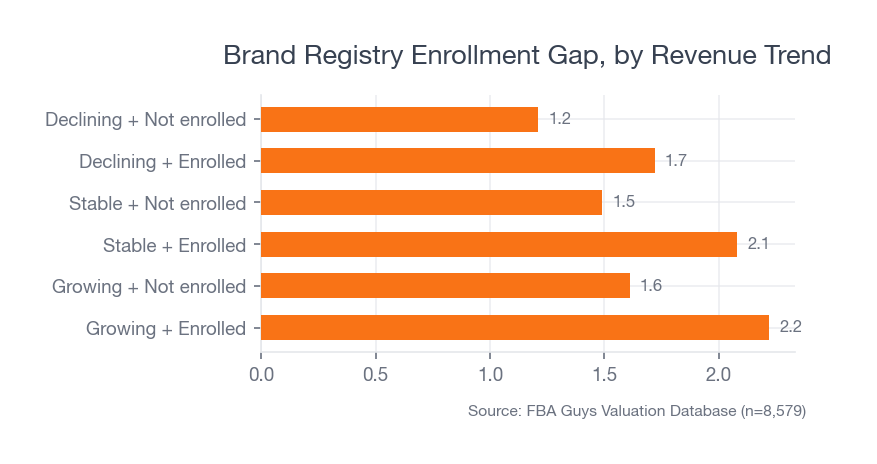
The table below controls for revenue direction:
 Source: FBA Guys Valuation Database (n=8,579)
The gap by trend group:
- Growing businesses: enrolled 2.22x, not enrolled 1.61x (+0.61x)
- Stable businesses: enrolled 2.08x, not enrolled 1.49x (+0.59x)
- Declining businesses: enrolled 1.72x, not enrolled 1.21x (+0.51x)
The gap doesn't close when the business is growing. It doesn't close when the business is large. The enrollment signal appears to travel independently.
The Reversal Worth Noting
The most counterintuitive cut: a growing non-enrolled business averages 1.61x, while a declining enrolled business averages 1.72x. Enrollment, in this data, outweighs revenue direction.
The same reversal shows up on size. A non-enrolled business earning over $200,000 in annual SDE averages 1.62x. An enrolled business earning under $50,000 in annual SDE averages 1.85x. Enrollment overrides size, at least at this level of aggregation.
The 3x Threshold
Among enrolled businesses, 1,512 of 6,525 reach 3x or better — 23.2%. Among non-enrolled, 137 of 2,054 reach 3x or better — 6.7%.
The gap at 3x is not driven by a handful of outliers. It reflects a structural difference in how far non-enrolled businesses can travel up the multiple range.
What We Don't Know
The database records self-reported enrollment status at the time of valuation submission. Our read: the enrollment signal is probably standing near several other business-quality markers that the form doesn't fully capture — brand ownership, listing control, IP documentation, and the kind of monobranded catalog that makes a business easier to defend post-acquisition. Those aren't things the form asks about directly.
Whether enrollment causes a higher multiple or simply travels with the profile of a business that earns one is something the database can't settle. What it does show: across every size band and every revenue trend in 8,579 records, the gap is there.
What It Means for Sellers and Buyers
For a seller: if you're brand registry eligible and haven't enrolled, the data suggests the cost of that decision shows up in the estimate. The enrollment itself is straightforward; what travels with it — brand protection, listing control, access to tools like A+ Content — may be what buyers are actually pricing.
For a buyer: the enrollment status is one of the first things to confirm in due diligence, not because unenrolled businesses can't be acquired, but because the multiple may already reflect the discount. A business at 1.54x unenrolled is being priced for that gap — and the path to enrolled status post-acquisition isn't always clean if there are IP gaps in the underlying catalog.
The data doesn't say what to do with the gap. It shows where it sits.
Curious what your business is worth?
Get a free, instant valuation and see how your Amazon business stacks up.
Get Your Free Valuation