High-Margin Books Still Lag in FBA Valuation Data
The FBA Guys
August 1, 2026

Books have the best margin profile in this week's category pull and still land at the bottom of the multiple table.
That is the part that made the cut worth checking. Among high-margin businesses with at least $100K in seller's discretionary earnings, books averaged a 65.9% gross margin. SDE is seller's discretionary earnings, the annual profit the business produces for one owner-operator. In the same controlled group, books averaged a 1.912 estimated multiple across 57 category records. The midpoint was lower: 1.700x. More than half of the books records, 52.6%, sat below 2x.
This is not the broad, messy category table where every niche is mixed together. The first cut had books at 1.584x across 246 records, with 70.7% under 2x. Then we narrowed to 40%+ gross margin. Books barely moved, averaging 1.602x across 179 records, while carrying the highest average margin in that higher-margin pull at 67.8%.
The size objection was obvious enough to test. Smaller businesses tend to estimate lower, and books in the full pull averaged less SDE than several larger categories. So the chart below keeps only records with $100K+ SDE and 40%+ gross margin, then compares categories with at least 50 records in that controlled pool.
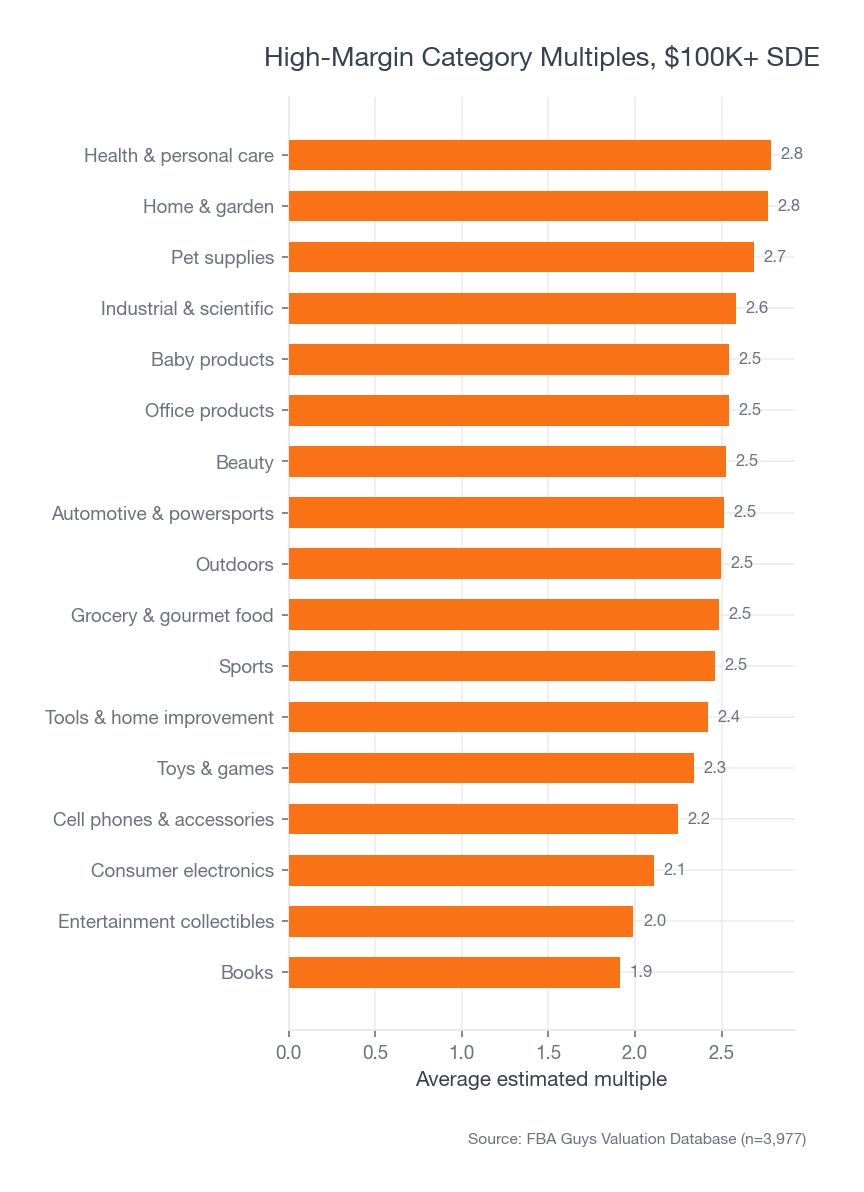
Source: FBA Guys Valuation Database (n=3,977 category records)
The top of the table looks very different. Health and personal care averaged 2.783x across 604 records. Home and garden averaged 2.768x across 720 records. Both had just over half their records reaching the 3x bar, and only about one in five under 2x.
Books did not follow that shape. In the same controlled pool, only 19.3% reached the 3x bar, and 52.6% stayed below 2x. Entertainment and collectibles and consumer electronics were also low, at 1.991x and 2.107x, but books still sat at the bottom.
Our read: category is carrying something margin does not capture. Margin tells you how much room the business has after product cost. It does not tell you whether demand holds, whether the product is defensible, whether the catalog ages quickly, whether the customer relationship transfers cleanly, or whether the business depends on inventory that looks easier to copy than to own.
Books are a useful stress test for that distinction because the economics can look clean. High gross margin gives a seller room. It can absorb ads, fees, supplier movement, and some operating mistakes. But if the category itself carries questions about durability or transferability, the margin line doesn't answer them by itself.
For sellers, the practical question is not whether books are bad. That would be too blunt for what the data can support. The better question is what else has to travel with the margin. A high-margin books business with owned demand, clean sourcing, repeat customers, documented processes, and a defensible catalog is a different object than a high-margin catalog that depends on fragile demand or easily copied listings.
For buyers, the category label should probably start a second pass rather than end the analysis. If a books-led business shows 60%+ margin, the next question is what protects that margin. Is it brand, audience, exclusive supply, content ownership, review depth, or something else? If the answer is only "the products have good margins," the table above is a useful warning.
There is one important limit. The category field is seller-selected and business-level. A record tagged books may be a books-led business, a mixed catalog with books as one slice, or a business where the seller used the closest available category label. The data shows how records tagged books behave in the valuation pool. It does not prove what every SKU in those businesses does.
That limit matters, but it does not erase the pattern. After controlling for margin and size, books still sit where a margin-only view would not expect them to sit.
Curious what your business is worth?
Get a free, instant valuation and see how your Amazon business stacks up.
Get Your Free Valuation