Amazon FBA Addbacks for Valuation: The Expense Has to Survive the Proof
The FBA Guys
August 20, 2026

Addbacks have a way of making a P&L feel suddenly negotiable. You start with net income. Then owner salary comes back. Health insurance comes back. Maybe a one-time legal bill comes back. Maybe the credit card points you sent to a personal account belong somewhere too. By the time you are done, the business can look meaningfully different from the number at the bottom of the profit and loss statement.
Amazon FBA addbacks for valuation are expenses added back to net income when calculating Seller's Discretionary Earnings, or SDE, if those expenses are owner benefits, non-cash charges, one-time or non-recurring costs, or clear adjustments that won't carry forward to a buyer. That last part is where the work sits.
In the FBA Guys database, among 8,651 qualified valuation records, the median derived value-to-estimated-SDE multiple is 2.55x. At that median, a $10,000 accepted addback is roughly $25,500 of valuation math, and a $5,000 accepted addback is roughly $12,750. The line items matter. The proof matters more.
What Addbacks Are and Why They Exist
Seller's Discretionary Earnings is the profit stream available to one owner-operator after adjusting net income for legitimate owner benefits, non-cash expenses, one-time expenses, and certain non-recurring adjustments. The simple formula is net income plus addbacks equals SDE. For most owner-operated Amazon FBA valuation work, SDE times the multiple equals the estimated business value.
Inventory may be handled separately or included in the price presentation, so the headline multiple can look different depending on how a sale is shown. The underlying point is the same: if the SDE number is wrong, the valuation math is wrong.
That is why addbacks exist. They are supposed to show the earnings of the business after removing expenses that belong to the current owner, accounting treatment, or a one-time event rather than to the future buyer.
A clean owner salary addback is easy to understand. If the business shows $20,000 of net income because the owner took $120,000 in salary, the business didn't really produce only $20,000 for one owner-operator. The salary is part of the economic benefit, while depreciation and amortization work differently because they may appear on the P&L without representing cash that left the business that month.
Interest expense on debt that won't transfer is another common example. So are certain owner-paid benefits, personal expenses run through the business, and one-time legal or setup costs.
The category is only the beginning. A $12,000 legal bill might be a clean addback if it was a one-time trademark filing or incorporation cleanup. It might be a weaker addback if it relates to an unresolved dispute a buyer could inherit through risk, distraction, or future expense. The label "legal" doesn't answer the valuation question.
The cleaner test is whether the buyer will have to spend the same money after closing to keep the business producing the same SDE.
How Much Addbacks Can Change an Amazon FBA Valuation
The database doesn't store addback schedules. It doesn't tell us which expenses were proposed, accepted, rejected, or negotiated during diligence.
That limitation matters. We can't say, from the database, that owner travel is accepted 82% of the time or that credit card rewards are missed in a certain share of FBA businesses. The fields aren't there.
What the database can do is show how sensitive valuation output is to SDE.
Among the 8,651 qualified records, the median derived value-to-estimated-SDE multiple is 2.55x. That is a valuation-output proxy calculated as estimated valuation divided by estimated SDE, not a closed-sale multiple.
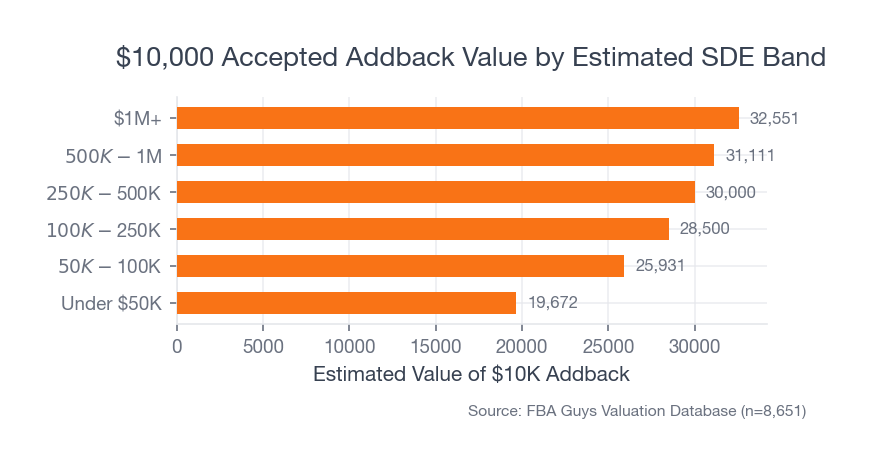
At the current median, a $10,000 accepted addback is about $25,500. The dollar effect changes by SDE band:
| Estimated SDE band | Records | Median derived multiple | $10,000 addback at median |
|---|---|---|---|
| Under $50K | 3,123 | 1.97x | $19,672 |
| $50K-$100K | 1,355 | 2.59x | $25,931 |
| $100K-$250K | 1,575 | 2.85x | $28,500 |
| $250K-$500K | 1,017 | 3.00x | $30,000 |
| $500K-$1M | 767 | 3.11x | $31,111 |
| $1M+ | 814 | 3.26x | $32,551 |
 Source: FBA Guys Valuation Database (n=8,651)
The smaller bands are interesting for a different reason. In the under-$50K SDE band, average estimated SDE is $20,494, so a $10,000 addback is large relative to that earnings base. In the $1M+ band, the same addback is worth more dollars after the multiple, but it is far less likely to change the shape of the business.
That is a useful distinction. Addbacks can be financially meaningful at any size, but they don't all carry the same narrative weight.
The multiple distribution adds another caution. In the qualified database, 35.3% of records sit below 2x, while only 2.0% reach 4x or higher. The practical work is usually to make the earnings base accurate and defensible before hoping for an outlier multiple.
The Addbacks Buyers Usually Accept When the Proof Is Clean
The easiest addbacks share three traits: the expense is visible in the P&L, the amount ties to a statement, invoice, payroll report, or accounting record, and the buyer won't need to keep spending it after closing.
Owner salary is the obvious starting point. One reasonable owner-operator salary is usually part of SDE. Owner health insurance and retirement contributions generally fit the same logic because those benefits belong to the seller, not the buyer.
Interest expense is another common addback when debt doesn't transfer. Most small business transactions are structured around assets, so the buyer isn't taking over the seller's loan in the ordinary case. The interest was a cost of the seller's financing, not the operating model.
Depreciation and amortization are non-cash accounting expenses. The IRS depreciation guidance is a tax resource, while the valuation question here is simpler: they may be legitimate entries on the P&L, but they don't usually represent a cash cost the buyer will pay again next month.
One-time professional fees can be clean too. A trademark filing, incorporation cleanup, one-time legal document, or bookkeeping setup project may belong in the addback schedule if it happened in the trailing twelve months and won't recur.
Personal miscellaneous expenses sit in the same family, but they require more care. A mobile phone, home office expense, vehicle cost, personal meals, or personal travel can be an owner benefit. Tax treatment belongs with a CPA and current IRS business expense resources; the valuation record still needs to show the amount and the reason it is personal. A vague "travel" account with business conferences, supplier visits, and family travel mixed together asks for an argument.
If you want a clean test, ask whether the buyer would have to spend this money to produce the same revenue and SDE after closing. If the answer is no and the documentation is clean, the addback has a reasonable start.
The Gray Area Addbacks That Need Math
The most useful addback work usually doesn't happen in the obvious categories. It happens in the gray areas where the expense is partly real, partly timing-related, or partly owner-specific. This is where addbacks become a proof exercise.
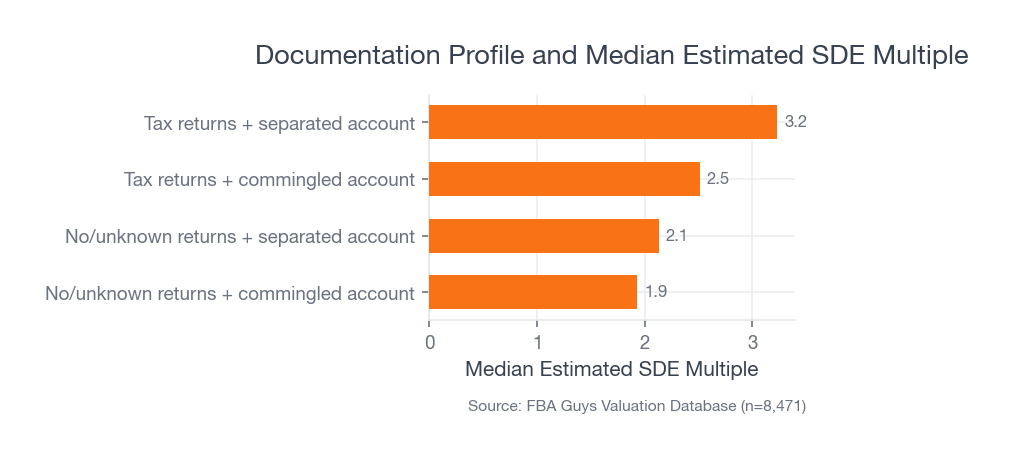
The database gives useful context. Records with tax returns and separated accounts had a 3.23x median derived value-to-estimated-SDE multiple; records with no returns or unknown returns plus commingled accounts had a 1.93x median. The confidence-score cut moved in the same direction: 1.50x at low confidence and 3.29x at high confidence.
 Source: FBA Guys Valuation Database (n=8,471)
Those aren't addback-causation numbers. The database doesn't know whether a buyer accepted the owner's travel addback or whether a seller's reward points were in the schedule.
But the pattern is still relevant. When the books are cleaner and the confidence profile is higher, the valuation output looks different, and addbacks live inside that trust environment. A website redesign is a useful gray-area example because the same invoice can be recurring, partly recurring, or one-time depending on the history behind it.
If your business redesigns every year, the expense is recurring and belongs in the future cost structure. If the business redesigns every four years and this year's P&L carries the full project cost, a partial addback may make sense. A $10,000 redesign that happens once every four years could support a $7,500 addback, because only one fourth of the cost reflects a normal annual burden.
The proof isn't that the redesign felt unusual. The proof is the history.
Credit card cash back and reward points create a different kind of gray area. If business spend produced cash back that went to your personal account, that is economic benefit. If reward points were earned on business spend, the value may be convertible using the card issuer's own terms.
The schedule still has to follow the trailing twelve months. One million points accumulated over three years shouldn't become a $10,000 TTM addback just because the account shows that balance today. The cleaner method is to assign the converted value to the months the points were earned.
Recent COGS changes need the same discipline. Suppose your supplier cost dropped three months ago and the lower cost will carry forward. The prior nine months of the trailing twelve months may overstate the future cost structure. That can support an adjustment, but only if you can show units sold, old cost, new cost, effective date, and the math.
The same logic can move against you. If COGS rose three months ago, the older nine months may understate the future cost structure. A buyer may adjust SDE downward.
That is why a good addback schedule doesn't only add. It normalizes.
The work isn't to find every expense that helps the seller. The work is to show the future buyer what the business would have earned under the cost structure they are actually buying.
Where Amazon FBA Addbacks for Valuation Get Rejected
Some expenses fail because they are normal operating costs.
Failed PPC tests are the common example. A buyer is likely to test advertising after closing, and some tests won't work. That is part of running an Amazon business. A one-time agency setup fee may be different, but the ad spend itself usually remains an operating expense.
Stockout losses are another weak category. You can explain them, and a clean stockout narrative can help someone understand revenue, margin, inventory timing, and working capital. But "we would have sold $40,000 more if inventory had been in stock" usually depends on a counterfactual. The revenue didn't happen. The cost line isn't clean. The math is often too fuzzy to carry an addback.
Staff cuts can also fail the test.
If you replaced an overpaid bookkeeper with a professional service at half the cost and the new structure is already running, there may be an adjustment to show. If you fired a critical employee right before valuation and took the work back yourself to make SDE look higher, that is a different story because the buyer still needs the work done and will price the replacement cost back in.
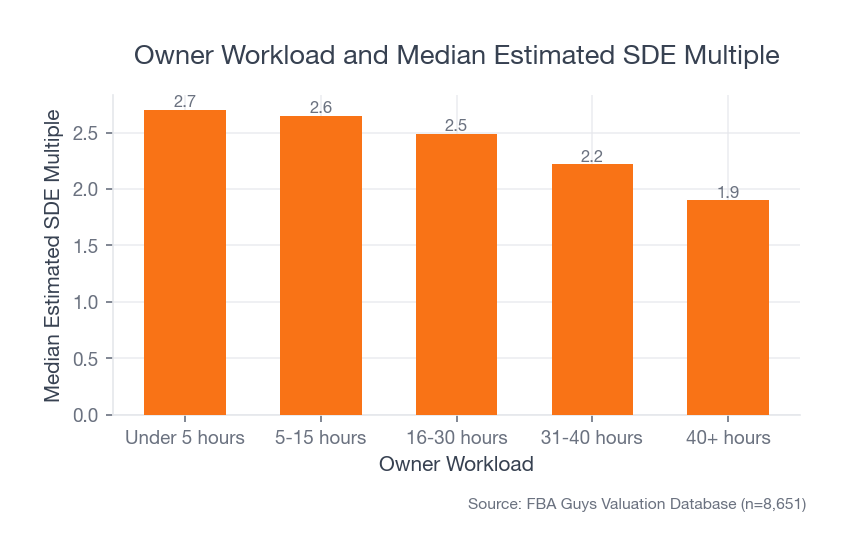
The owner-salary addback has the same issue when workload gets too high. In the database, under-5-hour records had a 2.70x median derived multiple, while records at 40+ hours had a 1.90x median. That gap doesn't prove workload caused the valuation difference, but it fits the transferability concern.
 Source: FBA Guys Valuation Database (n=8,651)
One owner working a reasonable week is part of the SDE model; two owners, a sixty-hour week, or specialized work that a buyer has to hire for can create an offset. The addback is strongest when it answers the buyer's future cost question without requiring them to trust the seller's optimism.
How to Present Addbacks in Your P&L
Build the addback schedule below net income. Keep it monthly. Keep it tied to the trailing twelve months.
Each row should include:
- Expense category
- Month
- Amount
- Account or source line in the P&L
- Full or partial addback
- Reason it won't carry forward
- Evidence file
- Notes on any replacement cost or negative adjustment
The evidence file is the quiet part that does most of the work. Payroll reports support owner salary. Loan statements support interest. Invoices support legal fees, trademark filings, equipment purchases, and bookkeeping cleanup. Card statements and reward exports support cash back or point conversion. Supplier invoices support COGS changes.
For partial addbacks, show the math in the schedule rather than asking the buyer to accept a rounded number. If a website redesign is treated as 75% non-recurring, the schedule should show why. If a cost reduction started three months ago, show old cost, new cost, units sold, and the period affected.
For new-normal adjustments, include negative adjustments too. That is a credibility move because it shows the schedule is trying to normalize earnings, not only raise them.
This is where the database's documentation pattern becomes practical. Tax returns plus separated accounts, high confidence scores, and lower commingling all travel with stronger valuation-output profiles. The article can't claim an addback schedule caused those differences. It can say that addbacks are easier to trust when the financial file already behaves like a file.
If the proof isn't ready, use a separate tab called proposed addbacks. Then move each line into the relied-upon SDE only when the evidence is attached.
Can Addbacks Increase the Multiple?
Addbacks directly increase SDE when they are accepted. They don't directly increase the multiple.
The multiple is a separate judgment about risk, growth, transferability, and documentation. Clean addbacks can support that judgment because they make the earnings base more credible, while weak addbacks can hurt it because they make the seller's numbers feel stretched.
That distinction matters for both sides of the table.
If you are a seller, the goal isn't to stuff the schedule until SDE looks impressive. It is to make the earnings base accurate enough that the valuation can stand up to review, which is a different job from making the number bigger.
If you are a buyer, the addback schedule is one of the first places to test the seller's logic. The best schedules show their work, and the weakest schedules ask you to accept a future that isn't visible in the records.
Our read: treat addbacks as earnings-base work first, even when that work also raises confidence. Accuracy is the first job.
FAQ
What are addbacks in business valuation?
Addbacks are expenses added back to net income to calculate Seller's Discretionary Earnings. They usually include owner benefits, non-cash accounting expenses, one-time or non-recurring expenses, and certain adjustments that show the cost structure a buyer is actually inheriting.
Are Amazon advertising costs addbacks?
Usually, no. Advertising is a normal operating expense for most Amazon FBA businesses. A one-time agency setup fee may be different from the ad budget itself, but failed ad tests are typically part of normal business operations.
Can owner salary be added back?
Usually, one reasonable owner-operator salary can be added back. If the business requires two owners, a very heavy owner workload, or specialized labor a buyer must replace, the addback may need an offset for replacement cost.
How much do addbacks affect Amazon FBA valuation?
Among 8,651 qualified valuation records in the FBA Guys database, the median derived value-to-estimated-SDE multiple is 2.55x. At that median, a $10,000 accepted addback equals about $25,500 of valuation math, though the actual effect depends on the accepted addback amount and the multiple applied to the business.
Do addbacks increase the multiple?
Addbacks increase SDE when accepted. They don't directly increase the multiple, which depends on risk, growth, transferability, and documentation. A clean addback schedule can support buyer confidence, while a stretched one can weaken it.
The Number Has to Survive the File
The final test is practical: Amazon FBA addbacks for valuation should make the earnings base clearer than the P&L alone, with less room for argument. That is the simplest useful standard. If the schedule explains a true owner benefit, one-time expense, non-cash charge, or new-normal adjustment with clean proof, it can change the valuation math quickly. If it asks the buyer to believe in a number the records don't support, the addback starts working against the seller.
Use the SDE calculator to rough out the number. Then build the file behind it: monthly P&L, clean accounts, tax returns, invoices, statements, payroll reports, and a schedule that shows the math line by line.
The multiple comes later. First, answer the better question: multiple of what?
Curious what your business is worth?
Get a free, instant valuation and see how your Amazon business stacks up.
Get Your Free Valuation