Amazon FBA Business Valuation Mistakes to Avoid: Fix the Inputs Before the Multiple
The FBA Guys
August 18, 2026

It is tempting to start an Amazon FBA valuation with the multiple. That is the number people remember, the number they compare in mastermind groups, and the number that makes a business feel more or less exciting.
The better place to start is earlier in the math. The Amazon FBA business valuation mistakes to avoid are usually mistakes in SDE, documentation, risk, timing, and concentration before the multiple ever gets applied. Seller's Discretionary Earnings, or SDE, means net income plus valid owner add-backs and certain adjustments, measured most often over the trailing twelve months.
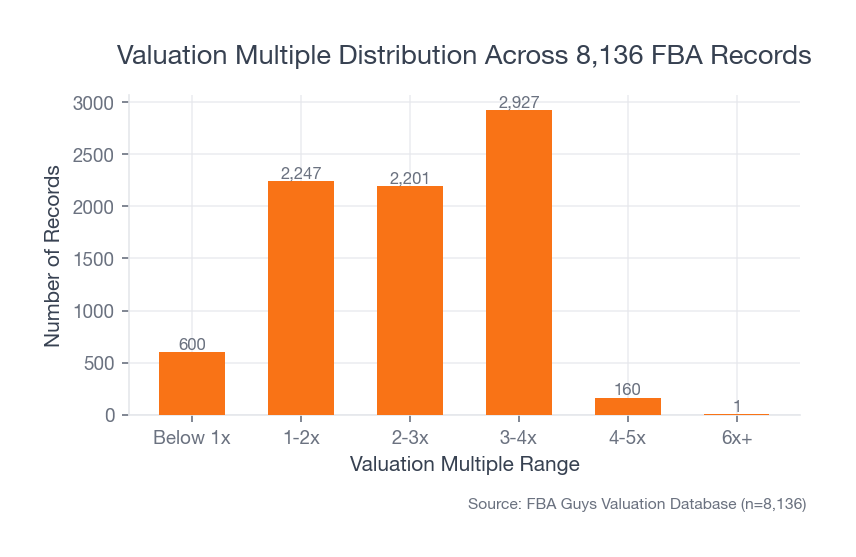
Among 8,136 usable valuation records in the FBA Guys database, the median multiple was 2.55x. Only 161 records reached 4x or higher.
 Source: FBA Guys Valuation Database (n=8,136)
That doesn't make a higher valuation impossible. It does make the input work harder to skip.
Mistake 1: Treating Revenue Like Value
Revenue is useful. It tells you the scale of the operation, the demand behind the catalog, and the size of the system a buyer would be taking over. It doesn't tell you what the business is worth by itself.
The cleanest comparison in the data is plain enough to sit with for a minute. Among 34 records with more than $1M in annual revenue and under $100K in SDE, the average valuation was $107,554 and the median multiple was 1.41x. Among 1,476 records with $250K-$999K in revenue and at least $100K in SDE, the average valuation was $639,315 and the median multiple was 3.03x.
A smaller business can be more valuable when the earnings are real, durable, and visible.
This is where many Amazon business valuation errors begin. A seller sees a seven-figure sales line and assumes the valuation should feel like a seven-figure business. A buyer has to underwrite the earnings that will transfer. If the revenue requires too much ad spend, too much inventory, too much owner labor, or too little margin, the top line won't carry the valuation.
Margin makes the same point from a different angle because the spread is wide: records with margins under 10% had a 1.10x median multiple, while records at 40% margin or higher had a 2.80x median. Revenue can look impressive while the business underneath it is fragile.
Mistake 2: Cleaning Up SDE After the Buyer Asks
SDE is the number the multiple is applied to, so a messy SDE calculation creates a messy valuation. If you miss $10,000 of valid SDE and the business is valued at 3x, that is $30,000 of value missing from the estimate. If you add back $10,000 that doesn't belong, the valuation is $30,000 too high before anyone starts diligence.
The documentation proxy in the database gives this point some shape. Under $100K SDE, records marked no for tax returns had a 1.90x median multiple. Records marked yes had a 2.63x median. In the $100K-$250K SDE band, the medians were 2.63x and 3.29x. In the $250K-$1M band, they were 2.64x and 3.29x.
Tax returns aren't the whole documentation pillar. They don't prove that the P&L is clean, that inventory is reconciled, or that the add-back schedule is defensible. They are a proxy.
The pattern still fits what valuation mechanics would predict. A claimed earnings number becomes more useful when it is supported by records that a buyer can inspect. For an inventory business, that usually means accrual-based financials, monthly P&Ls, inventory records, bank statements, marketplace reports, and a clear bridge from net income to SDE.
If those documents don't exist yet, the valuation is still possible. It is just less useful. You are estimating a number that the proof file hasn't caught up to. The SDE calculator is a useful starting point, but the support behind each input still matters.
Mistake 3: Stretching Add-Backs Past Math and Logic
Add-backs are one of the easiest places to be too conservative or too aggressive.
A valid add-back is usually an owner benefit, a non-cash expense, a one-time or non-recurring expense, or a trailing-twelve-month adjustment that reflects the cost structure a new owner will inherit. Owner salary can be an add-back. Depreciation can be an add-back. A one-time legal expense may be an add-back. A cost reduction that happened three months ago may justify an adjustment for the prior nine months if the math is clear.
The database doesn't track accepted and rejected add-backs, so we don't have a clean rejection-rate statistic. That limitation matters.
What we can say from valuation mechanics is that add-backs need to survive the carry-forward test. Will this expense exist for the next owner? If the answer is no and the documentation is clean, it may belong in SDE. If the answer is yes, or if the answer depends on a story the buyer can't verify, the add-back should be treated carefully.
Failed ad tests, stockouts, ordinary experimentation, and last-minute cost cuts are common trouble spots. They may have hurt the seller's year. That doesn't automatically make them buyer-neutral expenses.
The cleaner approach is to separate three piles before you trust the estimate: obvious add-backs, possible add-backs that need proof, and expenses that should stay in the business. The second pile is where most of the work lives.
Mistake 4: Reading Concentration as a Yes-or-No Problem
Single-product risk is real. A hero SKU can create supplier risk, review risk, competition risk, inventory risk, and transferability risk in one place.
The database doesn't support the idea that a one-SKU business has no value.
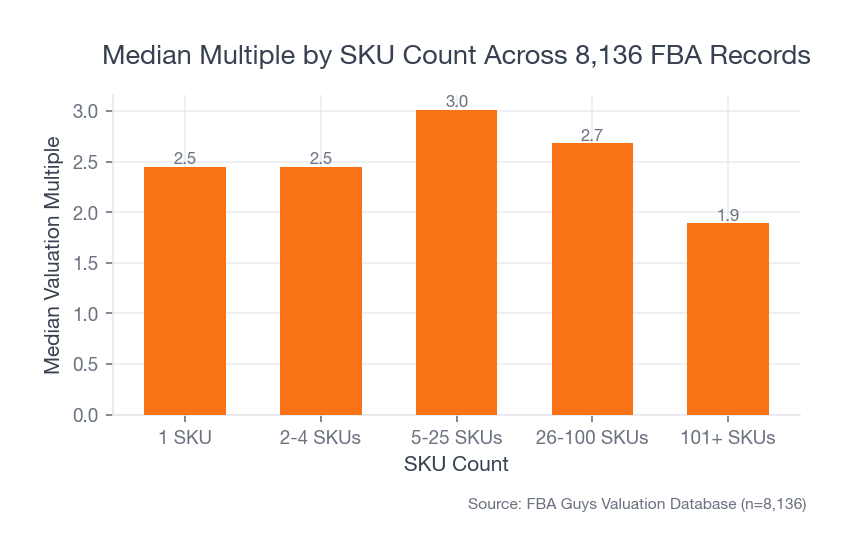
Among 623 one-SKU records with usable valuation outputs, the median multiple was 2.45x. That was lower than the 5-25 SKU bucket, which had a 3.01x median, but it wasn't close to zero. The trend cross-check is more interesting. One-SKU records marked declined had a 1.70x median. One-SKU records marked increased a lot had a 3.00x median.
The supplier side tells a similar story. One-SKU records with no backup vendor had a 2.21x median multiple. One-SKU records with backup vendors had a 2.60x median.
So the single-product problem isn't simply "one SKU." It is one SKU plus the facts around that SKU. Is it growing? Does it have backup supply? Is the product defensible? Does the seller have clean documentation for margin, reviews, returns, and account health?
Account health belongs in that same proof file. The database fields for account health and suspension history are too sparse for us to make a strong statistical claim. That doesn't make the issue small. It means this is a review item, not a database-led section. Recent warnings, unresolved policy issues, and suspension history need to be explained with dates, resolution records, and evidence that the issue hasn't repeated. Amazon's Seller Central account health guidance is the starting reference for where sellers monitor those issues.
The same caution applies in the other direction. More products aren't always better. The 5-25 SKU bucket had the strongest median multiple at 3.01x. The 101+ SKU bucket had a 1.89x median. Supplier count had a middle too: 2-5 vendors had a 2.75x median, while more than 10 vendors had a 1.51x median.
 Source: FBA Guys Valuation Database (n=8,136)
Our read is that diversification helps when it reduces risk in a way the next owner can operate. Past that, "more" can become complexity. This is where the four pillars of a valuation are more useful than a simple SKU count.
Mistake 5: Waiting for the Market Instead of Timing the Business
Market multiples deserve a look. They just shouldn't be asked to fix a business that isn't ready.
As of the writing of this article, the FBA Guys market multiple table shows base multiples from 2.69x to 2.95x across SDE bands. The latest effective date in that table is 2026-07-14. The effective samples are small, so this is context rather than a full answer.
The business-specific timing variables are easier to see in the larger database.
Records under two years old had a 2.05x median multiple. Records between two and five years old had a 2.63x median. Records over five years old had a 2.83x median. Trend mattered too. Records marked declined a lot had a 1.48x median multiple; records marked increased had a 2.75x median.
If your business is young, has a declining trend, has thin documentation, or has fragile concentration, a better market may still leave the estimate feeling light.
Sometimes the better timing question is operational: what would need to be true six months from now for the estimate to be less fragile?
Mistake 6: Expecting 4x Before Checking the Distribution
The multiple distribution is the part of this topic that changed our read the most.
Across 8,136 usable valuation records, 161 reached 4x or higher. That is 1.98%. One reached 5x or higher.
The rate improves with size, but it stays uncommon. Under $50K SDE, 0.9% of records reached 4x or higher. Over $1M SDE, 3.9% reached 4x or higher.
That doesn't mean the top end is imaginary. It means the business has to earn the conversation. Clean SDE, strong trend, age, defensibility, transferability, documentation, and manageable concentration all have to show up in the same file.
If one of those is missing, the valuation may still be good. It just has to be understood as the business the data describes, not the business the seller hoped the multiple would create.
What the Data Can't Tell Us Yet
The database is useful here, but it has edges.
It doesn't tell us whether a specific add-back schedule would survive a buyer's review. It doesn't give us enough account-health records to make a strong statistical claim about recent warnings, resolved suspensions, or active issues. It doesn't prove that tax returns caused higher multiples. It shows that tax-return availability travels with higher-multiple records inside the SDE bands we checked.
That uncertainty changes how you should use the data. Use it to identify where your estimate is likely fragile. Then review the underlying proof.
If the SDE is clean, the add-backs are documented, the risk profile is visible, and the business has enough age and trend to support the story, the valuation starts to mean something. For a broader preparation view, see the guide on how to raise the value of your Amazon FBA business.
The multiple comes after that work.
FAQ
What is the biggest Amazon FBA business valuation mistake?
The biggest mistake is usually starting with the multiple before confirming the SDE and risk inputs. A multiple only matters after the earnings base is accurate.
Are FBA businesses valued on revenue or profit?
Owner-operated FBA businesses are typically valued as a multiple of SDE. Revenue still matters, but it isn't the core valuation base.
Is a single-product Amazon business sellable?
Yes. In the FBA Guys database, 623 one-SKU records with usable valuation outputs had a 2.45x median multiple. The risk is real, but it is a pricing and proof issue rather than an automatic zero.
How common is a 4x FBA valuation?
In 8,136 usable valuation records, 161 reached 4x or higher. That is 1.98% of the dataset.
Curious what your business is worth?
Get a free, instant valuation and see how your Amazon business stacks up.
Get Your Free Valuation