How to Prepare Your Amazon Business for Sale: Build the Buyer File Before the Buyer Arrives
The FBA Guys
August 15, 2026

Most Amazon exit preparation advice starts too close to the listing date.
You get the checklist. Clean up the books. Write SOPs. Pull supplier invoices. Check account health. Gather screenshots. Those are all useful, but they make sale prep sound like a filing project. In the FBA Guys valuation data, the useful pattern is the confidence record that existed before the folder was assembled.
If you want to know how to prepare Amazon business for sale, start with the buyer-confidence file: defensible SDE, separated finances, tax-return support, documented owner work, current account-health records, supplier evidence, and a final 90-day verification sprint. The items that matter most usually need to exist before listing because a buyer is pricing the operating history, not the neatness of the upload.
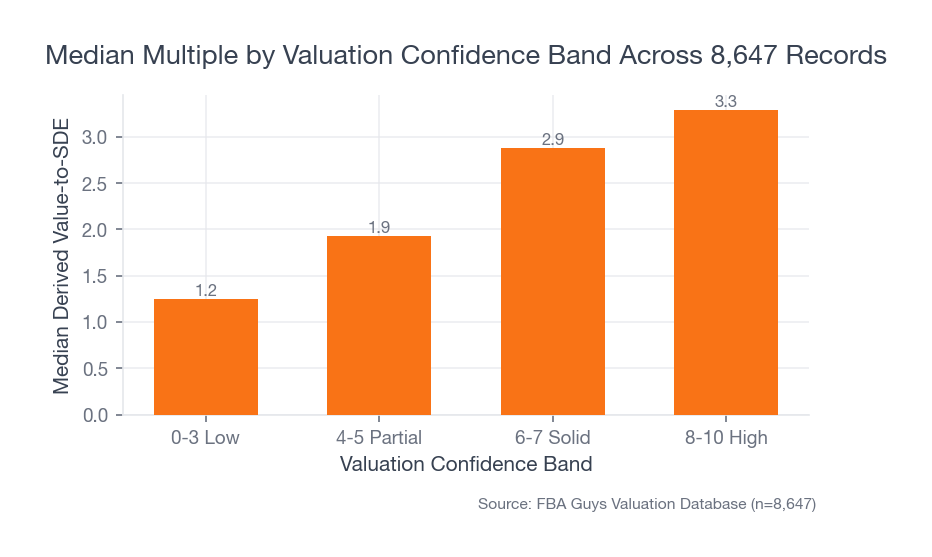
Among 8,647 successful positive-SDE valuation submissions, records in the high-confidence band had a 3.29x median derived value-to-SDE. Low-confidence records had a 1.25x median. That doesn't prove confidence caused the multiple. It does tell us that businesses with more reliable inputs looked very different from businesses where the data was thin or messy.
 Source: FBA Guys Valuation Database (n=8,647)
That is the useful starting point for a sell Amazon FBA business checklist. The checklist shouldn't begin with the teaser. It should begin with the records a buyer will trust when the seller isn't in the room.
Start With the Books Before You Start With the Listing
The first number a buyer has to believe is Seller's Discretionary Earnings, or SDE. SDE is the earnings base used for most owner-operated online businesses. It starts with net income, then adds back valid owner benefits, non-cash expenses, and one-time costs that won't carry forward to the buyer. If you need the math before the sale-prep work, start with the SDE calculator.
That sounds like a formula. In practice, it is a documentation test.
A seller can calculate SDE in an afternoon if the books are clean. A buyer can challenge SDE for weeks if the records don't support it. The difference is rarely the arithmetic. It is whether the P&L, settlement reports, bank statements, inventory records, supplier invoices, and add-back schedule all describe the same business.
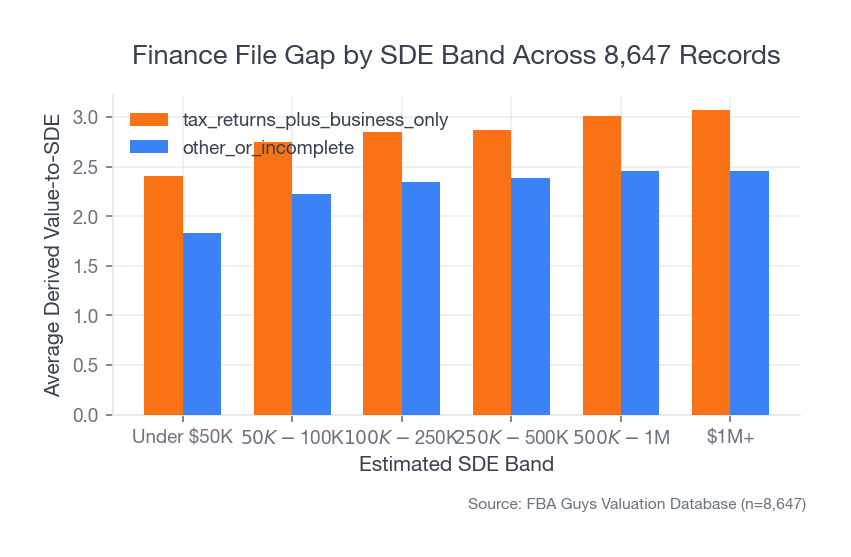
The broadest database pattern for this article came from the finance-file proxies. Records with tax returns available and business-only finances averaged 2.75x across 3,880 records. Records with no tax returns and commingled or other finances averaged 1.96x across 116 records.
That comparison has an obvious size problem, so we checked it inside rough estimated SDE bands. The gap stayed.
In the $100K-$250K estimated SDE band, records with tax returns plus business-only finances averaged 2.85x, compared with 2.34x for other or incomplete finance files. In the $250K-$500K band, the comparison was 2.87x versus 2.38x. In the $1M+ band, it was 3.07x versus 2.46x.
 Source: FBA Guys Valuation Database (n=8,647)
The data can't audit anyone's books. taxreturns and comingle are form-field proxies. Still, the pattern is strong enough to say the first preparation project is a finance file that can be followed without a tour guide.
What belongs in that file?
- Monthly profit and loss statements
- Bank statements
- Credit-card statements
- Amazon settlement reports
- Supplier invoices
- Inventory reports
- Ad account reports
- Payroll, contractor, and VA costs
- Tax returns, where available
- Add-back support
For an inventory business, the P&L should usually be accrual-based. Cash accounting can make COGS timing move profit into the wrong month. If a buyer has to normalize inventory timing before they can understand SDE, the finance file is already making the buyer work. The separate cash vs accrual accounting valuation guide goes deeper on that timing problem.
The add-back schedule deserves the same discipline. An add-back should answer a plain question: did this expense benefit the current owner, or was it non-recurring, non-cash, or not expected to carry forward to the buyer? If yes, preserve the support. If the answer is only that the expense feels unfair, the file probably needs more work.
Owner salary, owner health insurance, depreciation, amortization, and one-time legal costs may belong in the discussion. Advertising experiments, stockouts, and hoped-for lost sales are much harder. Buyers need math and logic, not the owner's preferred version of normal.
This is why the books come first. If the monthly financials are muddy, the add-back schedule starts repairing instead of explaining. Trust gets thinner after that.
Document the Work Someone Else Has to Run
The next question is transferability.
What happens when you stop doing the work?
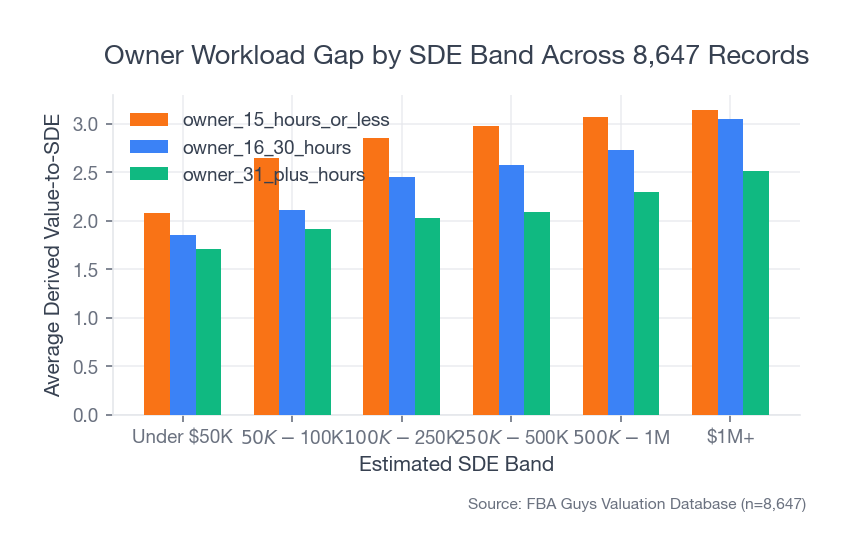
The owner-workload data points in a clear direction. Overall, records with 15 owner hours or less averaged about 2.50x, while records with 40+ owner hours averaged 2.03x. The pattern held inside estimated SDE bands. In the $100K-$250K band, 15 hours or less averaged 2.85x, 16-30 hours averaged 2.45x, and 31+ hours averaged 2.03x. In the $1M+ band, 15 hours or less averaged 3.14x while 31+ hours averaged 2.51x.
 Source: FBA Guys Valuation Database (n=8,647)
We don't know whether workload itself caused the gap. It may travel with stronger systems, better teams, cleaner fulfillment, or a more mature catalog. A buyer still has to replace the work.
That is the reason to write SOPs. Not because a binder is valuable by itself. SOPs are useful when they make a task transferable to a VA, contractor, employee, or new owner.
For an Amazon business, start with the tasks that would interrupt a buyer's first month:
- Reorder planning
- Supplier communication
- Shipment creation and tracking
- Listing edits
- PPC budget checks
- Coupon and promotion setup
- Account-health notice review
- Customer-service escalation
- Returns review
- Monthly close tasks
The populated SOP subset is smaller than the finance data, so it should support rather than carry the argument. No SOPs averaged 2.48x across 128 records. Some SOPs averaged 2.70x across 137 records. Comprehensive SOPs averaged 2.97x across 166 records.
That is transferability context, not causation. The more practical test is whether a buyer can watch the business operate for two weeks and understand who owns each recurring task.
If the answer is still "the owner just knows," preparation means getting the knowledge out of the owner's head while the work is still happening.
Clean Up Account Health Issues While There Is Still History After Them
Account health isn't just an Amazon dashboard. In a sale process, it becomes part of the risk file. Amazon's own Account Health Rating program policy is the primary source for current AHR mechanics; our Amazon Account Health Rating explainer covers how to read the score in valuation context.
The database's account-health fields are newer and thinner than the finance fields, so the numbers need a lighter hand. Never-suspended records averaged 2.79x across 279 records. Warnings-only records averaged 2.73x across 131. Resolved issue or suspension records averaged 2.43x across 85.
The useful read is that account history needs context.
Within resolved histories, no SOPs averaged 2.00x across 17 records, while comprehensive SOPs averaged 2.80x across 21. That is a small sample. It is also exactly how a buyer would think about a resolved issue: what happened, what changed, and why should the new owner believe the same problem won't return?
So the cleanup file should include:
- The original notice or warning
- The affected ASINs or listings
- The evidence submitted
- The resolution or current status
- The operating change made afterward
- The owner of the prevention routine
- A current account-health export
If you have a warning, resolved suspension, late-shipment problem, valid-tracking issue, listing-compliance issue, or recurring stranded-inventory pattern, preserve the evidence while it is fresh. Six months later, the sequence gets harder to reconstruct.
The database can't measure appeal quality, violation category, reinstatement timing, or the buyer's exact reaction. It can show that account-history severity and documentation context belong in the preparation file.
Diversify What You Can, Explain What You Can't
Some risks can be fixed before sale. Others have to be explained.
Product concentration is a useful example. The top-SKU data was softer than the folklore sometimes sounds. Records where the top SKU represented 80%+ of sales averaged 2.33x. Records in the 20-50% concentration band averaged 2.50x.
That gap matters. It just doesn't make product concentration the whole business.
If one SKU drives the business, a buyer will want the support file around that SKU: review depth, rank history, margin history, supplier history, IP protection if it exists, listing-control status, seasonality, and the product-development pipeline. You may not diversify a hero SKU in 90 days. You can make the concentration legible.
Supplier risk works the same way. Records with backup vendors averaged 2.50x across 5,032 records, compared with 2.28x across 3,615 records without backups. The database doesn't store lead times, MOQs, defect rates, payment terms, or inspection results, so the conclusion should stay modest. Backup-vendor readiness appears in stronger valuation context.
The operating work is more specific:
- Primary supplier contacts
- Order history
- Product specs
- Invoices
- Lead times
- Payment terms
- Inspection records, if relevant
- Backup supplier research
- Notes on tooling, exclusivity, or molds
If you can't remove the risk, show how the risk is managed. A buyer may still discount it. But a documented risk is different from a risk the buyer discovers alone.
Prepare Inventory and Working Capital Before the Handoff
Inventory gets strange in a sale because it sits beside the valuation, not always inside it.
Some deal presentations treat sellable inventory separately from the multiple. Others include inventory in the headline price, which can make the multiple look higher even when the seller's total proceeds are similar. The buyer still has a second problem after closing: the business needs cash to keep reordering.
So inventory preparation needs two files.
The first file proves what is on hand. It should include FBA inventory reports, inbound shipment status, warehouse or 3PL counts if relevant, inventory aging or reserved inventory, stranded inventory, open purchase orders, supplier deposits, and landed-cost support. If the seller says there is $180,000 of sellable inventory, the buyer needs a way to follow that number from supplier invoice to current stock.
The second file explains what the business needs next. Lead times, reorder points, MOQs, payment terms, seasonal inventory build, and normal safety stock all affect the buyer's cash plan. A business can have a clean purchase price and still create a cash problem if the buyer has to fund a large reorder three weeks after closing.
This is where a working-capital view belongs in the sale-prep file. It doesn't need to be elaborate. It needs to answer a practical question: how much cash does the next owner need to keep the business operating normally after the purchase price is paid? A working-capital calculator helps turn reorder timing into a dollar requirement.
That question matters for sellers too. A buyer who misunderstands the inventory requirement may come back with a lower offer, a larger holdback, seller financing, or a request to change how inventory is treated. The better prepared seller has the inventory math ready before that conversation starts.
How to Prepare Amazon Business for Sale in the Final 90 Days
The final 90 days should be a verification sprint, not the beginning of the preparation.
This is the period for checking whether the file holds together.
Reconcile the trailing twelve months of P&L to bank and Amazon records. Finish the add-back schedule. Pull supplier invoices. Export current account-health records. Organize inventory reports. Update SOPs for tasks that still depend on you. Build a working-capital view, especially if inventory is purchased separately or if the buyer will need cash for reorders soon after closing.
Then look for anything that makes the business look better for the wrong reason.
A seller can cut ad spend, delay inventory purchases, push normal expenses into add-backs, or starve the business to make SDE look cleaner. That may create a more attractive spreadsheet and a weaker diligence file. The older what not to do before selling your Amazon business article covers more of those late-stage mistakes. If a decision changed the trend, explain it with the record.
The timeline data gives this section a useful edge. Among successful records with a populated timeline, 3,441 sellers selected as soon as possible. The as-soon-as-possible group averaged a 5.57 confidence score and a 2.29x derived multiple. The 1-2 year group was much smaller at 441 records, but averaged a 5.93 confidence score and a 2.61x derived multiple.
We don't know from the data whether the 1-2 year group actually prepared longer. Our read is more cautious: the work that earns buyer confidence is easier when the seller isn't trying to invent history under deadline.
What Documentation Buyers Will Request
Expect the request list to feel invasive.
A buyer may ask for monthly P&Ls, bank statements, credit-card statements, Amazon settlement reports, ad account reports, supplier invoices, inventory records, tax returns, payroll records, contractor agreements, SOPs, trademarks, patents, Brand Registry proof, account-health exports, listing-performance files, customer-service records, and support for unusual expenses or revenue changes.
The exact list depends on the business. A private-label FBA brand with overseas suppliers has a different file than a reseller account, and a mixed-channel business has a different file than an Amazon-only business.
The point is organizing the source records by category so the buyer can follow the business without the seller narrating every folder.
Use clear folder names. Keep years and months in order. Save PDFs when the original source matters. Keep raw exports when the buyer may want to recalculate. Put a short note beside any strange month, unusual expense, one-time revenue event, stockout, suspension, or supplier change.
Small organizational choices matter because diligence is already asking the buyer to trust a lot. When the file is hard to follow, the buyer's next question becomes whether the business is hard to follow too.
Use a Valuation Tool Before You Think You Need One
A valuation calculator is useful before the sale process because it makes the weak inputs visible.
The number matters, but the questions may matter more: What is your real SDE? How much work does the owner still do? Are tax returns available? Are finances separated? Is there a backup supplier? How concentrated is the catalog? What is the account-health history? How much inventory does the buyer need to carry?
Those are the same areas a buyer will inspect later.
If the range comes back lower than expected, that isn't automatically bad news. It may be the cheapest version of diligence you get: a way to see which records need work while there is still time to build better answers.
FAQ
How long does it take to prepare an Amazon business for sale?
Six to twelve months is more useful than 90 days because clean financial history, owner workload reduction, and trend records need time to exist. A 90-day sprint can still organize files, finish add-back support, and clean obvious gaps.
What is the most important document before selling an Amazon business?
The monthly P&L is usually the center of the file because it supports SDE. It becomes much stronger when it reconciles with bank statements, Amazon settlement reports, inventory records, supplier invoices, and tax returns.
Can I sell an Amazon business with one main product?
Yes. Product concentration is usually about price and risk, not an automatic sale killer. The preparation work is to document the hero SKU's performance, supplier support, margin history, listing-control status, review base, and future product pipeline.
Should I fix account health before selling?
Yes, but the record matters too. A resolved issue should have the notice, evidence, resolution, current account-health export, and operating change that explains why the same problem is less likely to return.
The Practical Close
Preparing an Amazon business for sale starts with the records that make the business understandable without you.
That means SDE support first, then transferability, account-health history, supplier risk, product concentration, and the final 90-day verification sprint. The cleaner the buyer-confidence file is before listing, the less the sale depends on the seller explaining away gaps after the buyer has already found them.
Curious what your business is worth?
Get a free, instant valuation and see how your Amazon business stacks up.
Get Your Free Valuation