Amazon Account Health Rating Explained: The Score Is Only the Front Page
The FBA Guys
June 19, 2026

A healthy Amazon account can still leave you with questions.
You open Seller Central, see a green-ish account-health screen, and the obvious next thought is whether the number is good enough. Good enough for Amazon? Good enough for your own operating risk? Good enough for a buyer who may ask for the account-health export before they read the P&L?
Amazon Account Health Rating is Amazon's current score for deactivation risk tied to certain selling-policy issues. Amazon describes it as a color-coded 0 to 1,000 score, and its current public FAQ says a score above 200 is considered healthy.
That is useful, but it leaves out the part an operator has to manage. The score tells you what Amazon is already willing to summarize, while the account-health file shows the open violations, warnings, resolved suspensions, Buy Box stability, seller-fulfilled metrics, documentation quality, and proof behind prior responses.
In the FBA Guys valuation database, AHR fields are still new. We have 8,587 successful valuation records overall, but Account Health Rating and suspension-history fields are populated in 439 successful records, all from 2026. So this is current directional evidence, not a whole-history law.
Among those 439 records, 211 sat in the healthy-low bucket. That was 48.1% of the populated AHR subset. Healthy-low wasn't an edge case.
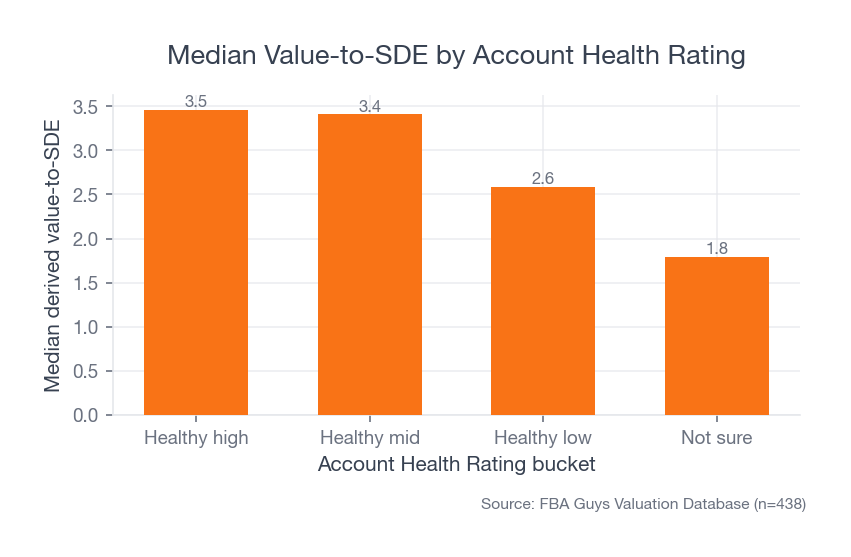
The more interesting pattern is what happened around the score. Healthy-high records had a 3.46 median derived value-to-SDE. Healthy-mid records were close at 3.41. Healthy-low records were lower at 2.59. Not-sure records were lower still at 1.79, though that group had only 11 records.
The data doesn't prove AHR causes valuation. It does suggest that known, healthier account-health signals travel with stronger business profiles.
 Source: FBA Guys Valuation Database (n=438)
SDE means Seller's Discretionary Earnings, the earnings measure commonly used to value owner-operated businesses. The ratio here is derived from calculator outputs, not closed transaction prices.
What the Amazon Account Health Rating Measures
Amazon's Account Health Rating program policy describes AHR as an indicator of a selling account's risk of deactivation from non-compliance with certain Amazon selling policies. Amazon's seller-policy guide also describes it as a snapshot of deactivation risk based on compliance with Amazon policies.
The rating lives inside Account Health. Amazon's Seller Central dashboard guide says the Account Health dashboard is where sellers monitor customer-service performance and policy compliance, plus shipping-performance targets.
That grouping matters. AHR isn't a general business-quality score. It doesn't know your true gross margin. It doesn't know whether your bookkeeper can reconcile Amazon payouts. It doesn't know whether your supplier invoices are easy to find.
It is narrower and more useful than a general business score.
It tells you how Amazon is currently summarizing a set of policy-compliance risks. If the account is clean, you get a useful signal. If the account has active violations, the score gives you a warning surface. If the account is technically healthy but drifting downward, it gives you a reason to open the details before a small problem gets older.
What 200, 250, and 1,000 Actually Mean
Amazon's AHR FAQ says a score above 200 is considered healthy. That should calm down one common fear: a seller at 220 or 240 isn't automatically sitting on the edge of deactivation just because the scale runs to 1,000.
The 1,000-point scale can make a normal healthy account look weaker than it is. A score near 200 may be frustrating, especially for a seller with no visible violations, but Amazon's public explanation is that above 200 is still healthy. The number should be read with the Account Health details open, not as a vanity score.
The 250 threshold matters for a different reason. Amazon's Account Health Assurance materials describe eligibility around professional sellers who maintain stronger AHR levels over time and keep valid emergency contact information current. In other words, 200 answers the basic health question. A higher sustained score can matter for access to a support benefit. For an operator, the practical reading is:
- Above 200 means Amazon currently considers the account healthy under the AHR framework.
- Around 250 or higher may matter for Account Health Assurance eligibility under current Amazon requirements.
- A score near 1,000 isn't necessary to prove the account is worth owning.
- Open violations and warning history explain the number better than the number explains itself.
This is where the data helped. Healthy-high and healthy-mid were close on median derived value-to-SDE, at 3.46 and 3.41. Healthy-low was meaningfully lower at 2.59, but it was also the largest populated group. The useful question isn't "Why am I not at 1,000?" It is "What would someone see if they opened the account-health details?"
Why a Healthy Score Is Useful but Incomplete
A healthy score isn't a shield. Amazon also says it may deactivate an account immediately for suspected fraudulent, deceptive, illegal, or harmful activity, regardless of AHR. Current AHR language and program details can change, so the live Seller Central page is always the operational source.
From a business perspective, the limitation is different. AHR is one surface on a larger file. If the score is healthy but the seller can't explain old warnings, current listing suppressions, poor Buy Box control, or seller-fulfilled metric drift, the score doesn't answer the next question.
What would someone ask after seeing the number?
They would ask whether anything is open. They would ask what happened last time Amazon sent a warning. They would ask whether the same issue repeated. They would ask whether the current score reflects a stable process or just a quiet week.
The score starts the review. It doesn't finish it.
How AHR Shows Up in Valuation Context
The AHR data is a 2026 subset, which keeps the claim narrow. Older records in the database don't have populated AHR fields. That boundary is important because account-health fields were added after years of valuation history had already accumulated.
Inside the usable 2026 subset, the pattern was clear enough to use carefully:
- Healthy-high: n=132, median derived value-to-SDE 3.46.
- Healthy-mid: n=84, median 3.41.
- Healthy-low: n=211, median 2.59.
- Not-sure: n=11, median 1.79.
The first thing we noticed was that healthy-high and healthy-mid were close. That pushes the article away from a perfect-score obsession. The meaningful split was between stronger known health, weaker known health, and uncertainty.
That fits the way platform risk usually works. Buyers and operators don't need Amazon to certify that a business is perfect. They need to see that the risk is visible, current, and controlled.
The Playbook's Risk Pillar treats third-party platform dependence as a real buyer concern because Amazon controls part of the selling environment. AHR sits directly in that concern. It is one way Amazon tells you where the platform relationship stands.
For valuation, our read is simple: AHR affects the context around value. It isn't the valuation model. The broader model still sits inside Amazon FBA business valuation, where risk, growth, transferability, and documentation all interact.
Warnings, Suspensions, and Active Issues
Suspension history changed the reading more than we expected.
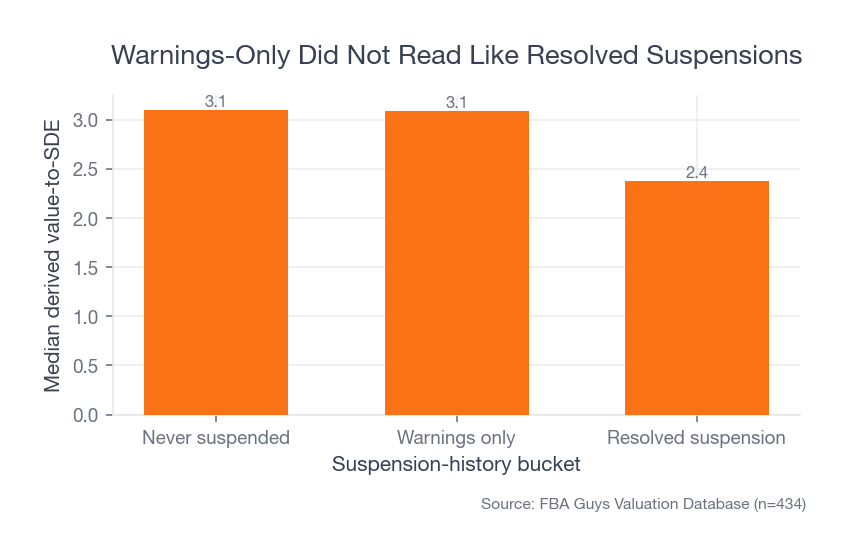
In the same 2026 subset, businesses with no suspension history had a 3.10 median derived value-to-SDE across 239 records. Businesses with warnings only were nearly identical at 3.09 across 118 records. Businesses with a resolved suspension were lower at 2.38 across 77 records. Active issues had only five records, so that bucket is too small to use.
 Source: FBA Guys Valuation Database (n=434)
This doesn't make warnings harmless. A warning can matter a lot if it involves a serious policy category, repeats across ASINs, or sits unresolved.
It does mean a warning and a suspension shouldn't be treated as the same business fact. A handled warning is often an operating event. A suspension is a deeper account-history event. A current active issue is a different conversation again.
Mark's correction file is blunt on suspension recency: a recent suspension in the last six months can kill a deal conversation, an old resolved suspension with 18 or more months of clean history can often move forward with price adjustment, and multiple suspensions or review manipulation can kill the deal outright.
The score matters. The dated history around the score matters more once someone has to trust the business.
The Metrics Around AHR That Still Matter
The Buy Box cross-tab was the most useful reminder that AHR doesn't explain the whole revenue engine.
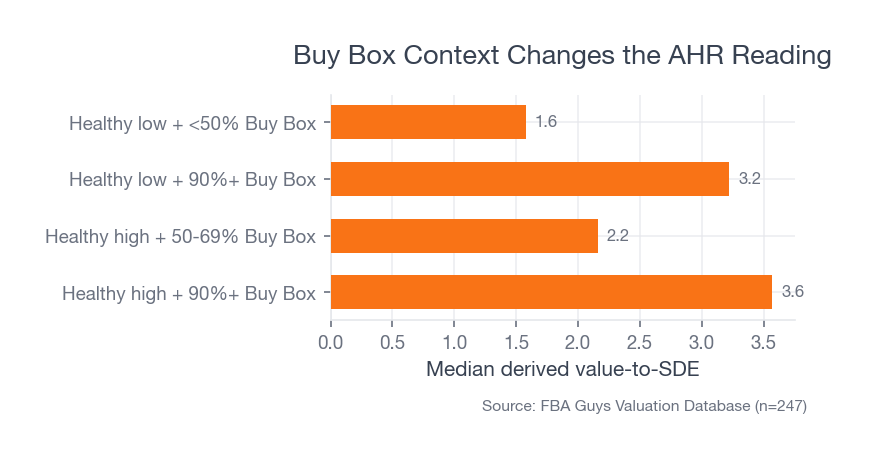
Healthy-high accounts with 90%+ Buy Box had a 3.57 median derived value-to-SDE across 95 records. Healthy-high accounts with 50-69% Buy Box had a 2.16 median across 12 records. Healthy-low accounts with 90%+ Buy Box had a 3.22 median across 130 records. Healthy-low accounts with below-50% Buy Box had a 1.58 median across 10 records.
 Source: FBA Guys Valuation Database (n=247)
The smaller cells need caution. The pattern still deserves attention.
AHR is the account-risk signal. Buy Box rate says something about offer control, stock availability, price position, competition, and whether the revenue showing in Seller Central is stable enough to explain. A healthy AHR with weak Buy Box control still leaves a question. A healthy-low AHR with excellent Buy Box control may be more stable than the label suggests.
Seller-fulfilled metrics belong in the same file. Amazon's seller-policy guide currently points sellers to Order Defect Rate, Late Shipment Rate, Cancellation Rate, Valid Tracking Rate, and On-Time Delivery Rate as account-health or fulfillment-performance items. These metrics matter more for FBM volume than pure FBA volume, but FBA doesn't make account health irrelevant. For a wider metric map, see our guide to Amazon Seller Central metrics.
Product-policy warnings, IP complaints, authenticity requests, restricted-product reviews, return patterns, and listing suppressions can all touch account health from different directions. The operator question is: what else would change the meaning of this score?
Documentation Makes the Score Easier to Believe
The SOP cross-tab pulled the article toward documentation.
Healthy-low accounts with no SOP documentation had a 2.28 median derived value-to-SDE across 73 records. Healthy-low accounts with comprehensive SOPs were at 3.04 across 50 records. Healthy-high accounts with comprehensive SOPs were at 3.59 across 64 records. Healthy-high accounts with minimal SOPs were at 2.37 across 17 records.
That isn't a causation claim. SOPs may be standing near older businesses, stronger teams, cleaner processes, and better financial documentation.
It is still useful for a seller trying to manage AHR.
The score tells you the current surface. Documentation tells you whether the business remembers what happened. If Amazon sends a warning, save the notification, screenshot Account Health, copy the ASIN or policy area, record the date, save the response, keep the evidence, and document the operating fix.
It sounds tedious because it is. Due diligence is also tedious. The Playbook's due diligence section makes the same practical point in a different context: organized files help the buyer verify the business without turning every request into a scavenger hunt.
An account-health file should be boring in the same way.
Account Health Assurance Helps, but It Doesn't Replace the File
Amazon announced Account Health Assurance as a free benefit that can help eligible sellers keep accounts active while working with Amazon to resolve issues. Amazon's current help snippets and forum materials describe eligibility around a Professional selling account, sustained AHR strength, and a valid emergency contact number.
If you have Account Health Assurance, treat it as a process advantage. Know who answers the emergency contact phone. Know what they do when Amazon calls. Make sure the person can reach invoices, compliance files, case history, and the person who owns the ASIN or category.
Amazon's Seller Challenge announcement also describes more review options for enrolled sellers after standard appeals have been used. Those options apply to eligible listing-level policy decisions.
That is helpful. It doesn't make the account invincible.
AHA doesn't erase serious policy risk. It doesn't organize your records. It doesn't explain a resolved suspension to a buyer. It doesn't keep a small warning from becoming a repeated issue if no one owns the fix.
How to Keep an Account Health File
Keep one account-health file for the business, not one scattered folder per panic.
For each material warning, policy issue, listing suppression, appeal, or suspension history, save:
- Original notification text.
- Account Health screenshot.
- ASIN, SKU, marketplace, order ID, or policy category.
- Date received.
- Deadline or required action.
- Submitted response or appeal.
- Evidence provided to Amazon.
- Amazon's final response or current status.
- Internal root cause.
- Operating fix and owner.
- Follow-up review date.
Then keep a lighter weekly log: AHR status, open violations, seller-fulfilled metrics if applicable, Buy Box changes on top ASINs, suppressed listings, and unresolved cases.
This isn't only a selling-prep habit. It is an operating habit. If the account is quiet for six months, the file tells you why. If a warning appears, the file tells you what changed. If a buyer asks for account-health history, the file lets you answer without reconstructing the past from memory.
What a Buyer or Lender Will Ask
A buyer doesn't usually stop at the current AHR screenshot.
They may ask for a full account-health export, current performance notifications, old warning history, suspension history, open cases, suppressed listings, and a record of how the business responded to each material issue. That fits the Playbook's broader due diligence logic: buyers verify the story with documents because they need to understand the risk before they wire money. Our guide on what to watch out for when buying an Amazon business covers the buyer side of that review.
The first question is simple: is anything currently open?
After that, the questions get more specific. Was there ever a suspension? If yes, when did it happen, what caused it, how long did it last, and what changed afterward? Were there IP complaints? Were they resolved through Amazon, retracted by the rights owner, or handled through listing changes? Are there authenticity complaints? If yes, are the supplier invoices clean, paid, and tied to the affected ASINs? Is there seller-fulfilled volume? If yes, do the shipping metrics support the story?
This is why the account-health file matters even when the current score is healthy. It turns a screen into a record.
Our related guides on Amazon seller performance notifications and the Amazon suspension prevention checklist go deeper on warnings and suspension-prevention habits. This article's narrower point is that AHR is the first page of the file, not the whole file.
What to Fix First
Start with open violations. Anything active gets an owner, evidence, and a deadline.
Then separate score risk from operating risk. If AHR is low because of policy violations, work the policy issue. If AHR is healthy but Buy Box rate is falling, don't let the healthy score distract from the revenue question. If seller-fulfilled metrics are drifting, pull the orders and fix the process. If no one knows the account-health status, the first fix is visibility.
The not-sure sample was tiny, only 11 records, but its median derived value-to-SDE was 1.79. We won't overread that. Still, "not sure" is a poor operating posture for a platform-dependent business.
You can't manage account health perfectly. You can make it visible.
FAQ
What is Amazon Account Health Rating?
Amazon Account Health Rating is Amazon's color-coded score for certain selling-policy compliance risks in a seller account. Amazon describes it as a 0 to 1,000 score that indicates deactivation risk tied to policy non-compliance.
Is an Amazon Account Health Rating above 200 good?
Amazon's current AHR FAQ says a score above 200 is considered healthy. A score just above 200 may still deserve review, but it isn't automatically a near-suspension signal.
Does Account Health Rating affect Amazon business valuation?
It affects valuation context. In the FBA Guys 2026 subset, healthy-high and healthy-mid AHR buckets had higher median derived value-to-SDE than healthy-low and not-sure buckets. The data doesn't prove AHR causes higher value.
Is a warning the same as a suspension?
No. In the 2026 subset, warnings-only histories looked much closer to never-suspended histories than to resolved-suspension histories. Severity, repetition, category, and resolution still matter.
Does Account Health Assurance prevent suspension?
Account Health Assurance can help eligible sellers work with Amazon before certain deactivation events, but it doesn't protect against every serious issue. Keep emergency contact information current and maintain the evidence file behind the account.
How often should I check Account Health?
Weekly is a practical default for active sellers. Check more often when there are open warning items, seller-fulfilled volume, category-compliance issues, suppressed listings, new supplier activity, or active appeals.
Curious what your business is worth?
Get a free, instant valuation and see how your Amazon business stacks up.
Get Your Free Valuation