Amazon Suspension Prevention Checklist: Keep Account Health Boring Before Buyers Ask
The FBA Guys
June 1, 2026

The cleanest Amazon accounts have a slightly annoying quality: they are boring.
No surprise policy warnings sitting in Seller Central. No stale performance notifications from six months ago. No one trying to remember which supplier invoice proves the product was authentic. The Amazon suspension prevention checklist starts there, with a business that treats account health as a weekly operating habit instead of a panic project.
For most sellers, suspension prevention means watching Account Health, fixing policy violations quickly, keeping fulfillment metrics inside Amazon's targets, and documenting the evidence behind products, suppliers, customer-service decisions, and listing changes. The checklist is simple. The discipline is where it gets expensive.
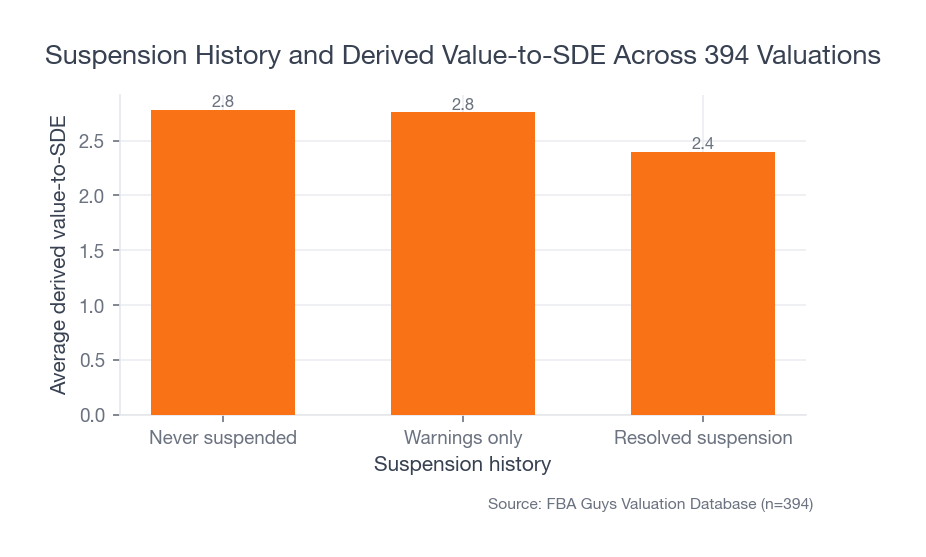
Among the 394 valuations in our database with usable account-health fields, businesses with no suspension history averaged 2.78 derived value-to-SDE. Businesses with warnings only averaged 2.76. Businesses with a resolved suspension averaged 2.40.
 Source: FBA Guys Valuation Database (n=394)
The interesting part is the gap between a warning and a resolved suspension. Warnings looked much closer to clean accounts than to resolved suspensions in this subset. That makes sense once you think like a buyer for 30 seconds. A warning asks, "Was this handled?" A suspension asks, "Could this happen again after I wire the money?"
Amazon Suspension Prevention Checklist: The Weekly Habits
Use this as a weekly checklist, not a quarterly cleanup.
- Open Account Health and review the Account Health Rating, current violations, and performance metrics.
- Assign one owner to every policy warning, even if the fix looks obvious.
- Save the evidence behind each response: invoices, authorization letters, supplier emails, test reports, appeal text, screenshots, and Amazon case IDs.
- Review ODR, late shipment rate, pre-fulfillment cancellation rate, and valid tracking rate if you fulfill any orders yourself.
- Check stranded, suppressed, inactive, and search-suppressed listings.
- Review Voice of the Customer, seller feedback, and product-review patterns for early complaint themes. For a deeper split between those two signals, see our guide to Amazon seller feedback vs product reviews.
- Verify that product claims, images, inserts, warranty language, and compatibility language still match Amazon policy.
- Reconcile inventory availability against lead times so stock pressure doesn't turn into rushed supplier decisions.
- Keep emergency contact information current.
- Keep a short account-health log with date, issue, owner, evidence, action taken, and result.
That last item is not decorative.
When account health comes up during diligence, a clean screenshot helps. A clean screenshot plus a dated history of what changed, who handled it, and what evidence was used helps much more.
What Account Health Is Actually Measuring
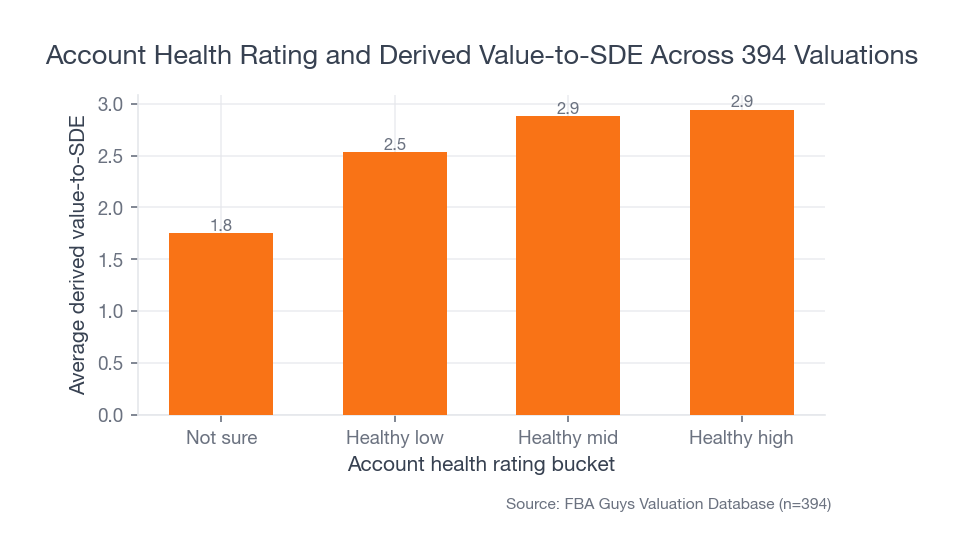
Amazon describes Account Health Rating as a color-coded score from 0 to 1,000 that reflects your account's risk of deactivation based on compliance with Amazon policies. Seller Central also gives sellers a place to monitor customer service, shipping performance, and policy compliance through the Account Health dashboard.
Current as of June 2026, Amazon's Account Health Rating policy says violations are weighted by severity. Critical violations can immediately qualify an account for deactivation. Repeat violations can make the score degrade faster. Amazon also says a healthy AHR doesn't protect against every possible deactivation scenario, including fraud, illegal activity, harmful behavior, or policies outside AHR.
That is a lot of machinery for a seller to remember while trying to ship product and answer customer messages.
So make it smaller.
Account health is measuring whether Amazon trusts your account to keep selling without creating customer, legal, IP, fulfillment, or marketplace risk. The score matters. The underlying pattern matters more.
 Source: FBA Guys Valuation Database (n=394)
The Metrics to Watch Before They Become a Suspension Problem
Some suspension prevention work is obvious because Amazon puts a warning on the screen. Some of it starts as a number moving in the wrong direction.
Order Defect Rate deserves special attention because it bundles customer-facing trust signals such as negative feedback, A-to-z claims, and chargebacks. Late Shipment Rate and pre-fulfillment cancellation rate matter most for seller-fulfilled orders, where Amazon is relying on your operation rather than FBA. Valid Tracking Rate is easy to ignore until it isn't, especially for sellers who only occasionally fulfill outside FBA and forget that the metric still exists.
FBA makes some of this quieter. It doesn't make the account invincible.
Returns can feed complaint patterns. Listing claims can trigger product-policy issues. A packaging change can turn into "used sold as new" complaints. A supplier substitution can create authenticity questions that feel wildly unfair when the product looks identical in the warehouse. Our Amazon FBA returns management guide covers the operating side of catching return patterns before they get louder.
This is where prevention becomes unglamorous. Someone has to look at the ugly details before Amazon does.
Policy Violations Need Owners, Not Good Intentions
A policy warning without an owner is just a calendar reminder waiting to become an argument.
In the valuation subset, warnings-only businesses averaged 2.76 derived value-to-SDE, almost identical to never-suspended businesses at 2.78. Resolved-suspension businesses averaged 2.40. That does not prove warnings are harmless. It suggests something more useful: warnings that get handled before they become account interruptions may stay in the category of operational noise.
Resolved suspensions are different. Even when resolved, they create a story someone has to believe.
The fact is, buyers don't enjoy mysteries inside Seller Central. If a warning happened, they want the original notice, the response, the evidence, and proof that the pattern stopped. If a suspension happened, they want all of that plus time.
Recent suspension history is the hard version. Mark's correction file is blunt here: a suspension in the last six months probably kills the deal, an old resolved suspension 18 or more months ago can often move forward with a price adjustment, and multiple suspensions or review manipulation can kill the deal outright.
Documentation Is Part of Suspension Prevention
The scar in this article is that the data moved us away from a pure metric checklist.
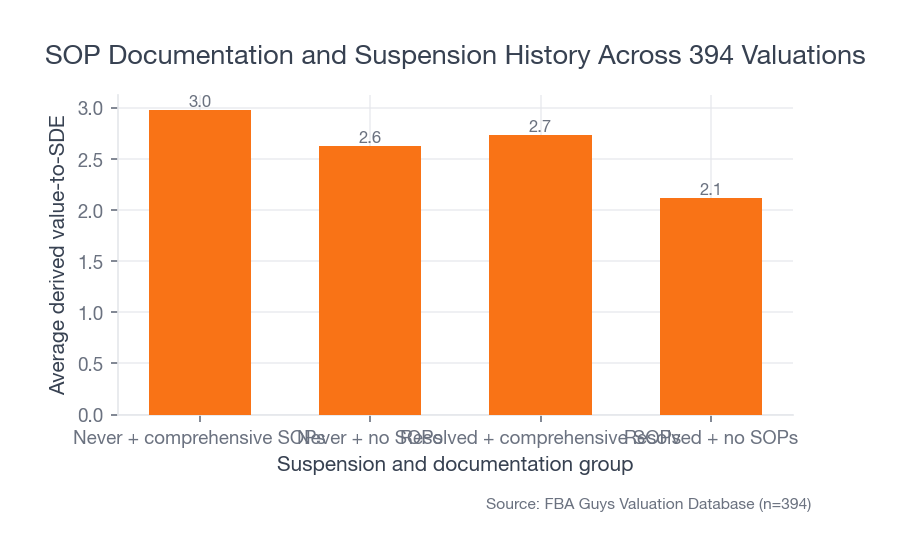
We expected the useful account-health angle to sit mostly in suspension history and AHR buckets. The documentation split kept showing up as the more operator-useful part. Never-suspended businesses with comprehensive SOPs averaged 2.98 derived value-to-SDE. Never-suspended businesses with no SOPs averaged 2.63. Resolved-suspension businesses with comprehensive SOPs averaged 2.74. Resolved-suspension businesses with no SOPs averaged 2.12.
 Source: FBA Guys Valuation Database (n=394)
That isn't a clean causal claim. It is more interesting than that.
The same habit that creates SOPs also creates better suspension prevention: someone writes down what happens, who owns it, what evidence is needed, and what a good resolution looks like. The account stays healthier because the business remembers what happened last time.
To illustrate: a seller gets a product-condition warning on a seasonal ASIN after two customer complaints mention "opened box." The weak process is to answer the Amazon case, grumble about customers, and move on. The stronger process is to save the notice, inspect the FBA returns report, check prep instructions, pull supplier packaging photos, update the warehouse receiving checklist, and add one line to the weekly account-health log.
Tiny. Irritating. Useful.
Brand Registry, IP, and the Evidence Behind the Listing
Brand Registry deserves its own place in a suspension prevention checklist because IP and listing-control problems rarely stay tidy.
In our account-health subset, Brand Registry businesses with no suspension history averaged 2.90 derived value-to-SDE. Businesses without Brand Registry and no suspension history averaged 2.03. Among resolved-suspension businesses, Brand Registry yes averaged 2.73 while Brand Registry no averaged 1.84.
Please read that carefully. The database doesn't say Brand Registry caused the higher ratio. Brand Registry is probably standing near several stronger business-quality signals: brand ownership, listing control, supplier documentation, better product differentiation, and cleaner evidence when complaints arrive.
Still, the operating lesson is practical. If you own the brand, keep the Brand Registry record clean. Keep trademark records, manufacturer agreements, product photos, packaging files, UPC/GTIN documentation, and authorized-reseller evidence where a human can find them. The related Amazon Transparency Program enrollment guide covers another layer of serialization and counterfeit-defense context.
The folder name can be boring. Actually, boring is ideal.
Supplier and Inventory Checks Belong Here
This section looks like a topic jump, but it belongs.
Suspensions often sound like policy events after the fact. Before the fact, they can look like inventory pressure, supplier confusion, or a quality-control shortcut. A late replenishment order creates FBM scrambling. A replacement supplier changes packaging. A rushed shipment creates condition complaints. A missing invoice makes an authenticity response weaker than it should be.
Among businesses with no suspension history, those with backup vendors averaged 2.89 derived value-to-SDE versus 2.62 for those without. Among resolved-suspension businesses, backup vendors averaged 2.49 versus 2.24.
Again, this is adjacent evidence. It doesn't prove backup suppliers prevent suspensions. It does suggest that better-prepared operations show up differently.
For prevention, keep three things ready: current supplier invoices, backup vendor research, and a written rule for when a supplier change requires listing, packaging, compliance, or customer-message review.
What Buyers Will Ask About Account Health
By 2024, buyers started requesting full account-health exports early in diligence. That is the direction of travel.
A buyer reviewing account health will usually ask for current Account Health screenshots, performance notifications, policy warnings, appeal history, suspension history, product-authenticity evidence, IP complaint history, and documentation showing what changed after any issue. If seller fulfillment is part of the business, they will care about shipping-performance metrics too. Our broader guide on what to watch out for when buying an Amazon business puts account health in the larger diligence context.
This is where a suspension prevention checklist quietly becomes an exit-preparation checklist.
The business can be healthy today and still look risky if no one can explain how it stayed healthy. The archive matters because account health is partly a trust file. Amazon wants proof when something goes wrong. Buyers want proof that the business won't hand them the same problem three weeks after closing.
The Checklist in One Place
Use this monthly if the account is quiet. Use it weekly if you have warnings, fast SKU launches, FBM volume, category compliance exposure, or a recent policy issue.
- Account Health Rating reviewed.
- Open policy violations assigned to one owner.
- Amazon case IDs saved.
- Evidence folder updated for invoices, authorization letters, compliance documents, and appeal responses.
- ODR reviewed.
- Late shipment rate reviewed.
- Pre-fulfillment cancellation rate reviewed.
- Valid tracking rate reviewed.
- Voice of the Customer reviewed.
- Seller feedback reviewed separately from product reviews.
- Suppressed and inactive listings checked.
- Product claims, images, inserts, and compatibility language reviewed.
- Brand Registry and trademark documentation current.
- Supplier invoice trail complete for top SKUs.
- Backup supplier list reviewed.
- Inventory risk reviewed against lead times and MOQs.
- Emergency contact information current.
- Weekly account-health log updated.
There is nothing heroic here. That is the point.
FAQ
What is the most important item on an Amazon suspension prevention checklist?
Start with the Account Health dashboard, then move immediately to ownership and evidence. A warning without evidence is fragile. A warning without an owner is worse.
Does a healthy Account Health Rating mean my account can't be suspended?
No. Amazon's AHR policy says a healthy score doesn't protect against every deactivation scenario. Fraud, illegal activity, harmful activity, and policies outside AHR can still create immediate risk. Treat the score as a dashboard, not a shield.
How often should I check Amazon account health?
Weekly is a sane default for active sellers. Check more often if you have open warnings, seller-fulfilled volume, recent listing changes, product-condition complaints, IP complaints, or new supplier activity.
Do old Amazon suspensions always kill business value?
No. Recency and severity matter. A recent suspension can kill a deal. An old resolved suspension with 18 or more months of clean history can often move forward with a price adjustment. Multiple suspensions or review manipulation are much harder to explain.
Should I keep account-health records if Amazon already has the case history?
Yes. Amazon's history is not the same as your operating file. Keep your own record with the notice, case ID, response, evidence, root cause, operational fix, and date resolved.
Conclusion: Keep the Account Boring
The amazon suspension prevention checklist works best when it becomes ordinary.
Open Account Health. Assign warnings. Save evidence. Watch metrics. Keep supplier and listing records clean. Write down what changed. Do it again next week.
A suspended account creates drama. A healthy account with boring records creates something much more useful: a business that can explain itself.
Curious what your business is worth?
Get a free, instant valuation and see how your Amazon business stacks up.
Get Your Free Valuation