Amazon Transparency Program Enrollment: Serialize the Product Before Counterfeits Become a Process Problem
The FBA Guys
May 26, 2026

A counterfeit problem rarely starts as a counterfeit problem.
It starts as a listing you recognize, a seller name you don't, and a customer message that sounds oddly specific: the cap was loose, the insert was missing, the bottle smelled different, the box had a sticker over another sticker.
Then someone asks whether Amazon Transparency program enrollment would fix it.
Amazon Transparency is Amazon's product serialization program. When a product is enrolled and protected, each unit needs a unique code that Amazon can verify before the product is sold through the Amazon store. The program can help brands reduce counterfeit, wrong-version, and diverted-product risk, but the real question is whether your operation can label every unit cleanly enough for the protection to work.
That is where this topic gets interesting. The enrollment requirements are quite simple on paper: Brand Registry, trademark, GTIN, and serialization. The operational commitment is larger than the form makes it feel because the form doesn't have to stand in a warehouse while someone decides whether 1,200 older units should be relabeled, sold through, removed, or kept away from Amazon until the file is clean.
What Amazon Transparency Actually Does
Transparency adds a unit-level authentication layer to a product.
For products using Amazon-issued Transparency codes, Amazon can verify codes before units are shipped to customers. Customers can also scan the code with the Amazon Shopping app or Transparency app to confirm authenticity and, where the brand uses those features, see product content attached to that unit.
Think of it as a physical control sitting between your product and the marketplace. What has to be true for that control to work every time?
The physical part matters. A Transparency code isn't just another claim inside Seller Central. It has to exist on the unit, in a format Amazon can read, and it has to follow the product wherever that unit is sold. If you manufacture 20,000 units for one GTIN, the program expects the serialization discipline to follow all 20,000 units, not only the units you plan to send to FBA this month.
That is the first place where the paperwork understates the work.
Amazon says Transparency can help prevent counterfeit products, incorrect variations, and international product diversion. The mechanism is fairly direct: if a protected product is supposed to have a valid code, units without valid codes can fail verification. The brand gains a control that is harder for a random reseller to fake than a product image or bullet point.
Of course, a control only works if the brand's own process is clean, and that is the part that makes Transparency more interesting than a standard Brand Registry tool.
Amazon Transparency Program Enrollment Requirements
As of the writing of this article, Amazon lists three core requirements for Transparency enrollment:
- An Amazon Brand Registry account associated with your brand's trademark and assigned the rights-owner role.
- An active, registered trademark for the brand.
- A Global Trade Item Number, or GTIN, for each product you want to enroll.
Those requirements explain why Transparency belongs after Brand Registry in the brand-protection sequence. Brand Registry establishes the rights-owner relationship. Transparency adds serialization to specific products.
The database can't tell us which businesses enrolled in Transparency. We don't have that field. It can show us the broader context around brand control, and that context is worth paying attention to.
Among successful valuations with positive derived SDE in our database, businesses marked as having newer Brand Registry averaged 2.66 value-to-SDE across 3,009 records. Businesses without Brand Registry averaged 1.81 across 2,043 records.
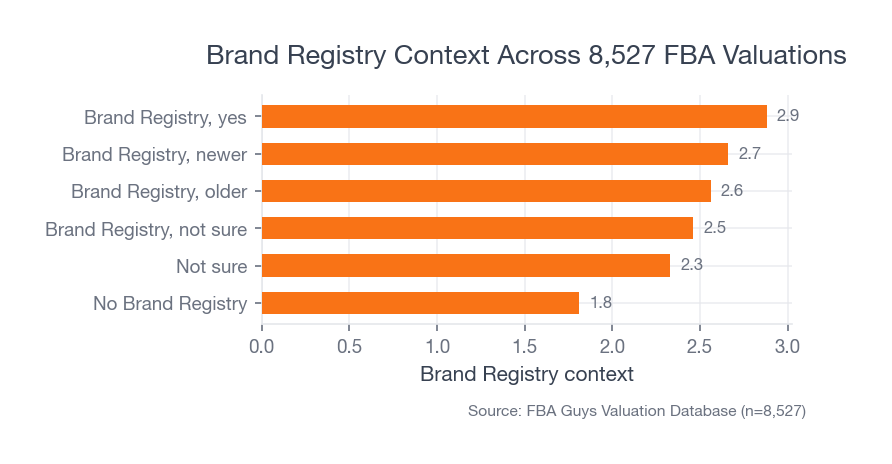 Source: FBA Guys Valuation Database (n=8,527 valuations with Brand Registry context and positive derived SDE)
That doesn't prove Brand Registry caused the gap. It would be lazy to say that. Brand Registry is tangled up with other things: more mature packaging, better listing control, clearer ownership, and products that were probably worth protecting in the first place.
Still, the direction isn't subtle, and it fits what we would expect from businesses that have already done the slower work of clarifying brand ownership.
If you don't have Brand Registry and a registered trademark, Transparency isn't the next step. Your first job is establishing the rights infrastructure. If you already have those pieces, then Transparency becomes a more practical question: can you serialize the product without making your operation brittle, and can you explain that process to someone who didn't build it?
The Hardest Requirement Is Labeling Every Unit
Amazon gives you two broad implementation paths.
You can use Amazon-issued Transparency codes. In that case, you need the ability to add those codes to every unit you manufacture for the enrolled product, regardless of where the units are sold.
Or you can connect Transparency to existing serial codes, where supported. For that path, Amazon says you need unique codes for every unit manufactured for the GTIN or SKU, externally scannable serial numbers in 1D, QR, or 2D format, serialized numbers that are 7 to 20 characters long, and the ability to share all serial numbers for that GTIN or SKU with Amazon.
The second option sounds cleaner if you already serialize products. It can be. But notice the burden that remains: every unit, every channel, every manufacturing run.
This is where competent operators can get squeezed. You may have one supplier applying labels correctly, one 3PL repacking bundles, one retail carton design in circulation, and a small batch of old packaging still sitting in a warehouse because nobody wanted to waste it. None of those details look dramatic in a planning spreadsheet, which is why the spreadsheet can feel so reassuring right up until Amazon starts expecting a code to be present and readable on the physical unit. This is also why Amazon FBA inventory management matters before the protection turns on.
The reality is that Transparency rewards boring packaging control.
One oddly specific detail tends to reveal the whole system: the product has a compliant GTIN on one panel, the serial sticker on another, and a seasonal insert that the supplier keeps tucking into the shrink wrap because it looked better that way in a sample photo. Is that a strategy problem? Not really. It is a Tuesday afternoon at the factory becoming an Amazon enforcement problem three months later.
What if your product already has a QR code?
A QR code on the package doesn't automatically mean you have a usable serialization system.
It might point to a warranty page. It might open a manual. It might be the same code printed on every unit because marketing wanted something interactive on the box. It might be a batch code, which is useful for traceability but still doesn't identify each unit.
Transparency cares about uniqueness at the unit level. If you plan to connect existing serial codes, the codes need to be unique, serialized, externally scannable, and shareable with Amazon for the product being enrolled. Could your current system qualify? Possibly. The answer depends less on the look of the code and more on the data behind it.
How Enrollment Usually Unfolds
The clean version looks like this:
- Confirm Brand Registry rights-owner access and trademark status.
- Select the products and GTINs you want to enroll.
- Choose Amazon-issued Transparency codes or existing serial codes, if eligible.
- Decide how codes will be applied: standard labels, custom labels, or packaging integration.
- Test packaging and scan quality before broad rollout.
- Coordinate with suppliers, 3PLs, distributors, and any trusted third-party sellers.
- Move through Amazon's review and protection process.
- Keep labeling every unit while the product remains protected.
The list is useful because it gives you the order of operations, but it is also too tidy for the way inventory usually moves.
The work between steps 4 and 7 is where most of the operating judgment lives. Who owns the code file? Who tells the supplier when a GTIN is protected? What happens to existing unlabeled FBA inventory? What do you do with a distributor that already has 1,200 units in mixed cartons? Does your packaging vendor understand that "close enough" barcode placement can still fail a scan?
These aren't glamorous questions. Fine. They are the questions that keep the program from turning into its own problem, and they are the questions a buyer or operator will ask later if the records don't answer them first.
What Protected Status Changes For FBA And MFN Sellers
Protected status is the point where Transparency starts to matter to other sellers on the listing.
Amazon's onboarding guide says that once a product is in protected status, inventory from third-party sellers must have a Transparency code to pass inbound scans at fulfillment centers. For merchant-fulfilled sellers, a Transparency code is required to list or fulfill orders.
This is the part brand owners usually care about, because it gives the brand something stronger than another complaint ticket.
If a reseller bought real inventory before protection turned on, the situation can be awkward. Amazon's guidance says existing inventory won't be removed once protections apply, but unlabeled Transparency products won't be allowed to enter fulfillment centers after protection. MFN sellers receive a window to upload codes or their listings can be removed.
The business consequence is practical, not theoretical. Your authorized sellers need to know what is happening before the switch flips. Your packaging pipeline needs to be ready before protection is enforced. Your own stranded-inventory risk needs to be considered before you treat enrollment as a quick anti-counterfeit button.
Honestly, this is the scar in the process. The brand wants enforcement. The channel may still contain older legitimate units. Both can be true, and both can be annoying. What looks like a clean enforcement milestone from the brand's desk can look like a stranded-inventory problem to the distributor who bought inventory before the change.
Where Transparency Helps Business Value
Transparency doesn't magically make a business more valuable.
It can, however, support the things that tend to make a business easier to understand and transfer: cleaner brand control, stronger packaging discipline, lower counterfeit anxiety, and a more defensible listing environment.
Our database shows that product uniqueness and formal IP context both sit close to stronger valuation signals. Unique-product businesses averaged 2.67 value-to-SDE across 4,758 records, while not-unique product businesses averaged 2.07 across 3,769 records. Businesses with trademark-only IP context averaged 2.60 across 5,268 records, while businesses with no IP protection averaged 1.91 across 2,745 records.
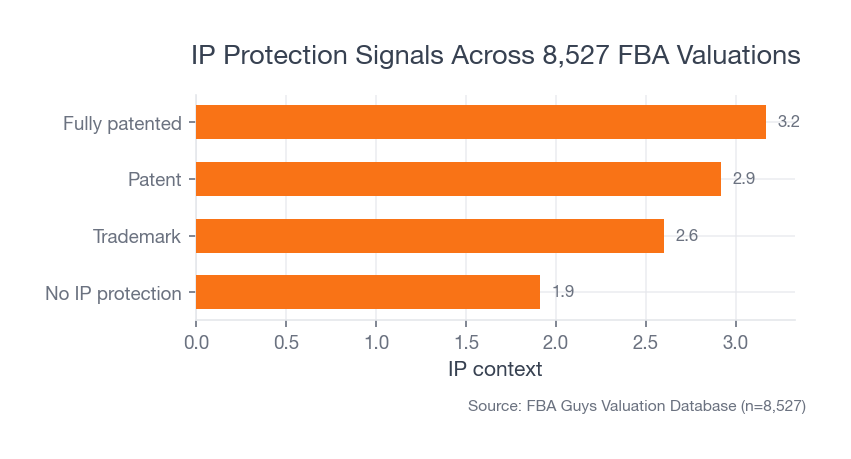 Source: FBA Guys Valuation Database (n=8,527 valuations with IP context and positive derived SDE)
Again, correlation. Not magic.
What the numbers suggest is more modest and more useful: protection tools seem to matter most when there is a real asset underneath them. A distinctive product, a controlled brand, a trademark, packaging that belongs to you, and a supply chain that can repeat the process are all easier for a buyer to understand than a generic listing held together by speed and hope.
Transparency fits that picture when the product is worth serializing, which is a higher standard than "we would like fewer headaches." That broader defensibility question is also central to what makes a valuable Amazon FBA business.
There is also a customer-trust angle. Businesses in our dataset without a negative-review signal averaged 2.47 value-to-SDE across 7,427 records. Businesses with a negative-review signal averaged 1.99 across 1,100 records. The database doesn't tell us whether any of those reviews involved counterfeits, diverted inventory, or wrong-version products, so we shouldn't pretend it does.
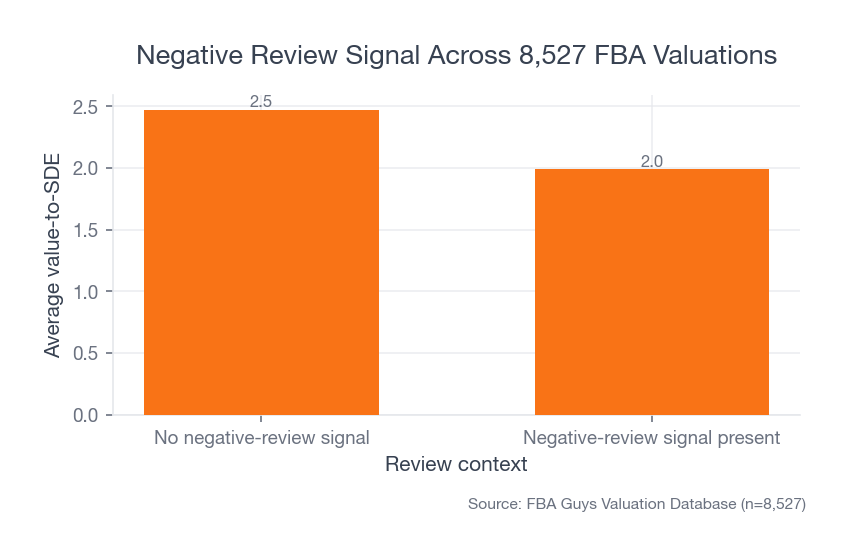 Source: FBA Guys Valuation Database (n=8,527 valuations with review-signal context and positive derived SDE)
But counterfeit control eventually shows up as customer trust. A buyer looking at the business will care less about the word "Transparency" and more about whether the brand has a repeatable way to prevent trust from leaking through the channel. Can the new owner keep the same control working after the founder stops answering supplier questions at 9 p.m.? That is where the business-risk review starts to feel real.
When Transparency Is Probably Too Much Process
There are businesses where Transparency is worth serious consideration.
Counterfeit risk is active. The product is distinctive. Packaging is under your control. You own the brand, the trademark is active, and unauthorized sellers are creating real confusion. The supplier can apply codes reliably, or your packaging workflow can absorb the added step without chaos.
There are also businesses where the program may be heavier than the problem.
If the product is a commodity SKU with weak differentiation, the first improvement may be product development, packaging ownership, or Brand Registry cleanup. If you can't control all units across channels, serialization can become fragile. If your supplier still treats barcode placement as decoration, fix that before you ask Amazon to enforce around it.
This is where the decision gets a little less satisfying than a checklist, because eligibility isn't the same as readiness.
The right question isn't "Can I enroll?" The better question is "What exactly am I protecting, and can my operation keep the protection true?"
Amazon-Issued Codes Vs Existing Serial Codes
Amazon-issued Transparency codes are the cleaner default for brands that don't already run serialization.
They also carry an operating cost. Amazon's current public Transparency page says there are no enrollment or subscription fees, no minimums or limits per order, and no costs for adding or removing products. It also says Amazon-issued codes and existing serial codes shared with Amazon have charges, with discounts based on volume.
That distinction matters when you build the unit economics.
Existing serial codes can reduce packaging disruption if your product already has unit-level serialization. Amazon currently limits the existing-code connection to certain countries, and brands using existing serial codes don't receive every customer-engagement or product-detail badge benefit available to brands using Amazon-issued codes.
So the decision isn't only "which one is cheaper?"
It is: which one can your factory, packaging vendor, warehouse, and reseller channel execute without creating a quiet pile of exceptions?
A simple readiness test
Before enrolling, answer five questions in writing.
Can you identify every GTIN and ASIN that belongs to the product family? Can you tell which inventory units are old, current, coded, uncoded, or uncertain? Can your supplier apply or print the code without you personally reviewing every carton photo? Can your team explain what happens when a unit fails a code check? Can a future owner find the enrollment records, code method, supplier instructions, and portal reports in under 15 minutes?
If the answer is yes, Transparency is probably an operational extension of work you already do.
If the answer is no, the program may still be worth doing. Just don't confuse enrollment with readiness.
What To Prepare Before You Enroll
Before you start enrollment, build a small operating file.
Include the trademark record, Brand Registry role confirmation, GTIN list, product images showing current packaging, supplier labeling instructions, channel inventory map, and a decision on Amazon-issued codes versus existing serial codes.
Then add the unglamorous parts:
- Who applies the code.
- Who verifies scan quality.
- Who receives code files or serial exports.
- Who is allowed to share codes with third-party sellers.
- How old unlabeled inventory will be handled.
- How distributors will be notified.
- How packaging changes will be approved.
If you are preparing the business for a future buyer, this file is more than operational housekeeping. It is evidence that brand protection doesn't live entirely in your head. If the brand already has a live complaint or counterfeit dispute, keep that file beside the evidence you would use to handle an Amazon intellectual property claim.
Buyers don't need a perfect story. They need a process they can inherit without guessing.
The FBA Guys View
Amazon Transparency program enrollment is worth considering when counterfeit risk, channel confusion, or wrong-version inventory is starting to threaten the brand.
It is less compelling when the brand hasn't yet built the basics: trademark, Brand Registry, packaging control, product differentiation, clean supplier instructions, and a repeatable way to manage GTIN-level changes.
The program's value isn't the shiny badge. The value is that it can convert brand protection from a complaint process into a physical control.
That is a much more serious commitment.
And if the product is worth protecting, serious is probably the point.
FAQ
Is Amazon Transparency the same as Brand Registry?
No. Brand Registry establishes the brand ownership layer inside Amazon. Transparency applies unit-level authentication to specific products after the brand has the required rights-owner setup, trademark, and GTINs.
Brand Registry is the doorway. Transparency is the control you add to the product.
Do I need to label every unit for Amazon Transparency?
For Amazon-issued Transparency codes, you need the ability to add codes to every unit you manufacture for the enrolled product, regardless of channel. That is the part that catches sloppy packaging processes quickly.
If you sell the same product through Amazon, wholesale, retail, or your own site, the serialization process still has to follow the units.
Can I use my existing serial numbers for Transparency?
Sometimes. Amazon currently allows existing serial-code connection only in certain countries and only when the codes meet Amazon's requirements, including unique unit-level serialization and scannability.
The practical question is whether your serial system actually identifies each unit. A QR code that sends customers to a warranty page isn't the same thing.
Does Amazon Transparency increase the value of an FBA business?
The database doesn't measure Transparency enrollment directly, so we won't claim a measured valuation lift. What we can say is that related signals such as Brand Registry, product uniqueness, formal IP context, and cleaner review signals sit close to stronger value-to-earnings patterns in our data.
Transparency can support business value when it strengthens a real brand-control system. It can't create that system by itself.
Should every private-label Amazon brand enroll in Transparency?
No. The program makes the most sense when the product is distinctive, counterfeit or channel-confusion risk is real, and the business can serialize every unit without creating operational clutter.
If the product is still generic, packaging is inconsistent, or Brand Registry isn't clean, fix those issues first.
Curious what your business is worth?
Get a free, instant valuation and see how your Amazon business stacks up.
Get Your Free Valuation