Amazon Account Health Impact on Business Value: The Score Is Only the Front Page
The FBA Guys
August 8, 2026

If your Amazon account is green today, a buyer still has one more question: what happened before today?
Amazon account health impacts business value by changing how buyers underwrite platform risk. It doesn't convert into a simple score-to-multiple formula. In the current FBA Guys account-health subset, never-suspended records had a 3.08 median derived value-to-SDE, warnings-only records sat almost identically at 3.07, and resolved histories were lower at 2.38.
That pattern is useful because it separates two things sellers often blend together: the current dashboard status and the account-health story a buyer has to inherit.
Derived value-to-SDE means the valuation output divided by estimated Seller's Discretionary Earnings. SDE is the earnings figure most owner-operated Amazon businesses are valued from: profit adjusted for owner benefits, one-time expenses, and other items that won't carry forward to the next owner.
The number is directional, not a closed-sale multiple. It still tells us something important about how account-health context shows up next to business value.
The Account Health Data We Can Actually Use
The valuation database has 8,632 successful records as of this run. The account-health fields are newer, so they are thinner: 484 records have Account Health Rating, suspension history, and Buy Box rate populated. IPI score is populated in 438 records. That boundary matters because the database doesn't store exact Account Health Rating points, violation category, affected ASIN, appeal text, appeal outcome, reinstatement timing, Account Health Assurance enrollment, Seller Challenge usage, or suspension recency. It also doesn't store exact ODR, late shipment rate, pre-fulfillment cancellation rate, valid tracking rate, or the policy-specific reason a seller ran into trouble.
So the database can't tell you that fixing a specific policy violation added 0.4x to a multiple. It can't tell you that moving from one AHR score to another caused a valuation change.
What it can do is more modest and more useful. It can show how account-health context travels with valuation outputs: clean history, warnings, resolved issues, current AHR, SOP documentation, Buy Box rate, IPI, Brand Registry, and product-control model. That is the right level of confidence for this topic.
Why Buyers Check Account Health Before They Check Revenue
Revenue is easier to read than platform risk. That doesn't make it more important.
A buyer can look at revenue, gross margin, SDE, and trend and start building a value model. But if the Amazon account is at risk, the model is missing a core assumption. The buyer is no longer asking only what the business earned. They are asking whether the account can keep earning after the transfer.
That is why account health belongs in the Risk pillar, but it doesn't stay there. It also touches documentation and transferability: risk asks whether the account can keep selling, documentation asks whether the seller can prove what happened, and transferability asks whether the new owner can keep the controls running. For the broader valuation frame, see our guide to Amazon FBA business valuation.
The current Account Health page is the fastest starting point. It shows policy issues, performance status, and current account-health context. Amazon's live Account Health Rating program policy should carry the platform mechanics because those rules can change. For a fuller account-health primer, read Amazon Account Health Rating Explained. The valuation question is different: does the seller have a buyer-readable file behind the dashboard?
If the account is green but the seller can't explain a resolved issue, the green status is only part of the answer.
Warnings Are Not the Same as Resolved Suspensions
The most useful split in the data is the difference between warnings-only histories and resolved histories. Among 484 account-health records, never-suspended accounts had a 3.08 median derived value-to-SDE. Warnings-only histories had a 3.07 median. Resolved histories had a 2.38 median. Active issues had only six records, which is too small for a serious read.
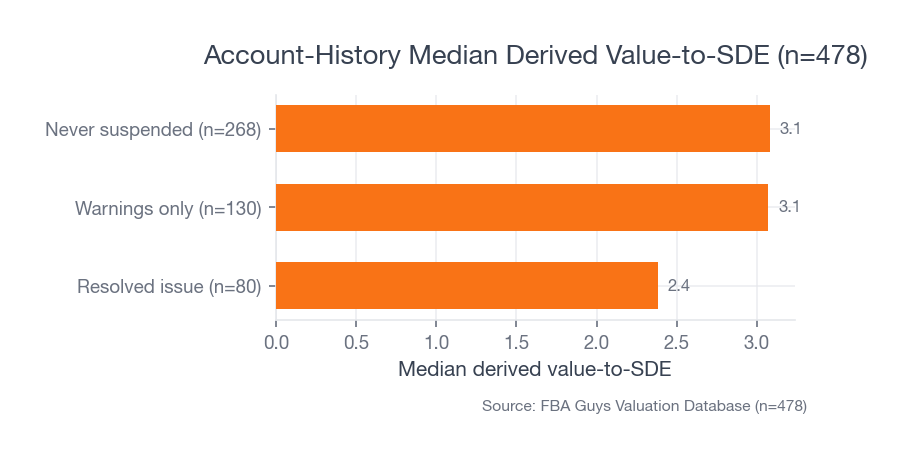 Source: FBA Guys Valuation Database (n=478 account-health records, excluding active-issue cell due to small sample).
The careful interpretation isn't that warnings are harmless. A warning can still matter if it shows a pattern, points to a real policy problem, or stays unresolved. The better interpretation is that a warning and a resolved account-health issue create different buyer questions. We covered the warning-file version of this in Amazon Policy Violation Warnings.
A warning asks: what happened, was it addressed, and did it repeat? A resolved issue asks all of that plus one more: did the business already lose platform trust in a way that could return under new ownership?
That extra question is where value can start to move. Not always. Not mechanically. But the buyer has to price the uncertainty somehow.
This is why the evidence file matters so much. A warning with a dated notice, clean response, supporting documentation, and no recurrence is a different file from a warning folder that only contains panic screenshots and half-finished notes.
A Green Account Today Does Not Erase the Old Issue
"Resolved" is a status. It isn't a complete explanation.
The strongest data cut in this run is what happens when resolved history is crossed with current Account Health Rating. Resolved plus healthy-high AHR had a 3.07 median derived value-to-SDE across 21 records. Resolved plus healthy-mid AHR had a 3.32 median across 12 records. Resolved plus healthy-low AHR had a 1.96 median across 46 records.
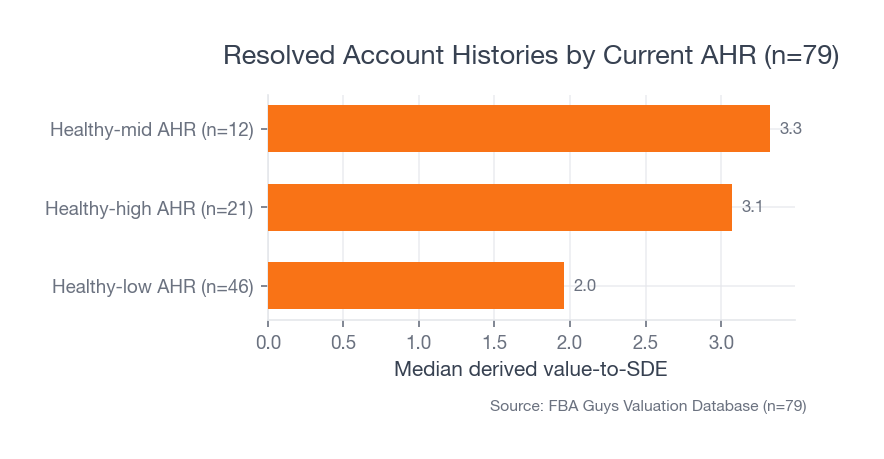 Source: FBA Guys Valuation Database (n=79 resolved-history records with healthy-low, healthy-mid, or healthy-high current AHR).
The cells aren't huge, so the exact numbers shouldn't be over-read. The shape is still useful.
A past issue reads differently when the current account is healthy, the issue hasn't repeated, and the seller can show what changed. It reads differently again when the account is technically active but still sitting in a weaker current-health bucket.
That is the difference between an event and a condition. An event can be explained: the account had a policy issue, the seller responded, Amazon resolved it, and the operating process changed afterward. A condition keeps creating buyer questions because the issue was resolved, but current account health is still weak, documentation is thin, and no one can explain whether the cause is gone.
The database doesn't store exact recency, so we shouldn't pretend it does. Industry experience still treats recency and severity as central. A recent suspension is much more dangerous than an old resolved issue with a clean record since. Review manipulation is in a different category because it creates a trust problem around the account itself. If you are working through the appeal side, see Amazon Seller Account Suspension Appeal.
For a seller, the question is simple enough: if a buyer asks about this issue six months from now, can you answer in five minutes without searching your inbox?
SOPs Are the Evidence Buyers Can Inherit
Account-health cleanup that lives only in the owner's head doesn't transfer very well.
That is where SOPs show up in the data. Resolved histories with comprehensive SOPs had a 3.11 median derived value-to-SDE across 20 records. Resolved histories with no SOPs had a 1.77 median across 17 records. Warnings-only histories with comprehensive SOPs had a 3.50 median, while warnings-only histories with no SOPs had a 2.57 median.
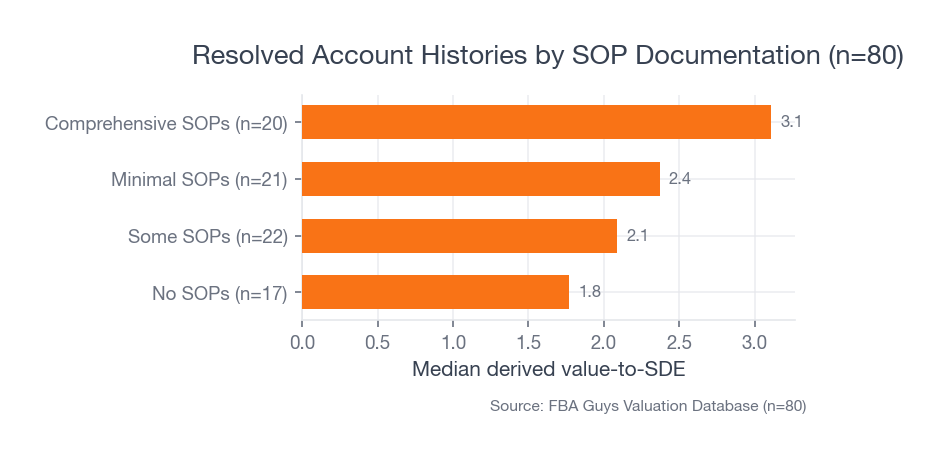 Source: FBA Guys Valuation Database (n=80 resolved-history records with SOP documentation status).
The database doesn't prove SOPs caused those valuation differences. More mature businesses are more likely to have SOPs in the first place. The practical reading is still useful: documented controls change the account-health file a buyer receives.
If the issue involved product authenticity, the file should include supplier invoices, supplier verification, product sourcing rules, and the person responsible for reviewing invoices before inventory is purchased. If the issue involved product condition, the file should include receiving standards, packaging checks, return quarantine rules, FBA removal or inspection notes where relevant, and the process for preventing returned units from leaking back into new inventory. If the issue involved shipping or customer service, the file should include handling-time settings, carrier rules, support response ownership, escalation triggers, and a regular review of the Account Health page.
Those documents don't make the business risk-free. They make the risk legible, which is usually the buyer's real need.
The Metrics That Actually Matter to Buyers
Account Health Rating is the front page. It should be clean, current, and explainable. But it isn't the whole file.
The overall AHR pattern looks useful at first glance. Healthy-high records had a 3.40 median derived value-to-SDE. Healthy-mid records had a 3.32 median. Healthy-low records had a 2.57 median.
Then business size complicates the story. Healthy-high records averaged $3,613,684 in sales. Healthy-low records averaged $358,858.
That doesn't make the AHR finding useless. It makes it more honest. Stronger AHR appears alongside larger, more mature businesses, and those businesses often have better systems, more order volume, cleaner teams, and stronger documentation. AHR may be one signal inside that larger operating profile.
Buy Box rate and IPI are similar. A 90%+ Buy Box rate had a 3.43 median derived value-to-SDE in the subset. Below 50% Buy Box had a 1.75 median. Excellent IPI had a 3.53 median. Acceptable IPI had a 2.20 median.
Those metrics matter because they connect the dashboard to operations. Buy Box rate points toward offer control and revenue stability. IPI points toward inventory discipline, stranded capital, and stockout risk.
If account health is only a score, it is easy to talk around. If it is already affecting offer control, inventory performance, or account access, it becomes much harder to separate from value.
How Account Health Affects Your Multiple
The cleanest way to think about the multiple is this: account health changes the buyer's confidence in the earnings.
The valuation formula still starts with SDE. The multiple still reflects risk, growth, transferability, and documentation. Account health can touch all four, but it starts with risk.
A clean account-health file can support the current multiple because it removes a question. A messy account-health file can pull the multiple down because the buyer has to carry the uncertainty. A severe or unresolved issue can stop being a multiple discussion altogether.
This is why a seller should be careful with the question "what is my AHR worth?"
The better question is: what account-health risk would a buyer have to price if they bought the business today?
If the answer is "none visible," then account health is probably not the reason the multiple moves. If the answer is "one old issue, fully documented, clean since," the buyer may still ask questions, but the file is manageable. If the answer is "several recent issues and no record of what changed," the multiple has to absorb that risk.
Our read is that account health rarely creates premium value by itself. It protects value by keeping buyers from discounting the earnings.
The 90-Day Account Health Cleanup Plan
If you might sell in the next year, spend the first 90 days making account health boring.
Start with a snapshot of the current Account Health page. Save the date, the current status, open issues, closed issues, and policy notices. Then build a simple account-health log. It doesn't need to be beautiful. It needs to be complete.
For each issue, record:
- Date noticed.
- Affected ASIN, order, or policy area.
- Amazon case ID or notice.
- Evidence collected.
- Response submitted.
- Amazon's reply.
- Root cause.
- Process change.
- Owner of the future control.
- Date reviewed again.
Then fix the live account. Close open violations where they can be closed. Respond to policy issues. Update emergency contact information. Review Account Health Assurance eligibility in Seller Central if it applies to your account, using Amazon's current instructions. Check Buy Box and IPI where they are relevant to the business model. The prevention version of this work is in our Amazon suspension prevention checklist.
The last step is the one sellers often skip: write the short explanation while the details are still fresh.
You aren't writing a legal brief. You are writing the note a future buyer needs when they ask, "What happened here?"
What Would Make a Buyer Walk Away?
Some account-health issues are pricing issues. Some are deal issues.
An old resolved problem with a clean record and good evidence can often be discussed. A recent suspension is much harder. Multiple suspensions are harder still. Review manipulation, unresolved deactivation risk, or a seller who can't explain the account record can move the conversation away from valuation and toward whether the buyer wants the risk at all.
This is where the data and the industry framework line up. Warnings-only histories looked close to never-suspended histories in the subset. Resolved histories sat lower. Resolved histories with stronger current AHR and better SOP documentation looked much better than resolved histories without that context.
The buyer isn't looking for perfection. They are looking for a risk they can understand. If they can't understand it, they will usually price it as larger than it may really be.
How Buyers Should Read Account Health During Diligence
Buyers should start with the Account Health page, then ask for the file behind it. This fits the larger diligence habit we describe in what to watch out for when buying an Amazon business.
The current AHR tells you the live platform status. Suspension history tells you whether the account has already had meaningful platform risk. Buy Box and IPI tell you whether account or inventory issues are showing up in operating performance. SOPs tell you whether the seller has a transferable control process.
Then ask what the database can't answer. Was the issue recent? Which ASINs were affected? Was there downtime? Did Amazon accept the appeal? Did the issue repeat? Was the same root cause involved more than once? Does the seller have current invoices, policy documents, or process screenshots? Who owns the control after close?
The right buyer question isn't "is this account perfect?" The better question is whether the risk is visible, explained, and controllable.
What We Still Don't Know
The FBA Guys data can show account-health context next to valuation outputs. It can't replace Seller Central, Amazon's live policy pages, or buyer diligence.
That is especially true for Account Health Rating. Amazon's scoring system, Account Health Assurance rules, policy categories, and performance thresholds are live platform mechanics. Use Amazon-owned sources for those details and verify them inside Seller Central before making decisions.
For valuation, the durable lesson is simpler. Account health affects business value when it changes buyer confidence in the account, the earnings, or the transferability of the operating process.
If the file is clean, account health becomes one less thing for a buyer to worry about. If the file is messy, the dashboard score is only the beginning of the conversation.
FAQ
Does Amazon account health affect business value?
Yes. Amazon account health affects business value by changing how a buyer reads platform risk. It doesn't create a clean score-to-multiple formula, but in the current FBA Guys account-health subset, resolved account histories sat lower on median derived value-to-SDE than never-suspended or warnings-only histories.
Is an Amazon policy warning as serious as a suspension?
Not usually. In the account-health subset, warnings-only histories sat close to never-suspended histories on median derived value-to-SDE, while resolved histories sat lower. A warning can still matter if it repeats, stays unresolved, or points to a deeper operating issue.
Does a high Account Health Rating increase my multiple?
Our read is that a high Account Health Rating protects value more often than it creates premium value by itself. Healthy-high AHR records had a stronger median derived value-to-SDE than healthy-low records, but stronger AHR also traveled with larger businesses, so the score shouldn't be read alone.
What should I show a buyer if I had an account-health issue?
Show the original notice, case IDs, affected ASINs or orders, evidence submitted, Amazon's response, the root-cause note, and the SOP or process change that prevents the issue from repeating. The buyer needs to understand the risk without depending on your memory.
Curious what your business is worth?
Get a free, instant valuation and see how your Amazon business stacks up.
Get Your Free Valuation