Amazon Seller Account Suspension Appeal: Build the Evidence File Before You Hit Submit
The FBA Guys
June 24, 2026

An Amazon seller account suspension appeal feels like a letter because Seller Central gives you a box to type into.
It is better to treat it as an evidence file.
An Amazon seller account suspension appeal is your response to Amazon's account deactivation notice. The appeal should explain the root cause, show what you already corrected, provide the documents Amazon requested, and describe the control that should prevent the same issue from happening again.
That matters for two reasons. First, you need the account reinstated. Second, the appeal becomes part of the future account-health history of the business.
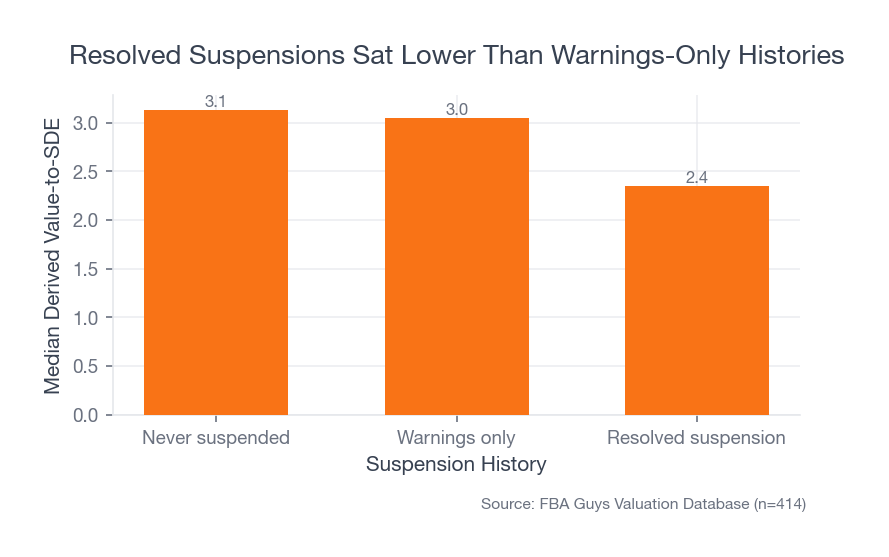
Our 2026 account-health data keeps pulling us toward that second job. Among valid 2026 records in the FBA Guys valuation database, resolved suspension histories had a 2.35 median derived value-to-SDE. Never-suspended histories sat at 3.13. Warnings-only histories sat at 3.05.
 Source: FBA Guys Valuation Database (n=414)
SDE means seller's discretionary earnings, the owner-operated profit figure buyers commonly use when valuing smaller Amazon businesses. Derived value-to-SDE is our calculator-output valuation divided by derived SDE, so it is valuation context, not a closed-deal multiple.
That doesn't mean the suspension caused the lower valuation context. The database doesn't store appeal text, suspension reasons, reinstatement timing, or whether Amazon made a mistake. It does mean a resolved suspension deserves a cleaner file than most sellers build while they are trying to get the account back.
Before you write the appeal, save the record
The first move is boring and quite practical: preserve everything before you start answering.
Save the deactivation notice. Save the Account Health page. Save the affected ASINs, order IDs, policy names, case ID, email notice, and any related performance notification. If Amazon names documents it wants, copy that request into your working file before you gather the documents.
Why slow down when the account is already inactive?
Because the notice is the scope of the appeal. A seller under pressure can easily write a broad apology, upload a pile of documents, and miss the one sentence Amazon asked them to answer.
Amazon's public forum guidance says the current appeal path starts in Seller Central under Performance, then Account Health, then Reactivate your account. Amazon says the appeal process may include a questionnaire, policy acknowledgment, supporting documents, and a Plan of Action. It also says sellers should monitor email after submission and use View Appeal from Account Health if Amazon asks for more information.
That sequence is useful because it tells you what the appeal is trying to become. It isn't just prose. It is a structured response to a structured notice.
Build the appeal from the notice, not from memory
The notice gives you the scope of the appeal.
Start by copying the exact policy name, the marketplace, the date, the affected ASINs or orders, and every document Amazon asks for. Then build the appeal under those headings. If Amazon asks for supplier invoices and a Plan of Action, don't let the first submission become a general story about the business.
This is where a lot of appeals start to drift. The seller remembers twelve things that might have contributed to the problem. Some are relevant. Some are old account-health anxiety. Some are only theories. The appeal needs the part Amazon can review.
If the issue is authenticity, the file should point to the supply chain. If the issue is condition, the file should point to receiving, packaging, inspection, FBA prep, return review, or customer-service records. If the issue is intellectual property, the file should point to authorization, ownership, retraction, or the specific listing field under dispute.
The appeal can still be honest about uncertainty. If you don't know whether a customer complaint came from a damaged FBA return or a supplier batch issue, say what you checked and what control changed. A confident guess is weaker than a verified boundary.
What an Amazon seller account suspension appeal is trying to prove
Most appeals need to prove one of three things.
The first is that the violation didn't happen. If the deactivation is wrong, the appeal needs clear evidence that supports the account. That might be supplier documentation, tracking records, authorization letters, policy screenshots, photos, or correspondence.
The second is that the violation happened and has been corrected. This is where vague language gets expensive. "We fixed the issue" doesn't say what changed. A better file names the affected ASIN, the product detail page field, the supplier document, the shipment, or the customer-service process that changed.
The third is that the business has changed enough to prevent recurrence. This is the part that often sounds good and proves little.
"We will monitor the account more closely" is a promise. Amazon usually needs the control. Who reviews the file? How often? Where is the invoice saved? What happens before the next shipment, listing edit, supplier reorder, or customer message goes live?
The useful appeal is less emotional than the situation feels.
The three-part Plan of Action
A practical Plan of Action has three sections: root cause, corrective action, and prevention.
Root cause explains what failed. Corrective action explains what has already been fixed. Prevention explains the control that keeps the same issue from coming back.
The root cause should be specific enough that it can be repaired. "We didn't understand the policy" may be true, but it often doesn't tell Amazon what changed inside the business. "A supplier sent an updated package insert with an unapproved claim, and our listing-review process didn't catch the claim before the May 28 shipment" gives the reviewer a concrete failure point.
Corrective action should already be done when possible. Removed the claim. Deleted the noncompliant image. Pulled the affected inventory. Uploaded the requested invoices. Refunded the affected orders. Replaced the supplier document. Opened the safety review. Name the action and the date.
Prevention is the future control. This is where the file starts mattering beyond reinstatement. The control should be boring enough that another person could follow it. A monthly compliance review is a control only if someone owns it, the checklist exists, and the evidence gets saved.
If the account is reinstated, that same prevention section becomes the first draft of the SOP.
Here is the practical test: could an employee who wasn't involved in the suspension follow the new process next month?
If the answer is yes, the prevention section has started to become an operating control. If the answer is no, the appeal is probably still making a promise.
Attach documents that answer the notice
Attach what Amazon asks for first.
If the notice asks for invoices, start with invoices. If it asks for authorization, start with authorization. If it asks for proof of delivery, start with tracking and carrier records. If it asks for product compliance, start with the safety or regulatory file.
The temptation is to attach everything. That can make the appeal harder to review.
For an authenticity issue, a supplier invoice and supply-chain file may matter more than a long narrative. For a condition complaint, the useful proof may be product photos, inspection records, FBA prep steps, and return-review notes. For an intellectual-property issue, ownership, authorization, or rights-owner retraction evidence may matter.
The document file should make the reviewer do less work. If the file has 14 attachments, label them so the reason for each one is obvious.
One clean way to organize the attachments is to name them by what they prove:
01-supplier-invoice-affected-asin.pdf02-product-photos-current-packaging.pdf03-corrected-listing-screenshot.pdf04-prevention-sop-owner-review.pdf
The file names are for you as much as Amazon. If the appeal gets another request, you can see what has already been provided and what is still missing.
If Amazon asks for more information, revise the file
A second submission shouldn't be a new appeal unless Amazon's response changes the issue.
Read Amazon's reply line by line. If it asks for documents, provide the documents. If it says the root cause is missing, add the root cause. If it says preventive steps are insufficient, strengthen the control. If it says the documents are invalid, replace the documents or explain why the existing documents support the account.
Save every version with the submission date.
This is partly for Amazon. It is also for the future. Six months later, the exact chain of notices and responses is much harder to reconstruct from memory.
Amazon's public forum guidance also warns sellers not to create new accounts while the current account is under review because that can lead to permanent suspension. If the issue involves related accounts, identity, fraud, product safety, or legal claims, the safer path is qualified help before another submission creates a worse record.
A few appeal paths need extra caution
Some suspension reasons are mostly document problems. Others are closer to legal, safety, or identity problems.
Authenticity issues often turn on invoice quality, supplier traceability, and whether the documents match the products, quantities, dates, and seller account under review. The appeal should make the supply chain visible enough for Amazon to inspect.
Condition issues usually need the physical product process. Look at receiving, storage, FBA prep, packaging, return inspection, and whether the listing promised a condition the operation couldn't consistently deliver. If the underlying issue is returns or product condition, the account file should connect with your Amazon FBA returns management process. The better appeal shows what changed before the next unit ships.
Intellectual-property issues can become legal quickly. If the claim is a simple brand-authorization mismatch, the document path may be clear. If the claim involves trademark ownership, patent allegations, design disputes, or a hostile rights owner, the appeal should stay careful and may need qualified legal review. We covered that evidence path separately in how to handle Amazon intellectual property claims.
Related-account, identity, forged-document, or review-manipulation issues are different again. Those categories can carry harsher trust problems because Amazon may be evaluating the seller, not only the ASIN. A vague appeal in those cases can make the file worse.
The appeal structure is still the same. Root cause, corrective action, prevention. The evidence behind those sections changes by suspension type.
Why the future account-health file matters
Account health is one part of the Risk Pillar. It doesn't stand alone, but it gets checked early because Amazon controls the selling environment. Amazon's public guide to seller policies describes Account Health Rating as a color-coded score for deactivation risk and says policy failures can lead to account deactivation, Featured Offer loss, funds withholding, or other actions. If you need the scoring layer first, start with our Amazon Account Health Rating explained guide.
The FBA Guys valuation database has 8,589 successful valuation records. The account-health fields are newer, so the current account-health subset is much smaller: 441 successful 2026 records have populated AHR and suspension-history data.
Inside the valid derived-SDE subset, resolved suspension histories sat lower than warnings-only and never-suspended histories. Never-suspended records had a 3.13 median derived value-to-SDE. Warnings-only records had 3.05. Resolved suspensions had 2.35.
That isn't a rule that one suspension ruins a business. It is a reminder that a suspension history asks for explanation.
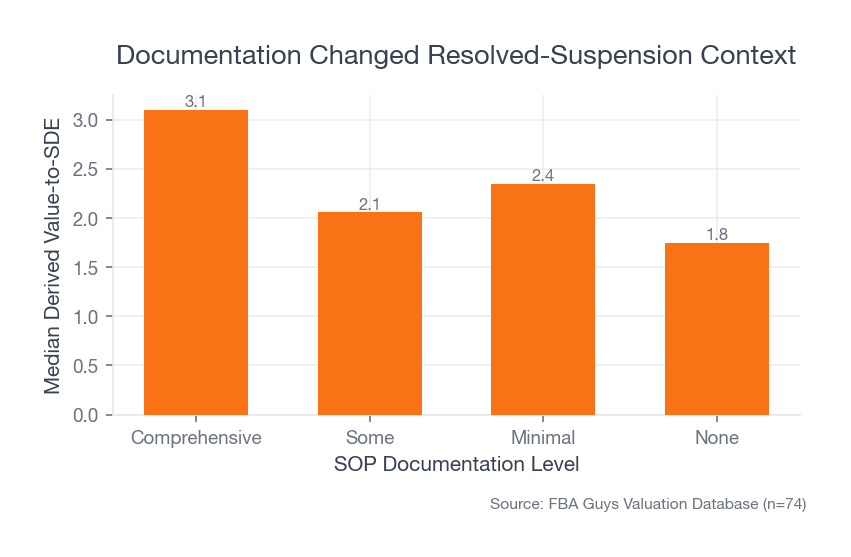
The more interesting cross-tab was documentation. Resolved suspension records with comprehensive SOPs had a 3.10 median derived value-to-SDE. Resolved suspension records with no SOPs had 1.75.
 Source: FBA Guys Valuation Database (n=74)
We don't know whether the SOPs caused the difference. Our read is more cautious: documented operations travel with cleaner future diligence. When a seller can show the notice, the appeal, the supporting documents, the corrective action, and the prevention control, the suspension is easier to inspect.
An unexplained suspension leaves the next reviewer guessing.
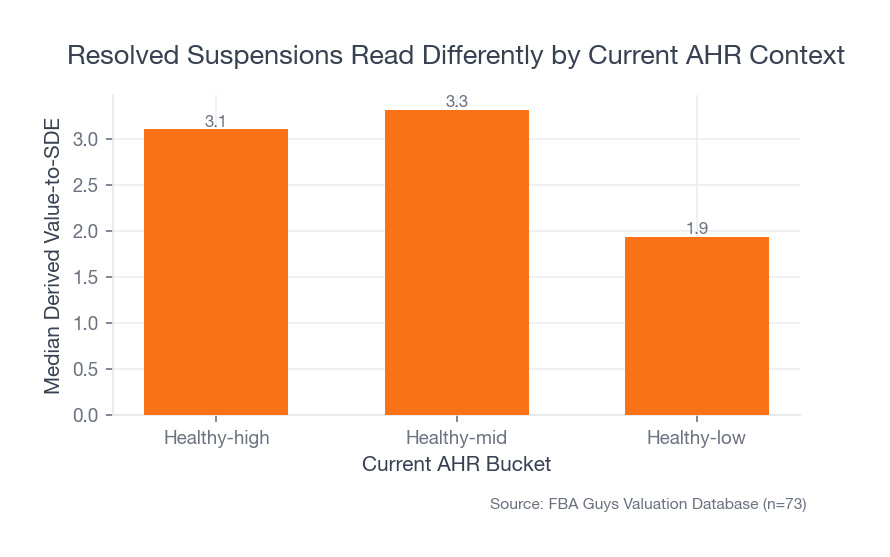
The AHR cross-tab adds another useful boundary. Resolved suspension records with healthy-high AHR had a 3.10 median derived value-to-SDE. Resolved suspension records with healthy-low AHR had a 1.93 median. Again, this doesn't prove causation. It suggests that an old suspension history reads differently when the current account-health file is still weak.
 Source: FBA Guys Valuation Database (n=73)
That is the future cost of a thin appeal file. The seller may get reinstated, but the next reviewer still has to ask whether the business actually changed.
What to put in the suspension evidence file
Create one folder for the event.
Put the original deactivation notice in it. Add screenshots of Account Health, affected ASINs, case IDs, messages from Amazon, submitted documents, appeal drafts, final appeal text, dates, and the final reinstatement notice.
Then add the operating repair. That might be a supplier-documentation SOP, a product-compliance checklist, a listing-edit approval step, a return-inspection workflow, a customer-message review process, or an owner-assignment record for Account Health review.
The file should answer four questions:
- What happened?
- What did Amazon ask for?
- What did the business change?
- Who owns the control now?
If the answer to the fourth question is "the owner will remember," the file isn't done.
After reinstatement, add one more item: the date the control was checked again. A prevention step that is never revisited becomes a statement in an old appeal. A prevention step that leaves a dated review record becomes part of the account-health routine.
This doesn't need to become a large compliance department. For many private-label sellers, a monthly Account Health review plus a saved ASIN compliance folder is enough to start. The important part is that the review happens before the next crisis.
Account Health Assurance and Seller Challenge
Amazon's current account-health programs can matter, but they shouldn't be treated as a substitute for the appeal file.
Amazon's Account Health Assurance FAQ says the program can help eligible sellers avoid deactivation as long as they work with Amazon within the required response window after Amazon contacts them. Amazon's Seller Challenge announcement says enrolled sellers can request reviews of eligible listing-level policy decisions three times every 180 days after standard appeal options have been used.
Both programs are current-policy details, so sellers should verify eligibility and requirements inside Seller Central before relying on them.
The operating point is simpler. If Amazon gives you a protected response path, use it carefully and save the record. If Amazon gives you an additional review path, use it only after the standard appeal record is complete enough to support the challenge.
Does a resolved suspension kill the value of an Amazon business?
A resolved suspension doesn't automatically kill the value of an Amazon business.
The industry correction file is very clear on this point: "any suspension kills the deal" is too broad. Recency, severity, recurrence, and resolution matter. A recent suspension can be a serious problem. Multiple suspensions or review manipulation can be much harder to overcome. An older, resolved suspension with a clean history afterward may be explainable. The prevention side belongs with a broader Amazon suspension prevention checklist, not only the appeal.
The valuation data supports a careful version of that view. Resolved suspension histories were lower as a group, but they were not zero-value businesses. The better question is whether the seller can explain the event and show that the business changed after it.
That is why the appeal file and the SOP belong together.
FAQ
What should I include in an Amazon seller account suspension appeal?
Include the root cause, corrective actions already taken, preventive controls, and the supporting documents Amazon requested. Keep the appeal specific to the notice. A broad apology usually isn't as useful as a clear file that names the failed control and the repair.
How long does Amazon take to respond to a suspension appeal?
Amazon's public forum guidance says sellers can expect a reply within 24-48 hours, but response time can vary by case and by the information Amazon needs. Monitor Seller Central, email, and spam folders after submission.
Should I use an Amazon appeal template?
A template can help you remember the structure, but it shouldn't write the appeal. The useful structure is root cause, corrective action, and prevention. The content has to come from the actual notice, actual documents, and actual operating changes.
Can I open a new Amazon seller account after suspension?
Don't open a new account while the current account is under review. Amazon's public forum guidance warns that creating new accounts during review can lead to permanent suspension.
Does a suspension appeal affect selling the business later?
The appeal can affect how the suspension history reads later. A reinstated account with no saved notice, no appeal record, and no prevention control is harder to explain. A reinstated account with a dated evidence file is easier to inspect, even though the suspension still has to be disclosed and understood.
Keep the appeal plain
The appeal doesn't need drama. It needs the notice, the evidence, the correction, and the control.
That is also the file you will want later if the business is ever valued, financed, or sold. Nobody reviewing the account-history folder six months from now will care whether the appeal sounded polished. They will care whether it shows what happened and why the same problem is less likely to happen again.
Curious what your business is worth?
Get a free, instant valuation and see how your Amazon business stacks up.
Get Your Free Valuation