Amazon Customer Service Response Time: Build the Record Before the Clock Runs Out
The FBA Guys
July 23, 2026

A late customer reply usually looks small until it stops being a reply problem.
One buyer message sits unanswered over the weekend. A return request waits in the wrong queue. Amazon Customer Service asks the seller for help on a post-order issue, and the request lands in a Case Log no one checks until Monday.
Amazon customer service response time is usually discussed as a clock. For Buyer-Seller Messaging, Amazon's current public guidance tells sellers to respond within 24 hours, even on weekends and holidays. Auto-responders don't count as valid responses.
That is the direct answer. The better operating question is whether the business can prove who owned the message, what was answered, and whether the issue stopped before it became account-health history.
What Amazon Customer Service Response Time Means For Sellers
The 24-hour rule most sellers hear about belongs to Buyer-Seller Messaging. Amazon's Respond to messages guidance tells sellers to answer buyer messages within 24 hours, weekends and holidays included.
It is easy to treat that as an inbox habit. Check messages. Reply quickly. Move on.
The account doesn't experience it that neatly. Customer-service work can arrive through buyer messages, return requests, Amazon's Customer Service by Amazon follow-ups, A-to-z claim information requests, chargeback evidence requests, seller performance notifications, and occasionally product questions that sound harmless until the answer changes what the buyer does next.
Each surface needs an owner. Each surface needs a rule for what counts as done.
Amazon's current public guidance also says auto-responders aren't valid responses. That is a useful boundary. A seller can't turn the metric into a receipt that says "message received" and assume the work is finished.
The first useful response has to classify the problem and move it forward. If the issue needs investigation, the response should say what is being checked and when the seller will follow up. If the message doesn't require a response, use the appropriate no-response or resolved path Amazon provides rather than sending filler.
The 24-Hour Rule Is Only One Clock
The 24-hour buyer-message expectation is the one to build around first. It is also not the only timing rule a seller can trip.
Amazon's Fulfilled by Merchant page says sellers need to respond to return requests within 24 hours. The same page tells sellers to monitor Account Health for order defects, late shipments, pre-fulfillment cancellations, and valid tracking.
Amazon's chargeback guidance tells sellers to respond to chargeback alerts and information requests within the stated timeframes, and it describes Order Defect Rate as including negative feedback, A-to-z claims that aren't denied, and chargeback claims. Amazon's A-to-z claims help content also includes short response windows when Amazon asks for claim information.
The customer-service record isn't just "did we answer the buyer message?" It is "did we answer the right queue on the right clock with the right evidence?"
That means a practical response file separates at least five lanes:
- Buyer-Seller Messages.
- Return requests.
- Customer Service by Amazon follow-ups.
- A-to-z and chargeback information requests.
- Seller performance or account-health notices tied to service outcomes.
One person can own all five in a small business. The file still needs five lanes.
When Amazon Handles The Customer
FBA changes much of the support load because Amazon handles fulfillment and customer service for FBA orders. That is one reason FBA businesses can feel operationally cleaner than merchant-fulfilled businesses.
Customer Service by Amazon changes a different part of the process. Amazon's program page says Amazon Customer Service handles eligible post-order customer inquiries for seller-fulfilled orders through phone, chat, and email. It describes 24/7 support, a first-response target under 15 minutes, and a typical goal of resolving inquiries within two days when Amazon needs to work with sellers.
There is still a seller-side obligation. The same page tells sellers to respond to requests in Case Log within 24 hours when Amazon needs help resolving an inquiry.
Amazon's June 2026 Customer Service by Amazon update said Amazon was routing follow-ups through Buyer-Seller Messages and adding daily contacts-per-unit monitoring and AI-generated contact reasons.
That turns CSBA into a cleaner queue only if someone owns the queue. If Amazon answers the customer but needs shipment, refund, product, or policy context from the seller, the seller still needs to respond.
What The Valuation Database Can And Cannot Say
The valuation database doesn't store Amazon customer service response time.
We checked the schema for the valuations table. It has 77 columns. It doesn't have Buyer-Seller Messaging timestamps, return-request response time, Case Log response time, auto-responder status, Customer Service by Amazon contact metrics, A-to-z response timestamps, or chargeback response timestamps.
So the article can't honestly say that answering in 4 hours creates a higher multiple than answering in 18 hours. The data doesn't support that.
What the data can show is adjacent. Response-time exposure usually lives around fulfillment model, account-health history, workload, and documentation. Those are valuation-relevant areas, but the relationship is indirect.
Among 8,582 successful valuations with usable calculated SDE and derived value-to-SDE ratios between 0.5 and 10, FBA records had a 2.68 median derived value-to-SDE across 6,210 records. Hybrid records had a 2.20 median across 1,992 records. FBM records had a 1.65 median across 380 records.
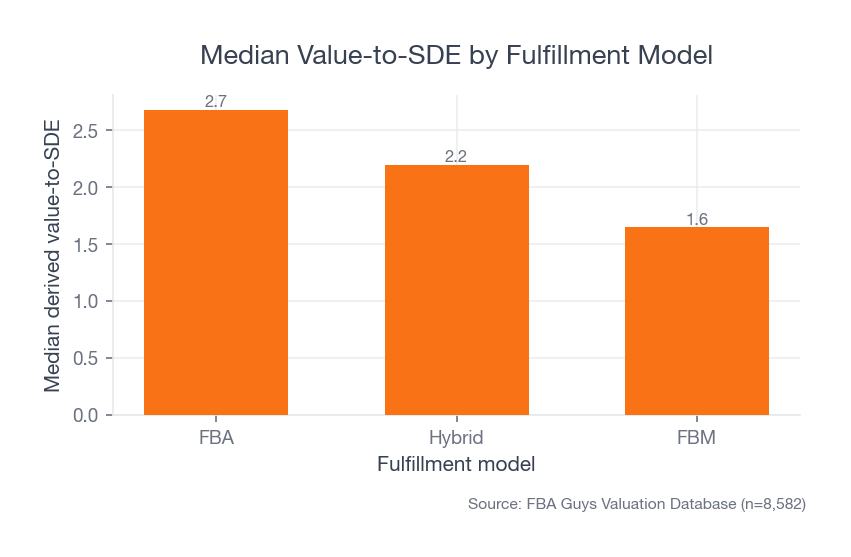 Source: FBA Guys Valuation Database (n=8,582 successful valuations with usable calculated SDE)
That doesn't prove fulfillment method caused the gap, and it certainly doesn't prove customer service response time caused it.
The careful reading is that merchant-fulfilled exposure travels with a different operating burden. Customer service is part of that burden. Shipping promises, returns, carrier evidence, buyer messages, replacement requests, and claim response all sit closer to the seller.
The hybrid count is the useful part. Hybrid records outnumbered pure FBM records 1,992 to 380. Response-time exposure can live inside businesses that mostly run through FBA.
Why Warnings And Suspensions Shouldn't Be Collapsed
The database gives one account-history boundary that is worth keeping in mind.
In 472 records with populated suspension history and usable calculated SDE, never-suspended records had a 3.10 median derived value-to-SDE. Warnings-only records had a 3.06 median. Resolved suspensions had a 2.35 median. Active-issue records had only six entries, too few for a clean read.
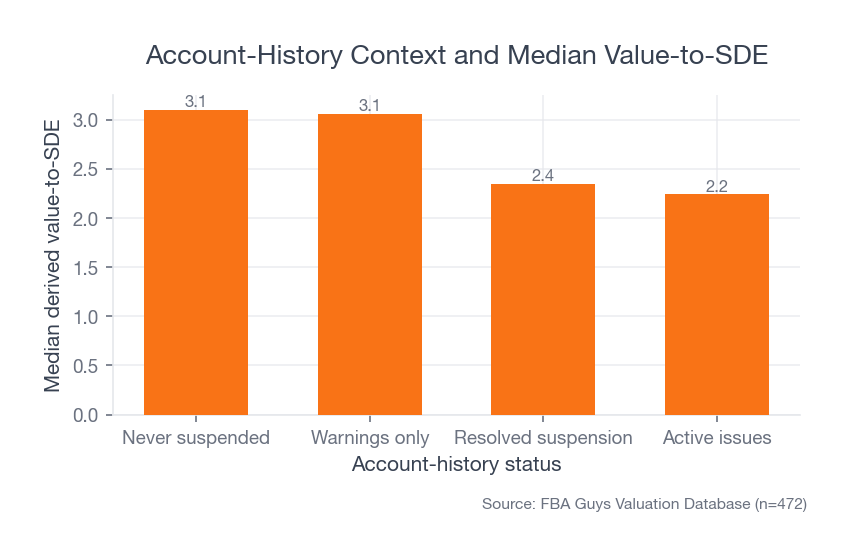 Source: FBA Guys Valuation Database (n=472 successful valuations with populated account-history data and usable calculated SDE)
That doesn't make warnings harmless. It says something narrower: a warning handled early and documented cleanly is a different future diligence fact from a resolved suspension.
This matters for customer service response time because late replies tend to be upstream. They may lead nowhere. They may lead to an annoyed customer, a return, a negative feedback event, an A-to-z claim, a chargeback, or an account-health notice.
The seller's job is to keep the issue in the first category whenever possible, and to preserve the record if it moves farther down the chain.
If the issue reaches a seller performance notification, the response file should already exist. If it reaches an account suspension appeal, the appeal shouldn't be the first place the seller tries to reconstruct what happened.
The Transferability Test
Response time gets more interesting when the current owner is removed from the process.
If the owner answers every buyer message personally, the account may still have a good response record. That doesn't make the process transferable. A buyer has to ask what happens when the owner is on a plane, across a time-zone gap, in a supplier meeting, or deep in diligence work while the business keeps operating.
The workload data points in the same direction. In the broader successful valuation set, records with less than 5 owner hours per week had a 2.70 median derived value-to-SDE after we normalized the two under-5-hour labels. Records with 40+ owner hours had a 1.90 median. That isn't customer-service causation. It is transferability context.
Customer service is one of the places owner dependence hides. The task feels small enough to keep, so it never becomes a documented process. Then the buyer asks who answers messages, who handles weekends, who decides whether a return request is routine or risky, and who knows when a customer complaint should move into the account-health file.
Those aren't advanced diligence questions. They are basic operating questions.
The buyer will also care about proof. A seller can say the team answers every message quickly, but the stronger file shows the coverage schedule, the message queue, the exceptions, and the corrective action after a miss. That evidence doesn't need to be elaborate. It needs to be easy to inspect.
The clean answer is simple: the queue has an owner, the owner has a backup, the backup has a script, and the exception file shows what happened when the normal process didn't work.
Build The Customer-Service Response File
The useful control is plain and repeatable.
One tab tracks queue ownership:
- Queue name.
- Where it appears in Seller Central.
- Normal owner.
- Weekend owner.
- Backup owner.
- Response deadline.
- Escalation rule.
- Evidence to save.
The second tab tracks issues:
- Date and time received.
- Order ID.
- SKU and ASIN.
- Queue.
- Customer issue.
- Response due.
- Response sent.
- Owner.
- Follow-up due.
- Outcome.
- Claim, feedback, return, or chargeback impact.
- Corrective action.
The third tab is the SOP. It should show how to answer the common cases: shipment status, lost item, replacement request, return confusion, damaged item, refund schedule, product compatibility, warranty question, and customer message that doesn't require an answer.
This is where the valuation data becomes more interesting. In 472 records with populated SOP documentation and usable calculated SDE, comprehensive SOP records had a 3.55 median derived value-to-SDE. Records with some SOP documentation had 2.88. Minimal SOP documentation had 2.58. Records with no SOP documentation had 2.45.
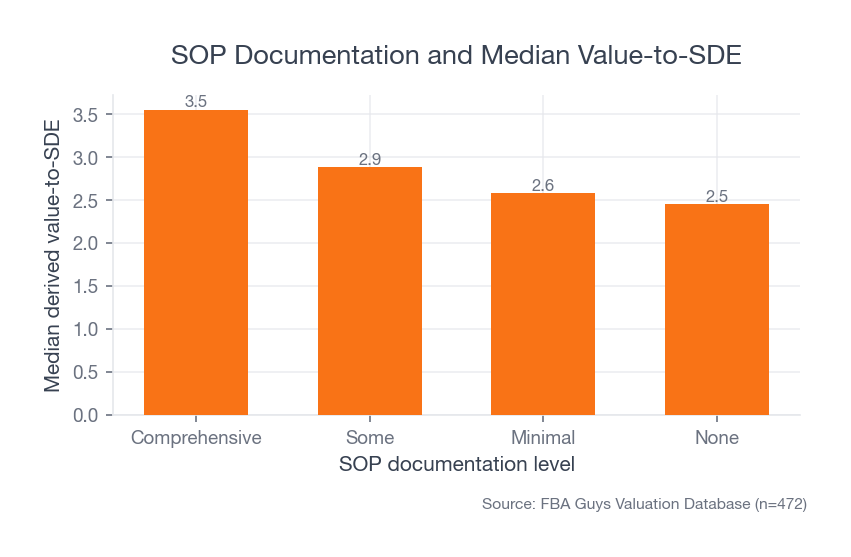 Source: FBA Guys Valuation Database (n=472 successful valuations with populated SOP-documentation data and usable calculated SDE)
The data doesn't prove a response-time spreadsheet creates a higher valuation. Our read is narrower: businesses with documented operating controls tend to show up differently from businesses where every service issue has to be reconstructed from memory.
That also fits the transferability problem. If customer service lives in the owner's phone notifications, a buyer has to replace the owner. If customer service lives in a queue, an SOP, and a weekly exception file, the buyer can inspect the process.
What A Buyer Will Want To See
A buyer doesn't need every customer-service thread. That would turn diligence into a message-by-message audit. The useful file is smaller.
Start with the last 90 days of queue metrics if Seller Central or CSBA provides them. Add the weekend coverage schedule, VA or contractor instructions, message templates, return-request workflow, claim-response workflow, and a short exceptions log. The exceptions log matters because it shows judgment. A perfect-looking file with no misses can be less useful than a file that shows two missed messages, why they happened, and what changed afterward.
For seller-fulfilled orders, include how the support process connects to shipping. The customer usually doesn't separate "where is my package?" from "why didn't the seller answer?" If the shipment problem turns into a claim, the message thread, carrier record, carrier page, and response timeline should sit together.
For FBA-first businesses, include the edges. Which SKUs can be seller-fulfilled? Who turns FBM offers on during stockouts? Who watches customer messages when a replacement part or product question doesn't fit the normal FBA support path? The edge cases are where a mostly automated process becomes manual again.
For Customer Service by Amazon, save the monthly performance summaries and any follow-up requests where Amazon needed seller input. CSBA can make the customer-facing side cleaner, but the buyer still needs to know whether the seller-side follow-up process is owned.
What To Answer Within 24 Hours
A good first response is rarely long.
It should do five things:
- Acknowledge the specific issue.
- Answer what can be answered now.
- Ask only for missing information that is actually needed.
- State the next action and timing.
- Save the evidence outside the message thread if the issue could become a claim.
For a shipping issue, save the label, carrier page, proof of movement, delivery proof, warehouse or 3PL note, and any customer photos. For a return issue, save the return authorization, refund status, item condition notes, and any SAFE-T or reimbursement record. For a product issue, save the ASIN, batch or lot if relevant, photo evidence, replacement decision, and the internal note about whether the listing needs clarification.
The first response doesn't need to solve every issue. It does need to prevent drift.
Drift is what creates ugly records. The customer asks a concrete question. The seller replies vaguely. A day passes. The customer files a claim. The seller then tries to explain the whole situation to Amazon from memory.
That record is harder to defend than a simple timeline.
If The Window Was Already Missed
Answer the customer first.
Then build the record while the facts are still fresh:
- When did the message arrive?
- When was the response due?
- When did the seller respond?
- Why was it missed?
- Did the customer file a return, claim, chargeback, or negative feedback?
- What changed in the process?
- Who owns the next review?
If the issue is isolated, the fix may be a coverage change. If the same miss happens twice, the fix is probably queue design. If the issue has already become an Order Defect Rate problem, the response file should connect customer message, order event, and corrective action in one place.
This file also belongs in the broader suspension prevention checklist. Account-health prevention is mostly the discipline of catching process failures while they are still small enough to explain.
FAQ
What is Amazon's required customer service response time?
For Buyer-Seller Messaging, Amazon's current public guidance says sellers should respond within 24 hours, even on weekends and holidays. Other queues can have different timing rules, so sellers should check the live Seller Central page for the specific issue.
Do auto-responders count as Amazon message responses?
Amazon's current guidance says auto-responders aren't considered valid responses. Use a real response, the appropriate resolved path, or the no-response-needed path when the message genuinely doesn't require a reply.
Does FBA mean Amazon handles all customer service?
FBA handles many post-order fulfillment and support issues for FBA orders. It doesn't remove every customer-service surface from the seller account. Product questions, seller-fulfilled orders, hybrid fulfillment, brand support, returns exceptions, and Amazon follow-up requests can still need seller action.
What is Customer Service by Amazon?
Customer Service by Amazon is a program where Amazon Customer Service handles eligible post-order customer inquiries for seller-fulfilled orders. It can reduce direct support work, but sellers still need to respond when Amazon asks for help resolving a customer issue.
Does customer service response time affect valuation?
The valuation database can't prove a direct response-time-to-valuation relationship because it doesn't store response-time data. It does show adjacent patterns around fulfillment model, account-history status, workload, and SOP documentation. Treat response time as part of the account-health and transferability file, not as a standalone valuation formula.
The Practical Takeaway
Amazon customer service response time starts with a 24-hour buyer-message clock. The business problem is larger than the clock.
The better system is concrete: name the queues, assign owners, cover weekends, answer real questions, save the evidence, and review exceptions before they become account-health history.
Fast replies help. Transferable records help more.
Curious what your business is worth?
Get a free, instant valuation and see how your Amazon business stacks up.
Get Your Free Valuation