Amazon Order Defect Rate: How to Fix ODR Before the Metric Becomes the Story
The FBA Guys
June 20, 2026

An ODR spike usually feels like one number. It isn't one problem.
To fix Amazon Order Defect Rate, download the ODR report, separate the defects by type, handle each defect through the right Amazon process, repair the operating cause, and keep the evidence until the 60-day window is clean. Negative seller feedback, A-to-z claims, and chargebacks don't get fixed the same way.
That order matters because the percentage is only the output. If you start with the percentage, you can spend three days being generally helpful while the same defect source keeps creating new account-health risk.
What Amazon Order Defect Rate Measures
Amazon currently defines Order Defect Rate as the percentage of orders with one or more defects during a 60-day period. The three defect types are negative feedback rate, A-to-z Guarantee claim rate, and credit card chargeback rate.
Amazon's current policy target is under 1%. An ODR above 1% may result in account deactivation.
The math is simple. If you have 300 orders in the 60-day window, three defect orders can put the account near the line. Four can push it over if the denominator and Amazon's classification land the wrong way. One order with multiple defect signals still needs order-level review. A single customer problem can create more than one record to handle.
The denominator is where low-volume sellers feel the metric first. A seller with 100 orders in the 60-day window has almost no room for defects. One defect is already 1%. A seller with 1,000 orders has more statistical cushion, but the work is the same: identify the affected order, figure out what Amazon counted, and stop the same cause from repeating.
The first working question is: which defect type created the percentage?
How to Fix Amazon Order Defect Rate in the Right Order
Use a five-step sequence.
- Download the ODR report from Account Health.
- Group the affected orders by defect type: negative feedback, A-to-z claim, or chargeback.
- Handle each defect through the process Amazon provides for that defect.
- Fix the operating cause that produced the defect.
- Save the report, order evidence, outcome, and SOP change.
That sequence keeps the work specific. A seller-feedback issue may need Feedback Manager, a listing edit, or a customer-service change. An A-to-z claim may need proof of delivery, claim review, refund timing, or a shipping-promise change. A chargeback may need a response inside Amazon's chargeback workflow and stronger order evidence.
ODR is a customer-service performance metric, but the fix is usually operational. The business either promised something the order didn't deliver, shipped in a way it couldn't prove, responded too slowly, or let the same product or fulfillment issue repeat. For a wider dashboard map, our guide to Amazon Seller Central metrics explains how ODR sits beside the other account-health numbers.
The repair plan should produce two outputs. The first is an Amazon-facing outcome: removed feedback, denied claim, resolved chargeback, cleaner customer-service record, or simply enough clean orders for the 60-day window to move. The second is an internal control: a changed shipping template, clearer listing promise, better packaging instruction, refund timing rule, or owner assigned to review the same metric each week.
Download the ODR Report Before You Decide What Happened
Amazon's ODR document points sellers to Account Health, then Customer Service Performance, then the Order Defect Rate tab. From there, download the report.
That report should become a working sheet. Add columns for defect type, order ID, ASIN or SKU, fulfillment method, promise date, delivery date, customer message status, refund status, claim status, and final action.
The report matters because ODR is order-correlated. The relevant date is tied to the order, not only the date you noticed the problem. If you wait until the dashboard turns red, some of the defects may already be old enough that the evidence trail is harder to rebuild.
For a small account, the first pass may take 20 minutes. For a high-volume account with mixed FBA and seller-fulfilled orders, it may take longer. The point is to stop treating the ODR percentage as a diagnosis.
We like adding one more column: "next prevention step." That sounds basic until you look at the report three weeks later. Without that column, the file tells you what happened. With it, the file tells you whether the business actually changed anything.
The first pass should also identify repeat patterns. Three different order IDs from the same SKU tell a different story from three unrelated orders across three different fulfillment paths. A single SKU points toward listing accuracy; product condition; packaging; prep; or supplier inspection. A seller-fulfilled cluster points toward shipping promises; tracking; carrier selection; or warehouse handoff. A refund cluster points toward customer-service timing.
Fix Negative Seller Feedback
Amazon's ODR document treats one- and two-star seller feedback as negative. If a buyer withdraws negative feedback, Amazon says it isn't counted as part of ODR, though it may take up to 48 hours to disappear from the metric.
Start with removal eligibility. If the feedback qualifies under Amazon's current rules, request removal through Feedback Manager. Keep the order ID, removal request, and result.
If removal isn't available, move to the cause. Seller feedback is about the order experience. It can come from late delivery; damaged packaging; wrong condition; missing parts; unclear listing expectations; poor communication; or a refund issue. Product reviews are separate from seller feedback, so don't chase product-review stars unless the ODR report points to seller feedback connected with the order. Our guide to seller feedback vs product reviews separates those two records in more detail.
This is a good place to separate sympathy from evidence. A thoughtful message to the buyer may be appropriate within Amazon's communication rules. The operating file still needs the factual cause: what was promised, what happened, what changed, and whether the same SKU or fulfillment path appears in other defects.
Fix A-to-z Claims
A-to-z claims need outcome review. Amazon's ODR document says several claim types can affect ODR: claims granted and debited from the seller account, claims where the seller refunded after the claim was filed, claims where the order was canceled by the seller or Amazon, and claims still pending a decision.
The same Amazon document says claims don't affect ODR when they are granted and paid by Amazon, denied to the customer, withdrawn by the customer, or removed after a successful appeal.
That split is useful. It means the claim record matters as much as the claim itself. A seller looking at ODR shouldn't stop at "we had an A-to-z claim." The question is what happened to the claim and what evidence supports the outcome.
For seller-fulfilled orders, delivery proof is usually central: carrier; tracking number; scan history; delivery confirmation; shipping date; and promised delivery date. For item-condition or wrong-item claims, the file shifts toward listing accuracy, pick-pack controls, photos where available, return notes, and supplier or warehouse review.
If the claim exposes a real operating issue, fix the process even if the individual claim later comes off ODR. Winning the claim and leaving the cause untouched is how the same metric shows up again.
Fix Chargebacks
Amazon's current chargeback guide separates fraud-related chargebacks from service-related chargebacks. Fraud-related chargebacks don't count against ODR. Service-related chargebacks can affect ODR when the customer's bank decides in favor of the customer.
The response window matters. Amazon says sellers should respond to a chargeback alert within seven calendar days of the email date and respond to additional information requests inside the stated timeframe.
For a service-related chargeback, build the response around order evidence: shipping date; shipping method; tracking; proof of delivery; customer communications; product information; and refund history. Keep a copy of the response and the outcome.
The operating fix depends on the pattern. Non-receipt chargebacks point toward delivery proof, carrier choice, signature rules for higher-value orders, and clearer shipment confirmation. Damaged or materially different item claims point toward listing accuracy, package quality, condition control, and warehouse inspection. Refund-related chargebacks point toward refund workflow and customer-message timing.
Chargebacks also deserve a finance check. If the customer says they didn't receive a refund, the order file should include the refund date, amount, transaction record, and any message that set the customer's expectation. If the customer says the product was materially different, the file should connect the chargeback back to the listing copy and the return reason. That connection helps you decide whether the issue belongs to finance, customer service, warehouse, or listing operations.
Separate FBA, FBM, and Mixed Fulfillment
Fulfillment method changes the triage. Amazon's chargeback guide currently says FBA orders don't impact shipping performance or overall account health in the same way seller-fulfilled orders do. Seller-fulfilled orders put more of the delivery promise, confirmation, and tracking record on the seller.
That doesn't make FBA account health irrelevant. It changes where you look.
For FBA-heavy accounts, ODR review often turns toward seller feedback; product condition; listing expectation; claim status; and customer communication. For FBM and mixed accounts, create a separate seller-fulfilled lane. Review late shipment exposure; tracking validity; promised delivery date; carrier performance; cancellation controls; and whether inventory availability is creating preventable cancellations.
Our 2026 valuation subset had 285 pure FBA records, 126 combination records, and 47 FBM records. That is too small to make a strong ODR-specific fulfillment claim. It is enough to remind us that mixed operations need mixed evidence. The seller-fulfilled side deserves its own file.
Preserve the Account Health Record
The practical ODR fix isn't finished when the dashboard looks better. It is finished when the business can explain what happened.
Keep the ODR export, affected order IDs, claim or chargeback records, Feedback Manager results, customer-message history, refund records, tracking proof, carrier notes, listing edits, warehouse notes, and SOP change. If you changed a shipping template, save the date. If you moved a SKU from FBM to FBA, record the reason. If packaging changed, record the SKU and supplier or warehouse instruction.
This matters for future operators and for any eventual buyer. Due diligence rewards organized evidence. A future reviewer shouldn't have to guess whether an ODR spike was a one-time delivery issue, a repeated product condition problem, or a warning sign that the seller never fully understood. The same recordkeeping discipline sits behind our Amazon suspension prevention checklist.
The file needs to be findable.
There is also a transferability point here. If the only person who knows what happened is the owner, the fix is trapped in the owner's memory. If the record sits in a clean folder with dates, order IDs, decisions, and process changes, the next operator can inherit the lesson without inheriting the confusion. That is the difference between an account-health scare and an account-health system.
What the FBA Guys Data Says About Account Health Context
The FBA Guys valuation database doesn't store exact ODR, A-to-z claim outcomes, seller-feedback ratings, chargeback outcomes, appeal text, or late shipment rate. We can't use it to say which ODR fix works fastest.
We can use it for adjacent account-health context.
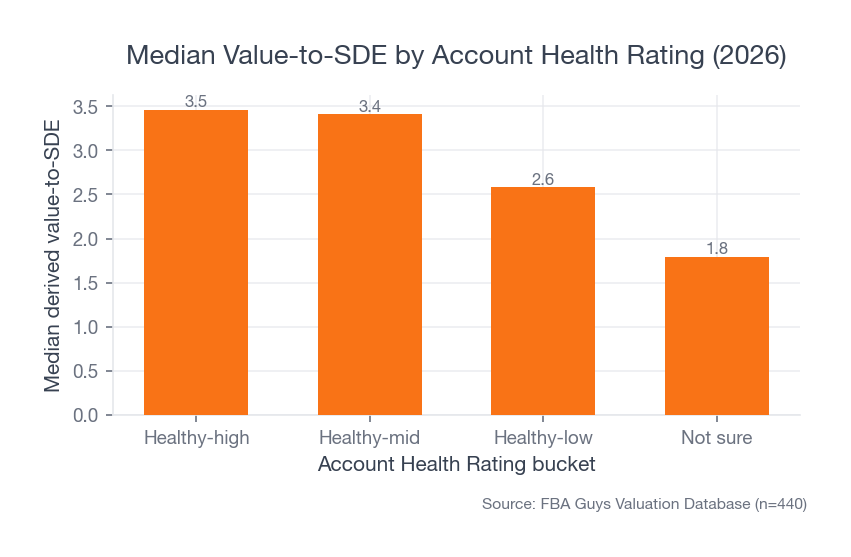
Among 440 successful 2026 valuations with populated account-health fields, healthy-high Account Health Rating records had a 3.46 median derived value-to-SDE. Healthy-mid records were close at 3.41. Healthy-low records were lower at 2.58. Not-sure records were lower still at 1.79, though that group had only 11 records. For the score mechanics behind those buckets, see Amazon Account Health Rating explained.
 Source: FBA Guys Valuation Database (n=440)
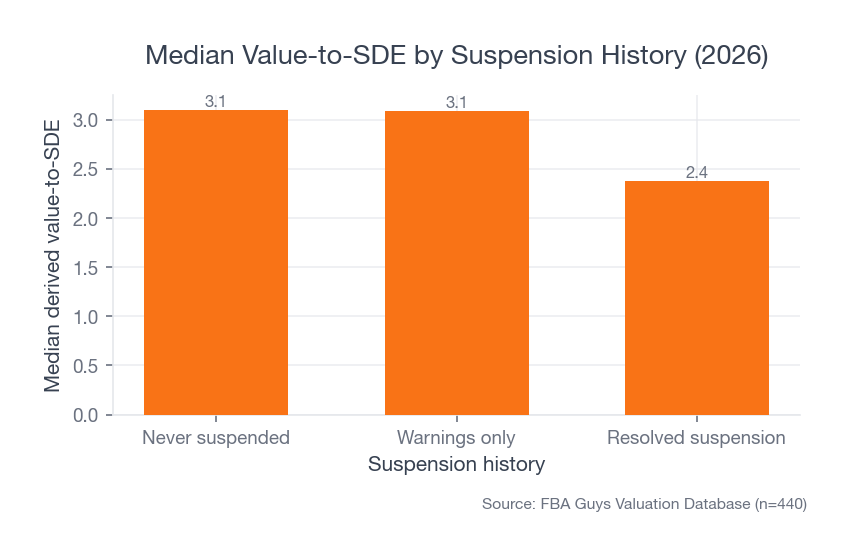
The more useful ODR-adjacent pattern was suspension history. In the same 2026 subset, never-suspended records had a 3.10 median derived value-to-SDE. Warnings-only records were nearly the same at 3.09. Resolved-suspension records were lower at 2.38. Active issues had only five usable records, so we don't use that bucket for inference.
 Source: FBA Guys Valuation Database (n=440)
That doesn't prove warnings are harmless. Our read is narrower: the record and the resolution matter. A warning that is handled, documented, and prevented from repeating reads differently from an account interruption that has to be explained later. If the ODR issue arrived through a formal warning, our guide to Amazon Seller Performance Notifications covers the record side of that workflow.
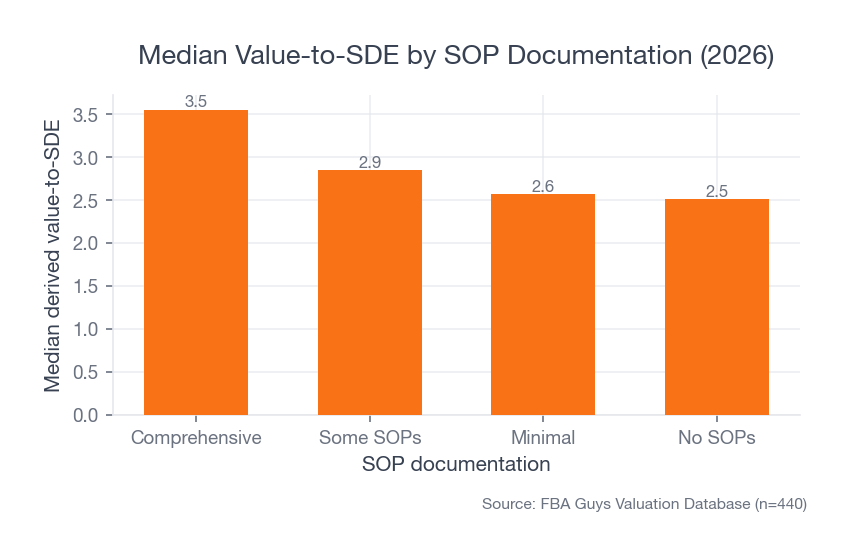
SOP documentation pushes the same point. Comprehensive SOP records had a 3.55 median derived value-to-SDE in the 2026 subset. Records with no SOP documentation had a 2.51 median. That doesn't prove SOPs create value or fix ODR. It suggests that documented operators give account-health issues better context.
 Source: FBA Guys Valuation Database (n=440)
How Long Does an ODR Fix Take?
Some fixes are visible quickly. Amazon says withdrawn negative feedback can take up to 48 hours to disappear from the ODR metric. Some claim outcomes may update after Amazon or the customer takes action.
Other fixes need the 60-day window to work through. If the old defect orders remain inside the period, the dashboard can stay elevated even after the operating issue is fixed. New clean orders help the denominator, but a low-volume account may need patience because each defect carries more weight.
Monitor weekly until the window is clean. If the account is at risk, follow the specific instructions in Account Health and Performance Notifications. Don't rely on a generic plan of action when Amazon has asked for something more specific.
The weekly review should be boring. Open Account Health, export the current report, compare it with the prior export, and write down whether new defects appeared. If the same defect type appears again, the process change didn't hold. If no new defects appear and the old defects age out, the business has a cleaner account-health story to tell.
A Simple ODR Repair File
Use one file per ODR event. It can be a spreadsheet, a folder, or both.
Minimum fields:
- Date discovered
- ODR percentage and 60-day order count
- ODR report export
- Defect order IDs
- Defect type for each order
- Fulfillment method
- Root cause
- Amazon action taken
- Customer action taken, if allowed
- Outcome
- Process change
- Owner
- Follow-up date
The owner field matters. ODR issues often touch customer service, warehouse, inventory, listings, and finance. If no one owns the follow-up, the issue becomes a Slack thread that everyone remembers differently.
FAQ
What is Amazon Order Defect Rate?
Amazon Order Defect Rate is the percentage of orders with one or more defects during a 60-day period. Amazon's current ODR defect types are negative feedback rate, A-to-z Guarantee claim rate, and credit card chargeback rate.
What ODR does Amazon require?
Amazon's current policy says sellers should maintain ODR under 1%. An ODR above 1% may result in account deactivation.
Does negative product review count toward ODR?
A product review is different from seller feedback. ODR uses negative seller feedback tied to order experience, along with A-to-z claims and chargebacks. Use the ODR report to identify the specific order defect before taking action.
Can an A-to-z claim be removed from ODR?
Yes, in some outcomes. Amazon's ODR document says claims denied to the customer, withdrawn by the customer, granted and paid by Amazon, or removed after a successful appeal don't affect ODR. The claim status matters.
How do you fix Amazon Order Defect Rate?
Download the ODR report, identify whether each defect is negative feedback, an A-to-z claim, or a chargeback, handle the defect through Amazon's current process, repair the root cause, and monitor the 60-day window until the metric is clean.
The article-level answer is simple. The order-level work is where the account actually gets fixed.
Curious what your business is worth?
Get a free, instant valuation and see how your Amazon business stacks up.
Get Your Free Valuation