Amazon Inauthentic Item Suspension: Build the Source File Before You Appeal
The FBA Guys
July 28, 2026

A seller usually knows whether the product on the shelf is real. Amazon doesn't know that yet.
That is the tension inside an Amazon inauthentic item suspension. You may be looking at authentic inventory, a real supplier relationship, and invoices you have used for months. Amazon is looking at a product-authenticity complaint, an ASIN, a seller account, and a document request that has to be verified from the outside.
An Amazon inauthentic item suspension is a source-file test. The immediate job is to prove legitimate supply to Amazon. The longer job is to leave behind an account-history file that a future buyer can understand without guessing.
Those are related jobs, but they aren't identical. One gets you back to selling. The other explains what happened after the account is back.
What an Amazon Inauthentic Item Suspension Asks You to Prove
The useful starting point is Amazon's notice, because that is the document Amazon will measure your response against.
The notice tells you which ASIN, policy area, marketplace, and response path Amazon wants you to use. It may ask for invoices, receipts, supplier information, a plan of action, or other documentation. The details matter because Amazon isn't asking for a general defense of your business. It is asking whether the product involved in the complaint can be traced to a legitimate source and whether the listing and inventory are safe to keep selling.
As of the writing of this article, Amazon's seller policy overview says policy failures can lead to account deactivation, loss of Featured Offer eligibility, withheld funds, negative reviews, or other actions. Amazon also describes Account Health Rating as a color-coded 0-1,000 score that gives a snapshot of account deactivation risk based on policy compliance.
Amazon's own Account Health training material puts product authenticity complaints inside the Product Policy Compliance area, alongside infringement, product quality, and listing policy violations. The invoice requirements page is the other page to keep open. Amazon uses invoices to verify legitimate sourcing. Official snippets from that page reference invoices dated within 365 days before the performance notification and quantities sufficient to cover sales volume.
That gives you the practical shape of the appeal file:
- The performance notification.
- The affected ASIN or ASINs.
- Supplier invoices or receipts that match the product and sales period.
- Supplier contact details and any manufacturer or distributor relationship proof.
- FBA shipment, receiving, and inventory records where relevant.
- A short explanation of root cause, action taken, and prevention.
If the complaint is wrong, the file still has to prove why it is wrong. If the complaint is valid, the file has to show what changed.
Build the Source File Before You Write the Appeal
Most weak appeals start too early.
The seller opens the appeal box, starts explaining, and then tries to attach documents afterward. That order makes the appeal longer than it needs to be. It also creates a small risk that the appeal says something the document packet doesn't prove.
The source file should come first.
For each affected ASIN, create a folder with the notice, invoices, supplier information, order history, inventory status, and any action you took after the complaint. If you pulled inventory, quarantined units, paused the listing, changed supplier, corrected packaging, or changed receiving inspection, include the dated evidence.
Then write the appeal from that file.
A good file answers plain questions. Who supplied the product? When was it bought? Does the supplier name and address match the document? Does the product identifier match the ASIN or listing? Do quantities cover the sales period Amazon is reviewing? Was inventory still in FBA when the complaint arrived? What happened to remaining units? Who owns the control going forward?
This is where a messy but real invoice can create trouble. A real invoice may still be weak evidence if the product description is vague, the supplier is hard to verify, the account name doesn't match, the quantity is short of sales volume, or the date sits outside the window Amazon requests.
The fix is legibility and explanation. Highlight the ASIN-relevant line items. Add a short cover note if the supplier's product code differs from the listing title. Include supplier contact information. If your business entity name changed, show that record instead of hoping the reviewer infers it.
Don't alter source documents in ways that create a new issue. If something is missing, state what is missing and provide the next best support. Manipulated documents are a larger problem than imperfect documents.
The file also needs a simple internal index. Put the newest notice at the top, then invoices in date order, then shipment or receiving records, then the corrective-action note. If there are several affected ASINs, keep the ASIN folders separate. A reviewer shouldn't have to hunt through one large PDF to figure out which invoice supports which product.
That same organization helps later. If the account is reinstated and you sell the business 18 months from now, the question won't be "did Amazon eventually accept something?" It will be "what happened, what changed, and can the new owner see the proof?"
The appeal itself can be quite short once the file is built. It should say what caused the complaint, what you did with the affected inventory, what documentation supports the product's source, and what control changed so the issue is less likely to recur. For the broader account-level process, see our guide to an Amazon seller account suspension appeal.
What the FBA Guys Data Can and Can't Say
The FBA Guys valuation database doesn't store inauthentic item complaints.
It doesn't store ASIN-level complaint reason, invoice upload result, supplier verification result, appeal text, Plan of Action quality, reinstatement outcome, appeal timing, Account Health Assurance enrollment, Seller Challenge usage, or exact AHR point value.
So we should be careful. We can't use the database to tell you which appeal format works. We can't use it to say whether Amazon will accept a particular invoice packet.
What the database can show is how account-health history travels with valuation context.
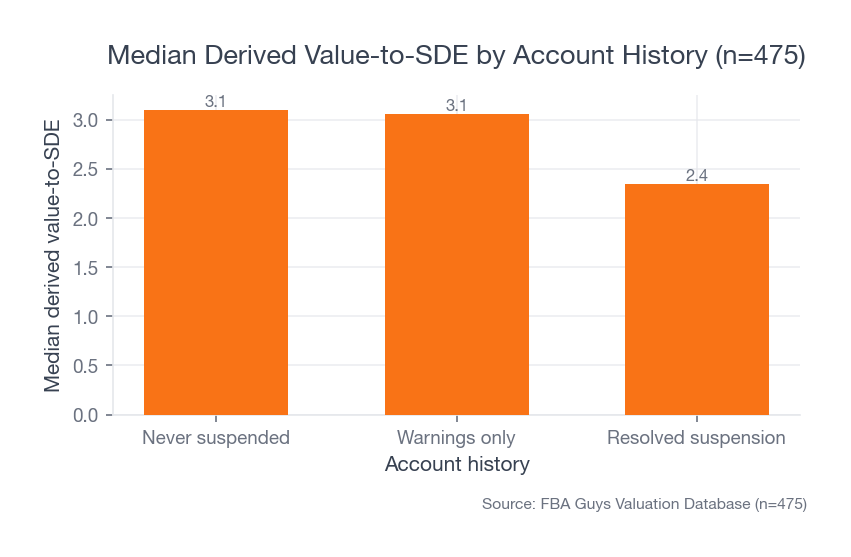
In the current 2026 account-health subset, 475 successful valuation records had populated Account Health Rating, populated suspension history, valid valuation output, and derived SDE. Derived value-to-SDE is the valuation calculator's estimated value divided by derived SDE. It is a directional proxy, not a closed-sale multiple.
Inside that subset, account-history buckets separated clearly:
- Never suspended: n=259, median derived value-to-SDE 3.10.
- Warnings only: n=130, median 3.06.
- Resolved suspension: n=80, median 2.35.
- Active issues: n=6, too small for inference.
 Source: FBA Guys Valuation Database (n=475)
The most useful interpretation isn't that every suspension permanently damages a business. The useful interpretation is that a resolved suspension still needs context. Warnings-only records looked close to never-suspended records. Resolved-suspension records sat lower.
The cross-tab with current Account Health Rating made that more interesting. Resolved suspension plus healthy-high AHR had a 3.08 median derived value-to-SDE across 21 records. Resolved suspension plus healthy-low AHR had a 1.94 median across 46 records.
That doesn't prove AHR causes value. It suggests that an old account-health event reads differently when the current account-health file is still weak.
If you are dealing with an inauthentic item suspension today, that is the valuation lesson worth keeping. Your job isn't finished when the account is reinstated. The event needs to become a resolved, dated, explainable record.
Product Control Changes the Risk Context
Product authenticity complaints are often about chain of custody. Who made the product? Who sold it to you? Can the supplier verify it? Does the product match the listing, packaging, model number, and customer expectation?
The answer is different for different seller models.
An owned-brand seller may have trademark records, Brand Registry access, manufacturer invoices, packaging specs, and perhaps serialization through Amazon Transparency. A reseller may have legitimate inventory too, but the file depends much more heavily on distributor invoices and proof that the supplier chain is acceptable for the product involved.
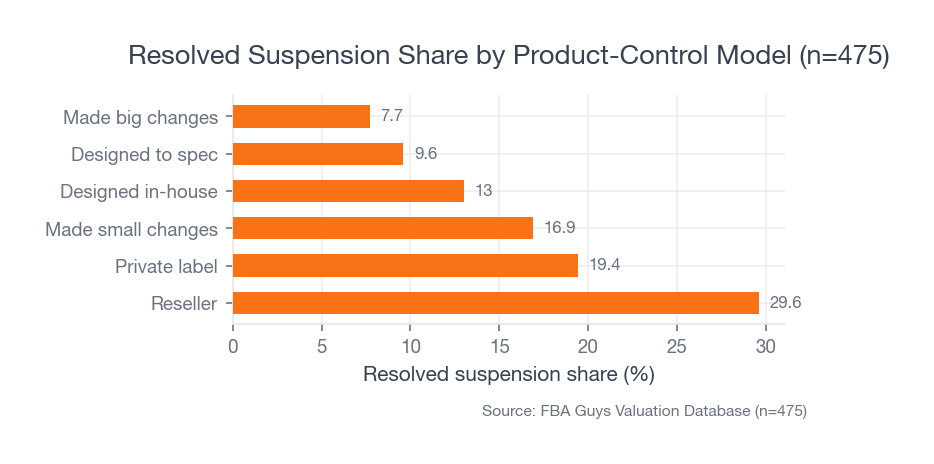
The database gave us a useful adjacent pattern. In the 2026 account-health subset, reseller records carried a heavier account-history burden than designed-in-house records:
- Reseller records: n=98; 29.6% had resolved suspension history and 32.7% had warnings-only history.
- Designed-in-house records: n=138; 13.0% had resolved suspension history and 20.3% had warnings-only history.
- Designed-on-specification records: n=73; 9.6% had resolved suspension history and 24.7% had warnings-only history.
 Source: FBA Guys Valuation Database (n=475)
The valuation proxy moved in the same direction. Reseller records had a 1.68 median derived value-to-SDE overall. Designed-in-house records had 3.60.
This doesn't prove reselling causes authenticity complaints. It does suggest that weaker product-control models travel with more account-history friction in this subset.
For a seller, the practical point is straightforward. The less control you have over the product and source, the cleaner your chain-of-custody file needs to be.
Brand Registry Helps With Control, but It Doesn't Replace the Invoice
Brand Registry is useful because it gives an owned-brand seller more control over the listing, brand record, and enforcement tools. In some cases, Transparency can add a physical product-authentication layer through serialization.
Those are real controls. They are also not the same thing as an accepted invoice for a specific authenticity complaint.
In the 2026 account-health subset, Brand Registry yes records had a 13.5% resolved-suspension share and a 3.25 median derived value-to-SDE. Brand Registry no records had a 30.6% resolved-suspension share and a 1.79 median.
The Brand Registry plus suspension-history cross-tab was also clear:
- Brand Registry yes plus resolved suspension: n=51, median derived value-to-SDE 3.15.
- Brand Registry no plus resolved suspension: n=26, median 1.38.
- Brand Registry yes plus never suspended: n=223, median 3.30.
- Brand Registry no plus never suspended: n=31, median 1.90.
Our read is that Brand Registry travels with stronger product-control context. It helps the file make sense. If Amazon asks for invoices, the brand-control layer still has to sit beside the sourcing proof.
This is especially important for private-label sellers who assume ownership proof answers everything. Ownership helps answer "is this your brand?" It may not answer "where did these units come from?" or "did the units customers received match the listing?"
Turn the Appeal Into a Future Evidence File
The most useful thing about an appeal file is that it can survive the crisis.
A buyer looking at your business later may ask for Account Health exports, performance notifications, reinstatement records, and supplier documentation. They may not understand the nuance of the event from memory. They will understand a dated folder.
That folder should show:
- The original Amazon notice.
- The affected ASINs.
- The appeal or response submitted.
- The invoices and supplier documents used.
- Amazon's resolution.
- Inventory actions taken.
- Supplier or product changes made.
- The SOP that now governs the issue.
- Current Account Health status after the event.
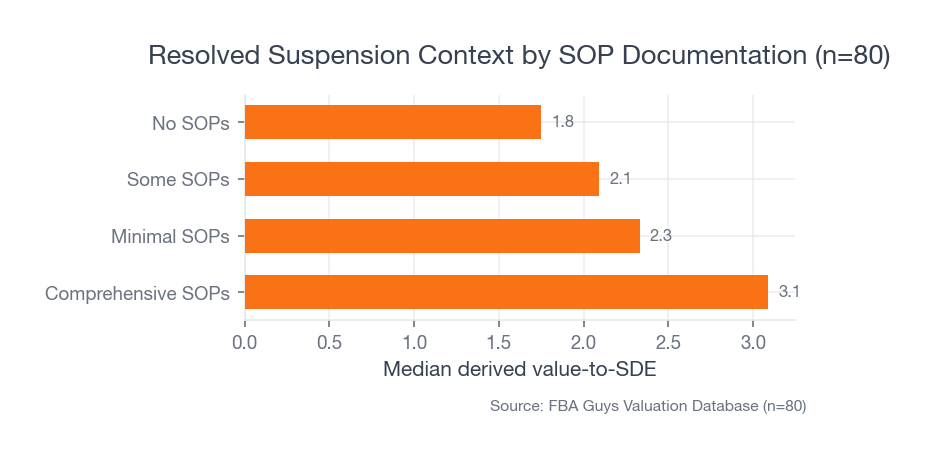
The SOP data supports this as a valuation-context habit. Among resolved-suspension records in the 2026 subset, comprehensive SOPs and no SOPs sat far apart:
- Resolved suspension plus comprehensive SOPs: n=20, median derived value-to-SDE 3.09.
- Resolved suspension plus no SOPs: n=17, median 1.75.
- Warnings-only plus comprehensive SOPs: n=36, median 3.54.
- Warnings-only plus no SOPs: n=40, median 2.54.
 Source: FBA Guys Valuation Database (n=80)
We can't say SOPs caused the difference. We can say documented operators give an old account-health event a better file to sit inside.
For an inauthentic item suspension, the SOP doesn't have to be elaborate. It should say who approves suppliers, where invoices are stored, how invoices are named, who checks product identifiers, how FBA shipment records connect to invoice records, what happens when a complaint arrives, and who decides whether inventory is removed or quarantined.
That routine is part of transferability because a new owner can inspect it, run it, and improve it without rebuilding the history from old Seller Central cases.
What to Fix After Reinstatement
Reinstatement isn't the end of the work.
If Amazon restores the account or ASIN, keep the full file and then look for the operating gap that let the complaint become urgent. The gap may be supplier approval. It may be weak invoice storage. It may be packaging version confusion. It may be old inventory. It may be a reseller source that was legitimate but hard to verify. It may be a listing that invited customer confusion.
The fix should be specific enough that someone else can run it. Our Amazon suspension prevention checklist covers the wider account-health routine.
If the issue was supplier proof, update supplier onboarding and invoice collection. If the issue was product version control, update receiving inspection and listing images. If the issue was FBA inventory, document removal or relabeling. If the issue was a rights-owner or brand-control problem, review whether Brand Registry, trademark records, authorized distributor documentation, or Transparency belongs in the operating file.
The goal is a boring file: a future reviewer can see the event, the proof, the action, and the current control without relying on memory.
How Buyers Should Read an Old Inauthentic Item Suspension
For a buyer, the useful request is the event file.
A seller's memory of the suspension isn't enough, and a current green Account Health screen isn't enough either. The useful file has the original notice, appeal submission, documents provided, Amazon's resolution, date of reinstatement or ASIN restoration, product and supplier actions, and evidence that the issue hasn't repeated.
Recency matters. A suspension from last month is a different risk than a suspension from two years ago with clean Account Health since. Severity matters too. One resolved authenticity complaint is a different file from repeated complaints across the catalog.
Our read is that buyers should separate three cases:
- A recent unresolved or repeated suspension is serious platform risk.
- An old resolved suspension with clean history and a readable file may become a price-adjustment discussion.
- Multiple suspensions, document manipulation, or review manipulation can kill the deal.
That framework is blunt, but it is more useful than treating every suspension as the same event.
FAQ
What is an Amazon inauthentic item suspension?
An Amazon inauthentic item suspension is an account or listing enforcement tied to a product-authenticity concern. The seller may be asked to provide invoices, supplier information, a Plan of Action, or other documents through Account Health or the Product Policy Compliance path Amazon provides.
What should I submit for an inauthentic item complaint?
Follow the specific notice. In most cases, start with supplier invoices or receipts, supplier contact information, affected ASINs, quantities that support the sales period under review, inventory action taken, and a short explanation of root cause, corrective action, and prevention.
Do invoices guarantee reinstatement?
No. Invoices are evidence. Amazon still has to accept the documents and the explanation for the specific enforcement. The FBA Guys database doesn't store invoice acceptance or reinstatement outcomes, so we won't pretend there is a guaranteed appeal formula.
Does an inauthentic item suspension kill business value?
It can, especially if it is recent, unresolved, repeated, or tied to document manipulation. In the FBA Guys 2026 account-health subset, resolved-suspension records had a lower median derived value-to-SDE than warnings-only and never-suspended records. Older resolved events with clean history and strong documentation are a different conversation than active account risk.
Does Brand Registry prevent inauthentic item suspensions?
Brand Registry can help with owned-brand control and enforcement tools, and Transparency can add serialization for enrolled products. Neither should be treated as a substitute for source documentation when Amazon asks for proof tied to a specific complaint.
Keep the File Readable
The appeal is urgent. The file is durable.
If you are dealing with an Amazon inauthentic item suspension today, build the source file before you write the appeal. Use Amazon's path, keep the documents clean, explain only what the evidence supports, and save the record as if someone else will inspect it later.
The account may need reinstatement now. The business may need that same file again when the suspension is old history and someone asks what really happened.
Curious what your business is worth?
Get a free, instant valuation and see how your Amazon business stacks up.
Get Your Free Valuation