Amazon Brand Registry Benefits for Sellers: The Protection Is Only Half the Story
The FBA Guys
June 5, 2026
Brand Registry looks like an Amazon checkbox until the catalog starts moving without you.
One product image gets replaced. A reseller shows up on a listing with inventory nobody recognizes. A customer asks why the box they received doesn't match the photos. A product detail page gains a sentence that sounds like it came from a competitor's intern after midnight.
The practical Amazon Brand Registry benefits for sellers are listing control, brand-building tools, customer-search data, and stronger paths for reporting infringement. The larger benefit is quieter: Brand Registry turns brand ownership into something Amazon can recognize, and that makes the business easier to defend, explain, and eventually transfer.
The FBA Guys valuation database doesn't prove Brand Registry causes a higher business value. We should get that out of the way early.
What the database does show is worth paying attention to. Among 8,550 successful valuations, businesses with Brand Registry present or claimed averaged 2.59 derived value-to-SDE across 6,491 records. Businesses without Brand Registry averaged 1.81 across 2,045 records.
That is a big spread, and it is also not magic. Brand Registry usually travels with other things buyers and serious operators care about: unique products, trademarks, cleaner product-page control, stronger review depth, better records, and fewer unresolved questions about who owns what.
Amazon Brand Registry Benefits for Sellers: The Short Version
Brand Registry gives eligible brand owners access to a suite of Amazon tools that sit in four buckets.
First, protection. Brand Registry can give rights owners and registered agents access to Report a Violation, protection dashboards, and other brand-protection tools. Amazon also connects Brand Registry to programs such as Transparency and Project Zero where eligibility requirements are met.
Second, listing and conversion tools. Enrolled brands can use tools such as A+ Content, Brand Story, Virtual Bundles, Vine, and brand-controlled content features that help customers understand the product and the company behind it.
Third, traffic and data tools. Brand Registry sits behind Brand Analytics, Manage Your Experiments, Sponsored Brands, Brand Stores, and other tools that help you see how customers search, click, compare, and buy.
Fourth, transferability. This one doesn't show up as neatly in Amazon's marketing copy, but it matters if you ever care what the business is worth. Brand Registry creates an ownership record, and ownership records are useful when someone else has to understand the business without inheriting your memory.
What part of the brand can someone else actually control after you are gone?
The fact is, a buyer doesn't only want to know that the brand sells. They want to know whether the parts that make it sell can be controlled after closing.
What Brand Registry Actually Unlocks
As of the writing of this article, Amazon describes Brand Registry as a free program for protecting and growing a brand, even if the brand doesn't sell directly in the Amazon store. Enrollment generally requires a brand name and logo permanently affixed to products or packaging, plus a pending or registered trademark from a designated government trademark office in a country with a corresponding Amazon store.
That last sentence is doing more work than it looks like.
The logo on the packaging matters because Amazon needs to connect the brand claim to a physical product. The trademark matters because Brand Registry isn't just a preference setting inside Seller Central. It is tied to intellectual property rights.
Once enrolled, the toolset can get broad quickly:
- A+ Content and Brand Story.
- Amazon Vine.
- Customer Reviews tools.
- Brand Stores.
- Sponsored Brands and other brand advertising formats.
- Brand Analytics.
- Manage Your Experiments.
- Amazon Attribution and Brand Metrics.
- Brand Tailored Promotions.
- Virtual Bundles.
- Report a Violation.
- Transparency.
- Project Zero.
- Neutral patent evaluation access.
That list is useful. It can also become a little misleading because it makes the benefit sound like software access.
Access is only the beginning. Who owns the work after the menu item appears?
Brand Analytics doesn't help much if nobody owns the weekly search-query review. Manage Your Experiments doesn't help if every test is a tiny design preference with no real hypothesis. Report a Violation doesn't help if the evidence file is thin. A+ Content doesn't help if the product is generic and the page spends six modules saying "premium" in different fonts.
The tool isn't the operating system.
What Our Data Can and Can't Say About Brand Registry
The scar in this topic is that the data refuses to say the convenient thing.
It would be easy to write, "Brand Registry increases valuation." It would also be sloppy. Our database has a Brand Registry field. It has valuation output, revenue, margin, operating expense, product uniqueness, patent and trademark signal, review bands, SKU count, backup vendors, tax-return availability, and some account-health context. It doesn't have Brand Analytics usage, A+ Content quality, Report a Violation outcomes, Transparency enrollment, Store traffic, or the date a trademark was approved.
So we have to be more precise.
Brand Registry is an adjacent signal. It sits near stronger businesses, but it doesn't explain all of them, and that distinction is what keeps the article honest.
In the database, Brand Registry present or claimed averaged 2.59 derived value-to-SDE. No Brand Registry averaged 1.81. Derived value-to-SDE is a valuation-output proxy: estimated valuation divided by derived seller's discretionary earnings, where derived SDE is gross profit minus operating expenses.
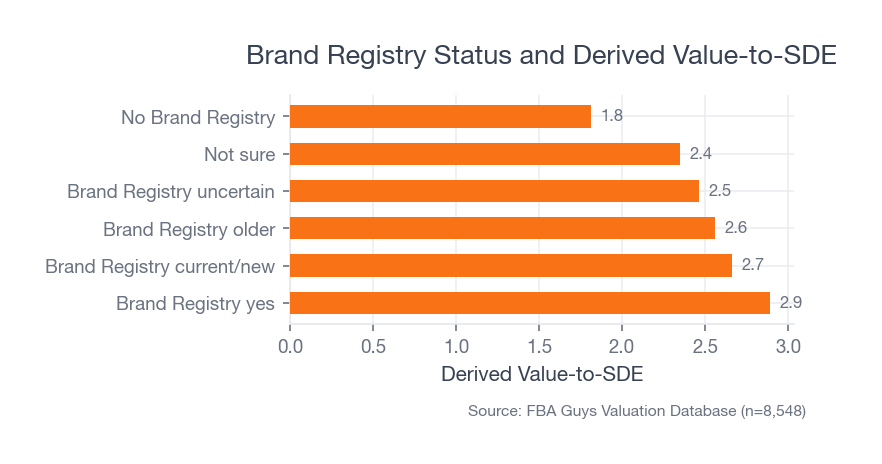 Source: FBA Guys Valuation Database (n=8,548 valuations with Brand Registry context and positive derived SDE)
The interesting part comes when you pair Brand Registry with product uniqueness, because the combination starts to separate mere account setup from something closer to defensible product ownership.
Brand Registry plus unique products averaged 2.74 derived value-to-SDE across 4,157 records. Brand Registry plus not-unique products averaged 2.34. No Brand Registry plus unique products averaged 2.24. No Brand Registry plus not-unique products averaged 1.62.
Read those middle two again. A unique product without Brand Registry was not far behind a Brand Registry business with non-unique products.
That doesn't make Brand Registry unimportant. It makes the point sharper: Brand Registry is most useful when there is an actual brand asset underneath it.
If the product is ownable, the trademark matters. If the product has design work, the content tools have something to explain. If the listing is carrying real demand, the protection tools have something to defend. If the catalog is clear enough to manage, the analytics tools can guide decisions instead of creating another dashboard nobody reads.
Review depth complicates the pattern in a useful way. Across every review-count band with enough records, Brand Registry present or claimed sat above the no-Brand-Registry group. Under 25 reviews, the gap was 1.96 vs 1.40. At 250-1,000 reviews, it was 2.66 vs 1.93. At 2,500+ reviews, it was 2.87 vs 1.94.
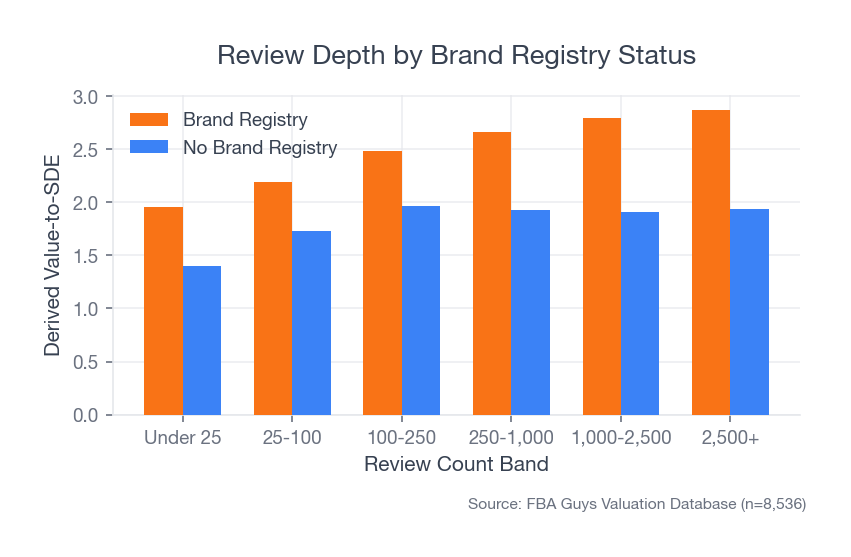 Source: FBA Guys Valuation Database (n=8,536 valuations with review-count and Brand Registry context)
There is a small absurdity here. The official benefit list has all the shiny names, and they are legitimate. A+ Content. Brand Analytics. Experiments. Stores. Transparency. Fine. But the valuation pattern is less shiny and more useful: businesses look stronger when the brand can be recognized, defended, documented, and understood by someone who didn't build it in the first place.
That is much less glamorous than a new Seller Central menu item.
It is also closer to what matters.
The IP File Matters More Than the Portal Login
Brand Registry is tied to intellectual property, but it isn't the same thing as owning a complete IP file.
This is operating guidance, not legal advice. If a trademark, patent, copyright, or counterfeit dispute has meaningful revenue attached to it, get counsel involved before a rushed Seller Central answer becomes the record.
That distinction matters. In the database, trademark-only businesses averaged 2.60 derived value-to-SDE across 5,282 records. Patent-claimed businesses averaged 2.93 across 226 records. Fully patented businesses averaged 3.17 across 291 records. Businesses with no patent or trademark signal averaged 1.91 across 2,749 records.
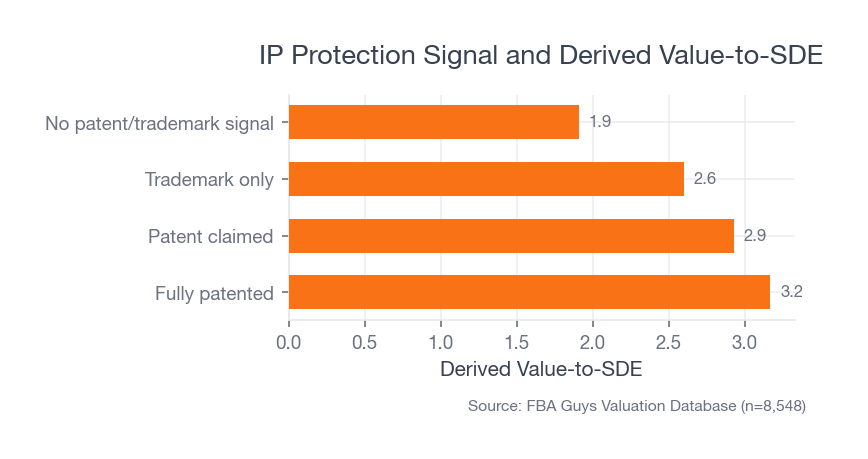 Source: FBA Guys Valuation Database (n=8,548 valuations with IP context and positive derived SDE)
Now for the part that made this more interesting: no Brand Registry plus a patent or trademark signal averaged 2.39 across 289 records. Brand Registry present or claimed without a patent or trademark signal averaged 2.27 across 985 records.
It is a small comparison, and we shouldn't make it carry the whole article. But it is useful because it separates two ideas that get mashed together in Seller Central shorthand.
There is the Amazon relationship. Then there is the underlying ownership record. Which one fails first if the listing is challenged?
You want both.
Amazon's current Report a Violation guidance makes the distinction practical. Rights owners or their agents can use Amazon's public notice form. Brands enrolled in Brand Registry get access to a separate Report a Violation tool when the Brand Registry account has the proper role. Amazon also says that if a brand enrolled with a pending trademark, trademark-based Report a Violation access waits until the trademark is fully registered, though some other Brand Registry benefits may be available while the trademark is pending.
That little timing detail is easy to miss. It is also exactly the kind of detail that turns "we have Brand Registry" into a more careful question: Which rights are secured? Which roles are assigned? Which marketplaces are covered? Which products are actually tied to the brand record?
A buyer, lender, or serious advisor won't be impressed by a vague answer, partly because a vague answer usually means the transfer problem has already started.
They will want the file.
Listing Control Is a Marketing Benefit and a Risk Benefit
Listing control sounds boring because the phrase has no drama in it. What happens when the product page changes and nobody can say why?
Then you see what happens when the wrong person controls the detail page.
The title changes. The brand field gets weird. The image sequence starts using old packaging. A compatibility claim appears that customer support has never seen before. The main image looks fine on desktop and ridiculous on mobile because someone exported it from a design file at the wrong crop.
None of this sounds like valuation theory while it is happening. It sounds like a Tuesday.
Brand Registry gives eligible brands more tools to manage and improve the product page. A+ Content can explain the product. Brand Story can connect the product line. Manage Your Experiments can test meaningful page changes when the ASIN has enough traffic. Brand Analytics can show search-query and customer-behavior patterns. Brand Stores and Sponsored Brands can organize how shoppers meet the brand rather than only the individual SKU.
Those are marketing tools, certainly. They are also documentation tools.
A good A+ module tells the customer what the product is, what it fits, how it compares, and why the brand exists. A good experiment record shows what the team tested and what changed. A good Brand Analytics routine shows which search terms, drop-off points, and basket patterns shaped catalog decisions.
If the business ever goes through a valuation process, that history becomes part of the explanation. The product line didn't just "perform well." Someone can show how the listings were managed, how customer questions were addressed, and how the brand learned from its own traffic. That doesn't mean a buyer prices every experiment as an asset, but it does mean the business has a more inspectable operating history than a catalog run entirely by memory and taste.
Honestly, that is a much better story than "we hired a designer once."
Brand Protection Tools Need Evidence Behind Them
The protection side of Brand Registry is where the emotional temperature rises.
Nobody gets excited about Report a Violation because they love forms. They get excited because another seller is on the listing, the offer looks suspicious, the image looks stolen, or the product customers are receiving doesn't match the product the brand built.
Amazon's Brand Registry materials describe tools for detecting and reporting suspected IP infringement, and Amazon's Brand Protection Report says proactive controls blocked more than 99% of suspected infringing listings before a brand had to find and report them. That is a serious machine.
It still needs accurate inputs from the brand. What exactly was violated, and what evidence proves it?
If you report a violation, you need to know what right was violated. Trademark? Copyright? Patent? Counterfeit? If you are using Transparency, you need a unit-level serialization process that can survive manufacturing, packaging, FBA inbound, and any other channel where the product moves. If you use Project Zero, eligibility and accuracy matter because self-service counterfeit removal isn't a toy.
This is where a clean evidence file starts to feel less administrative.
Keep the trademark record. Keep packaging photos. Keep manufacturer agreements. Keep product-image source files and rights documentation. Keep supplier invoices. Keep the GTIN records. Keep screenshots of old listing versions when major changes are made. If a complaint or violation report happens, save the case ID, the evidence submitted, the Amazon response, and the operational fix.
One messy detail is enough to show why this matters: the product packaging has the new logo, the Amazon listing uses the new logo, the supplier invoice still uses the old company name, and the image file is sitting in a folder called final_logo_white_v4_actual. Maybe everyone on the team understands the history because the same person approved the logo, talked to the supplier, and uploaded the listing image. A future buyer won't. Amazon support probably won't either.
The record has to travel better than the owner's memory.
When Brand Registry Matters Less Than You Think
Brand Registry doesn't make a weak product defensible.
It doesn't turn a commodity into a brand. It doesn't make copied images yours. It doesn't clean up supplier documentation. It doesn't fix catalog sprawl. It doesn't make an account-health issue disappear from diligence.
The SKU data is a useful check on this. Brand Registry present or claimed businesses averaged 2.78 derived value-to-SDE in the 6-20 SKU group and 2.75 in the 21-100 SKU group. At 100+ SKUs, the Brand Registry group fell to 2.24. The no-Brand-Registry group also fell, from 2.18 in the 6-20 SKU group to 1.58 at 100+ SKUs.
Brand Registry gives more control surfaces. A large catalog creates more surfaces to control, and that is where the administrative benefit starts to become an operating burden.
That means the benefit depends partly on the business underneath it. If you have 12 SKUs in a coherent product family, Brand Registry can help you explain, test, promote, and defend the family. If you have 600 loosely related ASINs, Brand Registry may give you tools while the catalog still behaves like a junk drawer with shipping labels. Which listings have current packaging? Which images were created by your team? Which ASINs belong together? Which products are worth defending first?
A small detour: roles matter.
Brand Registry roles can feel like admin housekeeping until the agency, VA, co-founder, or new owner can't access the tool they need. Rights Owner, Administrator, Brand Representative, and Registered Agent aren't decorative labels. They determine who can do the work. If the wrong person's email owns the access, the business has a transferability problem hiding behind a login screen.
Not exciting, and quite expensive when it goes wrong.
What to Do Before and After Enrollment
Before enrollment, make the brand file boring. Could someone verify the brand claim without calling you?
Use the same owner name consistently where possible. Confirm the trademark status and goods category. Make sure the brand name and logo are permanently affixed to products or packaging. Save product photos that prove it. Keep the trademark filing, specimen, registration or pending record, packaging proof, and Seller Central account information in one place.
Then think about the operating sequence.
- Confirm the trademark and brand-name match.
- Confirm product and packaging proof.
- Enroll the brand with the right Amazon account.
- Assign Brand Registry roles deliberately.
- Map which ASINs belong to the brand.
- Audit listing content, images, brand fields, GTINs, and variation families.
- Build or clean up A+ Content where the product needs explanation.
- Set a Brand Analytics review cadence.
- Use Manage Your Experiments for real hypotheses, not tiny preference tests.
- Create a violation-response folder before the first violation happens.
- Review whether Transparency, Project Zero, or patent evaluation tools are relevant.
- Add Brand Registry records to the diligence file if the business may sell.
The order doesn't have to be perfect. The ownership record does.
One reasonable first-week project after approval is to choose the top five ASINs by revenue and ask a simple question for each one: if this listing were challenged, copied, suppressed, or transferred tomorrow, could a competent stranger understand our rights and our evidence in 15 minutes?
If the answer is no, Brand Registry has already shown you the next job.
FAQ
What is Amazon Brand Registry?
Amazon Brand Registry is Amazon's free program for eligible brand owners that connects a brand's intellectual property record to Amazon tools for listing control, brand protection, content, analytics, advertising, and enforcement. It usually starts with a brand name or logo on the product or packaging and a pending or registered trademark.
What are the biggest Amazon Brand Registry benefits for sellers?
The biggest benefits are better listing control, access to A+ Content and other brand-building tools, Brand Analytics, Manage Your Experiments, Report a Violation, and eligibility paths for protection programs such as Transparency or Project Zero. The business-value benefit is broader: Brand Registry helps make brand ownership easier to prove and operate.
Does Brand Registry increase the value of an Amazon FBA business?
The FBA Guys database doesn't prove Brand Registry directly increases value. It does show Brand Registry present or claimed businesses averaging 2.59 derived value-to-SDE, compared with 1.81 for businesses without Brand Registry. Treat that as valuation context, not causation.
Can I use Report a Violation with a pending trademark?
Amazon's current guidance says brands enrolled with a pending trademark can't use Report a Violation for trademark infringement until the trademark is fully registered. Other Brand Registry benefits may be available while waiting, and patents or copyrights that are already secured can support reports for those rights.
Is Brand Registry worth it for a small private-label seller?
Usually, yes, if you are building a real brand and can meet the requirements. The earlier benefit may be practical rather than dramatic: cleaner listing control, better ownership records, and access to tools you will probably want later. If the product is generic and the brand file is thin, enrollment won't fix the underlying business problem.
What should I organize after getting Brand Registry?
Organize the trademark record, packaging proof, Brand Registry roles, ASIN map, listing asset files, supplier authorization records, image rights, GTIN records, and any violation reports or Amazon case history. Keep the file simple enough that someone else can use it without needing you to explain the whole business from memory.
The Benefit Is Control You Can Prove
Amazon Brand Registry benefits for sellers are often described as tools: A+ Content, Brand Analytics, Vine, Stores, Report a Violation, Transparency, Project Zero, and the rest of the menu.
Those tools matter, but the deeper benefit is control you can prove. You can show who owns the brand. You can show which products belong to it. You can improve the page with better content and real experiments. You can inspect search and customer behavior. You can report infringement with a cleaner evidence file. You can make the product line easier for Amazon, customers, operators, and future buyers to understand.
Brand Registry won't make an ordinary product valuable by itself.
It can help a real brand behave like one.
Curious what your business is worth?
Get a free, instant valuation and see how your Amazon business stacks up.
Get Your Free Valuation