Amazon Restricted Products List 2026: Build the Evidence File Before the Listing
The FBA Guys
August 4, 2026
Some Amazon products fail before the listing is even live.
The Amazon restricted products list in 2026 includes products Amazon prohibits outright and products that require approval, compliance documentation, category permission, brand authorization, or FBA eligibility before they can be sold. The working list includes obvious categories such as weapons, tobacco, alcohol, drugs, medical devices, pesticides, hazardous goods, and surveillance equipment. It also reaches into more ordinary-looking areas: supplements, cosmetics, food, electronics, plants, automotive parts, jewelry, children's products, environmental claims, and product claims that cross a policy line.
The list matters. The evidence file matters more.
Amazon's own Restricted Products page is the page to check, because this is a live policy area. A product that looks allowed in January can require different approval or documentation later. A SKU can also pass the broad category test and still fail because of an ingredient, claim, battery, age restriction, import rule, dangerous-goods classification, or FBA inventory rule.
For an operator, the useful question goes beyond "Is this product restricted?" The better question is: "What would we need to prove before we buy it, list it, replenish it, or let a buyer diligence it?"
Amazon Restricted Products List 2026: The Working Categories
Amazon's restricted-products pages are more detailed than any short article can be, and you should treat Seller Central as the live source before acting. As of the writing of this article, the recurring restricted or approval-sensitive categories include:
- Alcohol
- Animals and animal-related products
- Automotive and powersports products
- Coins, currency, cash equivalents, and stamps
- Cosmetics and skin or hair care products
- Dietary supplements
- Drugs and drug paraphernalia
- Electronics, especially products with batteries, wireless functions, or safety claims
- Food and beverage
- Hazardous or dangerous goods
- Jewelry and precious gems
- Medical devices and accessories
- Pest control products and pesticides
- Plants, plant products, and seeds
- Recalled products
- Surveillance equipment
- Tobacco and tobacco-related products
- Weapons, explosives, and related items
- Other products Amazon identifies in live restricted-products policy
That is the category map. It isn't a safe-to-sell list.
Two sellers can look at the same category and have different answers. One product may be prohibited. Another may need approval. A third may be allowed for sale but blocked from FBA. A fourth may be allowed only if the listing removes a prohibited claim or adds required compliance information.
This is where a lot of bad inventory decisions begin. The seller looks at a broad category, sees competitors live on Amazon, and assumes the product is sellable. Competitor presence is weak evidence. It doesn't prove your account is approved, your supplier can support the product, your claims are compliant, or your inventory can go into FBA.
Restricted Doesn't Always Mean Prohibited
Restricted and prohibited get used together often enough that the distinction can blur.
A prohibited product can't be listed. A restricted product may be allowed only if the seller, product, brand, catalog record, or documentation passes Amazon's current requirement. Some categories require pre-approval before the listing goes live. Some products trigger document requests because of safety, regulatory, health, age, or import risk. Some listings run into prohibited-claim problems even when the underlying product is ordinary.
Amazon's seller policy overview frames product compliance and safety as part of the broader account-health system. It points sellers back to restricted-products guidance, product-compliance rules, condition guidelines, and FBA product restrictions. That placement is useful. Restricted products belong in account health as much as catalog.
The practical difference shows up before the purchase order. If there is a Request Approval path, you need to know whether you can pass it. If there is no approval path, you need to know whether the product is prohibited or whether the restriction sits somewhere else: claim language, documentation, brand authorization, FBA eligibility, or local law.
This isn't legal advice. It is the operating sequence that keeps a product idea from becoming a stranded-inventory problem.
The Approval Check Before You Buy Inventory
Start the approval check inside Seller Central. Use Add Products, search the product or category, and look for a Request Approval path if one exists. Amazon's approval guidance is the starting point for categories and products that require permission before listing. Then check the relevant restricted-products page, category policy, product-compliance requirement, prohibited-claims guidance, and FBA eligibility.
A clean pre-listing check usually answers five questions:
- Can this product be sold in the Amazon store at all?
- Does this category, brand, product type, or ASIN require approval?
- Does the listing make a health, safety, environmental, disease, performance, or age-related claim that needs substantiation or may be prohibited?
- Does the product require certificates, test reports, registrations, invoices, safety data sheets, labels and warning language, or import documentation?
- If you use FBA, can this product be stored, handled, shipped, returned, and disposed of through FBA?
The order matters. Approval first, then inventory. If the product needs a document packet, build the packet before the supplier invoice becomes a sunk cost.
The file usually starts with product identity: manufacturer, supplier, invoices, ingredients or materials, labels, package photos, UPC or GTIN records, brand authorization if relevant, and product images. Then add the policy-specific layer. That may mean lab reports, certificates, registrations, safety data sheets, compliance marks, age warnings, import documents, or claim substantiation.
A pesticide-adjacent product isn't the same as a supplement. A lithium-battery product isn't the same as a toy. A medical-device accessory isn't the same as a beauty tool that happens to use medical-sounding language. The category tells you where to look. The specific SKU tells you what to prove.
FBA Has Its Own Restricted-Inventory Layer
FBA adds a second eligibility test.
A product can be allowed for sale on Amazon and still be prohibited or restricted for FBA because Amazon has to store, handle, ship, return, and sometimes dispose of the inventory. Amazon's FBA guidance includes FBA prohibited products and dangerous-goods rules for products that need special handling. The FBA question is separate from the marketplace-listing question.
That split changes the purchase decision. If you plan to use FBA, the review has to include product restrictions, dangerous-goods status, expiration-date rules, meltable inventory rules, package and prep requirements, label rules, import restrictions, and any category-specific FBA limits.
This is especially relevant for products that look simple on the product page but are complicated in storage or transport: aerosols, flammables, products with lithium batteries, supplements and food with expiration dates, meltable goods, products with chemical ingredients, oversized products, and items that need specific warning labels.
The FBA file should answer two questions plainly: this product can be sold on Amazon, and this exact inventory can be sent to FBA under the current rules. If one answer is yes and the other is no, the operating plan changes.
Why Restricted-Product Issues Matter Later
The FBA Guys database doesn't store exact restricted-product warnings, approval requests, gated category denials, test reports, dangerous-goods classifications, or reinstatement outcomes. That means we can't say, "a restricted-product warning is worth X multiple points." The data doesn't support that.
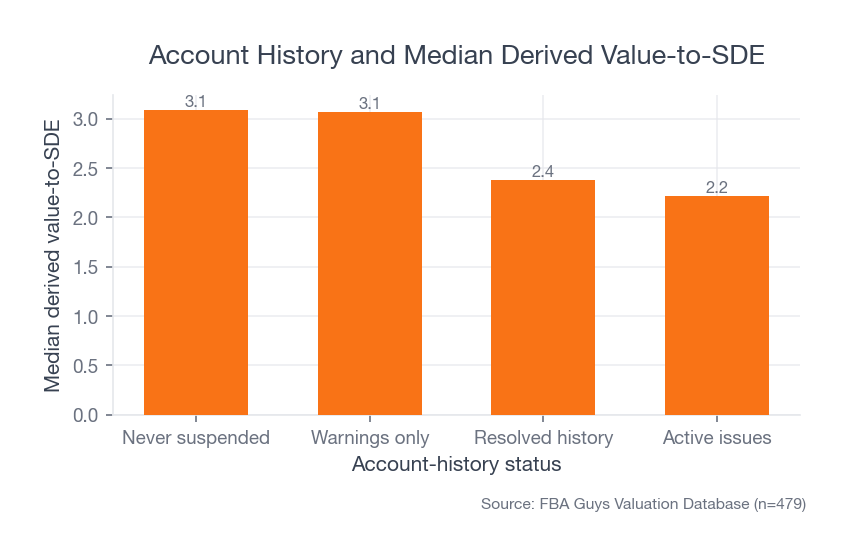
We can look at adjacent account-history context. Derived value-to-SDE is our internal comparison of estimated business value to derived seller discretionary earnings, used here as a valuation-context measure rather than a direct sale multiple.
Among 479 valuation records with the newer account-health fields populated, the warning-only group had a 3.07 median derived value-to-SDE. Never-suspended histories were almost identical at 3.08. Resolved histories were lower at 2.38, and active issues were lower again at 2.22, though the active-issue group had only 6 records.
 Source: FBA Guys Valuation Database (n=479)
The more careful reading is that an Amazon policy violation warning can be manageable when it is resolved, documented, and prevented from repeating. A durable account-history issue is different. It changes the diligence conversation because a buyer or operator has to understand what happened, why it happened, whether it can happen again, and whether Amazon accepted the fix.
This is where the evidence file earns its keep.
If Amazon flags a product, save the policy page you relied on, the approval request, Amazon's response, the document packet, the listing fields that mattered, the date of the review, the ASIN or SKU affected, the root cause, the corrective action, and the prevention step. If the issue involved FBA, save the FBA eligibility or dangerous-goods record as well.
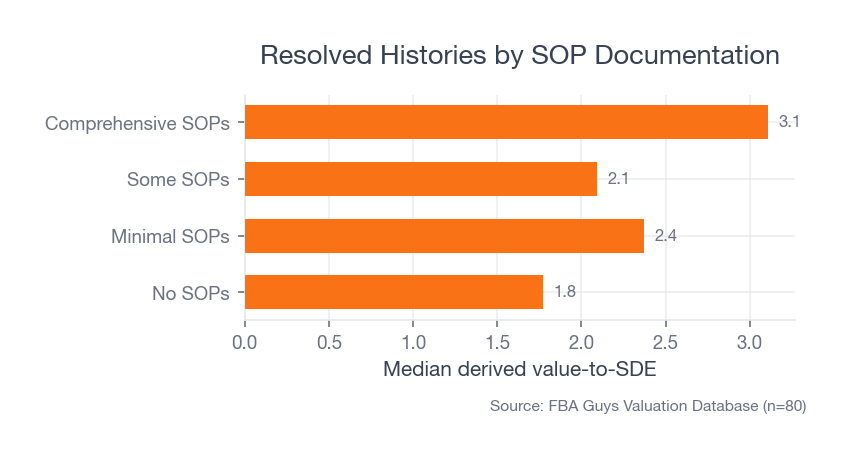
The pattern around SOPs supports that discipline. Among resolved-history records, comprehensive SOPs had a 3.11 median derived value-to-SDE, compared with 1.77 for records with no SOPs. The database can't prove the SOP caused the stronger valuation context. It does suggest that a resolved issue with an operating routine is a different file from a resolved issue that lives only in memory.
 Source: FBA Guys Valuation Database (n=80 resolved-history records)
Product Control Changes What You Can Prove
Brand Registry and product design don't make Amazon policy disappear. They do change what the seller can prove.
In the account-health subset, yes-or-partial Brand Registry records had a 13.4% resolved-history share and 3.23 median derived value-to-SDE. No-Brand-Registry records had a 30.2% resolved-history share and 1.84 median derived value-to-SDE.
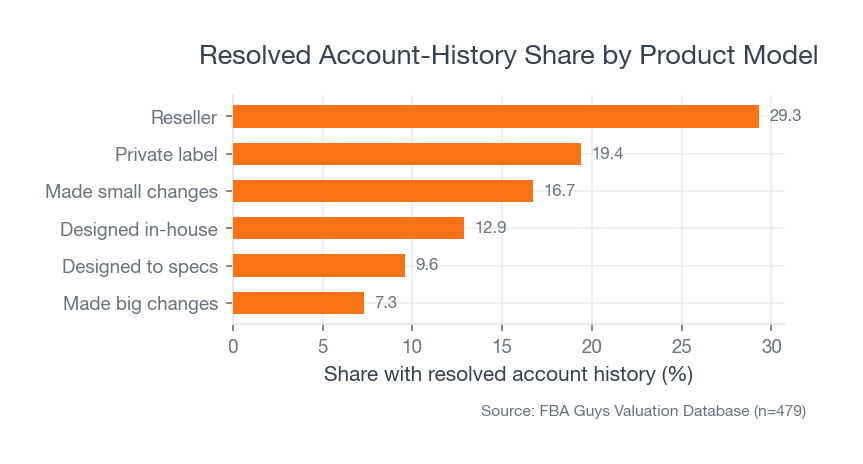
The product-design split is even more direct. Reseller records had a 29.3% resolved-history share and 1.63 median derived value-to-SDE. Private label records had a 19.4% resolved-history share and 2.19. Designed-in-house records had a 12.9% resolved-history share and 3.58.
 Source: FBA Guys Valuation Database (n=479 account-health subset records)
The database can't prove that Brand Registry or product design prevented restricted-product issues. Our read is narrower: product control affects the proof available when Amazon asks questions.
If you designed the product, own the brand file, control the package, know the materials, and can obtain test reports from the manufacturer, the evidence path is clearer. If you are reselling a product through a distributor, your file needs to work harder. You may need stronger invoices, brand authorization, supplier traceability, product identity records, and claim discipline because you control less of the product record.
The Three Files a Sensitive Product Needs
A restricted-products review becomes easier to manage when it is split into three files: source, claims, and fulfillment.
The source file proves what the product is and where it came from. It should include the supplier, manufacturer, invoice trail, brand authorization if needed, product photos, package photos, ingredients or materials, model numbers, UPC or GTIN records, and any document that ties the product in your hands to the product Amazon is reviewing. For a reseller, this file matters more because the supplier chain may be the only proof you control.
The claims file proves what the listing says. This is where health, wellness, disease, medical, safety, environmental, age, compatibility, and performance language gets reviewed. A compliant physical product can still create a policy issue if the listing claims too much. The claims file should keep the current title, bullets, description, A+ modules if any, images with embedded text, package claims, and any substantiation or label language used to support them.
The fulfillment file proves how the inventory can move. For FBA, that means FBA eligibility, dangerous-goods status if relevant, expiration-date rules, meltable inventory rules, prep instructions, warning labels, carton labels, shipping limits, and any Amazon response that confirms the product can enter the fulfillment network. For FBM, it may mean carrier limits, age verification, hazmat rules, customer-service scripts, and return process notes.
The three files don't guarantee approval. They make the question reviewable. That is useful today, and it is useful later if an account-health warning appears in the business history.
A Pre-Listing Compliance Checklist
Use this before you buy inventory, create a new listing, change claims, or replenish a product in a sensitive category.
- Identify the exact product type, not only the browse category.
- Search Seller Central for the product and category approval path.
- Read the live Amazon restricted-products page for that category.
- Check whether the product is prohibited, restricted, approval-gated, brand-gated, claim-sensitive, or document-sensitive.
- Review the listing claims. Watch health, disease, safety, environmental, age, performance, and compatibility language.
- Confirm required documents before the purchase order: invoices, manufacturer records, certificates, lab reports, registrations, safety data sheets, labels and warning language, photos, and import records.
- Check FBA eligibility separately from marketplace eligibility.
- Save screenshots or PDFs of the relevant policy pages, approval screens, and Amazon responses with dates.
- Write the SOP for future listings, replenishments, claim changes, and document renewals.
- Recheck the policy before every material change: new supplier, new ingredient, new package, new claim, new marketplace, new fulfillment method, or large reorder.
This checklist is intentionally slower than "find product, check demand, place order." Restricted-product risk usually shows up after the cash has already left. The point is to move the friction earlier, where it is cheaper.
What to Do If You Already Have a Restricted-Product Warning
First, preserve the record before you change the listing. Save the warning, affected ASIN, policy cited, catalog content, product images, supplier invoice, package images, labels, and any compliance documents already on hand.
Second, identify the policy type. Is Amazon saying the product is prohibited? Is it approval-gated? Is the issue a claim? Is it documentation? Is it dangerous goods? Is it FBA eligibility? Those are different problems.
Third, correct the issue only after you understand the cause. Removing a phrase from a listing may help a prohibited-claim issue. It won't fix an unsafe product, missing registration, invalid invoice, or product that Amazon doesn't allow.
Fourth, write the prevention step. A warning with a prevention routine is easier to explain later than a warning with no memory. Add the SKU, policy, owner, document location, renewal date if any, and recheck trigger to the SOP.
If the issue is legally sensitive, safety-related, repeated, or tied to account deactivation, get qualified help. The operational file is useful, but it doesn't replace legal or regulatory advice.
FAQ
What is the Amazon restricted products list in 2026?
It is Amazon's current set of prohibited, restricted, approval-sensitive, and compliance-sensitive product policies. It includes categories such as alcohol, animals, automotive, cosmetics, supplements, drugs, electronics, food, hazardous goods, jewelry, medical devices, pesticides, plants, recalled products, surveillance equipment, tobacco, weapons, and other products Amazon identifies in Seller Central.
Are Amazon restricted products the same as gated categories?
No. Gating is one approval mechanism. A restricted product may also involve product-compliance documents, prohibited claims, brand authorization, dangerous-goods review, FBA restrictions, import rules, or complete prohibition.
Can I sell a restricted product if other sellers are already selling it?
Maybe, but competitor listings don't prove your SKU, account, supplier, claim language, or FBA shipment is approved. Use Seller Central's approval path and the relevant Amazon policy page for your exact product.
Do restricted-product warnings hurt valuation?
The database doesn't isolate restricted-product warnings. In the broader account-health subset, warning-only histories looked close to never-suspended histories, while resolved and active issues were lower. Our read is that documented, resolved warnings are a different diligence file from repeated or unresolved account-history issues.
Should I use FBA for restricted products?
Only after you check FBA eligibility separately. Some products may be allowed for sale but restricted or prohibited for FBA because of storage and handling, shipment limits, dangerous-goods status, expiration dates, meltable status, or other inventory rules.
The Practical Close
A restricted-products list is a starting map. It doesn't tell you whether a specific SKU, claim, supplier, approval path, and FBA shipment will survive Amazon's current review.
The useful habit is to turn the list into a file before the money moves: policy checked, approval path tested, documents collected, FBA eligibility confirmed, SOP written, and recheck trigger set. That file helps now. It also helps later, when the business has to explain its account history to someone who wasn't there when the warning arrived.
Curious what your business is worth?
Get a free, instant valuation and see how your Amazon business stacks up.
Get Your Free Valuation