Amazon Policy Violation Warnings: The Warning Starts the Evidence File
The FBA Guys
June 21, 2026

An Amazon policy violation warning can feel oddly small.
The account is still active, orders are still coming in, and the Account Health page may still be green. Then one notice appears in Seller Central and asks you to decide, often quickly, whether this is a listing cleanup, a document problem, an appeal problem, or the first sign of something larger.
An Amazon policy violation warning means Amazon has identified a possible breach of one of its selling policies and wants you to review, correct, appeal, dispute, or document the issue through Seller Central. The warning matters less as a single line item than as the beginning of a record: what Amazon said, what you did, what evidence you used, and whether the issue came back. For the broader message trail around these notices, see our guide to Amazon seller performance notifications.
That record is where the business value angle starts.
In the FBA Guys valuation database, we have 8,588 successful valuation records overall. Account-health fields are newer, so the useful subset here is 440 successful 2026 records with populated Account Health Rating data, valid derived SDE, and valuation output.
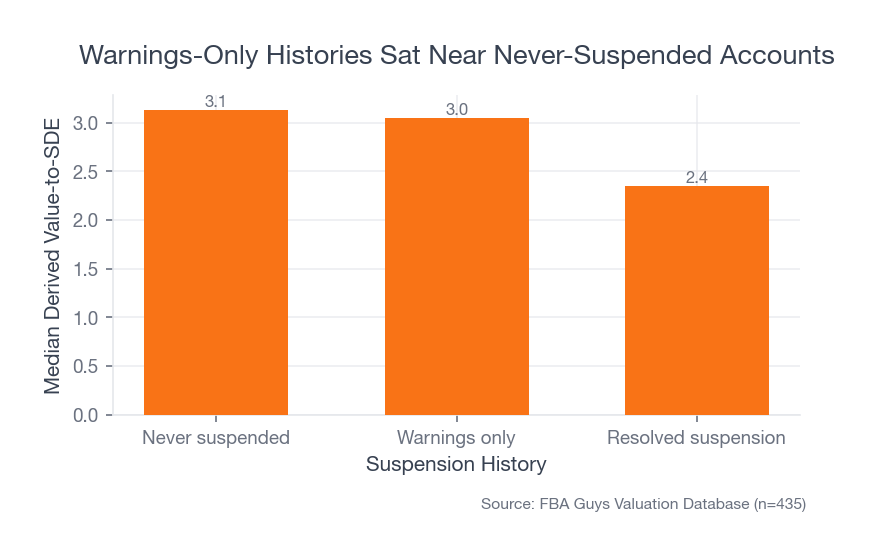
Among those 440 records, businesses with no suspension history had a 3.10 median derived value-to-SDE. Businesses with warnings only were almost the same at 3.08. Businesses with a resolved suspension were lower at 2.38.
 Source: FBA Guys Valuation Database (n=435)
The data doesn't prove warnings are harmless. It does suggest that a warning and a suspension shouldn't be treated as the same business fact.
SDE means Seller's Discretionary Earnings, the earnings measure commonly used to value owner-operated businesses. The ratio here is derived from calculator outputs, not closed transaction prices.
What an Amazon Policy Violation Warning Means
A policy violation warning is Amazon's formal notice that something about your account, listing, product, communication, fulfillment behavior, intellectual property posture, or marketplace conduct may be out of compliance.
The warning may point to a listing. It may point to a product. It may point to customer complaints, restricted-product concerns, suspected IP issues, review behavior, invoice requests, condition complaints, or seller-fulfilled performance. Some warnings ask for an appeal. Some ask for documentation. Some ask for a listing edit. Some ask you to stop doing something and keep the account clean.
The first useful move is to slow the warning down into facts:
- What policy category is named?
- Which ASIN, marketplace, or order is involved?
- Is there a deadline?
- Does the warning show Account Health Rating impact?
- Is it labeled as repeat behavior?
- Is Amazon asking for an appeal, dispute, document upload, edit, or acknowledgement?
The category matters because the response path changes. An expired-product condition complaint doesn't ask for the same evidence as a suspected counterfeit complaint. A restricted-products warning doesn't ask for the same evidence as a communication-guidelines issue. An IP complaint may need rights-owner context, trademark records, authorization letters, or listing edits. For a deeper IP-specific workflow, see our guide to handling Amazon intellectual property claims.
The warning belongs in the account-health file from the moment it arrives.
Read Severity Before You Write Anything
As of the writing of this article, Amazon's Account Health Rating program policy describes AHR as a color-coded 0-1,000 score tied to deactivation risk from non-compliance with certain selling policies. Amazon says a score of 200-1,000 is Healthy, 100-199 is At Risk, and 99 or lower is Unhealthy.
Amazon also says new AHR-covered policy violations deduct points, successfully addressed violations can add points back, and order volume can affect the score. Violations are grouped by severity: critical, high, medium, and low.
That severity label is more useful than the emotional tone of the message.
Amazon messages can sound calm even when the issue deserves immediate attention. A critical violation can bring AHR to red and create a 3-day period to address the violation before deactivation. Repeat violations can make AHR degrade faster, and certain repeat thresholds can create immediate risk in infringement-related and restricted-products policy areas.
So before you write the appeal, read the warning as a set of operating inputs. Category. Severity. Repeat status. Deadline. Evidence requested. Account-health effect.
If you can't answer those five items, you aren't ready to respond.
A Five-Minute Triage Sequence
The first five minutes after a warning should produce a simple classification.
Start with status. Is the account active, at risk, deactivated, or still healthy with an open policy item? Then move to scope. Is the warning tied to one ASIN, one marketplace, a group of listings, or account-level behavior?
Next, separate evidence from action. Evidence is what you need to understand the issue: invoice, policy page, customer complaint, listing screenshot, rights-owner notice, message text, shipment record, or supplier file. Action is what Amazon is asking for: appeal, dispute, edit, document upload, removal, acknowledgement, or operational correction.
Those two pieces get mixed together when the warning feels urgent. The seller starts writing before the file is complete, then discovers halfway through the response that the invoice doesn't match the supplier name, the ASIN changed after a listing edit, or the warning was a repeat of an issue someone handled three months ago.
Our read: classify first, answer second.
If the warning is account-level, preserve the Account Health page before changing anything. If it is listing-level, preserve the product detail page and the backend fields that relate to the warning. If it is document-supported, preserve the supplier and payment trail before uploading a file. If it involves IP, authenticity, product safety, or regulated-product claims, get the right help before turning a narrow warning into a broad admission.
The First Response Is Preservation
The first response to an Amazon policy violation warning should be boring: save the record.
Screenshot the notice. Copy the full text. Save the date, ASIN, marketplace, case ID, policy category, account-health impact, deadline, and the exact next step Amazon gives. Save the linked policy page or PDF. If there is an appeal box, screenshot it before typing.
Then save the evidence before you decide what to say.
For an authenticity or product-condition warning, that may mean supplier invoices, payment proof, shipment records, product photos, packaging records, receiving notes, or lot codes. Amazon has a Seller Central help page for invoice requirements for appealing a policy violation, and that is a better starting point than a generic appeal template.
For an IP warning, save rights-owner correspondence, trademark records, authorization letters, product-page history, and any listing edits. For a communication-policy warning, preserve the original buyer message, template, insert, or automation rule. For a restricted-products warning, save the compliance basis for why the product was listed, plus the edit or removal history if the listing had to come down.
The file doesn't need to be fancy. It needs to survive memory.
Six months later, the person who handled the warning may not remember which invoice proved authenticity, why the listing was edited, or whether the issue was disputed or accepted. A policy-warning file keeps the business from trying to reconstruct Amazon compliance from Slack fragments and half-remembered case IDs.
How Warnings Affect Account Health Rating
Policy warnings can affect Account Health Rating when they fall inside the policies Amazon includes in AHR. Amazon's current policy says AHR is based on policy adherence and selling activity over the last 180 days, and that violations can deduct points based on severity. For the score mechanics and current valuation context, see Amazon Account Health Rating explained.
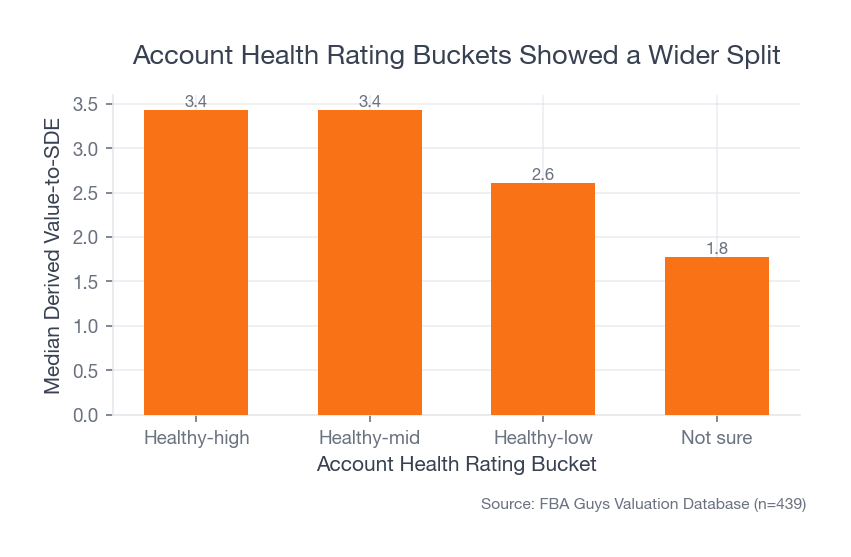
Healthy-low AHR was the largest group in our 2026 account-health subset. Out of 440 populated records, 212 were healthy-low, or 48.2%. Healthy-high had 132 records and healthy-mid had 84.
That matters because healthy-low is common. A seller can be technically healthy and still have a score that deserves attention.
The median derived value-to-SDE by AHR bucket looked like this:
- Healthy-high: n=132, median 3.45.
- Healthy-mid: n=84, median 3.43.
- Healthy-low: n=212, median 2.60.
- Not sure: n=11, median 1.78.
 Source: FBA Guys Valuation Database (n=439)
This doesn't prove the score caused the valuation difference. The database doesn't know exact AHR points or policy-warning details. The more careful reading is that stronger known account-health signals tend to travel with stronger business profiles.
The practical question is whether the details under the score are current, resolved, and explainable.
Why Warnings and Suspensions Are Different Records
The warnings-only data was the part worth sitting with.
In the 2026 subset, never-suspended accounts had a 3.10 median derived value-to-SDE. Warnings-only accounts had a 3.08 median. Resolved-suspension accounts had a 2.38 median. Active issues had only five records, so that group is too small to use.
Warnings-only also stayed close to never-suspended accounts inside current AHR buckets. Warnings-only plus healthy-low had a 2.75 median across 61 records. Never plus healthy-low had the same 2.75 median across 105 records. Resolved suspension plus healthy-low fell to 1.94 across 44 records.
Treat this as a useful boundary. The query can't prove causation.
A warning asks whether the business saw the issue, handled it, and kept it from repeating. A suspension asks a harder question: could the account be interrupted again after someone else owns it?
The internal correction file is blunt on suspension recency. A suspension in the last six months can kill a deal conversation. A suspension 18 or more months ago, resolved and followed by clean history, can often move forward with price adjustment. Multiple suspensions or review manipulation are much harder to explain.
A warning is earlier in that chain. The work is to keep it there. Our Amazon suspension prevention checklist covers the weekly account-health habits that help prevent warnings from becoming a larger history.
What the Data Can and Can't Tell Us
The data can separate account-health histories into broad groups. It can show that warnings-only records didn't behave like resolved-suspension records in the 2026 subset. It can also show that current AHR bucket, Buy Box control, and SOP documentation add context around the account-health file.
The data can't read your warning.
It doesn't know whether Amazon flagged an expired-product complaint, suspected IP issue, restricted-product listing, review request, invoice problem, or buyer-message violation. It doesn't know whether the warning was valid, disputed, forgiven, removed after rights-owner retraction, or simply resolved after an edit. It doesn't know whether the seller handled it in two hours or let it sit until the deadline.
That boundary matters for how the article should be used. A seller shouldn't look at the 3.08 median for warnings-only histories and relax. The useful interpretation is narrower: a warning with a clean record may stay in a different risk category than a suspension history, but only if the account file can support that reading.
What Makes a Warning Worse
A warning gets worse when it repeats, stays open, touches a high-severity category, lacks evidence, or changes the account's operating reality.
Repeat behavior is the easiest one to underestimate. Amazon's AHR policy says repeat violations can make point deductions increase and, in some policy areas, can create immediate deactivation risk after maximum repeat thresholds. A seller may think, "We fixed this last time." Amazon may read the second warning as a pattern.
Category also matters. A low-severity condition complaint doesn't carry the same account-health meaning as suspected counterfeit product, review manipulation, infringement, restricted-products repeat behavior, or attempts to damage another seller. The account may stay active in all of those situations while the underlying risk profile differs.
The operating context matters too.
In the same 2026 account-health subset, Buy Box control showed a wide spread. Records with 90%+ Buy Box had a 3.48 median derived value-to-SDE across 279 records. Below-50% Buy Box records had a 1.73 median across 20 records. Healthy-low accounts with 90%+ Buy Box had a 3.18 median, while healthy-low accounts with below-50% Buy Box had a 1.58 median.
That doesn't mean Buy Box rate explains policy warnings. It means account health reads differently when the revenue engine is stable and controlled.
If a warning sits beside weak Buy Box control, frequent listing suppression, seller-fulfilled metric drift, or unclear ownership of compliance work, the warning becomes one piece of a larger account-health story. For a wider metric map, see our guide to Amazon Seller Central metrics.
What Belongs in the Policy-Warning Evidence File
The evidence file should answer three questions quickly:
- What did Amazon say?
- What did the business do?
- Why is this less likely to happen again?
For most warnings, that means saving:
- Original notice and screenshot.
- Date received, deadline, marketplace, ASIN, order ID if applicable, case ID, and policy category.
- The exact policy page or Amazon source linked from the warning.
- Submitted appeal, dispute, acknowledgement, catalog edit, or document upload.
- Supporting evidence: invoices, authorization letters, supplier records, product photos, test reports, package records, trademark records, screenshots of the listing, customer-message records, or shipment records.
- Result: removed, forgiven, upheld, accepted, restored catalog page, edited catalog page, recovered account score, or still open.
- Prevention step: owner, SOP update, catalog-review change, supplier-documentation change, customer-service template change, package change, or weekly account-health check.
This is where SOPs showed up in the data.
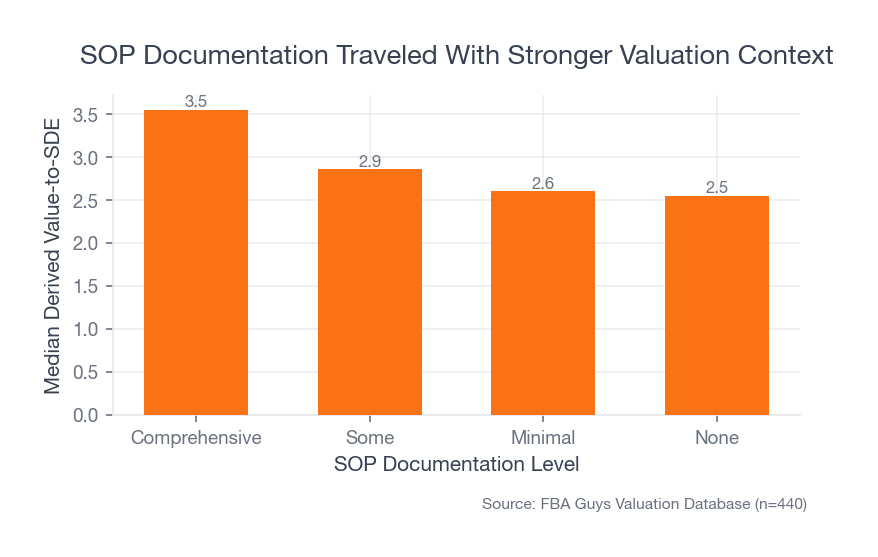
Across the 2026 subset, records with comprehensive SOPs had a 3.59 median derived value-to-SDE across 144 records. Records with no SOPs had a 2.53 median across 114 records. We can't say SOPs caused the valuation spread. We can say the habit that creates SOPs is the same habit that makes warnings easier to explain.
 Source: FBA Guys Valuation Database (n=440)
A good warning file is really a small SOP. It tells the next person what happened last time and what to do if it happens again.
Appeal, Dispute, or Fix?
The response path depends on whether the warning is wrong, valid, unclear, or caused by something you can fix quickly.
If Amazon is wrong, dispute with evidence. Keep the response narrow. Show the invoice, rights record, product detail, or communication context that proves the violation didn't happen.
If the issue happened, appeal or respond with the facts Amazon asks for: root cause, corrective action, and prevention. Avoid the dramatic apology letter. The useful response is specific. What happened? What changed? Who owns the control now?
If the warning points to a listing problem, fix the listing and preserve before-and-after screenshots. If the warning points to supplier documentation, get the invoice file in order before uploading anything. If the warning is legal, safety, customs, or regulated-product adjacent, get qualified help. The wrong shortcut can turn a small warning into a larger record.
There is one more boring detail: keep the emergency contact information current. Amazon's AHR policy says an Account Health specialist may attempt to call when account health degrades or a critical violation appears. A missed call shouldn't be the reason a fix gets slower.
What This Means for Valuation
Policy violation warnings affect valuation context through risk and documentation.
They don't replace the core model. A business is still valued around earnings, growth, risk, transferability, and documentation. Our broader Amazon FBA business valuation guide covers that model.
Warnings sit inside the risk and documentation pillars. A clean warning file reduces hidden-risk anxiety. A vague warning history increases it. The Playbook's due diligence chapters make the same point in a wider way: buyers ask for evidence because they are trying to verify what they are buying.
By 2024, internal industry notes show buyers asking for full account-health exports on day one of diligence. That fits the data. Warnings-only histories in our 2026 subset didn't look like resolved-suspension histories, but that only helps if the warning history is visible and explainable.
Our read: one resolved warning with evidence is usually an account-health record. A pattern of warnings, a serious category, a repeat violation, or a warning no one can explain becomes risk.
The difference is the file.
FAQ
Is an Amazon policy violation warning the same as a suspension?
No. A warning is a notice of a policy issue or possible policy issue. A suspension or deactivation interrupts selling privileges. In the FBA Guys 2026 account-health subset, warnings-only histories sat close to never-suspended histories on median derived value-to-SDE, while resolved suspensions were lower.
Should I appeal every Amazon policy violation warning?
No. Follow the path Amazon gives for the specific warning. Some warnings need an appeal. Some need a dispute. Some need a listing edit, document upload, acknowledgement, or operational fix. Preserve the warning and evidence before responding.
Can a policy violation warning lower Account Health Rating?
Yes, if it is a policy violation included in Amazon's AHR framework. As of the writing of this article, Amazon says new covered policy violations deduct points and successful resolution can add points back. Severity and repeat status affect the account-health impact.
What should I do first after receiving a policy warning?
Save the original notice, screenshot the Account Health details, record the date and deadline, identify the policy category, and gather the supporting evidence before writing the response. Then follow the appeal, dispute, or correction path Amazon provides.
Does one warning make an Amazon FBA business harder to sell?
One resolved warning with documentation is different from an unresolved issue, repeat pattern, recent suspension, or serious policy category. The database can't evaluate your specific warning, but it does show that warnings-only histories didn't behave like resolved-suspension histories in the 2026 subset.
Curious what your business is worth?
Get a free, instant valuation and see how your Amazon business stacks up.
Get Your Free Valuation