How to Handle Amazon Intellectual Property Claims Without Turning One Notice Into a Bigger Problem
The FBA Guys
May 24, 2026

An Amazon intellectual property claim tends to arrive in the least literary way possible: a short notice, a suppressed listing, a policy warning, maybe a line in Account Health that makes the rest of the day rearrange itself.
The strange part is how much can be hidden inside that little notice.
A trademark complaint is not a copyright complaint. A patent dispute is not a counterfeit accusation. A rights-owner complaint is not the same thing as Amazon detecting a policy problem on its own. If you handle all of them with the same generic appeal, you can make the record noisier before you understand what actually happened.
If you are trying to figure out how to handle Amazon intellectual property claims, start with three jobs: identify the right being asserted, preserve the evidence before you respond, and build a clean resolution file that a future buyer, lender, or advisor could read without needing you on the phone for an hour.
That third job is the one sellers tend to underweight, partly because it feels administrative while the listing is on fire and partly because nobody is thinking about a buyer's diligence folder while Seller Central is blinking at them.
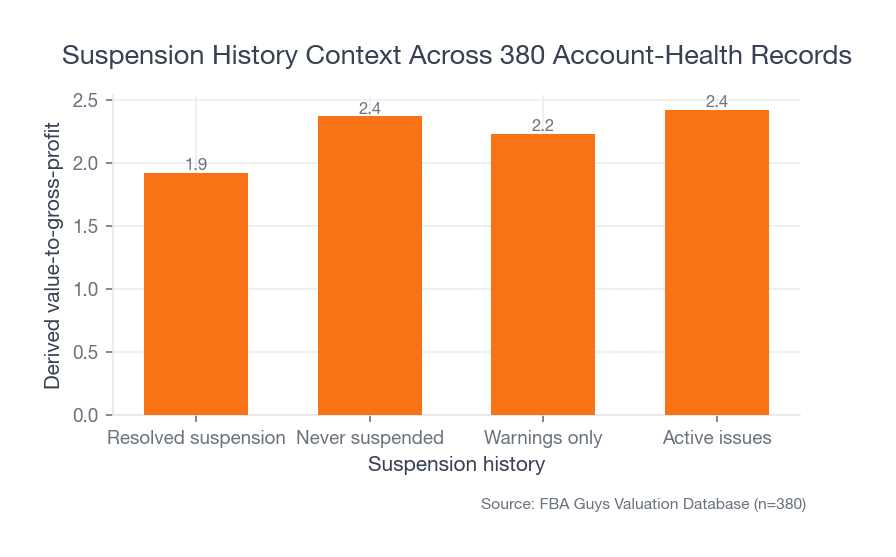
In the FBA Guys valuation database, accounts with no suspension history averaged 2.37 derived value-to-gross-profit across the records where account-health history was available. Accounts with resolved suspensions averaged 1.92. That data does not prove an IP claim caused the discount, and the account-health sample is much smaller than the full database. Still, the direction is worth paying attention to. A resolved issue can remain a diligence question.
The claim may disappear from your operational emergency list.
It doesn't disappear from the story of the business.
First, Identify What Kind Of IP Claim You Are Dealing With
The first mistake is usually speed.
Not urgency. Urgency is fine. You should treat an IP claim quickly because the listing may be suppressed, the affected ASIN may lose rank, or the account-health dashboard may start showing risk before the sales report has time to look ugly.
Speed is different. Speed is when you write the appeal before you know whether the complaint is about a trademarked brand name, a copyrighted image, a patented design, a counterfeit accusation, or a product-detail-page contribution that accidentally used someone else's protected text.
Amazon's own reporting materials group suspected IP violations into categories such as copyright, trademark, counterfeit, and patent issues. That sounds tidy in a help page. In a live account, the notice can feel less tidy because one ASIN may contain several possible problems: product title, brand field, images, bullet copy, packaging, offer condition, variation setup, and the actual product itself.
So the first pass is boring:
- Screenshot the notice.
- Save the ASIN, SKU, FNSKU, complaint ID, policy type, and date.
- Save the original listing content before anyone starts changing it.
- Pull invoices, purchase orders, supplier authorization letters, trademark registration records, design files, packaging proofs, and email history with the rights owner if you have it.
- Identify whether the claim is coming from a rights owner, Amazon, a competitor, a distributor, or a brand protection agent.
Then stop for a moment.
What is the claim actually saying you did?
That question matters because the appeal should answer the claim that exists, not the claim you wish it were. A seller who receives a trademark complaint and responds with supplier invoices may still be missing the point if the issue is use of a protected brand name in the title. A seller who receives a copyright complaint over product images may not fix the problem by proving the product is authentic. Authentic product and copied creative are different problems.
This is also where you decide whether to bring in counsel. We are not lawyers, and this article is not legal advice. If the complaint involves patents, repeated rights-owner contact, a meaningful sales concentration, or language that suggests actual litigation risk, an IP attorney can be cheaper than learning the difference between "good enough for an appeal" and "good enough for a legal dispute" the expensive way.
The First 24 Hours Are Mostly About Preserving The Record
There is a small panic ritual that happens with Amazon claims.
Someone opens Seller Central, changes the listing, writes a paragraph that sounds cooperative, uploads one invoice, and hopes the machine likes the shape of the answer. Sometimes that works. More often, it creates a record that nobody can reconstruct later.
The better first day is less dramatic, and it typically feels a little unsatisfying because the work looks like collecting files instead of fighting the complaint.
Build a claim folder. Give it a name that will still make sense two years from now: 2026-05-24_ASIN_B00EXAMPLE_trademark_claim_brand-name. Put the notice in it. Put the ASIN detail page snapshot in it. Put every relevant invoice in it. Put the product photos in it. Put the registry records in it. If you changed the listing, save a before-and-after note with timestamps.
This sounds fussy until the claim returns six months later and nobody remembers which bullet point was changed, which supplier invoice was sent, or whether the complaint was withdrawn by the rights owner or simply closed by Amazon after a listing edit. Or until a buyer asks for account-health history and the only answer is, "We fixed that."
Fine. Fixed how?
The fact is, buyers and serious operators are not only looking for whether an issue was resolved. They are looking for how the business behaves when something breaks. A clean record says the company has a process. A messy record says the owner remembers everything personally, which is a fragile operating system with a human face.
Here is a simple evidence file:
- Claim notice and complaint ID.
- Affected ASINs, SKUs, FNSKUs, and marketplaces.
- Current listing screenshots.
- Archived listing copy and images.
- Purchase invoices or manufacturing records.
- Supplier authorization or distribution agreement.
- Trademark, copyright, patent, or design ownership records.
- Rights-owner communication.
- Appeal text submitted to Amazon.
- Amazon's response.
- Final account-health status.
- Preventive change made after resolution.
One oddly useful detail: include the packaging proof.
Packaging is where clean stories sometimes get muddy. The listing says one thing, the insert says another, the carton still has last year's logo, and the supplier sent a product photo with a competitor's brand faintly visible on a corner of the box. None of those details are fun to explain after the fact.
Put the proof in the folder.
Trademark, Copyright, Patent, And Counterfeit Claims Need Different Responses
The word "IP" is too broad to be operationally useful, and it is quite capable of making four different problems sound like one tidy compliance event.
Treat the notice by category.
Trademark
A trademark claim usually concerns a brand name, logo, phrase, or source identifier. On Amazon, this can show up in the title, bullets, backend fields, product images, packaging, or the branded product itself.
The practical question is whether you have the right to use the mark in the way it appears. If you are an authorized reseller, the evidence may include invoices, authorization letters, and supply-chain documents. If you own the brand, the evidence may include trademark registration, Brand Registry access, packaging proofs, and manufacturing records.
If the mark appears because the listing copy got lazy, fix the listing. There is no honor in defending a bullet point that should have been written better.
Copyright
Copyright claims often involve images, product-page copy, diagrams, videos, or packaging artwork. They are sometimes easy to misunderstand because the underlying product may be legitimate. That doesn't automatically give you the right to use another brand's photo, instruction diagram, or lifestyle image.
For copyright claims, preserve the creative source trail: original photo files, design invoices, photographer agreements, design briefs, image licenses, and dates. If a freelancer created the assets, you want the agreement showing rights transfer or usage rights. "We paid someone on a marketplace" is not much of an evidence file.
Patent
Patent claims are slower, more technical, and usually more dangerous.
This is where the do-it-yourself appeal can get thin fast. A design patent, utility patent, or trade dress dispute can hinge on details a normal operator doesn't evaluate every day. If a meaningful ASIN is involved, get counsel involved before sending a confident paragraph into a record you may later regret.
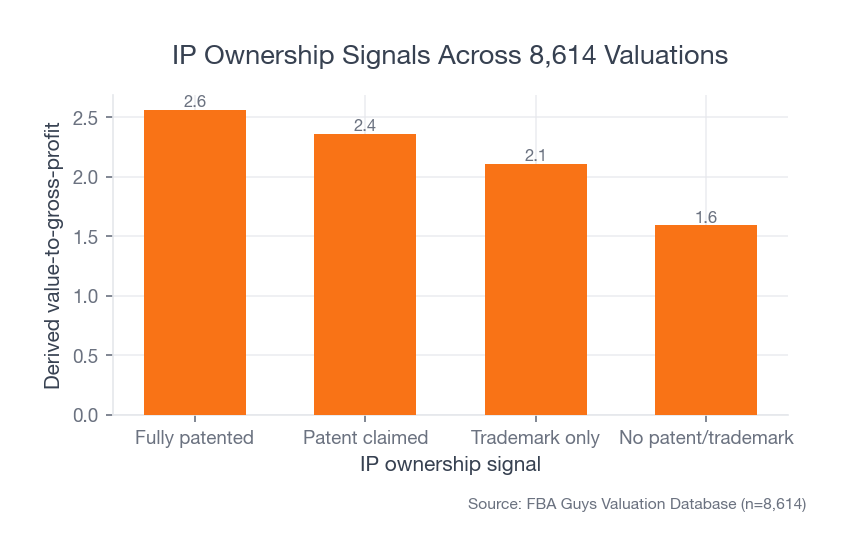
Our database gives one reason to treat patent protection as a different animal. Fully patented businesses averaged 2.56 derived value-to-gross-profit across 293 records. Patent-claimed businesses averaged 2.36 across 225 records. No patent or trademark signal averaged 1.59 across 2,801 records. That does not mean a patent creates value by itself. It does suggest that defensible product rights travel with a different business profile.
 Source: FBA Guys Valuation Database (n=8,614)
So when a patent claim arrives, don't treat it like a listing-edit task.
Counterfeit
Counterfeit claims are about authenticity. The evidence usually needs to show the product is genuine, where it came from, and why the supply chain is legitimate.
Invoices matter here, but so does the quality of those invoices. Marketplace receipts, vague supplier statements, or invoices with mismatched business names can make the answer feel thinner than you think. A clean invoice from a recognized supplier, with product identifiers that match the ASIN, carries a different weight.
There is a detail here that sellers dislike because it feels unfair: even if you are right, and even if the complaint eventually gets withdrawn or closed cleanly, the record can still be expensive while the business is waiting for the platform to catch up with the facts.
Rank drops. Ads pause. Inventory sits. A customer-service person answers the same confused message twelve times. Someone on the team starts checking Account Health before coffee.
The claim is not only about winning the argument.
It is about shortening the period where the business operates with one eye on a warning screen.
What Brand Registry Can And Can't Do
Brand Registry is useful. It is not a force field.
Amazon says Brand Registry gives enrolled rights owners and registered agents access to tools such as Report a Violation. Amazon also says its public reporting form is available for rights owners or their agents when they need to report suspected infringement.
Those tools matter. Report a Violation can search Amazon's catalog using ASINs, offers, and images, and Amazon says enrolled brands can bulk search up to 50 ASINs or product-detail-page URLs. Project Zero can give eligible brands a self-service counterfeit-removal tool. Transparency can apply unique serial codes so Amazon and customers can verify units.
Those are real tools.
They still require good inputs.
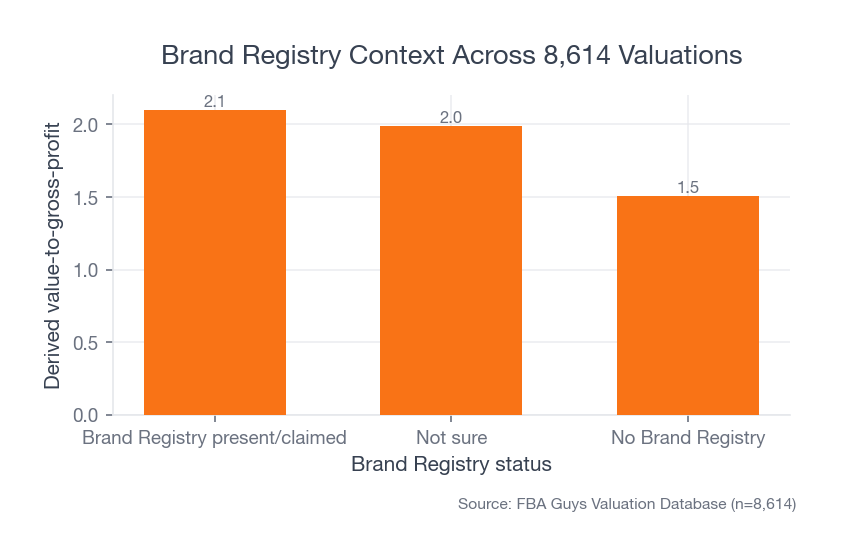
In our valuation database, Brand Registry present or claimed groups averaged materially higher derived value-to-gross-profit than the no-Brand-Registry group. The no group averaged 1.51 across 2,085 valuations. Brand Registry groups ranged from 2.07 to 2.40 depending on response type.
 Source: FBA Guys Valuation Database (n=8,614)
Again, correlation only. Brand Registry did not magically cause the higher value. Larger, more mature, better-documented brands are more likely to have Brand Registry in place. Still, that is part of the point. Serious brand ownership tends to leave paperwork behind.
If you have Brand Registry, use it to monitor and enforce. If you don't have it, understand what you are missing. You may still be able to respond to claims and report infringement, but you may have fewer tools and a slower path. The same habit applies to the listing itself: clean main images and well-owned A+ Content reduce the number of creative assets that nobody can explain later.
One more distinction matters: owning a trademark, enrolling in Brand Registry, and proving a specific Amazon violation are three separate tasks.
A trademark certificate helps. It doesn't prove a particular seller counterfeited your product. Brand Registry helps. It doesn't mean every complaint you submit is accurate. Amazon's tools help. They don't replace a clean evidence file.
That is where the operator work sits.
What An IP Claim Does To Account Health And Business Value
The current sale is usually the loudest thing in the room, which is understandable because suppressed revenue has a way of making every other business concern feel theoretical for a while.
The future sale is quieter.
An IP claim can affect business value in two ways. First, it can interrupt current revenue if the listing is suppressed, the offer is removed, or the ASIN loses momentum. Second, it can create a due diligence question later, even after the issue is resolved.
This is where the Mike story from the exit-planning material is useful. A business can have an attractive brand, real revenue, and real profit, yet still lose value because a primary SKU has intellectual property rights that don't transfer cleanly. The product may sell. The margin may work. The buyer still has to ask whether the thing being bought can actually be operated after closing.
Transferability is a valuation issue hiding inside an IP file.
The account-health data points in the FBA Guys database are smaller than the rest of the valuation data, so we should be careful with them. Among records where suspension history was available, never-suspended accounts averaged 2.37 derived value-to-gross-profit. Warnings-only averaged 2.23. Resolved suspensions averaged 1.92. Active issues had only four records, which is too small to use as a broad benchmark.
 Source: FBA Guys Valuation Database (n=380 account-health records)
The pattern is still useful as a warning label.
When a claim is resolved, keep the paper trail. If the issue involved a mistaken complaint, save the retraction or Amazon resolution. If the issue involved a real listing error, save the corrective action. If the issue involved supplier authorization, save the updated authorization.
What would you want a buyer to see when the question comes later, after the emergency has passed and the screenshots, appeal language, and Amazon responses have all blurred into one unpleasant memory?
Not a perfect business. Perfect businesses are rare, and frankly, suspicious in their own way. You want them to see a business that knows how to document a problem, fix it, and keep it from turning into folklore.
Build The Evidence File Buyers Will Want Later
The best time to build the file is while the claim is active, because the record is still close enough to the work that you can capture facts instead of reconstructing them from fragments.
After that, details get soft. The team member who handled the appeal leaves. The supplier changes invoice formats. Amazon's case page gets harder to find. Someone renames the folder "IP stuff old" and drops it into a shared drive with three other folders named almost the same thing.
Very professional. Somehow also very common.
Build the file like a buyer will read it cold:
- What happened?
- Which ASINs were affected?
- What right was asserted?
- Was the claim valid, mistaken, or partially valid?
- What evidence was submitted?
- What did Amazon decide?
- What changed afterward?
- Has the issue repeated?
If the answer to number eight is no, that is worth making easy to see.
For an operating team, this file can become an internal playbook. For a future sale, it becomes part of the risk narrative. For your own sanity, it keeps the next appeal from starting with a Slack search and a bad memory.
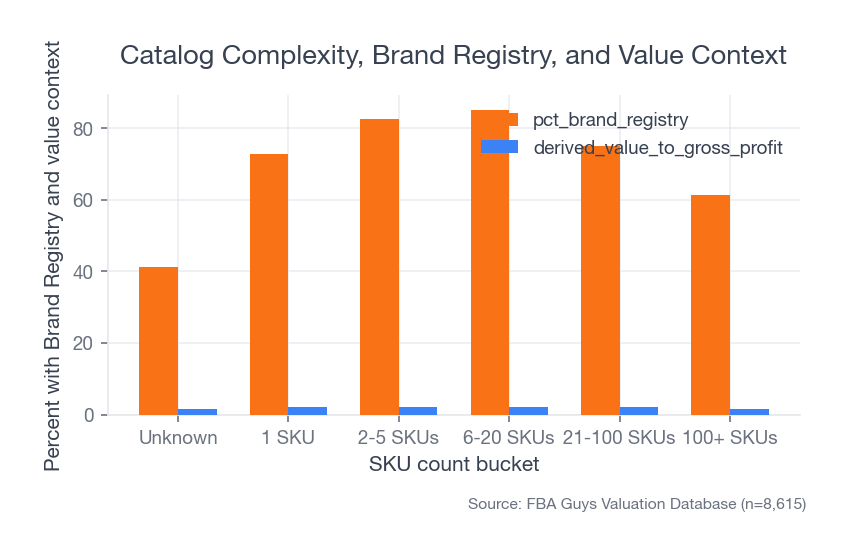
Catalog size changes the job. In the valuation database, 6-20 SKU businesses had the highest Brand Registry rate at 85.1% and the strongest SKU-bucket value-to-gross-profit at 2.20, while businesses with 100+ SKUs had 61.3% Brand Registry and 1.55 value-to-gross-profit.
 Source: FBA Guys Valuation Database (n=8,615)
There are many reasons for that gap, and IP hygiene is only one possible piece. But the operating picture is easy to understand. The broader the catalog, the more surfaces there are for copied images, outdated packaging, unauthorized sellers, stale brand names, and product-detail-page edits nobody remembers approving.
At some point, "handle the claim" becomes too small a process, because the claim is only the visible part of a catalog system that may include supplier documents, image ownership, packaging history, authorization letters, and old listing copy scattered across several people and several years.
You need a catalog IP review:
- Which ASINs use third-party images or design assets?
- Which listings mention other brands?
- Which suppliers have written authorization on file?
- Which products have packaging that matches the current listing?
- Which listings rely on claims that need substantiation?
- Which brands are enrolled in Brand Registry?
- Which ASINs have prior notices, warnings, suppressions, or rights-owner contact?
Run that review quarterly if IP risk is material to the business. Run it before a sale process. Run it before launching a large batch of new SKUs.
One quiet benefit: it makes your appeal writing less theatrical.
When the evidence is already organized, the appeal can be plain. Here is the notice. Here is the right. Here is the evidence. Here is the correction. Here is why the listing should be reinstated or why the complaint should be withdrawn.
Plain is good.
FAQ
What should I do first after receiving an Amazon IP complaint?
Preserve the notice and listing record before changing anything. Save the complaint ID, affected ASINs, policy type, listing screenshots, invoices, rights documents, and all relevant correspondence. Then identify whether the complaint is trademark, copyright, patent, counterfeit, or another policy issue.
Should I contact the rights owner?
Sometimes. If the complaint appears mistaken, a concise rights-owner message can lead to a retraction. If the dispute is material, hostile, repeated, or patent-related, get legal advice before sending anything that could become part of the record.
Does Brand Registry prevent IP claims?
No. Brand Registry gives enrolled rights owners stronger tools to monitor and report infringement, but it doesn't prevent every hijacker, counterfeit offer, mistaken complaint, or listing dispute. Treat it as infrastructure, not immunity.
Can an IP claim hurt the value of my Amazon business?
Yes, especially if it affects a major SKU, creates account-health history, repeats, or exposes weak transferability of product rights. A resolved, well-documented claim is easier to explain than a vague one the owner says was "handled."
When should I hire an IP attorney?
Hire counsel when the claim involves patents, a high-revenue ASIN, repeated complaints, a threatening rights owner, unclear ownership, or any fact pattern that could move beyond a normal Seller Central appeal.
Closing
An Amazon intellectual property claim starts as a notice.
It becomes something else depending on how you handle it. It can become a clean file, a corrected listing, a rights-owner retraction, and a useful internal process. Or it can become a half-remembered incident that keeps coming back whenever someone asks about account health.
The practical work is not glamorous: classify the claim, preserve the evidence, answer only what was alleged, and document the resolution.
That is the part that protects more than the ASIN.
Curious what your business is worth?
Get a free, instant valuation and see how your Amazon business stacks up.
Get Your Free Valuation