Amazon FBA Supplier Negotiation Tactics: Negotiate the Terms That Make the Price Real
The FBA Guys
June 11, 2026

The cheapest supplier quote has a habit of looking best before the first reorder.
Amazon FBA supplier negotiation tactics should protect seven things before you push hard on unit price: product specification, minimum order quantity, lead time, payment schedule, inspection rights, backup-vendor readiness, and documentation. The unit price matters. It just has to survive the rest of the order, including the full landed cost.
That is where the data keeps pulling. Across 8,556 successful valuation records with positive derived SDE, businesses with backup vendors averaged 2.50 derived value-to-SDE. Businesses without backup vendors averaged 2.28. The cleanest supplier-count signal came from the 2-5 supplier group, which averaged 2.53.
Derived value-to-SDE is a directional valuation proxy: estimated valuation divided by derived seller's discretionary earnings. SDE, or seller's discretionary earnings, is the earnings base buyers usually use for owner-operated businesses.
The database can't tell us what deposit percentage each seller negotiated, or whether a supplier gave them 30-day terms after three clean orders. It can tell us that supplier optionality, product depth, and inventory shape keep showing up near stronger business profiles.
That boundary matters because negotiation advice gets sloppy when it pretends every concession has the same value.
What Supplier Negotiation Is Really Trying to Protect
A supplier negotiation can produce a lower unit cost and still make the business weaker.
That happens when the lower price comes with a larger MOQ, slower lead time, vague material tolerance, weak package control, no pre-shipment inspection window, or invoice documents that won't work if Amazon asks questions later. The cost didn't disappear. It moved into cash, time, or risk.
For Amazon FBA sellers, the supplier conversation needs to protect the full buying system. You need to describe the product precisely enough for the supplier to manufacture it twice. You need to inspect before the balance payment leaves your account. You need paperwork that proves where the goods came from. You need a reorder plan that doesn't drain the cash account. And if the current supplier stops working, you need to know what the next option costs.
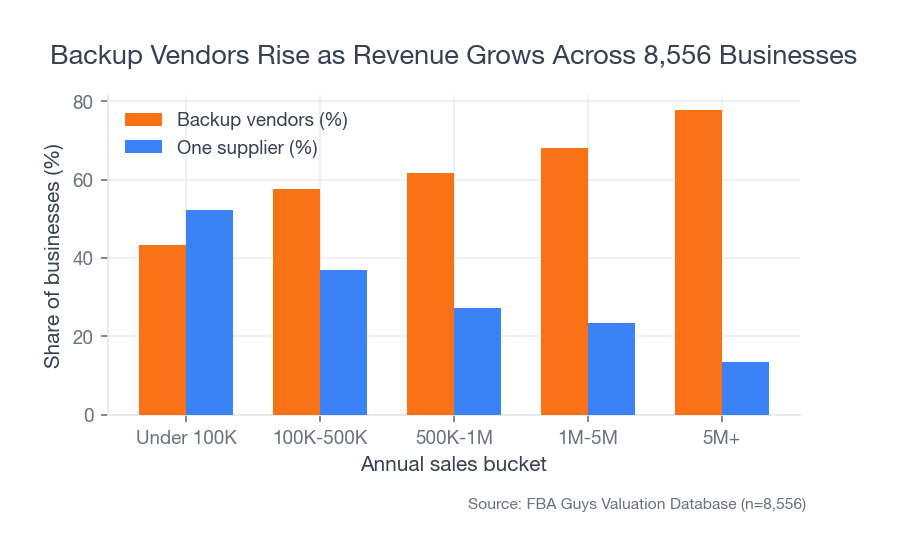
That last piece matters more as the business grows. In our data, backup-vendor readiness rose from 43.3% of businesses under $100K in annual sales to 77.8% above $5M. The one-supplier rate moved the other way, from 52.3% under $100K to 13.5% above $5M.
 Source: FBA Guys Valuation Database (n=8,556)
The more likely reading is simple: larger businesses tend to formalize supplier alternatives. They may not use every backup supplier. But they know what the alternative costs, how long it takes, and what would have to change if the current supplier stopped working.
That knowledge changes the negotiation.
Start With the Product Spec Before Price
The best price quote isn't worth much if the supplier and the seller are picturing different products.
A real specification sheet should answer plain questions: material, dimensions, tolerance, finish, color, package design, insert language, carton count, barcode workflow, label workflow, acceptable defect rate, inspection method, and what counts as a failure. If the product touches food, skin, batteries, children, pets, heat, health claims, safety claims, or regulated categories, the spec has to include the documentation side too. The broader Amazon FBA product sourcing checklist is useful if the product file itself is still thin.
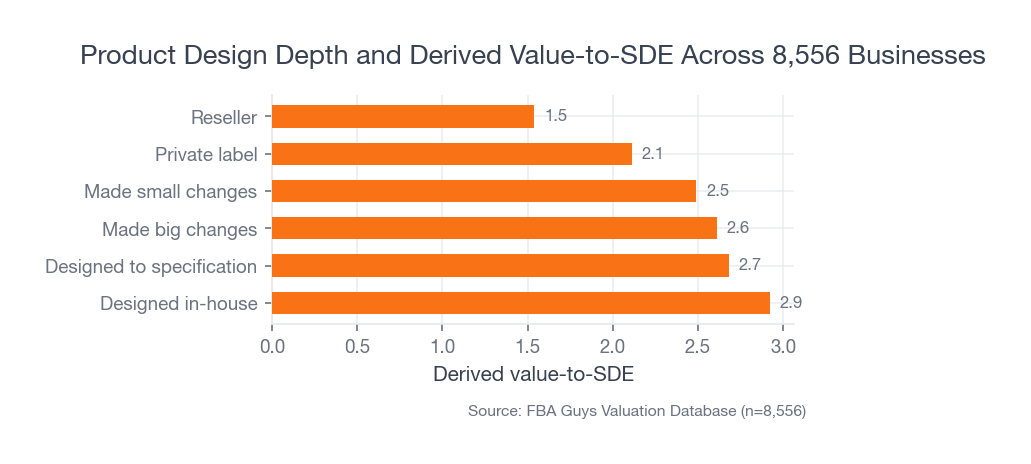
This is where the database gives us a useful hint. Designed-in-house products averaged 51.1% margin and 2.92 derived value-to-SDE across 2,199 records. Designed-to-specification products averaged 47.5% margin and 2.68 across 1,125 records. Private-label products averaged 44.5% and 2.11. Reseller products averaged 42.0% and 1.54.
 Source: FBA Guys Valuation Database (n=8,556)
That doesn't mean every seller should become an inventor. Custom products create cost, testing work, tooling questions, and slower development. It does suggest that product depth changes the negotiation. A catalog item mostly gives you price, MOQ, package details, and lead time to work with. A specified product lets you negotiate tolerances, replacement terms, change control, component substitutions, inspection standards, and tooling access.
The supplier has to know exactly what you are buying before either side can know whether the price is good.
How Many Suppliers Is Enough?
Supplier count has a curve.
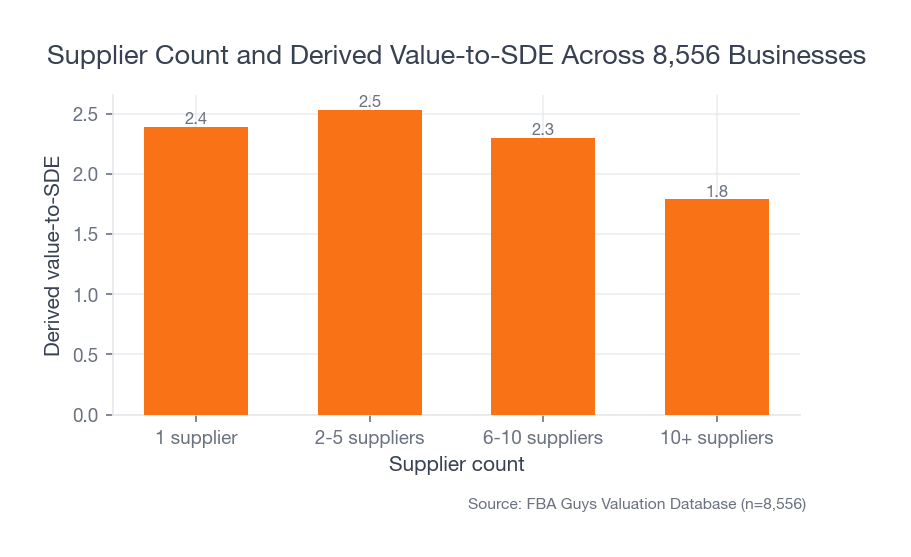
One-supplier businesses averaged 2.39 derived value-to-SDE across 3,003 records. The 2-5 supplier group averaged 2.53 across 4,179 records. Then the signal softened: 6-10 suppliers averaged 2.30, and the 10+ group averaged 1.79.
 Source: FBA Guys Valuation Database (n=8,556)
The more likely reading is that the second supplier matters more than the sixth. A second qualified supplier reduces dependence on one relationship. Ten suppliers can also mean a wider catalog, inconsistent terms, more invoices, more quality variation, and more places for reorder discipline to break.
So the practical target is enough supplier optionality for the fragile parts of the business.
If one factory makes the only SKU that matters, your negotiation should include a backup path. That might be a fully qualified second factory, a sample-tested alternative, a domestic emergency source at a worse margin, or a researched supplier file with quote history and product notes. The backup doesn't have to be perfect to be useful. It has to be real enough that you aren't negotiating from memory. If Alibaba is one of those sourcing channels, the companion guide to Alibaba sourcing tips for Amazon sellers goes deeper on supplier validation.
Use Backup Suppliers as Information First
A backup supplier is often more useful as information than as a threat.
It tells you whether your primary supplier's unit cost is still reasonable. It shows whether the primary supplier is actually strong on lead time, package consistency, communication, credit, quality control, or Amazon-ready documentation. It gives you a better sense of which concession you should ask for.
Inside the same supplier-count bands, backup vendors still showed a stronger profile. One-supplier businesses without backups averaged 2.31 derived value-to-SDE. One-supplier businesses with backups averaged 2.53. In the 2-5 supplier group, the no-backup group averaged 2.35, while the backup-vendor group averaged 2.62.
That isn't proof that a backup quote creates a higher valuation. Our read is more cautious: businesses that know their alternatives tend to be run more systematically. They have likely had to define the SKU, compare terms, preserve supplier records, and think through what happens if the reorder doesn't go as planned.
That is negotiation work even before anyone asks for a discount.
Negotiate MOQ Around Cash and Inventory Turn
MOQ is where the supplier's cost curve meets your cash account.
A higher MOQ can lower unit price, reduce per-unit freight, and make the supplier more willing to customize package details or materials. It can also force you to buy six months of demand, increase storage exposure, slow cash conversion, and leave you defending a stale product while the market changes. That is why MOQ belongs in the same conversation as FBA cash flow management, not only supplier pricing.
The database doesn't store MOQ directly. Inventory turn gives us adjacent context. Businesses turning inventory every few months averaged 2.51 derived value-to-SDE with $147,464 in average inventory. Businesses taking a year or more averaged 2.07 with $163,279 in inventory and lower average sales.
That pattern doesn't say "fastest turn always wins." Some products require slower turns because of seasonality, manufacturing lead time, freight, or category economics. The useful point is that MOQ negotiation belongs inside a cash model.
Before accepting a lower price at a higher quantity, calculate the cash effect:
- Deposit due today.
- Balance due before shipment or after inspection.
- Freight, duties, prep, and Amazon inbound time.
- Expected sell-through by month.
- Storage and aged-inventory exposure.
- Reorder point before the first order fully sells through.
- Cash left for ads, returns, replacements, and the next SKU.
If the lower unit price makes the cash cycle ugly, the negotiation target may be smaller MOQ, split shipments, a reorder price ladder, better payment schedule, or faster production windows. The related inventory management guide covers the reorder side of that decision.
Payment Terms Should Follow Inspection and Trust
Payment terms sound financial. In supplier negotiation, they are also quality-control terms.
For a new supplier, a clean structure is usually more valuable than a clever concession: deposit to start production, pre-shipment inspection before balance payment, and clear replacement or credit terms if the order misses the agreed spec. If the order runs through a platform like Alibaba, the order terms should reflect the actual quality, shipment, and payment protections you negotiated. Alibaba's official Trade Assurance materials are worth reading before you rely on platform-level protection.
After a supplier has performed through several clean orders, the conversation can change. You may ask for lower deposits, better reorder terms, shorter production windows, reserved capacity, package consistency, or limited credit. The point is to tie better terms to evidence: clean inspections, on-time shipments, predictable defect rate, and accurate paperwork.
There is a difference between asking for payment relief and showing a supplier the buying system you are building. The second version is easier for a serious supplier to respect.
Put Amazon Documentation Into the Supplier Conversation
Amazon creates a documentation layer that a normal wholesale buyer may not care about until later.
For some products, Amazon may ask for purchase invoices, product photos, safety documents, compliance records, brand authorization letters, or category-specific approvals. The exact requirements depend on the product, category, marketplace, and current Amazon rules. Amazon's Seller Central pages on categories and products that require approval and product compliance documentation are the right current source before a large order.
That means documentation belongs in the supplier negotiation before the first large order. Ask whether the supplier invoice will show the legal supplier name and address, product description, quantity, date, and payment details. Ask whether the supplier can provide applicable test reports, certificates, material declarations, product photos, and brand authorization documents when relevant. Ask whether package and label details can match the product file you'll use for Amazon.
A supplier that can't support the paperwork may still be able to make the product. That doesn't make the supplier a good fit for Amazon.
This is especially important when a seller is comparing a cheap quote against a more expensive supplier with stronger documentation. The quote isn't complete until it includes the record you may need to defend the listing, satisfy a compliance request, or explain the supplier relationship later.
Run the Negotiation in the Right Order
The order matters because each answer changes the next question.
First, make the SKU specific. A supplier can't negotiate intelligently against a vague product. Your request for quote should include the product spec, package requirements, carton count, inspection standard, target order quantity, target ship date, and destination assumptions. If you ask five suppliers for five slightly different products, the cheapest quote won't tell you much.
Second, ask for quantity breaks. Don't ask only for the MOQ and the price at that MOQ. Ask what happens at 500 units, 1,000 units, 2,500 units, and whatever quantity matches your real reorder model. The useful answer isn't always the lowest price. Sometimes it is the first quantity where the supplier's setup cost stops dominating the order. Amazon's Revenue Calculator can help sanity-check fulfillment and fee assumptions before a quantity break becomes a purchase order.
Third, put inspection before payment release. That can mean a third-party inspection, your own receiving check for domestic suppliers, or a sample-retention process that lets you compare production goods against the approved sample. The mechanism will vary. The principle is the same: the supplier should know what standard the order must meet before the balance payment is due.
Fourth, negotiate the next order while the current order is still clean. If the supplier ships on time, passes inspection, and provides accurate documents, that is when you have the best reason to ask for better reorder terms. Waiting until cash is tight or the factory misses a deadline makes the conversation smaller.
Fifth, keep the supplier file current. Quotes expire. Contacts leave. Material costs move. A backup supplier file from 18 months ago may still be useful, but only if you know what has changed.
The Supplier Negotiation Checklist
Use this as a working checklist before the first purchase order or before a major reorder.
- Define the SKU in writing before requesting quotes.
- Ask suppliers to quote against the same spec, package requirements, quantity, inspection standard, and freight assumption.
- Compare landed cost, not only unit cost.
- Ask for MOQ options at several quantities, then model cash tied up by each option.
- Confirm production lead time and what can delay it.
- Set the deposit, balance trigger, and inspection point in writing.
- Define acceptable defect rate and what happens if inspection fails.
- Confirm replacement, credit, or remake terms.
- Ask for invoice format and supporting documents before you need them.
- Confirm barcode, FNSKU, carton, warning-label, and package responsibilities.
- Keep at least one backup supplier file with quotes, samples, notes, and known tradeoffs.
- Reopen negotiations after clean order history, not only when something breaks.
The checklist is intentionally plain. A supplier negotiation that only gets exciting after the order fails has already become more expensive than it needed to be.
What We Would Negotiate First
For a first order, we would negotiate clarity before concessions.
That means a precise spec, smaller test quantity when possible, inspection before balance payment, clear replacement terms, and invoice or compliance documents that fit the Amazon category. If the supplier refuses to define the product, the inspection standard, or the paperwork, a cheaper unit price doesn't answer the real question.
For a reorder with a proven supplier, the negotiation changes. You have history. You can ask for a price ladder, lower deposit, faster production slot, split shipment, improved package consistency, or lower MOQ on variant tests. You can also show the supplier why better terms may lead to more predictable future orders.
For a business preparing for valuation or sale, the supplier file matters in a different way. Manufacturer relationships, costs, and terms need to be understandable to someone else. If the next owner has to replace the supplier immediately after buying the business, perceived risk rises.
This is why supplier negotiation is part of making the business transferable.
FAQ
What is the best Amazon FBA supplier negotiation tactic?
The best first tactic is to make every supplier quote against the same written product specification, quantity, package requirement, inspection standard, and freight assumption. Without that, you are comparing impressions. A supplier who quoted a cheaper product didn't really quote the same order.
Should I always negotiate for the lowest unit cost?
No. The lowest unit cost can be the wrong deal if it requires too much inventory, weak documentation, vague quality standards, slow production, or payment before inspection. Compare the full landed cost and the cash cycle. The useful price is the one that still works after freight, duties, prep, Amazon fees, defect allowance, and reorder timing.
Is one supplier enough for an Amazon FBA business?
Sometimes. A small or simple business may run on one supplier for a long time. The risk is dependence. In our data, one-supplier businesses averaged 2.39 derived value-to-SDE, while the 2-5 supplier group averaged 2.53. That pattern suggests a credible second option is often more useful than a long vendor list.
How should I negotiate MOQ with a supplier?
Ask for several price breaks, then model the cash tied up by each quantity. If the larger order creates cash strain, negotiate a smaller first run, a reorder price ladder, split shipments, or better payment schedule. A lower unit cost that forces a bad cash cycle isn't really lower cost.
What supplier documents should Amazon sellers request?
Ask for detailed invoices, product photos, package records, brand authorization where applicable, and safety or compliance documents required for the category. The exact requirements vary, so check current Amazon-owned guidance before placing the order. The supplier should be able to support the product as an Amazon product, not only as a manufactured item.
The Price Has to Survive the Reorder
A supplier negotiation is finished only when the terms can survive normal operating pressure: reorder deadlines, cash needs, inspection, Amazon documentation, and supplier backup.
The price matters. The terms decide whether the price stays real.
Curious what your business is worth?
Get a free, instant valuation and see how your Amazon business stacks up.
Get Your Free Valuation