Amazon FBA Product Sourcing Checklist: Build the Product Before You Buy It
The FBA Guys
June 8, 2026

The purchase order feels like the moment sourcing becomes real.
Usually, it is just the moment the earlier assumptions get expensive.
An Amazon FBA product sourcing checklist should cover product fit, Amazon compliance, supplier validation, sample testing, landed cost, minimum order quantity, backup vendors, invoices, authorization letters, packaging, labeling, and reorder documentation. The checklist is doing a bigger job than finding a supplier. It is testing whether the product can be specified, bought, inspected, replenished, and explained after the first order excitement wears off.
That last part matters. In the FBA Guys valuation database, designed-in-house products averaged 51.1% gross margin and 2.92 derived value-to-SDE across 2,198 records. Reseller products averaged 41.9% margin and 1.54 across 1,470 records.
The sourcing file starts showing up in the economics earlier than most spreadsheets admit.
Amazon FBA Product Sourcing Checklist: The Operating Version
Here is the working checklist.
- Define the customer problem and product use case.
- Check Amazon category, product, safety, and compliance requirements before requesting quotes.
- Decide whether you are reselling, private labeling, modifying, designing to specification, or designing in-house.
- Write the product specification sheet before contacting suppliers.
- Validate the supplier's business, authorization, factory role, and category experience.
- Order samples and compare them against written specifications, not memory.
- Calculate landed cost with freight, duties, inspection, prep, packaging, defect allowance, Amazon fees, and returns.
- Test MOQ against cash flow and expected inventory turns.
- Confirm invoice requirements, brand authorization, and proof-of-purchase documents.
- Confirm packaging, barcodes, FNSKU workflow, carton labels, and any warning labels.
- Identify at least one backup supplier or backup production path.
- Save the sourcing file in a place someone else could use for the next reorder.
That list looks simple. It isn't.
The danger is treating it like a launch checklist rather than an operating record. A launch checklist asks, "Can we get inventory into FBA?" An operating record asks a better question: "Can the business keep buying this product without depending on the founder's memory?"
Start With What the Product Has to Prove
Before you ask a supplier for a quote, write down what the product has to prove.
Does the product touch food? Does it use lithium batteries? Is it for children? Does it go on skin? Does it make a health, safety, performance, compatibility, or durability claim? Is it restricted, gated, hazmat, seasonal, fragile, oversized, meltable, breakable, bundled, serialized, or expiration-dated?
That isn't a dramatic list. It is just Tuesday in Seller Central.
Amazon's current wholesale sourcing guidance tells sellers to check category and product approval requirements, use Manage Your Compliance for required documents, avoid prohibited sources, verify authorization to sell or resell, and keep invoices as proof of authenticity and validity. Amazon's compliance materials also say missing documentation can lead to removed listings, account-health effects, customs issues, or disposal of inventory in fulfillment centers.
As of the writing of this article, some products may also require dangerous-goods review, safety documentation, battery information, warning labels, or category-specific approvals. That can change by product and marketplace, so the sourcing checklist has to point back to Amazon-owned materials before an order is placed.
Here is the practical scar in sourcing: the sample can be good while the product is still wrong for Amazon.
A rechargeable product can look great on a desk and still need battery documentation. A supplement bottle can look finished and still need compliance records. A kid-facing product can have nice packaging and still be a category problem. A product with a logo can still fail if the supplier cannot prove where the goods came from.
The first sourcing decision is whether the product can carry the documents it needs.
Product Design Changes the Margin Conversation
The database doesn't know whether a seller found a product on Alibaba, at a trade show, from a domestic distributor, or through a manufacturer relationship. We shouldn't pretend it does.
What it does know is how the product was shaped.
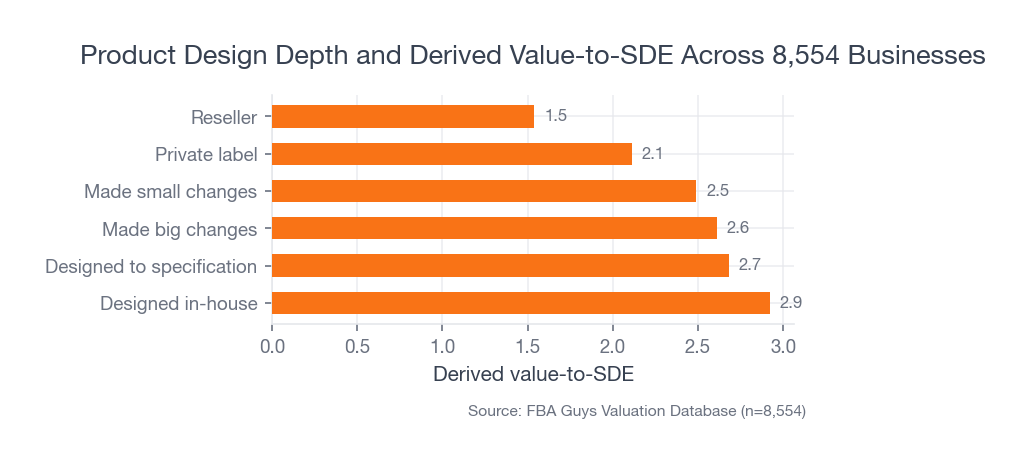
Across 8,554 successful valuations with positive derived SDE, the product-design spread was wide:
- Designed in-house: 51.1% average gross margin and 2.92 derived value-to-SDE.
- Designed to specification: 47.5% margin and 2.68 derived value-to-SDE.
- Made big changes: 45.4% margin and 2.61 derived value-to-SDE.
- Made small changes: 42.1% margin and 2.49 derived value-to-SDE.
- Private label: 44.5% margin and 2.11 derived value-to-SDE.
- Reseller: 41.9% margin and 1.54 derived value-to-SDE.
 Source: FBA Guys Valuation Database (n=8,554)
Derived value-to-SDE is a valuation-output proxy: estimated valuation divided by derived seller's discretionary earnings, where derived SDE is gross profit minus operating expense. If you want to estimate your own earnings before thinking about valuation, start with the SDE calculator.
The useful part isn't that every seller should become an inventor. Many shouldn't. Product design creates cost, testing work, tooling risk, and a charming little folder full of decisions nobody wants to revisit after the first production run.
Still, the pattern is hard to ignore. The deeper the product specification, the more the business can separate itself from "same catalog item, different logo."
What changes the actual sourcing work?
The spec sheet gets more serious. Instead of "silicone spatula, orange, premium," it says material grade, temperature range, handle stiffness, dimensions, tolerance, packaging, barcode placement, carton count, insert language, smell test, color code, acceptable defect rate, and inspection standard. There is a difference between a supplier understanding the vibe and a supplier manufacturing the same thing twice.
Of course, this creates a slower sourcing process.
Good. Some slowness is useful. The product you can specify clearly is easier to quote, sample, inspect, document, reorder, and explain. The product you can only describe with competitor links and hope is harder to defend when the second batch arrives a little different from the first.
Supplier Location Is a Smaller Question Than Supplier Structure
Supplier location matters. It affects lead time, communication, freight, tariffs, inspection options, payment terms, minimum order quantity, and how quickly you can fix a bad batch.
It just isn't the whole sourcing story.
In the database, China-sourced businesses averaged 45.1% gross margin and 2.53 derived value-to-SDE. U.S.-sourced businesses averaged 46.6% margin and 2.38. Europe-sourced businesses averaged 45.6% margin and 2.02.
The margin spread by region was smaller than the spread by product-design depth.
The supplier-count pattern was more interesting. One-supplier businesses averaged $688,280 in annual sales and 2.39 derived value-to-SDE. Two-to-five supplier businesses averaged $1,364,196 in sales and 2.53. Six-to-ten supplier businesses averaged $3,043,068 in sales and 2.30. The 10+ supplier groups averaged about 1.79.
So yes, having only one supplier can leave the business exposed. The second supplier seems to matter. The sixth supplier doesn't automatically make the business better.
This is where sourcing checklists can get a little silly. "Have multiple suppliers" sounds wise until the business has eleven vendors, six packaging versions, three untracked MOQs, two different insert files, and one folder called final-final-supplier-notes-v3.
The goal is redundancy without confusion.
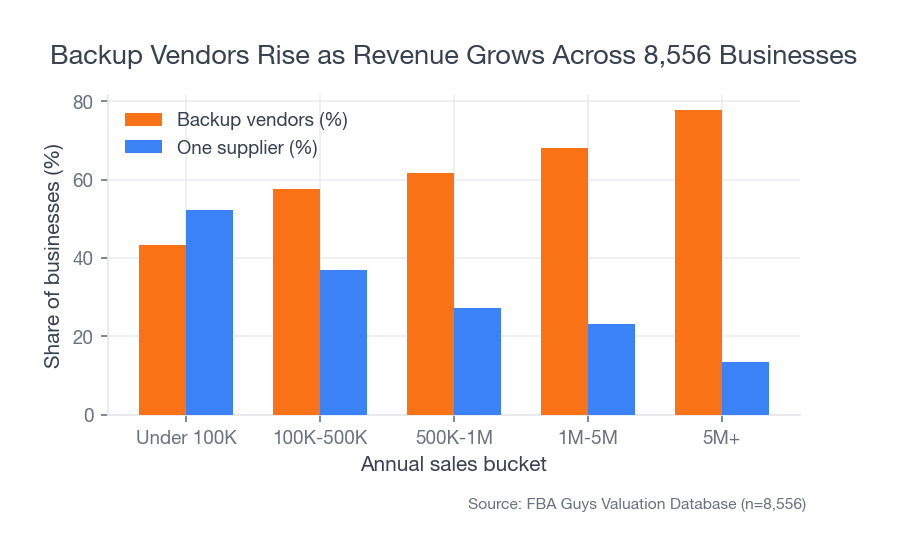
Backup-vendor data supports that. Businesses with backup vendors averaged 2.50 derived value-to-SDE and $1.87M in annual sales. Businesses without backup vendors averaged 2.28 and $920K.
Even better, backup-vendor readiness rose with revenue. Below $100K in annual sales, 43.3% of businesses reported backup vendors and 52.3% relied on a single supplier. Above $5M, 77.8% reported backup vendors and only 13.5% relied on one supplier.
 Source: FBA Guys Valuation Database (n=8,556)
The pattern says something ordinary and useful: bigger businesses tend to formalize the backup plan.
For the first launch, a second factory may stay in the research file. What matters is knowing who could make the product, what would change, what it would cost, how long qualification would take, and which documents would need to be refreshed.
The Invoice File Belongs in the Sourcing Checklist
Amazon sourcing has a paperwork layer that doesn't care how good the product looks.
Amazon's current wholesale guidance says that if a product requires approval, sellers may need a purchase invoice from a manufacturer or distributor, or a letter from the brand authorizing the seller to sell the product. It also recommends keeping purchase invoices as proof of authenticity and validity, with supplier information, itemized products, recent dates, matching seller account name and address, manufacturer or distributor information, and sufficient unit quantity.
That is a sourcing decision, not an admin chore.
If the supplier can't issue a clean invoice, the product is carrying a future account-health question. If the brand authorization is vague, the reseller model may be weaker than the gross margin suggests. If the business name on the quote, invoice, payment record, inspection report, and export documents doesn't line up, you have not created a sourcing file. You have created a scavenger hunt.
Keep the ugly records:
- Supplier business name, address, contacts, and tax or registration details.
- Quote, purchase order, invoice, packing list, and payment proof.
- Brand authorization letter if selling someone else's branded product.
- Product specification sheet and approved sample photos.
- Test reports, certificates, safety data sheets, or compliance documents where applicable.
- Inspection report and defect notes.
- Packaging files, barcode records, FNSKU process, and carton-label instructions.
- Reorder notes, lead times, MOQ changes, price changes, and quality issues.
This is the unglamorous part of sourcing. It is also the part that makes the next reorder less dependent on whoever happened to remember the WeChat thread.
MOQ and Landed Cost Decide Whether the Product Can Breathe
A low unit cost can still produce a bad business.
MOQ is where that happens quietly. The supplier offers a better unit price at 2,000 units. Freight looks acceptable if the cartons move together. The sample was fine. The contribution margin looks good inside a clean spreadsheet.
Then the product turns slowly, Amazon fees take their piece, storage starts to matter, returns arrive, the reorder point gets fuzzy, and the business has cash sitting in inventory that should have been learning from the next product test.
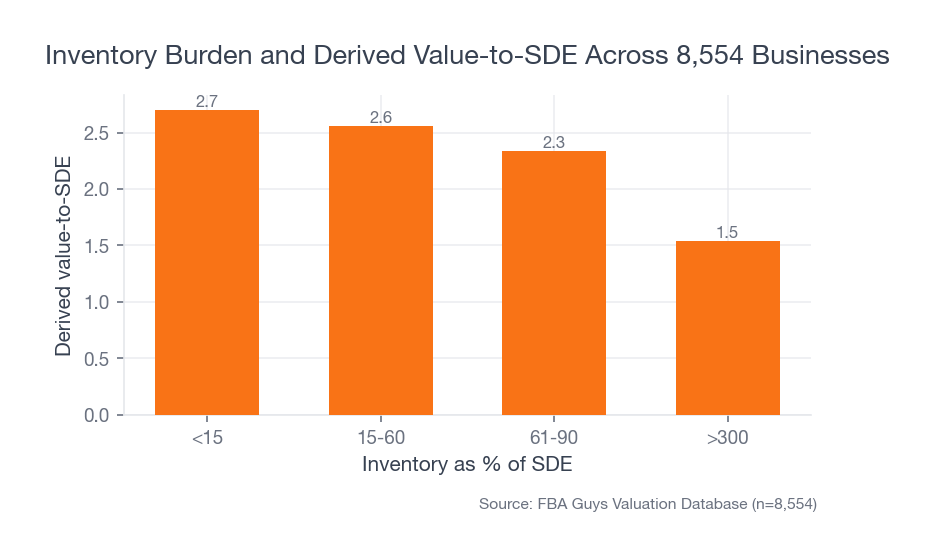
Inventory burden shows up clearly in the valuation data. Businesses with inventory below 15% of SDE averaged 57.0% gross margin and 2.70 derived value-to-SDE. Businesses with inventory above 300% of SDE averaged 34.7% margin and 1.54.
 Source: FBA Guys Valuation Database (n=8,554)
That doesn't mean low inventory is always better. Stockouts are expensive too. The point is that sourcing decisions set the cash rhythm before the product ever reaches FBA. For a deeper operating model, see the FBA Guys guide to Amazon FBA inventory management best practices.
Your checklist should force four numbers before the first order:
- Landed cost per unit after freight, duties, inspection, prep, packaging, defect allowance, and Amazon fees.
- Cash required for the opening order, including buffer for delays and rejected units.
- Expected days of supply at conservative sales velocity.
- Reorder cash needed before the first order has fully paid you back.
Use Amazon's fee estimate tools and a landed-cost calculator before the quote becomes emotionally attractive. The product doesn't care that the factory gave you a price break. If you need the longer walkthrough, the Amazon FBA landed cost breakdown is the better place to go line by line.
Build the Sourcing Checklist You Can Repeat
The best sourcing checklist becomes boring after a while.
That is the point.
Each new product should leave behind the same kind of file: product brief, compliance notes, supplier validation, sample scorecard, landed-cost math, MOQ decision, backup supplier note, invoice file, packaging records, label workflow, inspection report, and reorder history.
The fact is, a sourcing process that only works while the founder is staring at the supplier conversation is still unfinished.
A better test is simple. Could someone else place the next order, understand what changed, and know which risks still need attention?
That repeatability is also part of transferability. If brand ownership is part of the sourcing strategy, the related guide to Amazon Brand Registry benefits for sellers is worth reading before packaging, trademark, and product-page decisions get baked into the first production run.
If the answer is yes, the checklist is doing its job.
FAQ
What should be included in an Amazon FBA product sourcing checklist?
An Amazon FBA product sourcing checklist should include product fit, Amazon category and compliance checks, supplier validation, sample testing, landed-cost math, MOQ review, invoice and authorization documents, packaging and label requirements, backup suppliers, inspection standards, and reorder notes.
The checklist should also include a place for decisions, not just documents. If you rejected a cheaper supplier because the invoice was weak, write that down.
How many suppliers should I have before launching an Amazon FBA product?
You can launch with one supplier, but you should identify a backup path before the first meaningful reorder. The database pattern is clear enough to respect: backup-vendor rates rise as businesses get larger, and one-supplier reliance drops sharply with revenue.
That doesn't mean adding suppliers for its own sake. Two good options beat six half-understood ones.
Can I source Amazon FBA products from Alibaba?
Yes, many sellers use Alibaba, but the platform doesn't remove your responsibility for supplier validation, product compliance, invoice quality, inspection, or Amazon approval requirements. Treat Alibaba as a sourcing channel, not a substitute for a sourcing system.
For products with safety, battery, children's, topical, ingestible, or restricted-category issues, check Amazon-owned compliance resources before ordering.
When should I calculate landed cost?
Calculate landed cost before paying for samples, again before the first production order, and again before each reorder if freight, duties, packaging, Amazon fees, or defect rates have changed.
The first calculation keeps you from chasing a false unit cost. The reorder calculation keeps the product honest after the launch story has worn off.
Final Thought
The sourcing checklist isn't there to make the first order feel organized.
It is there so the product can survive the second order, the first defect issue, the first compliance question, the first supplier delay, and the day someone else needs to understand how the business buys what it sells.
Curious what your business is worth?
Get a free, instant valuation and see how your Amazon business stacks up.
Get Your Free Valuation