Amazon FBA Landed Cost Breakdown: The Number Looks Simple Right Up Until It Starts Costing You Money
The FBA Guys
March 26, 2026

You can write an Amazon FBA landed cost breakdown in one line.
What usually takes longer is admitting how many costs never made it into that line in the first place, and how quickly a neat-looking margin story starts to wobble once you force the product to carry freight, duty, customs fees, prep, packaging, and the other irritating little charges people keep pushing into some innocent-looking overhead bucket.
That is the direct answer. An Amazon FBA landed cost breakdown should separate supplier cost, freight, customs duty, any additional tariff treatment that still applies, broker and entry fees, prep and packaging, inspections when they are real, and any inbound handling cost you have to absorb before the unit is genuinely ready to sell. If the breakdown stops earlier than that, it isn't wrong because the spreadsheet failed. It is wrong because you let the product off too easily.
Why does this matter so much?
Because the landed-cost line sits upstream from almost every other decision you make. Your pricing logic borrows confidence from it. Your contribution-margin math borrows confidence from it. Your reorder timing borrows confidence from it. Even your emotional relationship with a SKU borrows confidence from it, which is why sellers can stare at a product that feels healthy, busy, and oddly stressful all at once without immediately realizing that the unit economics have been flattering them for months.
What an Amazon FBA landed cost breakdown actually includes
If your landed-cost model is supplier quote plus a rough freight estimate plus a percentage you labeled "tariff" because that felt close enough, you don't have a landed-cost breakdown. You have a polite approximation.
At minimum, the breakdown should include:
- Factory or supplier unit cost.
- Freight cost per unit.
- Customs duty tied to the correct HTS classification.
- Any additional tariffs or trade measures that currently apply.
- Broker, entry, port, and customs-processing fees allocated per unit.
- Prep, packaging, labeling, inspection, or relabeling costs that happen before the inventory is sellable.
- Any inbound handling charge you have to absorb before the unit is truly ready for Amazon to touch it.
That list doesn't look dramatic on paper. Of course it doesn't. Most expensive mistakes don't. The trouble is that those lines move on different clocks, get documented by different people, and arrive in different places. Supplier cost changes with quote revisions or material changes. Freight changes because route, cube, timing, or mode changed. Duty treatment depends on classification and current customs treatment. The smaller admin charges feel too minor to deserve their own argument until you multiply them across a reorder and discover that "minor" became real money while nobody was paying attention.
You have probably seen a version of this already. The supplier sends a revised quote, so that line gets fixed immediately because it is obvious and sits in the clean part of the model. The freight line stays old because the forwarder has not sent the final invoice yet. Prep costs go unchanged because the last batch was "close enough." Brokerage gets parked in general overhead because someone didn't want one more input field. Then the landed-cost number still looks disciplined, which means the product still looks disciplined, which means the margin story gets one more month to keep lying politely.
That is not a math problem. It is an honesty problem wearing spreadsheet clothes.
The landed-cost formula sellers usually oversimplify
The base formula is short:
landed cost per unit = supplier cost + freight + duty + additional tariffs + import-related fees + pre-FBA prep costs
Simple formulas make people sloppy because the line itself feels settled even when the inputs are not. Sellers see a compact formula and assume they are looking at a stable object. They are not. They are looking at a temporary truce between a bunch of cost lines that do not update themselves just because the spreadsheet was built with care.
Here is a plain illustration:
- Supplier cost:
$8.90 - Freight per unit:
$1.75 - Duty:
$0.53 - Additional tariff exposure:
$1.10 - Broker, entry, and customs fees per unit:
$0.28 - Prep and packaging:
$0.42
That gives you a landed cost of $12.98 per unit before Amazon takes its referral fee, fulfillment fee, storage fee, or any advertising spend. If your file still says $10.87, you didn't miss by a little. You modeled a different business.
That is what sellers keep resisting. They want the formula to feel clean and permanent while the operating reality stays messy and moving. Why? Because rerunning the ugly lines forces ugly decisions. You may have to raise price. You may have to cut ad spend. You may have to reconsider a reorder. You may have to admit the SKU is not as resilient as it looked three weeks ago, and no one enjoys being the person who volunteers that update in a planning meeting.
Wouldn't it be easier if landed cost were just product plus freight plus some tariff line you could leave alone for a quarter?
Certainly. It would also be fiction.
Why the breakdown matters after the shipment lands
Amazon's public pricing guidance is useful precisely because it separates standard selling fees from optional costs such as FBA and ads, and the revenue-calculator page is blunt that the results are estimates. That is healthy framing. It tells you Amazon understands that modeled economics are only as good as the assumptions you feed them.
The landed-cost problem happens before Amazon's tools even become the main issue.
The landed-cost line is the upstream number. Once that number is stale, everything downstream can stay beautifully organized while still being wrong in a way that feels professional. Your gross margin can look healthy. Your contribution margin can look tolerable. Your TACoS conversation can sound thoughtful. Your reorder plan can look responsible. None of those downstream discussions become intelligent merely because the dashboards are cleaner than the import-cost tab.
We keep seeing sellers get very disciplined about the visible Amazon fees because Amazon makes those fees visible in interfaces they trust. The import stack is different. It is scattered across invoices, customs documents, freight quotes, and email threads nobody wants to revisit unless something went obviously sideways. So which side gets the better hygiene?
Usually the side with the cleaner user experience.
That is a bad reason to trust a number.
The reality is, many operators are not actually mispricing products because they don't understand margin formulas. They are mispricing products because the cost inputs that make the formula worth using are maintained with different levels of seriousness. Clean interface on one side. Tired spreadsheet tab on the other. Guess which side starts winning the argument inside your head.
How landed cost, inventory turns, and working capital connect
This is where the database becomes useful, even though it does not store duty paid, HTS codes, or freight mode. The valuation dataset can't tell you the average tariff burden on an FBA SKU, and it shouldn't pretend to. What it can show you is how margin cushion, inventory turns, and financing flexibility tend to travel together in businesses buyers trust more or trust less.
Among 8,376 successful valuations in the current snapshot, the most common inventory-turn bucket is every_few_months, with 4,126 businesses. 2,636 businesses turn every few weeks. 1,348 take several months, and 266 take a year or more.
That is already worth noticing because sellers talk as if ultra-fast turns are the obvious benchmark of healthy inventory management. The database doesn't support that clean little story. Most of the distribution sits in the middle, not at the fastest end.
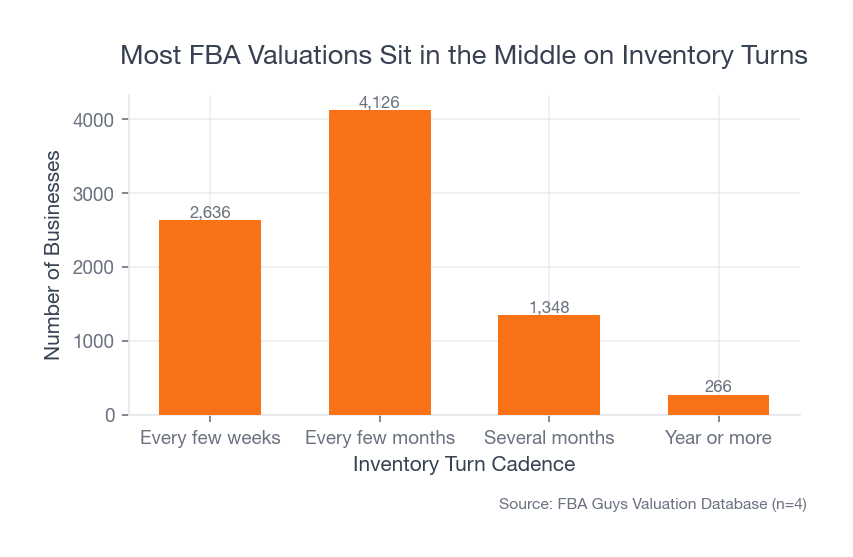 Source: FBA Guys Valuation Database (n=8,376)
The better result shows up when you hold margin bands constant. In the <20% margin band, businesses with fast turns averaged a 1.69x multiple. Medium turns averaged 2.04x. Slow turns averaged 1.61x. In the 20-39% margin band, fast turns averaged 2.23x, medium turns 2.42x, and slow turns 2.08x. In the 40%+ band, fast turns averaged 2.52x, medium turns 2.66x, and slow turns 2.43x.
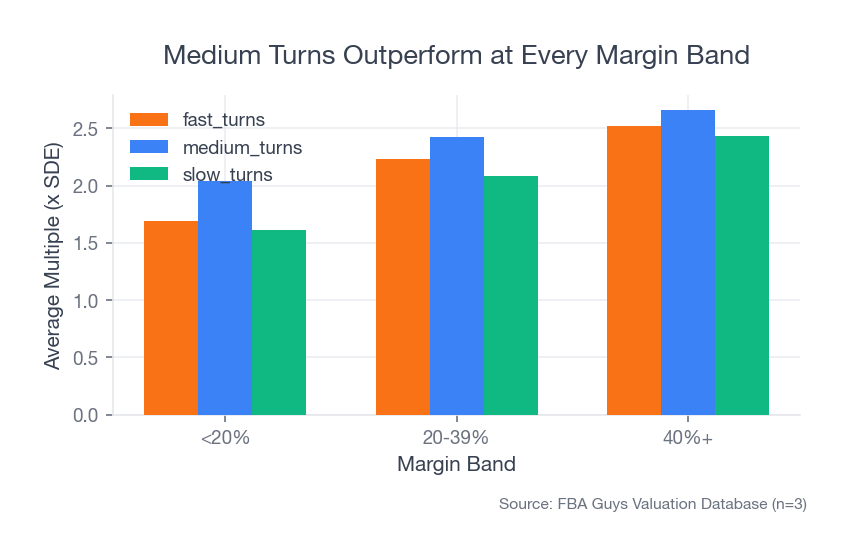 Source: FBA Guys Valuation Database (n=8,376 underlying query set)
We reran that query because the first pass felt backward.
Same result.
Why would medium turns beat the fastest group in every margin band?
Probably because buyers do not only want speed. They want control. They want enough margin in the unit, enough breathing room in the cash cycle, and enough operational stability that the business does not feel like it has to sprint constantly just to keep the spreadsheet from confessing. A business can move inventory fast because demand is healthy. It can also move inventory fast because the operator is solving for cash pressure every month and doesn't have the luxury of calm decisions. Those are not the same thing.
That is why bad landed-cost math matters more than the phrase "bad landed-cost math" sounds like it should. If import costs are understated, the margin cushion looks stronger than it is. If the margin cushion looks stronger than it is, you will tolerate pricing, reorder cadence, and ad spend that only make sense while the flattering number survives. Then the inventory-turn pattern starts getting interpreted through a cost structure that never really existed.
And if you are wondering whether buyers can feel that kind of fragility, yes, they usually can.
The expensive part is usually cash, not arithmetic
The formula itself is arithmetic.
The pain shows up in cash timing.
You pay the supplier on one schedule. Freight and customs cash hit on another. Inventory ties up money before it proves anything. Amazon pays on its own cadence. Ads keep spending because the machine never waits for your accounting preferences. Then someone notices that the product still reports an acceptable gross margin while the bank account feels surprisingly thin, and everyone acts as though those two facts should not be able to coexist.
Of course they can coexist. That is the whole problem.
The database has a blunt but useful proxy for this: access to a credit line. Businesses with a credit line averaged a 2.60x multiple across 4,395 successful valuations. Businesses without one averaged 2.18x across 3,981.
That result gets more interesting when you add the margin context. The credit-line group did not even post higher average margin. It averaged 44.8% margin versus 46.5% for the no-credit-line group. The higher multiple still showed up.
What does that tell you?
It suggests buyers are not only rewarding prettier percentage margins. They may also be rewarding the practical ability to absorb inventory and import-cost timing without turning every reorder into a small household emergency disguised as a business process. Flexibility is valuable, and cash flexibility is especially valuable in a model where cost outflows happen before confidence arrives.
That matters for a landed-cost breakdown because sellers love to treat landed cost as a per-unit truth and cash strain as some separate finance conversation. They are the same conversation seen from different distances. If your landed-cost model understates the real cash tied up in the unit, you will overestimate how comfortable the reorder is. If you overestimate how comfortable the reorder is, you will call a tight decision a strategic decision. Then the business starts feeling more stressful than the margin report says it should, which is one of the oldest signs that the underlying cost logic is flattering you.
You don't need more dashboards at that point.
You need truer inputs.
Supplier coverage matters more than a heroic spreadsheet
A landed-cost breakdown also gets more believable when the sourcing setup itself isn't fragile. In the current dataset, 2,942 successful valuations rely on one vendor. 4,082 operate with 2-5 vendors. After that the counts fall off quickly: 747 in the 6-10 bucket and 605 once you combine the more_than_10 and >10 labels.
That pattern matters because sellers sometimes hear "landed cost" and assume the only relevant conversation is import math. It isn't. Cost math becomes more trustworthy when the business has at least one realistic backup path, because the number is then anchored to a sourcing system that can absorb pressure rather than just a spreadsheet that can format pressure nicely.
The second supplier still matters more than the tenth. We have seen that in other slices of the data, and it is still the useful way to think about it here. A business with one fragile supplier relationship and a gorgeous landed-cost file is still fragile. A business with two or three realistic supplier options and a habit of rerunning the ugly cost lines is usually telling you a much healthier story, even if the spreadsheet itself looks less elegant because more real-world complexity is allowed to stay visible.
There is a scar hidden in this section, and it matters. We genuinely expected the inventory-turn result to flatter the fastest group more than it did. It didn't. The rerun came back the same way, which forced the article to get less smug. Faster is not always better. Lower-looking cost is not always safer. The stronger business is often the one with enough slack to avoid making panicked decisions every time freight moves, customs treatment gets revisited, or a supplier asks for a change that makes the old unit-cost story feel embarrassingly optimistic.
That is a much better landed-cost lesson than "remember to include tariffs."
When a calculator is enough and when you need outside help
A calculator is enough when the classification is settled, the customs treatment is clear enough to trust, the freight assumptions are current, and the smaller import-related charges are actually being allocated instead of buried where they stop interrupting the story. That covers a lot of normal operating work, and you shouldn't overcomplicate routine modeling just because complexity feels serious.
But when do you need help?
You need a customs broker or another trade specialist when classification itself is unclear, when product composition creates edge cases, when a policy change may affect treatment, when low-value shipment assumptions are doing too much work in the model, or when the dollars at stake are large enough that being confidently wrong would be expensive in a deeply unfunny way.
CBP's duty-rate guidance says the quiet part plainly: the HTS is the reference point, your answer is only as good as the information you provide, and CBP makes the final determination. The HTS search tool is useful because it gives you a place to start. It is not a substitute for judgment, and it certainly isn't a substitute for fixing your model when new information makes the old answer less flattering.
That boundary matters because sellers keep asking calculators to replace unresolved customs judgment. They won't. A calculator is good at arithmetic. It isn't good at turning ambiguity into certainty just because the cells recalculate cleanly.
The mistakes that make an Amazon FBA landed cost breakdown lie
The first mistake is leaving out the small lines because they look too small to deserve a fight. Broker fees, prep, destination handling, inspection, relabeling, small customs admin charges. Tiny on one unit. Annoying across a reorder. Embarrassing across a year.
The second mistake is updating supplier cost but not freight, which is one of those errors that feels temporary right up until it becomes your normal number.
The third mistake is treating duty or tariff assumptions as durable just because the last shipment cleared under those assumptions and nobody wants to reopen the discussion.
The fourth mistake is forgetting that landed cost sits upstream from contribution margin and profit margin. If you want the tariff-specific companion to this article, read Amazon FBA duty and tariff calculator. By the time you are arguing about downstream percentages, the first lie may already have happened earlier in the model. Those later metrics don't rescue you from that.
The fifth mistake is pretending the cash strain from landed cost belongs to finance while SKU economics belong to operations. It is the same problem wearing two shirts, and the business doesn't care which department thought it owned the conversation.
The fact is, a landed-cost breakdown matters because it keeps the product from looking cheaper, safer, and easier to finance than it really is. That is the whole game. Break the number into the real components. Use the landed cost calculator if you want a working model, but don't let the interface flatter you into skipping the ugly lines. Date-stamp the assumptions that can move. Recheck the ugly lines when the shipment profile changes. If the SKU looks worse afterward, good. You don't need a kinder spreadsheet. You need one that survives contact with actual invoices, current customs treatment, and the very ordinary fact that inventory ties up cash long before it delivers certainty.
FAQ
What is included in an Amazon FBA landed cost breakdown?
Supplier cost, freight, customs duty, any additional tariffs or trade measures that apply, broker and entry fees, prep and packaging, inspection or relabeling when those costs are real, and any other pre-FBA charge you have to absorb before the unit is actually ready to sell.
Is landed cost the same as total Amazon unit cost?
No. Landed cost gets the product to the point where it is ready to sell. Amazon referral fees, FBA fulfillment, storage, advertising, and returns sit downstream from that. If you blur those together, you won't know which part of the stack got worse.
How often should you update landed-cost assumptions?
Whenever supplier cost, route, dimensions, freight mode, customs treatment, or fee allocation changes. In practice, that means more often than most sellers want to hear, because import-cost inputs age quietly while the spreadsheet keeps acting fresh.
Can a landed-cost calculator replace a customs broker?
No. It can model routine economics. It can't resolve genuine classification ambiguity or policy-sensitive customs questions for you, and you shouldn't ask it to.
Why does landed cost matter so much for valuation?
Because margin quality, working-capital pressure, and sourcing fragility all show up eventually, even when the model tries to smooth them over. Buyers may not call it a landed-cost problem in so many words, but they still price the consequences.
Curious what your business is worth?
Get a free, instant valuation and see how your Amazon business stacks up.
Get Your Free Valuation