Are Amazon Lightning Deals Worth It? The Discount Has to Survive the Math
The FBA Guys
May 21, 2026
Lightning Deals have a strange pull on Amazon sellers.
They look like momentum. A badge, a countdown, a burst of orders, and for a few hours the listing feels more alive than it did yesterday. It is easy to understand the appeal.
Amazon Lightning Deals are worth it when the deal clears a specific business problem: overstock, launch momentum, repeat-purchase acquisition, or ranking support for a SKU with enough margin to fund the discount. They usually aren't worth it when the deal is being used to manufacture revenue on a product that already has thin contribution margin.
The deal itself is simple. The math around it gets fussy.
Amazon describes Lightning Deals as limited-time offers that can last only a few hours, with limited promotional quantity. Amazon's seller-facing Deals Guide says Lightning Deals usually run for 4 to 12 hours as determined by Amazon, and the guide lists seller and product eligibility requirements such as a Professional selling account, sales history, Prime eligibility, review standards, and discount requirements.
That is the platform frame.
The business frame is different: did the promotion create profit, clear the right inventory, or produce customers you can keep?
What a Lightning Deal Actually Changes
A Lightning Deal changes four things at once:
- Price
- Unit velocity
- Visibility
- Inventory movement
Only one of those is visible while the deal is running. The other three show up later, usually in the part of the P&L sellers don't check quickly enough.
The tempting part is unit velocity. You sold 180 units in an afternoon. Great. What happened to contribution margin after the discount, referral fee, FBA fee, advertising support, and deal fee?
Contribution margin is the profit left on a unit after direct selling costs. For a Lightning Deal, it is the first number to protect. If your normal contribution margin is $9 per unit and the deal discount takes away $6, you have $3 left before the deal fee gets allocated.
That can still work.
It can also turn a busy day into a pretty screenshot attached to a losing promotion.
The Margin Test Before You Submit the Deal
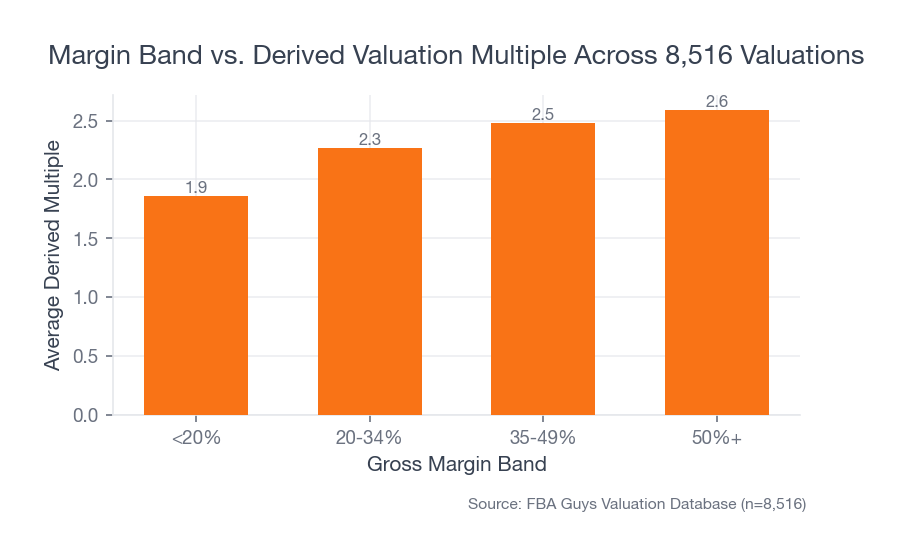
The FBA Guys valuation database gives us a useful starting point. Among 8,516 successful valuation records with positive computed SDE, businesses with margins below 20% averaged a 1.86x valuation multiple. Businesses between 20% and 34% averaged 2.27x. Businesses between 35% and 49% averaged 2.48x, and businesses above 50% averaged 2.59x.
 Source: FBA Guys Valuation Database (n=8,516)
That pattern isn't only about valuation. It is about flexibility.
Higher-margin businesses have more room to buy traffic, fund discounts, and make mistakes without turning the product upside down. Lower-margin businesses can still run promotions, of course, but the promotion has to be much more precise.
Here is the test we would use before calling an Amazon Lightning Deal worth it:
Normal selling price minus deal price.
Then subtract the deal fee allocation per unit, incremental ads, FBA fees, referral fees, return allowance, and any coupon stacking that might apply. Amazon's Seller Central deal instructions say sellers review the fee before submission and that fees are charged after the deal finishes running.
If the remaining contribution margin is positive, ask a harder question: positive enough for the reason you are running the deal?
There is a difference between a deal that makes $1 per unit while clearing old inventory and a deal that makes $1 per unit while pulling demand forward from next week. Same margin. Different business result.
When a Lightning Deal Makes Sense
A Lightning Deal typically makes sense in four situations.
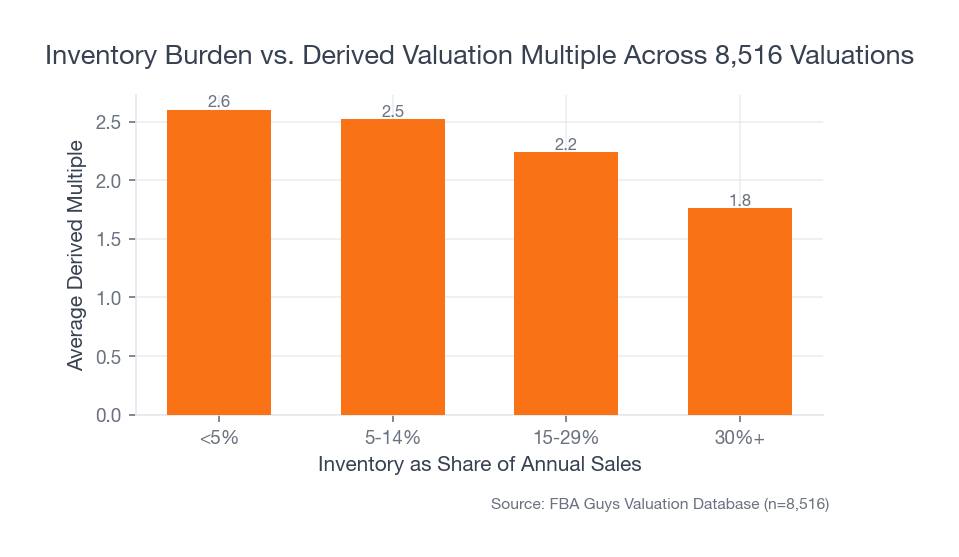
First, you have stale inventory that is quietly creating a worse problem. In our valuation data, businesses with inventory below 5% of annual sales averaged a 2.60x multiple. Businesses with inventory at 30% or more of annual sales averaged 1.76x.
 Source: FBA Guys Valuation Database (n=8,516)
That gap is too large to ignore.
Inventory isn't just cash sitting on a shelf. It affects storage fees, reorder decisions, working capital, and how cleanly the business can be explained. If a Lightning Deal turns excess inventory into cash without destroying margin, it may be doing something useful even if the promotion doesn't look impressive on a pure profit basis.
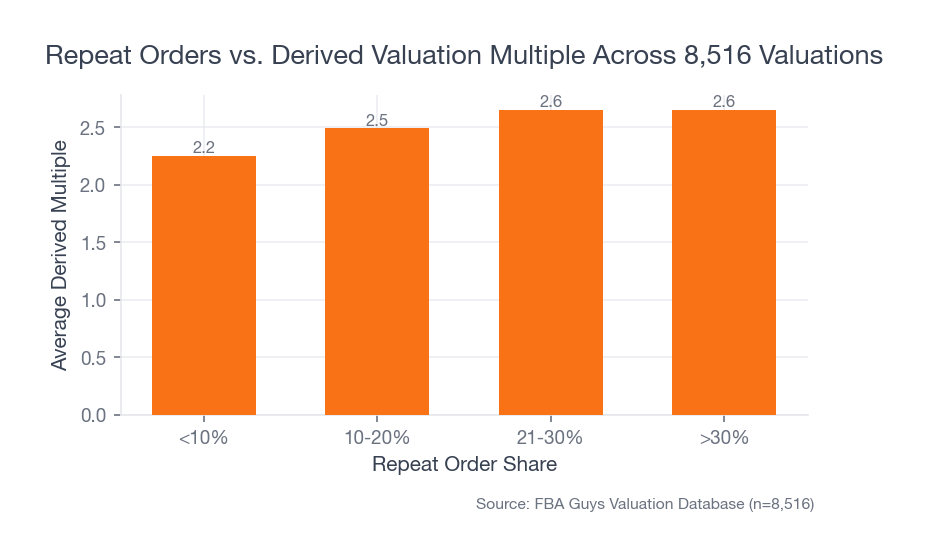
Second, the product has repeat purchase behavior. Businesses with less than 10% repeat orders averaged a 2.25x multiple in our data. Businesses in the 21-30% repeat-order range averaged 2.65x.
 Source: FBA Guys Valuation Database (n=8,516)
That makes the first order more interesting.
If a promoted customer comes back at full price, the initial discount can behave more like acquisition cost. The same logic shows up in Subscribe and Save profitability: the first order gets more interesting only when the second order has real margin. If the product is a one-time purchase, the deal has fewer ways to redeem itself.
Third, the product already has trust. Amazon's deal materials point to review and eligibility standards for a reason. The customer sees the badge, but they still see the product detail page. A 4.5-star listing with useful images and a clear offer has a different ceiling than a listing that still feels unfinished.
Fourth, the deal supports a real growth trend. In the FBA Guys database, stable businesses averaged a 2.37x multiple, increased businesses averaged 2.54x, and increased-a-lot businesses averaged 2.50x.
The interesting part is how close the last two were.
A sudden spike doesn't automatically make a healthier business. Durable trend does. A Lightning Deal should feed the trend you already understand, not substitute for one.
A Small Annoyance: The Deal Can Make Your Numbers Harder to Read
This is the part that gets less attention because it is boring.
After the deal, your average selling price drops. Your return rate may change. Your ad spend may be different because you supported the deal window. Your settlement report may include the fee in a place that doesn't line up neatly with the day you mentally assign to the promotion.
Honestly, this is where a lot of promotion analysis gets lazy.
The seller remembers the sales graph. The books remember everything else.
If you run a Lightning Deal, tag the SKU, date, units, discount, fee, incremental ad spend, and post-deal sales separately. Even a plain spreadsheet is fine. The record matters more than the software.
When It Usually Doesn't Make Sense
A Lightning Deal usually doesn't make sense when the product is already margin-starved, review-weak, inventory-constrained, or dependent on discounting to look alive.
If you are about to stock out, a deal can create a second problem. The promotion may lift sales, but the lost rank and customer interruption after the stockout can erase the benefit. If you have plenty of inventory but no repeat purchase behavior, the math has to work on the first order. If the deal requires a discount that takes contribution margin negative, the expected lift has to be very specific.
Specific means a number, not a feeling.
The fact is, "brand awareness" is a dangerous reason to run a paid discount when you can't measure what happens after the customer buys. That is especially true when the SKU's unit economics were already tight before the discount.
How to Calculate Lightning Deal ROI
Use this structure:
Incremental gross profit - deal fee - incremental ad spend - incremental return cost = promotion profit
Then divide promotion profit by total promotion cost:
Promotion profit / (deal fee + discount cost + incremental ad spend + incremental return cost)
The key word is incremental.
If you would have sold 60 units without the deal and you sold 140 units with the deal, the deal didn't sell 140 incremental units. It sold 80. The first 60 were probably going to happen anyway.
To illustrate:
- Normal price: $30
- Deal price: $24
- Normal contribution margin before discount: $10
- Contribution margin after discount: $4
- Units sold during deal: 140
- Expected baseline units: 60
- Incremental units: 80
- Deal fee: check Seller Central for the current fee before submission
- Incremental ad spend: $150
The deal looks exciting at 140 units. The analysis starts at 80 incremental units and $4 contribution margin before the extra costs.
Small change. Very different read.
What to Measure After the Deal
Measure the deal in three windows.
During the deal, track units sold, contribution margin, ad spend, and whether the deal claimed the quantity you expected.
For the next seven days, track organic rank, full-price conversion rate, TACoS, and whether the SKU holds any lift without staying on discount.
For the next 30 to 60 days, track repeat orders, return rate, inventory position, and net profit by SKU.
The final question is simple: did the business get healthier?
Not busier. Healthier.
FAQ
Are Amazon Lightning Deals worth it for new products?
Sometimes, but new products have less room for vague goals. If the listing doesn't have enough reviews or sales history to qualify, the question may be theoretical anyway. If it does qualify, the deal should be tied to a launch plan with a clear post-deal measurement window.
How much discount do Lightning Deals require?
Amazon's seller-facing Deals Guide says discounts must be at least 15% off the lowest price in the last 30 days and comply with Amazon pricing policies. Check Seller Central before submitting because deal requirements can change by marketplace, event, and product.
Do Lightning Deals help ranking?
They can help unit velocity, and unit velocity can influence rank. The useful question is whether the lift holds after the discount ends. If rank only exists while margin is being sacrificed, the deal didn't create much.
Should I run a Lightning Deal or a coupon?
Use a Lightning Deal when the time-bound visibility and inventory movement matter. Use a coupon when you want a more controlled discount that can be tested over time. For either one, run the ROI math at the SKU level.
Curious what your business is worth?
Get a free, instant valuation and see how your Amazon business stacks up.
Get Your Free Valuation