Amazon Subscribe and Save Profitability: The Discount Only Works if the Reorder Is Cheaper Than the Reacquisition
The FBA Guys
March 23, 2026

Amazon Subscribe & Save is profitable when the discount costs you less than winning that order again from scratch, and most of the confusion around the program comes from sellers measuring the discount itself while ignoring the customer acquisition pressure, inventory discipline, and category behavior sitting underneath it.
That is the whole argument, though it takes a little work to prove.
As of the writing of this article, Amazon says many eligible FBA products are auto-enrolled at a 0% seller-funded discount, that sellers can raise that to 5% or 10%, and that Amazon funds a 5% discount on some deliveries with five or more items. You can see why people like the setup. It feels like a clean path to recurring revenue, and recurring revenue sounds expensive in the good way. But if you stop at that sentence, you will almost certainly overestimate what the program is doing for you.
We approached this from two directions because you need both. First, you need the operating math at the SKU level, where the truth is usually less glamorous and more useful. Second, you need the business-quality question, because a recurring order is not just a sale. It also tells you something about how defensible the product is, how dependent the account is on fresh demand, and whether the business looks calmer or merely cheaper. Our valuation database does not track Subscribe & Save as a standalone field, so we used repeat-order share as a proxy for recurring demand and labeled it that way throughout. Even with that limitation, the pattern was rather clear.
Higher repeat-order behavior tended to travel with stronger margins and higher valuation ratios. It just didn't behave like magic.
What makes Amazon Subscribe & Save profitable or unprofitable
The program itself is not the profit engine. The customer behavior behind it is, and if you blur those two things together you will end up praising a mechanism that is merely exposing whether the product deserved a second purchase in the first place.
If you sell something replenishable, keep it in stock, and retain the customer without having to buy that next order through PPC all over again, the discount can be a very cheap trade for you. If you use the program to prop up weak unit economics, or to persuade a customer back into a product they would not otherwise miss, it turns into a tidy little machine for shrinking gross profit while everyone congratulates themselves on the repeat-order rate.
The fact is, sellers often talk about Subscribe & Save as if it creates loyalty by itself. It doesn't. It reveals whether loyalty was already available at a price you can live with.
That may sound like a fussy distinction, but you can feel it immediately once you start looking at actual products instead of dashboard labels. A supplement, detergent, diaper, or pet consumable already has an argument for coming back into the cart. A novelty kitchen gadget, seasonal item, or product with an awkward replacement cycle generally doesn't, no matter how elegant the subscription settings look in Seller Central.
Our database proxy makes the broad point nicely. Among 8,368 valuations with usable repeat-order data, businesses below a 10% repeat-order rate averaged a 44.1% margin and a 0.93x average SDE multiple, while businesses above 30% averaged a 50.2% margin and a 1.24x average SDE multiple. That is a real change in business quality, not a decorative stat thrown into an SEO article to make it look awake.
It is also not permission to put every SKU on autopilot and hope the recurring revenue story writes itself for you.
How to calculate the true margin impact
You can calculate the first-order effect in a few lines, but the bigger job is deciding what those lines are actually measuring, because a clean formula can still lie to you if the assumptions around customer behavior are lazy.
Start here:
Subscribe & Save order contribution = net selling price after discounts - landed product cost - Amazon fees - fulfillment cost - packaging or prep cost - expected return/refund cost
Then force the spreadsheet to answer the question most people avoid because it makes the conversation less fun:
What customer acquisition cost did this repeat order save you?
That line matters because the discount is not the whole cost of the program, and "repeat revenue" is not the whole benefit. If the discount costs you $1.80, and if the retained order helps you avoid $4.60 in blended acquisition pressure that you would otherwise have to spend to recreate demand, the trade is usually quite good. If the discount costs you $1.80 and the customer was already going to reorder through habit, branded search, email, or plain inertia, you took the haircut for nothing and then called it strategy. If you need a cleaner baseline before doing that math, our guide on how to calculate Amazon FBA profit margin is the right place to start.
Here is a simplified composite to illustrate what this looks like in the real world:
- Selling price: $28.00
- Seller-funded Subscribe & Save discount: 10%
- Net price before fees: $25.20
- Landed product cost: $7.40
- Amazon referral and fulfillment costs: $8.10
- Prep, packaging, and expected return leakage: $1.20
That leaves $8.50 of contribution on the discounted order.
Now compare it with the non-subscription version of the same order. If that standard reorder would have contributed $11.30, the program cost you $2.80 in margin on that transaction. Was the customer going to reorder anyway? If yes, you paid $2.80 to feel modern. If no, and preserving that order means you avoided another paid path that typically costs you $4 to $6 to recreate, the math starts looking rather attractive because you gave up less than you saved.
Same arithmetic. Very different business.
This is where sellers get themselves into trouble. They treat the discount as the cost, even though the real cost is discount plus fee drag plus inventory risk plus the possibility that you trained a customer to wait for the lower price. Then they describe the upside as recurring revenue, even though the real upside is a retained order that costs less to keep than a fresh order costs to win. If you remember only one line from this article, make it that one. And if your reacquisition math still feels slippery, our breakdown of how to calculate TACoS for Amazon PPC gives you the paid-demand side of the equation.
You can push the analysis one step further, and you should, because a formula without operating context is just a prettier guess. Ask yourself what happens when the product is out of stock for ten days. Ask what happens when the customer subscribed because a launch coupon stacked nicely with the first order, then cancels on the second cycle once the cabinet is full. Ask whether the reorder cadence matches how people actually use the product, or whether you are quietly bribing them into a subscription rhythm they never wanted.
That is where the spreadsheet gets human enough to be useful.
Products with natural replenishment cycles usually survive this scrutiny rather well. Supplements, household consumables, baby goods, pet products, and other repeatable consumables typically have a clearer argument for coming back into the cart. The reorder behavior is often built into the product, so the subscription discount acts more like lubrication than deception. Other products are trickier, because the subscription can look healthy for a quarter while the underlying behavior stays flimsy, and then you find out the hard way that a repeat-order metric was flattering a product that never really earned habit in the first place.
For a while we thought the database might be too blunt to say anything useful here because it does not track Subscribe & Save directly. It wasn't. Once we normalized the repeat-order buckets, the pattern came through cleanly enough to support the bigger point. The harder part was not the data. The harder part was resisting the temptation to say the program caused the behavior, when all we can honestly say is that repeat behavior and stronger business quality tend to travel together.
That distinction is annoying if you wanted a simpler story. It is also what keeps the article honest.
When repeat orders help more than they hurt
Most businesses in our data do not have much recurring behavior at all, which is useful context because sellers can get strangely proud of a repeat-order rate that is ordinary once you step back from your own dashboard.
Nearly half of the usable sample, 47.5%, sat below a 10% repeat-order rate. Another 33.5% lived between 10% and 20%. Only 11.9% reached the 21% to 30% bucket, and just 7.1% cleared 30%. So when someone tells you they have repeat buyers, the natural response is not applause. It is a question: how many?
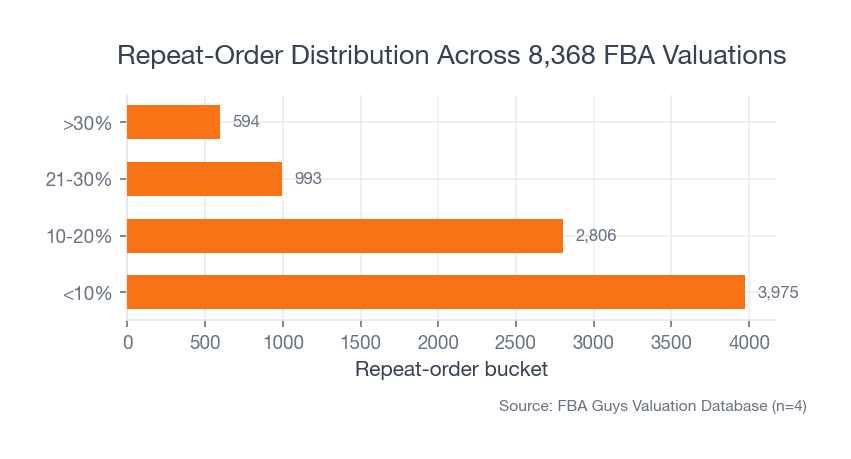 Source: FBA Guys Valuation Database (n=8,368)
The second pattern matters more. As repeat-order share rose, the valuation metrics kept stepping up as well. Businesses below the 10% bucket averaged 0.85x value-to-revenue. The 10% to 20% group averaged 0.95x. The 21% to 30% group reached 1.06x. Above 30%, the average reached 1.12x. Margins moved in the same direction, climbing from 44.1% below the 10% bucket to 50.2% above 30%.
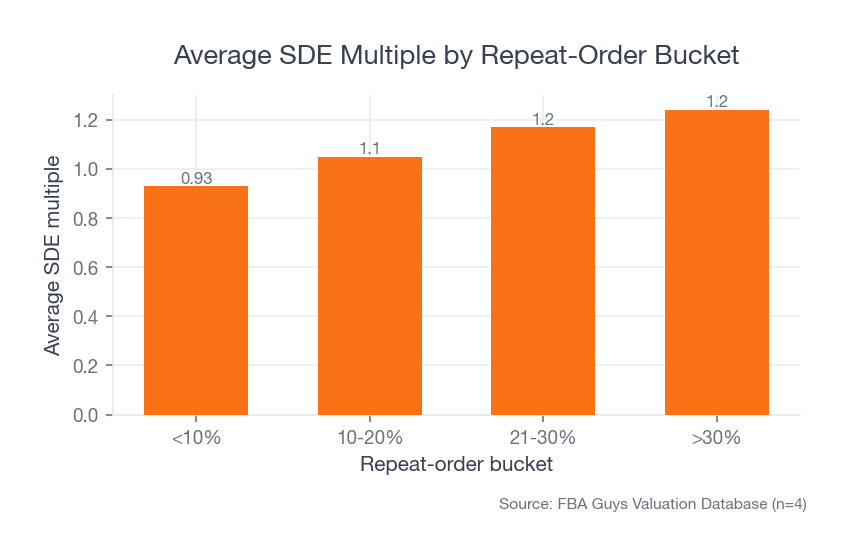 Source: FBA Guys Valuation Database (n=8,368)
Why would buyers care so much about that?
Because recurring demand changes the shape of the risk. It suggests that future revenue does not need to be reinvented from zero each month, that the product has earned some place in the customer's routine, and that the business may be less dependent on constantly paying for attention. Buyers are not paying for the phrase recurring revenue. They are paying for a business that looks more stable, more defensible, and easier to forecast when they open the hood. That is also why recurring demand matters in any broader Amazon FBA business valuation conversation.
There is a difference, and you can feel it in a valuation long before anyone starts using fancy retention language.
When the discount is a bad trade
A bad Subscribe & Save setup usually fails in one of four ways, and none of them are mysterious once you stop pretending the program can rescue a weak product.
The first failure is simple. Your margin was too thin before the discount, and you enrolled anyway because conversion looked more exciting than gross profit.
The second is subtler and more common. The reorder was going to happen anyway, so the discount bought you nothing except a lower realized margin and a customer now trained to expect the cheaper price.
The third failure is operational. You win the subscription, go out of stock, retrain the customer to buy elsewhere, and learn the world's least enjoyable lesson about retention. Amazon's own seller materials are rather direct on this point. Keeping enrolled items in stock is a core best practice, which sounds obvious right up until you remember how many brands still let the replenishment product stock out because a launch took precedence.
The fourth failure is strategic. Sellers enroll too many products because the dashboard makes the decision look reversible and tidy. It is reversible. It is not tidy. A weak SKU with a weak reorder pattern does not become stronger because you attached a subscription cadence to it.
Here is the business consequence turn most people skip. Once you train a meaningful share of customers to expect the lower price, the non-subscription order starts looking expensive even when the original economics were fine. You don't notice this on day one. You notice it later, when the subscription base looks healthy, the top line looks stable enough, and the gross profit line feels a little too polite for the amount of work the account is doing. That is a nasty feeling because the business does not look broken. It just looks less rewarding than it should.
If the customer needs heavy bribery to come back, you probably don't have a Subscribe & Save winner. You have a retention problem wearing an operations costume.
Why buyers care about repeat orders and still punish a weak trend line
This was the best finding in the memo because it keeps the article from drifting into the usual retention worship.
High repeat-order behavior supports value. It doesn't excuse decline.
In our proxy data, businesses with more than 30% repeat orders and a stable trend averaged a 1.28x SDE multiple. Businesses in the same repeat bucket with an increasing trend averaged 1.26x. Those are healthy numbers. They suggest a business that buyers can understand without a lot of narrative gymnastics.
But businesses above 30% repeat orders with a declining trend averaged 0.94x.
That is the same average multiple as businesses below 10% repeat orders that were merely stable.
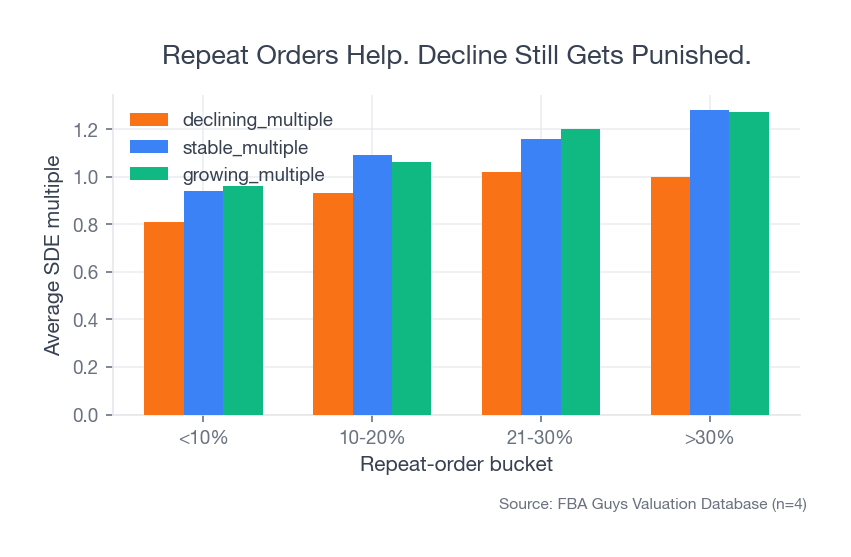 Source: FBA Guys Valuation Database (n=8,368)
Read that again because it kills a lot of lazy storytelling. Repeat demand can stabilize a business. It cannot fully rescue one that is shrinking in ways buyers don't like. Why not? Because buyers still ask the same unpleasant questions they ask everywhere else. Is the product getting tired? Did the category get more competitive? Is the customer base genuinely loyal, or merely slow to leave? Are subscriptions supporting the business, or hiding the fact that new demand has gone soft?
Recurring demand lowers some risk. It does not remove the Growth pillar from the equation, and you can see that clearly in the data once you stop asking the program to do work that belongs to the business model itself.
That is why the best Subscribe & Save businesses usually feel boring in a productive way. The product gets reordered. Inventory stays available. Margin survives the discount. The account is not trying to buy growth with coupons every third Tuesday while someone in the finance seat pretends the trend line is still fine. Nothing dramatic is happening, and that is precisely what buyers pay for.
The odd part is that sellers often spend more time arguing about whether the program works than measuring what kind of business it is sitting inside. We would reverse that. Start with the business. Then decide how much of it Subscribe & Save should touch.
So is Amazon Subscribe & Save worth it for sellers?
Usually yes for the right products. Absolutely not by default.
If the product replenishes naturally, your margin can absorb the discount, your inventory is reliable, and the retained order is cheaper than reacquiring the customer, the program can be excellent for you. Amazon's current setup also makes testing relatively accessible because eligible products can start at a 0% seller-funded discount and move upward only if the economics justify it.
That does not make the answer easy. It just means the experiment is cheap enough to run if you are honest while it is running.
Run the product-level math. Compare discounted reorder contribution against your true reacquisition cost. Watch cancellation behavior. Watch stockouts. Watch whether the subscription base makes the business calmer or merely flatter. If it makes the business calmer, buyers usually like what they see. If it makes the business flatter, you bought stability at the wrong price.
FAQ
Does Amazon fund part of the Subscribe & Save discount?
As of the writing of this article, yes. Amazon's current seller materials say eligible products can be auto-enrolled at a 0% seller-funded discount, sellers can raise that to 5% or 10%, and Amazon funds a 5% discount on some deliveries with five or more items. Helpful? Certainly. Enough to let you skip your own margin math? Not a chance.
Do you have to use FBA for Subscribe & Save?
For automatic enrollment, yes, under Amazon's current program rules. Seller-fulfilled products can still be requested for enrollment through Seller Support. That detail sounds administrative until you are juggling replenishment inventory, which is usually when it becomes painfully operational.
Does Subscribe & Save improve valuation by itself?
No. Our valuation database only shows repeat-order share as a proxy, not direct program participation, and the real pattern is broader than the program itself. Higher repeat behavior correlates with stronger margins and valuation. A declining business still gets punished, which is exactly the kind of correction sellers would rather not hear.
What is a good repeat-order rate on Amazon?
Higher than the lazy benchmark in your head.
In our usable sample, 47.5% of businesses sat below a 10% repeat-order rate, while only 7.1% cleared 30%. So if your product or brand is sustaining repeat behavior above 30%, that is worth paying attention to. It isn't automatically great. But it is no longer ordinary.
Should every replenishable SKU be enrolled?
No, and this is where sellers slip into completeness thinking. Some replenishable products still have weak margins, awkward reorder cycles, or enough baseline loyalty that the discount just gives money away. The right question isn't "could this be subscribed?" It is "does this make the next order cheaper to keep than to buy again?"
Curious what your business is worth?
Get a free, instant valuation and see how your Amazon business stacks up.
Get Your Free Valuation