Amazon Vine Program for New Products: The First Reviews Are Only the Beginning
The FBA Guys
May 20, 2026

A new Amazon product page has a strange kind of silence to it.
The images can be clean. The title can be tight. The bullets can answer the obvious questions. Then the buyer scrolls to the review section and finds nothing, or almost nothing, and the whole page starts to feel untested. That is the moment the Amazon Vine program for new products is trying to solve.
As of the writing of this article, Amazon Vine lets eligible sellers provide free units to Amazon-invited reviewers, called Vine Voices, who can request the product and leave honest reviews. For a new product, the practical attraction is simple: Vine can help the listing stop looking empty while the product is still early enough for feedback to matter.
It doesn't make the product good.
That is the useful boundary. Vine can accelerate early review exposure. It can give you customer language, defect warnings, fit complaints, packaging feedback, and social proof before the listing has much sales history. It can't turn a weak product into a defensible one, and it can't tell you whether the business underneath the launch is getting stronger.
Our valuation database doesn't track Vine enrollment. We can't say Vine users sell for higher multiples, and we shouldn't pretend otherwise. What we can see is the business context Vine touches: review depth, Brand Registry, product uniqueness, SKU breadth, and new product cadence. The pattern is quite interesting. Early reviews matter, but the businesses that look healthier are usually not just collecting reviews. They are launching products that deserve interpretation.
What the Amazon Vine Program Actually Does for a New Product
Amazon Vine is a review-access program. You enroll eligible products, make units available, and Amazon offers those products to Vine Voices. The reviewers choose products they want to try, receive them through FBA, and publish reviews that reflect their honest opinion.
That last phrase matters.
Vine isn't a paid positive-review program. It isn't a way to script praise, and it isn't a way to bury product uncertainty under a layer of friendly stars. The seller gives up inventory and pays the program cost when the billing conditions are met. The reviewer still controls the opinion.
For a new product, that creates a useful kind of pressure. If the product page overpromises, Vine may expose that faster. If the packaging is confusing, Vine may surface it. If the product solves a real problem and the listing explains it clearly, Vine can help the page get out of the zero-review hole.
The fact is, that is a narrower and better use than treating Vine as launch magic.
Who Can Use Amazon Vine
As of the writing of this article, Amazon says sellers need a Professional selling account and eligible FBA offers to participate. For branded products, the seller generally needs the right Brand Registry role, such as Brand Representative or Reseller. Amazon also says generic products can be eligible in the catalog.
Product-level requirements matter too. Amazon's current Vine pages say enrolled products need FBA selected as the fulfillment method, fewer than 30 reviews on the product detail page, an image, and a description. Amazon lists adult, digital, and bundled products as ineligible on its program page, and its seller-tool page also lists heavy and bulky products as ineligible.
Check Seller Central before you build the launch plan around Vine. Amazon program rules change, and category details can make a tidy article age badly.
One more practical detail: Vine is tied to FBA partly because Amazon protects reviewer anonymity. If you were hoping to run this through FBM and send a handwritten note with the box, that isn't the shape of the program.
What Amazon Vine Costs
As of the writing of this article, Amazon's US Vine enrollment tiers are based on units enrolled per parent product:
| Units enrolled per parent product | Amazon Vine enrollment cost |
|---|---|
| Up to 2 units | $0 |
| 3-10 units | $75 |
| 11-30 units | $200 |
Amazon says there is no additional enrollment cost for child products. It also says sellers are charged after the first review is published, and sellers won't be charged if no Vine review is received within 90 days from enrollment.
That table is the easy cost.
The real cost includes the free units, FBA costs, referral fees where applicable under Amazon's current rules, and the possibility that the product receives blunt feedback in public. For a $14 accessory, the inventory cost may be tolerable. For a bulky, high-COGS product, 30 units can feel less like a marketing test and more like a small bonfire with labels on it.
Of course, some launches can justify that. A product with strong margin, clean positioning, and a real differentiation story may need early review volume to get the flywheel moving. A product with thin margin and a vague reason to exist may only learn faster that the market is not impressed.
What Our Valuation Data Can and Can't Say About Vine
We need to be precise here because this is where lazy analysis gets tempting.
The FBA Guys valuation database doesn't store Amazon Vine enrollment, Vine unit claims, Vine review counts, Vine fees, or whether a product used Vine before launch. So we aren't claiming Vine causes a valuation increase. That would be too clean, and too convenient.
What the database does show is review depth.
Among 8,517 successful valuations with review-count data, businesses with fewer than 25 reviews averaged 1.64 derived value-to-SDE. Businesses with 25-100 reviews averaged 2.03. The pattern kept climbing: 100-250 reviews averaged 2.36, 250-1,000 averaged 2.53, and 1,000+ averaged 2.66.
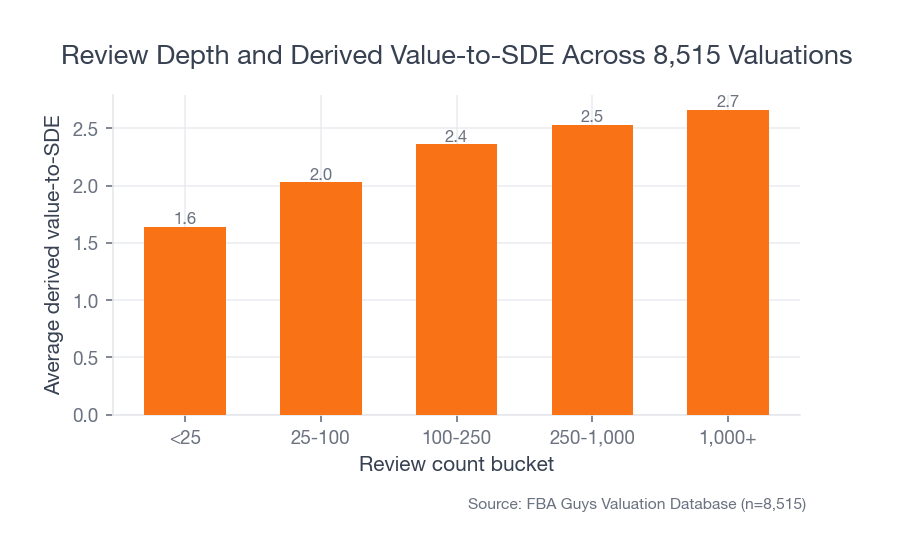 Source: FBA Guys Valuation Database (n=8,515)
Derived value-to-SDE is a valuation-context measure. It is calculated as valuation divided by derived seller's discretionary earnings, where derived SDE is gross profit minus operating expenses. It isn't a public market multiple and it isn't a promise that more reviews automatically create value.
Still, the shape of the data is useful. The first 30 reviews are meaningful because they help a buyer trust the listing enough to keep reading. They aren't the same as 300 reviews, and they certainly aren't the same as years of customer proof across a mature catalog.
This is the quiet trap in Vine. It can make a product look less new. It can't make the product seasoned.
The Product Has to Give Reviewers Something Real to Evaluate
The strongest Vine candidates usually have a concrete reason to exist. Different material. Better fit. Clearer use case. Stronger bundle. Simpler install. Better compatibility. Something.
Our proxy data points in the same direction. Among 8,515 valuations with usable Brand Registry and product-uniqueness data, businesses with Brand Registry yes/partial plus unique products averaged 2.73 derived value-to-SDE. Brand Registry yes/partial plus not-unique products averaged 2.34. No or unsure Brand Registry plus not-unique products averaged 1.62.
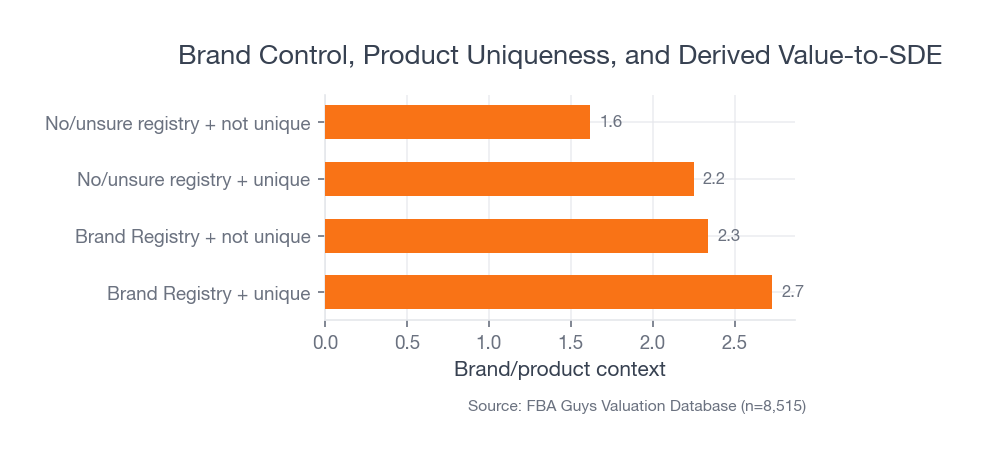 Source: FBA Guys Valuation Database (n=8,515)
That doesn't mean Brand Registry or uniqueness alone creates value. It means the business context looks better when there is something ownable and something distinct. Vine fits best in that context because reviewers can talk about real differences instead of describing another version of a product Amazon already has in 400 colors.
The messy detail is usually in the three-star review. "Nice pouch, zipper sticks at the corner." "Great size, but the included screws stripped immediately." "Works, but the instruction card uses photos from the older model." That isn't glamorous customer insight. It is more useful than another dashboard screenshot with a green arrow.
When Vine Makes Sense for a Launch
Use Vine when the product is ready for honest strangers.
That sounds obvious. It is also the part that gets skipped when the launch calendar starts bullying the product team.
The listing should already have a clear main image, readable secondary images, accurate dimensions, complete compatibility notes, solid packaging, and enough inventory planning to handle the sales lift if the product works. If you are still arguing internally about what comes in the box, wait. Vine reviewers aren't beta testers who agreed to be gentle.
Vine is especially useful when one of these is true:
- The product solves a specific fit, compatibility, setup, or use-case problem.
- The product is better than competitors in a way a reviewer can actually experience.
- The category needs review proof before shoppers will trust a new listing.
- The brand can afford the product cost, program fee, and potential criticism.
- The team is willing to revise the listing or product based on the feedback.
There is a scar in this kind of launch work. The feedback you wanted for conversion may become feedback about the product. A seller can be completely competent and still discover that the insert confused people, the color photographed warmer than the unit looked in hand, or the "compact" feature felt flimsy to someone who didn't see the prototype journey. That is uncomfortable. It is also useful before you reorder 5,000 units.
Launch Cadence Matters More Than Launch Theater
Vine is a per-product tool. That makes it tempting to apply it to every new ASIN that crosses the desk.
Our new-SKU data argues for more restraint. Businesses with 1-5 new SKUs averaged 2.61 derived value-to-SDE across 2,627 valuations. Businesses with 6-20 new SKUs averaged 2.46. At 21-100 new SKUs, the average fell to 2.00. At 100+ new SKUs, it fell to 1.70.
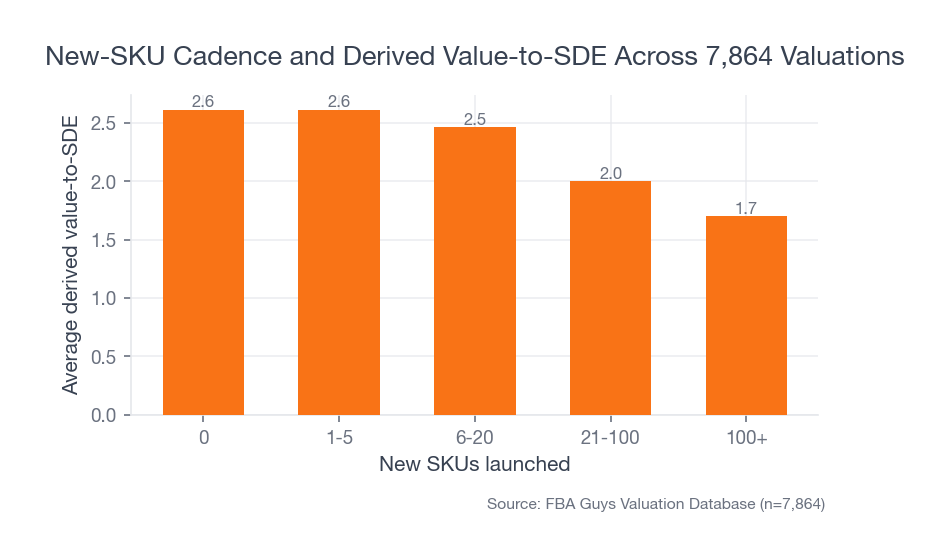 Source: FBA Guys Valuation Database (n=7,864)
There are good businesses with large catalogs, of course. Catalog models exist for a reason. But the pattern suggests that disciplined product expansion tends to read differently from SKU sprawl. Vine can't fix a launch process that produces too many products for the operator to understand.
This is where the operator question changes. Not "Can we get reviews on this?" The better question is: "If Vine gives us 12 honest reviews in the first month, who is responsible for learning from them?"
A review program without a feedback owner becomes decoration. Someone needs to read the language, tag the complaints, compare them to returns, update the listing, decide whether the issue is product, packaging, expectation, or category fit, and then decide whether the next reorder deserves more capital.
Tiny job. Somehow it never fits cleanly on a calendar.
How to Use Vine Without Learning the Wrong Lesson
The first lesson is to separate review count from product truth.
A product can collect early Vine reviews and still have weak repeat purchase behavior. It can get a few positive comments and still carry margin problems. It can look promising on the listing and still create operational drag if the package is expensive to ship, the size tier is awkward, or the defect rate starts to show up after the first few weeks.
So use Vine as one input in a launch scorecard. Keep the scorecard boring:
| Signal | What to watch |
|---|---|
| Vine claim rate | Are reviewers interested enough to request the product? |
| Review sentiment | What words do reviewers repeat without being prompted? |
| Star rating spread | Are complaints clustered around one fixable issue? |
| Organic conversion | Do non-Vine shoppers convert after reviews appear? |
| Returns and support | Do reviews match the problems customers report later? |
| Gross margin | Does the product still work after launch costs and discounts? |
| Reorder decision | Does the next PO deserve more, less, or no capital? |
A complicated model won't help much here. The useful thing is enough structure that one enthusiastic five-star review doesn't start making inventory decisions on your behalf.
This connects to the broader operating metrics that matter after launch. Review depth is a signal. So are contribution margin, stockout behavior, inventory burden, and SKU-level profitability. A product that wins early reviews while quietly consuming cash is giving you mixed information, not clean success.
What To Track After The Vine Reviews Arrive
The review count is the easiest number to watch and the least complete.
What happens after those reviews land? That is where the launch starts to tell you something more useful than "we got reviews."
Track the Vine claim rate first. If Vine Voices don't request the product, that is a signal. It may be a category issue, an image issue, a price-perceived-value issue, or simply a product that doesn't look interesting enough to try for free. That isn't the same as paid-customer demand, but it is still a reaction from strangers looking at the offer.
Track review language next.
Don't only record the average star rating. Pull the repeated phrases into a simple note: "smaller than expected," "good travel size," "hard to assemble," "works with iPhone case," "smell faded after one day," "box arrived crushed." A bland five-star review may be less useful than a three-star review that tells you exactly which part of the product needs attention.
Then compare the reviews to paid-customer behavior.
If conversion improves after Vine reviews appear, the page may have needed early trust. If conversion doesn't move, the reviews may be answering questions customers didn't have. If returns show the same issue that Vine reviewers mentioned, the product is giving you a second warning in a different format.
This is where Vine becomes more than a review tactic.
It can improve the listing, sharpen the product, and keep the next purchase order from becoming an expensive vote of confidence in a problem you already saw.
Where Vine Fits In A Business You Might Sell Someday
Vine won't appear as its own premium in a valuation model.
A buyer won't look at a business and pay more because a product used Vine in March. The evidence created by a successful launch can still matter because reviews, conversion stability, cleaner product feedback, stronger organic rank, and a repeatable launch process all feed into the broader story of growth and transferability.
The repeatable part matters.
If you can show how you evaluate a product before Vine, how you decide unit count, how you review customer language, and how you update the listing afterward, the launch process becomes easier to understand. If the records show nothing except a few zero-dollar orders, a $200 enrollment fee, and a Slack message that says "reviews looking good," the process disappears.
What does a repeatable launch process look like when someone else has to run it?
Keep a launch log. Save the pre-Vine listing screenshots, record the unit count and fee tier, note the first review date, summarize the feedback themes, and capture the changes you made because of those reviews. None of this has to be fancy. A plain spreadsheet with dates, links, screenshots, and decisions beats a perfect memory that only exists in the founder's head.
Documentation is boring right up until someone asks how the business actually grows.
FAQ
Is Amazon Vine worth it for a new product?
It can be worth it when the product is ready for outside scrutiny, the unit economics can absorb the giveaway, and early review detail would help shoppers make a decision. It is a poor fit when the product is half-tested or the launch budget is already stretched thin.
Does Amazon Vine guarantee positive reviews?
No. Vine reviewers are expected to leave honest, unbiased reviews. A free unit can still produce a critical review, and that is part of the bargain.
How many Vine units should I enroll?
Start with the job the reviews need to do. Some products may only need a few early reviews, while others may need a broader review base because shoppers care about fit, durability, assembly, texture, or compatibility. The maximum is 30 units, but the maximum isn't automatically the right answer.
Can I use Vine before launch?
Amazon says new products can be enrolled before launch once a customer-ready FBA listing exists and a future launch date is set. Amazon also recommends having inventory available in the fulfillment network at least three weeks before the planned launch date.
Do Vine reviews count as verified purchase reviews?
Vine reviews are labeled separately as Vine Customer Review of Free Product. Treat them as transparent early reviews, not ordinary full-price purchase reviews.
The First 30 Reviews Are a Doorway
Amazon Vine can be a good program for new products when the product is differentiated, the listing is ready, and the team treats early reviews as learning rather than applause.
The first 30 reviews help a product page feel less empty. They may help shoppers trust the product enough to buy. They may also reveal that the launch still has a product, packaging, positioning, or margin problem hiding underneath the page.
That is why Vine belongs near the beginning of the launch process, not at the center of the business strategy.
The review count can open the door. The product still has to walk through it.
Curious what your business is worth?
Get a free, instant valuation and see how your Amazon business stacks up.
Get Your Free Valuation