China Tariffs Impact on Amazon Sellers 2026: Margin Pressure Is the Easy Part
The FBA Guys
June 6, 2026

The dangerous thing about tariffs is how ordinary they look once they land in the spreadsheet.
One new duty line. One supplier email about revised pricing. One freight quote that looks almost like last quarter's, except for the small line item someone labeled "Misc China increase" because no one wanted to reopen the landed-cost model before lunch.
For the china tariffs impact on Amazon sellers 2026 question, the direct answer is this: tariffs raise the true landed cost of China-sourced products, compress gross margin unless price or cost structure changes, and make supplier optionality more valuable. The first-order problem is product margin. The larger business problem is whether the seller can explain and absorb the change without turning inventory, pricing, and valuation into guesswork.
That is where this gets more interesting than a tariff-rate table.
What Changed in 2026
As of the writing of this article, China tariff exposure isn't one clean number an Amazon seller can paste into a formula. It is a stack.
The stack can include the normal HTS duty rate, Section 301 duties for China-origin products, Chapter 99 tariff treatment, product-specific actions such as steel or aluminum derivative rules, and the practical loss of easy de minimis treatment for many China and Hong Kong shipments. On top of that, Amazon announced a 2026 fuel and logistics surcharge for AWD, MCF, and Buy with Prime, which isn't a tariff, but still shows up in the same place in an operator's head: the unit economics.
The timing matters. USTR extended 178 China Section 301 exclusions through November 10, 2026, and in June 2026 requested public comments on China's compliance with the US-China Economic and Trade Agreement and on proposed responsive tariff actions. The Federal Register also shows that de minimis duty-free treatment for covered PRC and Hong Kong shipments ended effective May 2, 2025.
Of course, your exact duty rate still depends on the product. The HTS code, country of origin, customs value, exclusions, shipment path, and current Customs and Border Protection treatment matter. A silicone spatula, a steel rack, and a battery-powered gadget don't have the same tariff story just because all three came from Shenzhen.
That little HTS-code aside is annoying. It is also the work.
How Tariffs Hit Your Landed Cost
Landed cost is the full cost required to get a sellable unit into inventory. For an Amazon seller, that usually means product cost, packaging, freight, insurance, customs duties, tariffs, inspection, prep, domestic handling, and other costs that belong to the unit before the unit is sold.
A tariff changes landed cost before the rest of the business gets a vote.
Here is a simplified version of the math. If a product sells for $50 and the factory cost plus inbound freight is $20, the product has $30 of room before Amazon referral fees, FBA fees, ad spend, storage, returns, overhead, and owner earnings start competing for the same dollars. If a tariff adds $5 to that unit, gross margin drops by 10 percentage points before the listing has seen a single customer.
Can you raise price? Sometimes.
Can you push the supplier? Sometimes.
Can you absorb it? Also sometimes, although that answer gets expensive when it becomes the default setting.
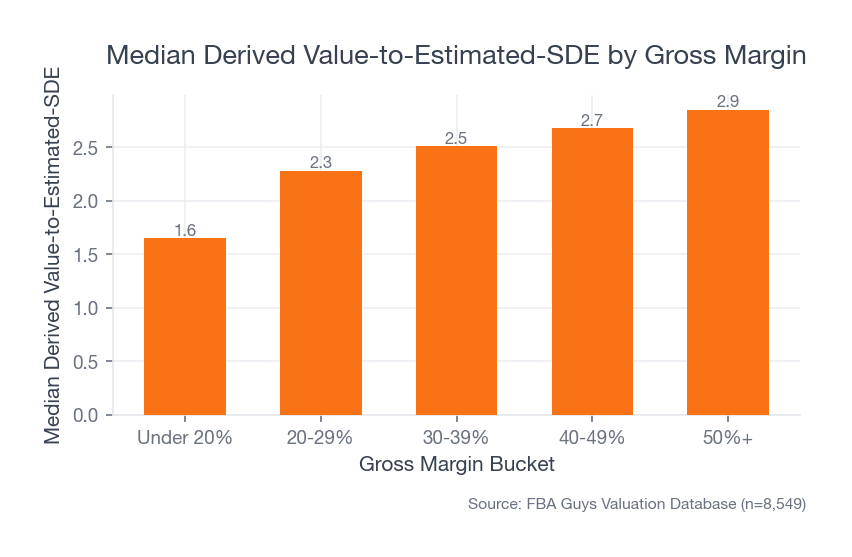
In the FBA Guys valuation database, gross-margin bands have a clear valuation-context pattern. Among 8,549 successful records with enough data to estimate SDE, the median derived value-to-estimated-SDE was 1.65 for businesses under 20% gross margin. It rose to 2.28 in the 20-29% bucket, 2.51 in the 30-39% bucket, 2.68 in the 40-49% bucket, and 2.85 for businesses at 50%+ gross margin.
 Source: FBA Guys Valuation Database (n=8,549)
This doesn't mean tariffs caused those valuation differences. The database doesn't track actual tariff bills, HTS classifications, or customs entries.
It does show why margin compression deserves respect. Gross margin is where tariff pressure first appears, and gross margin is also one of the places where an FBA business starts telling you how much room it has left.
The China Exposure in Our Data
The database made this topic feel less theoretical.
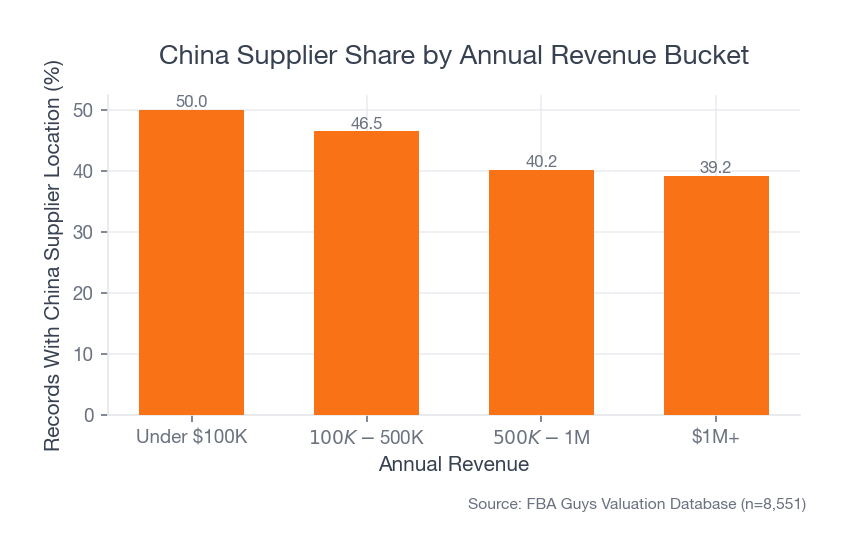
Among 8,551 successful valuation records, 3,809 list China as the supplier location. That is 44.5% of the successful records in the dataset. China supplier exposure isn't limited to tiny hobby sellers either. It appears in every revenue band we checked: 50.0% of sub-$100K businesses, 46.5% of $100K-$500K businesses, 40.2% of $500K-$1M businesses, and 39.2% of $1M+ businesses.
 Source: FBA Guys Valuation Database (n=8,551)
The surprise was not that China showed up often. Everyone in FBA knows China sourcing is common. The more useful observation is that exposure stayed high even as businesses grew.
That means a tariff change can reach into businesses that otherwise look mature: larger catalogs, stronger review profiles, better operations, and cleaner advertising systems. The supplier geography may still be sitting underneath the whole thing.
China-sourced records also showed a heavier inventory shape. In our data, 24.7% of China-sourced records reported inventory turnaround of several months or a year or more, compared with 14.8% for non-China or mixed supplier records.
That doesn't make China sourcing bad. It makes the cash timing visible. Longer replenishment paths and bigger order cycles can turn a tariff update into a working-capital event.
The Sourcing Diversification Question
The clean answer is to diversify out of China.
The useful answer is slower than that.
Moving production can create new tooling costs, quality variance, MOQ changes, longer qualification cycles, packaging updates, compliance checks, freight differences, and the strange little problems that only appear after the first container leaves a new factory. Some products can move. Some shouldn't. Some can split production between suppliers, which is less dramatic and often more useful.
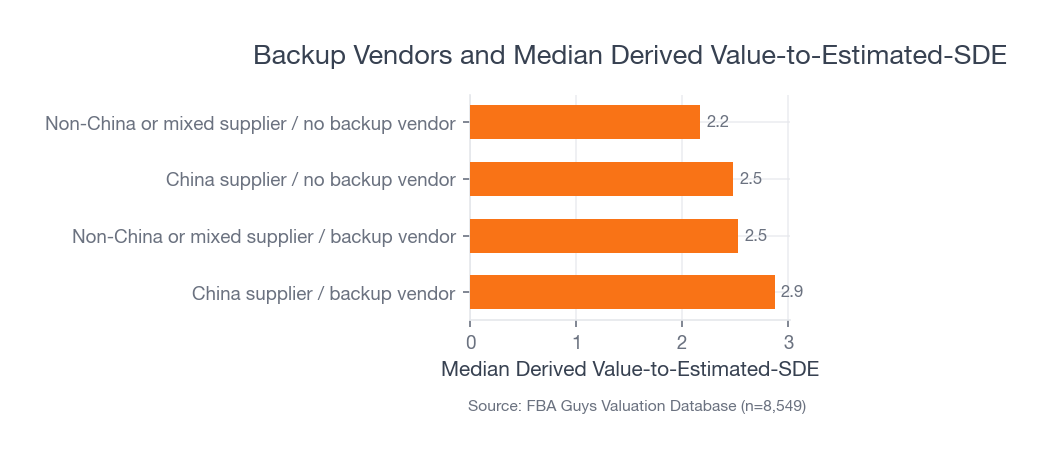
The fact is, the backup-vendor signal mattered more than the country label alone.
In China-sourced records, businesses with backup vendors had inventory equal to 16.9% of annual sales on average and a 2.87 median derived value-to-estimated-SDE. China-sourced records without backup vendors had 19.8% inventory-to-sales and a 2.48 median. The same direction appeared outside China: non-China or mixed supplier businesses with backup vendors had a 2.53 median, versus 2.17 without.
 Source: FBA Guys Valuation Database (n=8,549)
Correlation only. Stronger operators may be more likely to have backup vendors, cleaner books, better inventory routines, and fewer surprises generally.
Still, the operating implication is quite practical. A second qualified supplier gives you something to do when the first quote changes. It can create a second price check, a fallback production path, or enough confidence to carry less fear inventory.
Fear inventory is the inventory you buy because the supply chain feels fragile.
Sometimes fear is justified. If a tariff deadline, port delay, or production slot puts the account at risk, the business may need extra stock. The point is to know why the extra stock exists and what it costs.
What This Means for FBA Business Valuations
FBA businesses are usually valued off Seller's Discretionary Earnings, or SDE. SDE is the profit stream available to one owner-operator after adding back legitimate owner benefits and one-time expenses. When tariffs raise landed cost and the seller cannot recover the increase through price, supplier terms, mix, or operations, SDE gets thinner.
The multiple can also feel pressure, although the mechanism is different.
Tariff exposure touches risk, growth, transferability, and documentation. A buyer can understand a cost increase if the seller can show the HTS code, duty treatment, supplier quotes, price tests, gross-margin bridge, inventory impact, and updated reorder assumptions. The same cost increase gets harder to evaluate when it is buried in COGS, freight, or a monthly "misc" line that changes shape every close.
We kept coming back to that boring documentation point.
If you changed price after a tariff update, preserve the before-and-after. If you changed supplier, keep the qualification file. If you absorbed the duty, show what happened to gross margin, contribution margin, and SDE. If you split production, document the new lead time and quality checks.
None of this makes the tariff disappear. It makes the business easier to understand.
That matters because uncertainty usually gets priced. A buyer may accept tariff exposure when the margin bridge is clear and the supplier path is believable. The same buyer will have a much harder time with a seller who says, "We think it is in freight somewhere."
There was probably a tired bookkeeper involved.
Three Things to Do This Month
Start with the SKU-level landed-cost file.
For each meaningful SKU, update the factory cost, freight, duty, tariff, prep, domestic handling, Amazon fees, storage assumptions, ad cost, refund allowance, and gross margin. Then compare the current file to the version you were using before the tariff or supplier change. If you don't have the old version, rebuild it from invoices and customs records as well as you can.
Second, run the price and volume scenario before changing the listing.
A $2 price increase can protect margin and still damage the business if conversion drops enough. A $2 margin hit can preserve rank and still damage SDE if the product was already thin. Use actual unit economics, not vibes. The landed cost calculator, duty and tariff calculator, and landed cost breakdown are useful starting points.
Third, qualify one backup path.
That might be a second China supplier, a Vietnam quote, a domestic finishing step, a secondary packaging source, or a 3PL plan that lets you hold less stock inside Amazon. The backup path doesn't need to replace the primary supplier immediately. It needs to be real enough that the next tariff update doesn't leave you with only two choices: overbuy or panic.
FAQ
How much are China tariffs for Amazon sellers in 2026?
There is no universal China tariff rate for Amazon sellers. The duty stack depends on the product's HTS classification, country of origin, customs value, Section 301 treatment, exclusions, shipment path, and any product-specific tariff rules. Check the HTS, current USTR and CBP guidance, and a customs broker before relying on a rate.
Did de minimis changes affect Amazon sellers?
Yes, for sellers who relied on low-value direct shipments from China or Hong Kong. The Federal Register order ended de minimis duty-free treatment for covered PRC and Hong Kong shipments effective May 2, 2025. FBA sellers importing bulk inventory were already dealing with customs entry and duties, but direct-to-consumer or testing workflows may have felt the change more directly.
Should Amazon sellers leave China because of tariffs?
Sometimes, but the first question is whether the product can move without losing quality, margin, lead-time reliability, or supplier knowledge. A backup vendor, split production, or better landed-cost control may be more realistic than a full country shift. The decision belongs at the SKU level.
Do tariffs reduce the value of an Amazon FBA business?
They can reduce value when they permanently compress SDE, increase supplier risk, or make the margin story harder to explain. Tariff exposure is easier to evaluate when the seller has clean landed-cost records, supplier documentation, price-test history, and a clear plan for backup sourcing.
The Cost Has to Be Explainable
China tariffs impact Amazon sellers in 2026 because they move through the unit before the seller gets to talk about advertising, refunds, storage, or owner earnings.
The tariff line may look small. The business effect can be larger because it changes margin, cash timing, supplier choices, and the quality of the story behind the numbers.
Get the landed cost right. Keep the supplier path visible. Preserve the record.
Months later, the spreadsheet should still make sense.
Curious what your business is worth?
Get a free, instant valuation and see how your Amazon business stacks up.
Get Your Free Valuation