Amazon FBA Duty and Tariff Calculator: Get the Landed Cost Right Before Margin Lies to You
The FBA Guys
March 24, 2026
An Amazon FBA duty and tariff calculator should calculate landed cost per unit with factory cost, freight, customs duty, any additional tariffs that still apply to your product and origin, plus the broker, port, prep, and packaging costs that sellers keep pretending will somehow stay small enough to ignore. That is the direct answer.
The more useful answer is that the calculator is not really about tariffs, but about whether you are willing to look at the product with the flattering parts stripped off, because if the import-cost inputs are stale, blended together, or copied from the last shipment because everyone was busy, your margin is already lying to you before Amazon even gets paid.
Most sellers don't need a more complicated spreadsheet because they love spreadsheets. They need one because a business can feel healthy while the unit economics are quietly softening, and the damage usually starts upstream in the landed-cost line where nobody wants to revisit the assumptions.
Why does this matter so much?
Because your pricing, your reorder timing, your contribution margin, and eventually your valuation all inherit whatever nonsense you allowed into that number, and none of those downstream decisions get smarter just because the original error was made in a calmer-looking tab.
What an Amazon FBA duty and tariff calculator should include
If the calculator only asks for product cost and one tariff percentage, it isn't a landed-cost calculator. It is a confidence machine, and you shouldn't trust it with anything more consequential than a rough sanity check.
At minimum, it should include:
- Factory unit cost.
- Freight cost per unit.
- Customs duty tied to the product's HTS classification.
- Any additional tariffs that apply to the country of origin and product category.
- Broker, entry, port, and customs-related fees allocated per unit.
- Prep, packaging, or other pre-FBA costs that have to happen before the inventory is actually sellable.
That list looks obvious when written cleanly like this, but it doesn't stay obvious once you are in the middle of a reorder, the supplier updated the carton dimensions, somebody changed the quote after tooling, and the freight number in the model is still hanging on from a shipment profile that felt normal in another quarter under another set of assumptions.
As of March 24, 2026, Amazon's public seller pricing guidance still frames profitability around referral fees, fulfillment cost, shipping, storage, and inventory cost. That fee stack matters. Of course it does. But customs math sits upstream from all of it, and upstream mistakes are nasty because the rest of your model keeps acting precise after the first number is already wrong, which means you can feel disciplined while you are still underwriting the wrong landed cost.
CBP's basic import and export guidance and duty-rate guidance still make the same unromantic point: duty depends on classification and customs treatment, and CBP makes the final determination. Your calculator can't save you from a bad classification, and it won't rescue you from lazy assumptions either. It can only make the downstream consequences easier to see.
That distinction matters more than sellers admit.
The landed-cost formula sellers usually oversimplify
The basic formula is simple:
landed cost per unit = factory cost + freight per unit + customs duty per unit + additional tariffs per unit + import-related fees per unit
Simple formulas are dangerous because people start treating them like complete formulas.
Here is a simplified illustration:
- Factory cost:
$9.80 - Freight per unit:
$1.90 - Customs duty:
6%of declared customs value - Additional tariff exposure:
25% - Broker and entry fees allocated per unit:
$0.35
That gives you roughly:
- Duty:
$0.59 - Additional tariff:
$2.45 - Total landed cost before Amazon fees:
$15.09
If you modeled that product at $12.05 because you left out one of those lines, you weren't "a little off." You were using a different business, and you were probably making pricing or reorder decisions that don't hold up once the real cost structure shows up.
This is the part sellers keep resisting. They want the formula to be stable even when the inputs aren't, and they want the spreadsheet to feel calm while the freight quote moves, the packaging changes, or the tariff treatment needs to be rechecked because policy moved again. Why? Because rerunning the number can force unpleasant decisions about price, MOQ, whether you should eat the margin hit, or whether the product still deserves another reorder at all.
And yes, the classification work matters more than the math itself. The official HTS search exists because duty is not a vibes-based percentage. Sellers say "tariff" as if that word does all the work. It doesn't. The work is in determining what the product is, how customs treats it, what extra trade measures apply, whether your declared value still matches reality, and whether you'll be brave enough to update the model when those answers get less flattering.
We see a version of the same mistake over and over. The product cost gets updated because the supplier quote changed. The freight line doesn't. The brokerage fees stay parked in a generic overhead bucket. Someone blends duty and additional tariffs into one line called "import tax" because it feels cleaner. Then the gross margin looks fine right up until it doesn't, and by then you have already explained the old number to yourself so many times that the correction feels emotionally expensive.
That isn't a math problem. It is an honesty problem.
How duties, Section 301 tariffs, and freight stack together
Sellers use these terms loosely, and loose language becomes loose accounting rather quickly. Customs duty is the base duty tied to classification, while additional tariffs can sit on top of that treatment depending on product and origin.
Freight is neither of those things, which is why combining them into one emotional bucket called "import costs" makes the number less useful precisely when you most need it to diagnose what changed and what you should fix first.
As of March 24, 2026, CBP's own tariff notices still show that additional country-based or program-based tariffs can be layered onto ordinary customs treatment, which is exactly why a calculator needs date-stamped assumptions instead of a number copied from a tab that nobody wants to touch. Policy-sensitive content ages badly. Your spreadsheet ages worse if you don't admit that.
What changes when freight jumps, and what should you look at first?
You look at mode, dimensions, cube, route, consolidation, and timing.
What changes when duty treatment changes, and what will you need to revisit?
You revisit classification, customs value, and current tariff treatment.
What changes when you jam all of that into one line and call it close enough?
You lose the ability to tell which lever actually got worse, which means you also lose the ability to decide what you should renegotiate, reclassify, reroute, or simply stop pretending is temporary. That is a bigger operating mistake than the fee miss itself.
We have watched sellers blame tariffs for margin compression that was partly freight, partly packaging, and partly a quote revision that the model never absorbed because the old version was still sitting in a tab named something like "final-final-2." It would be funny if the downstream consequences weren't so expensive.
Why a small tariff miss can wreck contribution margin
The valuation database does not track exact duty paid, HTS codes, or Section 301 status by record. Good. That means we are not tempted to fake precision the dataset doesn't have.
What the data does show is how little room many businesses have for bad landed-cost assumptions before the economics begin to look weaker to a buyer. Among 3,722 successful valuations with vendorlocation = China, businesses below 20% margin averaged a 2.07x multiple. China-sourced businesses in the 20-39% band averaged 2.43x. Businesses at 40%+ averaged 2.68x.
That is the first interpretation worth caring about. The gap between the bottom and top margin bands is not tiny. If your calculator consistently understates landed cost by a dollar or two per unit, you are not merely understating a cost line. You may be misclassifying the business into a stronger margin story than the market will eventually believe.
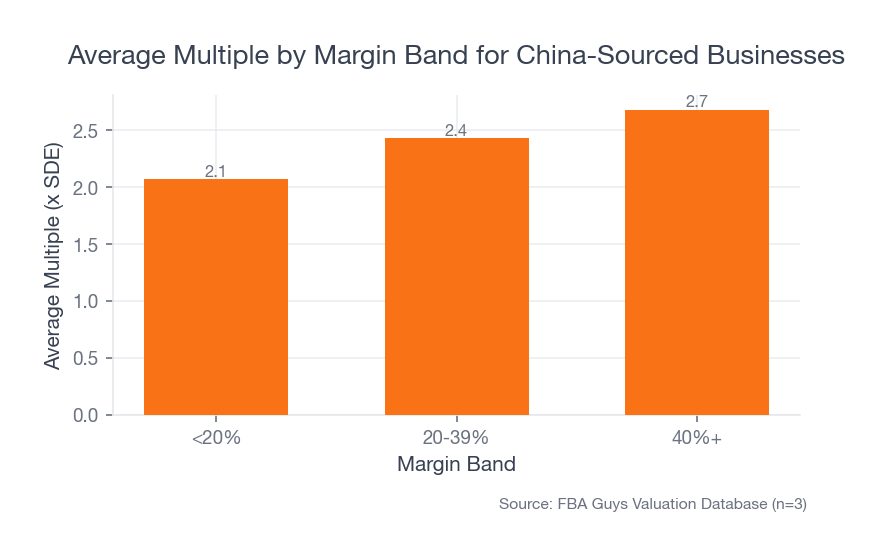 Source: FBA Guys Valuation Database (n=3,722)
That is why contribution margin is the right downstream lens here. You can survive a lot of ugly operating details if the contribution margin still has air in it. You can't survive much if the product only works while the freight estimate is old, the duty treatment is hand-waved, and the ad account is being asked to keep volume alive on top of a cost structure you haven't bothered to recalculate carefully.
We have seen operators talk about tariffs as if they were random weather. Sometimes they are. More often, the damage comes from pretending a moving cost line is temporary, isolated, or too annoying to model cleanly until the next reorder cycle. Then the catalog gets a little tighter. Then ad efficiency has to work harder. Then the margin profile gets thinner while the revenue line still looks busy enough to be reassuring.
Busy isn't the same as healthy.
This is where the scar belongs. We expected China-sourced businesses to screen materially worse on margin. We ran the query three times because the first result felt too convenient to distrust and too inconvenient to love. It didn't show a disaster. China-sourced businesses in the database still averaged 44.8% margin and a 2.52x multiple, versus 46.6% and 2.38x for USA-sourced businesses, which means the lazy version of the article wouldn't have survived contact with the data.
That changed the article, and it should change the way you read this topic too. The problem isn't "China equals bad." The problem is that sellers often use tariff anxiety as a cover story for cost discipline that already slipped.
The second supplier matters more than perfect tariff outrage
This section interrupts the neat calculator tutorial because it is more interesting than the neat calculator tutorial.
Among China-sourced businesses, those with backup vendors averaged a 2.62x multiple across 2,215 valuations. China-sourced businesses without backup vendors averaged 2.38x across 1,507 valuations. USA-sourced businesses show the same pattern, just from a slightly different base: 2.47x with backup vendors and 2.26x without.
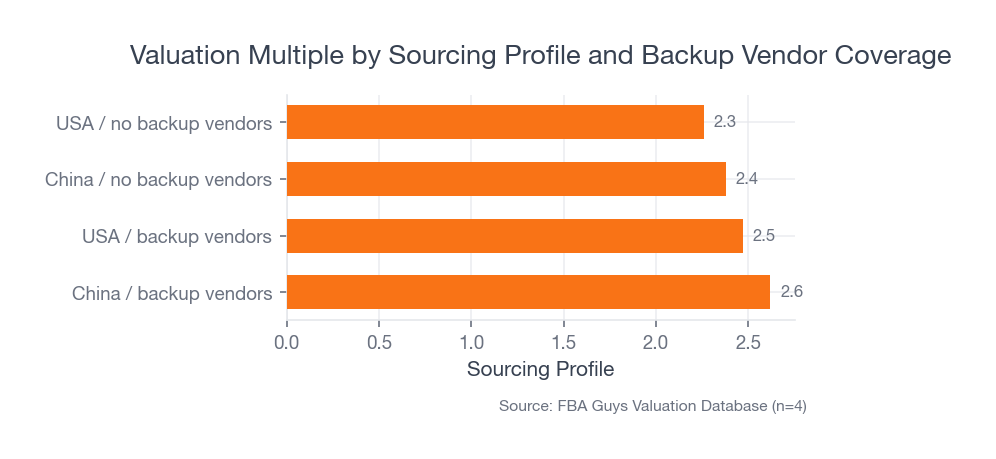 Source: FBA Guys Valuation Database (n=6,792 across China and USA profiles shown)
That is the second interpretation worth keeping. Buyers do not appear to be pricing "China risk" as one giant undifferentiated penalty. They appear to be pricing fragility more directly. A China-sourced business with redundancy can still look sturdier than a domestic business with no backup options and sloppy cost control. That is not a political argument. It is an operating one.
There is another detail here that is too ugly to smooth out. The supplier-count bucket in the database literally ends at more_than_10, which feels less like a strategy label and more like a tired systems field admitting nobody wanted to keep counting after the supply chain got messy. Businesses with exactly 1 vendor averaged 2.38x. Businesses with 2-5 vendors averaged 2.52x. Then the curve bends the wrong way: 6-10 vendors averaged 2.29x, and more_than_10 fell to 1.79x.
What does that tell you about what buyers actually punish? The second supplier matters a lot. The tenth may just mean your operating complexity started sending invoices of its own.
So yes, build the calculator. But do not let the calculator flatter you into thinking the whole import-risk discussion is solved because the tariff line finally looks tidy. If one vendor goes sideways and the business has no backup path, the number is still fragile even when the spreadsheet is beautiful.
When the landed cost calculator is enough and when you need a customs expert
For day-to-day operating decisions, a calculator is enough when you know the correct classification, the current tariff treatment, the customs value basis, and a freight-plus-fee allocation recent enough to trust.
That covers more of the routine work than sellers think, and it also covers more of the routine work than many operators actually maintain with enough discipline to trust.
You probably need a customs broker, trade attorney, or specialist when classification is genuinely disputed, when product composition creates edge cases, when origin treatment is unclear, when new policy announcements hit your category, or when the dollars at stake are large enough that being confidently wrong would be expensive in a very unfunny way.
If you are asking, "Which chapter applies here?" or "Does this accessory change the tariff treatment?" you are already past the point where a casual spreadsheet should be taking solo reps.
That is not a failure of the calculator. It is the correct boundary of the calculator, and you shouldn't confuse a boundary with a defect.
The mistakes that make tariff math look cheaper than it is
The first mistake is using the supplier quote as if it were the full unit cost. It isn't, and you know it isn't, but people still let that partial number sit in the model because it feels close enough until the rest of the charges arrive.
The second mistake is blending duty and additional tariffs into one percentage because the blended line looks cleaner on a dashboard. Cleaner for whom? Certainly not for you six weeks later when you are trying to diagnose what changed, explain the variance, and decide which part of the cost stack actually moved.
The third mistake is treating freight as static. We just wrote about Amazon FBA dimensional weight pricing for the same reason. Physical reality keeps billing you whether the spreadsheet notices or not, and it doesn't care how neatly last quarter's assumptions were formatted.
The fourth mistake is treating customs work like a one-time setup task. Your calculator should be rerun when unit cost changes, when packaging changes, when freight changes, when a policy update changes treatment, and when your sourcing mix changes enough to alter the risk profile, because if the operating facts move and the model doesn't, you don't have a stable calculation. You have stale comfort.
The fifth mistake is pretending import-cost math and margin math live in different departments. They don't. If you want the downstream version of the same conversation, go read contribution margin for Amazon products and how to calculate Amazon FBA profit margin. Customs mistakes don't stay in customs. They leak into contribution margin, pricing decisions, reorder decisions, and eventually the valuation narrative you tell yourself about the business.
The fact is, a lot of sellers argue for hours about ad efficiency while using landed-cost assumptions that were last true before the supplier changed the carton spec, the freight forwarder changed the route, and somebody quietly folded a new fee into overhead because it was easier than fixing the per-unit model.
That is how cheap tariff math gets expensive.
A duty and tariff calculator is really an honesty test
That is the thesis, and it holds up rather well once you stop asking the calculator to do jobs it was never meant to do.
The calculator won't classify the product for you. It won't decide whether a new trade measure applies to your category. It won't rescue a weak catalog. It won't make a low-margin product suddenly resilient. What it will do is force the product to stop pretending it costs less than it costs, and that is more useful than most operators give it credit for because it keeps you from making smart-looking decisions on top of bad inputs.
Among 3,722 China-sourced valuations in the database, the average margin still sits at 44.8% and the average multiple at 2.52x. So this isn't an article about panic. It is an article about discipline. The businesses that hold up best are not the ones with the prettiest stories about sourcing. They are the ones whose landed-cost math can survive a skeptical second look, whose margin still has room after the real costs are loaded, and whose sourcing setup doesn't collapse into chaos because one vendor got difficult at the wrong moment, which is another way of saying that the spreadsheet, the sourcing model, and the operating habits all have to agree with one another.
Use the landed cost calculator. Break the number into real components. Date-stamp the tariff assumptions. Update the model when the operating facts change. If the product looks less attractive after that, good. You don't need a more flattering number. You need a truer one. Better to discover the weakness in a spreadsheet than in a reorder, and better to discover it in a reorder than during diligence.
FAQ
What is an Amazon FBA duty and tariff calculator?
It is a calculator that estimates landed cost per unit by combining factory cost, freight, customs duty, any additional tariffs that apply, and the smaller import-related fees sellers are always tempted to bury somewhere else. If it gives you one neat percentage and nothing more, it is skipping the hard part, and you shouldn't confuse speed with accuracy.
Do duty and tariff mean the same thing for Amazon imports?
Not necessarily. Sellers use the words interchangeably all the time, but they do not always describe the same line item. Duty is tied to classification. Additional tariffs can sit on top depending on origin and current trade treatment. Freight is neither, which is why rolling everything into one "import tax" bucket usually produces a worse model and a worse diagnosis later.
Should I include de minimis assumptions in the calculator?
Only if they actually apply to the way the goods are being imported, and only if you are willing to revisit that assumption when policy changes. This is one of those areas where sellers get hurt by using a once-true rule like a permanent law of nature, and you don't want your calculator built on an assumption that stopped being true while the file still looked official.
What customs value should the calculator use?
The customs value basis should match the treatment your entry actually relies on. If your team is fuzzy on that, the model is already shakier than it looks, and you shouldn't let a tidy output distract you from an unresolved customs question upstream. The calculator is downstream from that decision, not a substitute for it.
How often should I update landed-cost inputs?
Any time unit cost, freight, packaging, route, tariff treatment, or sourcing geography changes. In practice, that means more often than most operators want to hear. Certainly more often than once a year, and probably every time a change makes you think, "We'll clean that up later."
Can a landed-cost calculator replace a customs broker?
No. It handles routine modeling. It doesn't replace professional advice when classification or tariff treatment is genuinely unclear. Use the calculator for operating discipline. Use a broker when the rules themselves are the uncertain part.
Why does this matter so much for valuation?
Because valuation does not happen in a separate emotional universe where buyers politely ignore margin compression. If the landed-cost math is wrong, the margin profile is wrong. If the margin profile is wrong, the quality of earnings is wrong. Everything downstream gets uglier from there.
Curious what your business is worth?
Get a free, instant valuation and see how your Amazon business stacks up.
Get Your Free Valuation