Amazon Reimbursement Audit Guide: The Claim Is the Easy Part. The Record Is the Job.
The FBA Guys
April 22, 2026

Amazon reimbursement audit guide sounds like the kind of keyword that should end in a spreadsheet template and a triumphant little number about how much money you have been leaving on the table.
That is not really what this is.
The claim itself is usually the last ten percent of the work. The real job is building a monthly record of what shipped, what arrived, what disappeared, what Amazon reimbursed automatically, what it did not, and what cost basis you can actually prove when Amazon asks for it. Since Amazon pushed more reimbursement activity into the Inventory Defect and Reimbursement portal, added more proactive reimbursements, and moved lost-or-damaged inventory reimbursement toward manufacturing cost, the sloppy version of an audit got weaker. The disciplined version got more important.
If you want an Amazon reimbursement audit guide that still works when the policy details move around, start there. Build the evidence trail first. Then audit the exceptions.
What an Amazon reimbursement audit actually covers
Most sellers say "reimbursement audit" when they mean "did Amazon owe me money for something weird."
Close enough for conversation. Not close enough for process.
An actual audit usually touches four buckets:
- Inventory defects and reimbursements visible inside Amazon's Inventory Defect and Reimbursement portal.
- Lost or damaged inventory events that should have triggered an automatic reimbursement but did not.
- Cases that still need manual attention, including certain removals, missing-from-inbound issues, or edge cases where the policy logic did not resolve the case cleanly.
- Underpaid reimbursements where the event exists, but the valuation or evidence chain is wrong or incomplete.
That fourth bucket is where sellers get irritated, and not without reason. Amazon's 2025 reimbursement-policy changes pushed the conversation harder toward manufacturing cost rather than the all-in fantasy number sellers sometimes carry in their head. If your freight, prep, duties, packaging, and timing discipline already live in a clean inventory record, that change is annoying but manageable. If your cost history exists across screenshots, inboxes, and one panicked spreadsheet export, the reimbursement audit turns into archaeology.
Amazon reimbursement audit guide: the records you need before you open the portal
The part most sellers skip is boring, which is probably why they skip it.
Before you open the portal, you need a file that ties together five things:
- Shipment and receiving evidence.
- Inventory movement by SKU or ASIN.
- Reimbursements already issued.
- Unit cost support.
- Accounting treatment after the reimbursement lands.
That is the whole game.
If any one of those breaks, the audit gets fuzzy fast. You find a lost unit, but cannot prove whether it was ever fully received. You find the event, but cannot tell whether Amazon already reimbursed it in a later settlement cycle. You win the reimbursement, then book it into the wrong place and tell yourself the operational problem is solved because cash showed up once.
That is not an audit. That is a recurring argument with your own records.
The weekly source stack is not complicated, but it has to be consistent:
- Seller Central shipment and receiving reports
- The Inventory Defect and Reimbursement portal
- Settlement and reimbursements reports
- Your inventory ledger or SKU movement file
- The cost record that supports manufacturing cost
- The monthly P&L or close file where the reimbursement is classified
This is where the spreadsheet gets weird in useful ways. The seller who runs a decent reimbursement audit is not necessarily the seller with the fanciest reimbursement software. It is usually the seller whose files agree with each other often enough that the exceptions stand out.
How to run a weekly and monthly reimbursement audit
Daily auditing is usually a waste unless the account is large enough that the volume justifies dedicated labor.
Weekly review is where the money starts to show up without turning the business into a grievance desk.
Monthly reconciliation is where the process becomes real.
That split matters.
Weekly: review exceptions, not the whole universe
A weekly reimbursement review should answer five questions:
- What new defect or reimbursement events appeared this week?
- Which ones were resolved automatically?
- Which ones still look open after Amazon's normal waiting periods?
- Which SKUs or shipment IDs have repeat issues?
- Do any cases require cost documentation you cannot produce yet?
That last question saves more time than most people expect. It keeps you from filing a claim before the supporting record exists, which is how sellers create extra back-and-forth and then call the policy impossible.
The point of the weekly pass is not completeness. It is triage.
Flag the exceptions. Tag the repeated failure points. Keep notes on why the claim is credible. Move on.
Monthly: reconcile the money, not just the case count
The monthly pass runs longer on purpose.
This is the section that most sellers either rush through or avoid, and it is the section that turns reimbursement audit work from "nice little operational recovery" into actual financial discipline.
At month end, reconcile these lines in one place:
| Line | What to check | Why it matters |
|---|---|---|
| Lost or damaged events | Whether the inventory event exists and is still unresolved | The case count tells you where to look |
| Reimbursements issued | Date, amount, SKU, and related event | Prevents duplicate chasing |
| Inventory value | Whether the missing units were still being carried correctly | Keeps the balance sheet honest |
| Amazon fees and adjustments | Whether the reimbursement landed as an offset or separate line | Otherwise the P&L starts lying |
| Cost support | Whether the manufacturing-cost evidence is current and defendable | Amazon's newer reimbursement logic cares about this |
There is a practical reason to do it this way. A reimbursement is not just a refund-shaped gift from Amazon. It is an accounting event attached to an inventory event attached to a process failure. If you treat it as found money, you stop asking the useful question.
Why did this happen in the first place?
And that question matters because a reimbursement can mask the real damage. You got paid once. Fine. But did the stockout still hurt rank? Did the replacement cycle still delay cash? Did the issue happen often enough that the reimbursement line is becoming part of the operating model?
If the answer is yes, the audit should expose the pattern, not merely celebrate the recovery.
Build one reimbursement evidence packet while the month is still fresh
This is the part that keeps the monthly pass from turning into a forensic project two quarters later.
For every meaningful unresolved case, keep one small packet with the shipment ID, SKU, units affected, dates, current status, reimbursement amount if any, manufacturing-cost support, and one line on what still needs to be proven. Nothing fancy. The useful version fits on one screen or one printed page.
Why bother when the portal already has case history?
Because case history is not the same thing as operator memory.
By the time someone reviews the issue again, the surrounding context is usually gone. The receiving problem from six weeks ago has blended into the next three shipment problems. The partial reimbursement from last month has disappeared into settlement noise. The invoice you meant to attach is still somewhere in a purchasing inbox that nobody wants to search.
The packet fixes that. It gives the team one stable record of what happened, what Amazon thinks happened, and what your own files can support. It also makes delegation less sloppy. A VA, bookkeeper, or ops lead can take over the follow-up without restarting the story from scratch.
That sounds administrative because it is administrative. It is also the difference between a reimbursement process that compounds and one that resets every month.
Which reimbursement cases still need manual attention
Amazon has made more reimbursements proactive. That helps. It does not remove the need for an audit.
It just changes where the effort belongs.
As of April 22, 2026, the official Amazon announcements around the IDR portal and reimbursement automation point in the same direction: warehouse-lost and some customer-return cases are increasingly automated, while inbound, removals, and edge cases still need more deliberate review. That means the best manual work now tends to sit in three places:
1. Cases the portal does not fully surface
Amazon's own IDR launch notes say the portal does not include everything. If a seller assumes the portal equals the full universe, the audit is incomplete from the start.
Missing-from-inbound is the obvious example. Removal and disposal disputes are another. Those still need a separate evidence trail.
2. Cases where the reimbursement amount is the problem
This is the post-2025 headache.
If reimbursement is tied more tightly to manufacturing cost, then the seller who cannot support cost cleanly is effectively negotiating with fog. The claim may exist. The dollar amount may still be wrong. The practical response is not outrage first. It is cost support first.
Invoices. Supplier records. Unit-cost history. Any update you have made inside Amazon's sourcing-cost workflow. Without that, the reimbursement audit becomes a feelings audit.
3. Cases where the same operational failure keeps repeating
One lost unit is a claim.
Fifteen similar defects around the same SKU family, prep workflow, inbound lane, or packaging profile is an operating problem that happens to throw off claims.
That is why a useful reimbursement audit guide has to interrupt itself and talk about root cause. The reimbursement line is not the whole point. It is evidence that something else is slipping.
If the same pattern shows up three months in a row, promote it out of the reimbursement sheet and into an operating review. Look at prep instructions, carton labeling, shipment creation discipline, inbound routing, and any SKU that seems to attract more adjustments than its neighbors. A reimbursement audit is one of the few places where accounting, ops, and inventory control accidentally meet each other. Waste that signal and you will keep recovering dollars from the same leak instead of fixing the leak.
Common reimbursement audit mistakes
Mistake 1: Treating the portal as the record of truth
The portal is a workflow surface. It is not the whole business record.
Your own shipment logs, cost files, settlement reports, and inventory ledger still have to agree with it. If they do not, the portal becomes one more tab, not a control system.
Mistake 2: Auditing only for missing money
The seller finds unreimbursed losses, files claims, gets some cash back, and calls the project done.
That is the shallow version.
A better audit also asks:
- Which defects repeat?
- Which SKUs are noisy?
- Which warehouse or inbound patterns keep showing up?
- Which reimbursements are getting booked in a way that hides the operational problem?
That is where the audit starts earning its keep.
Mistake 3: Keeping manufacturing cost support too loose
Amazon's reimbursement-policy changes made this more painful, not less.
If your sourcing cost is a guess, the reimbursement conversation will feel arbitrary because your side of the file is arbitrary too. The seller who knows landed cost but cannot isolate manufacturing cost cleanly is still under-documented for this specific workflow.
Mistake 4: Letting accounting clean-up happen later
Later usually means never.
If reimbursements are not reconciled into the same monthly close that handles fees, refunds, deposits, and inventory movement, then the P&L starts mixing operations and recovery events in ways that make margin diagnosis harder. We see this in ordinary Amazon bookkeeping all the time. A reimbursement gets counted as if it fixed the root problem. Then somebody looks at the final line and calls it insight.
Why reimbursement audit discipline matters beyond the claim
This is where the topic stops being narrow.
In the valuation database, businesses with tax returns available showed a 2.68x average valuation-to-SDE proxy, versus 2.09x for businesses without tax returns available. High-confidence submissions also showed meaningfully stronger valuation math than low-confidence ones.
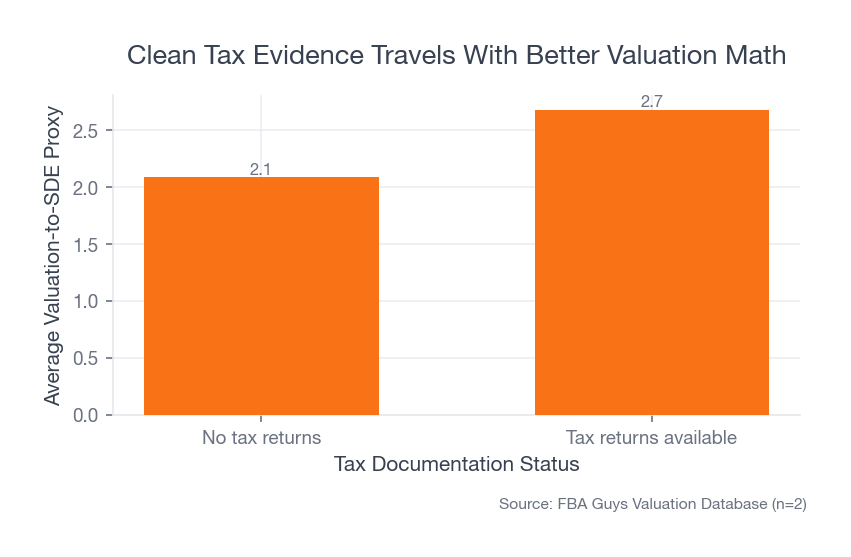 Source: FBA Guys Valuation Database (n=5,256 submissions with tax-return availability)
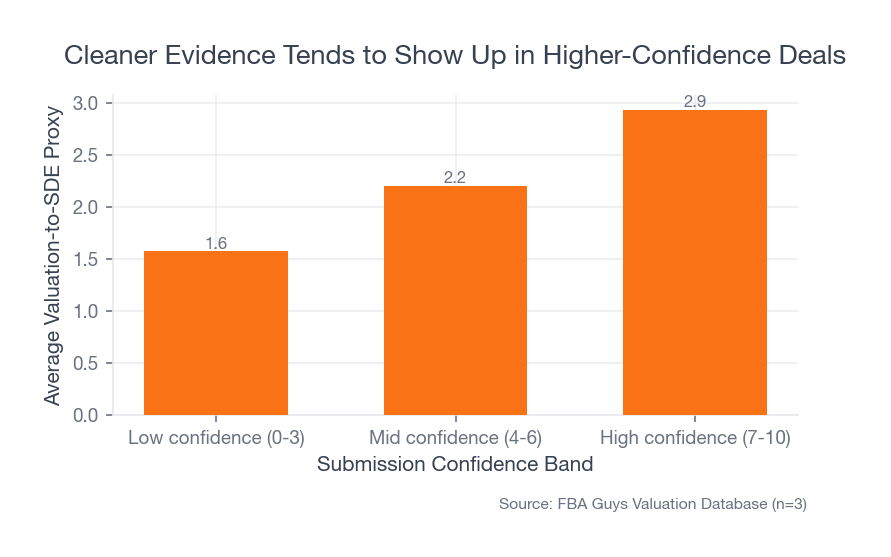 Source: FBA Guys Valuation Database (n=7,936 successful submissions with confidence bands and numeric SDE)
That does not mean reimbursement audits cause higher multiples by themselves. It does mean that evidence quality tends to travel together. The seller who can prove tax returns, reconcile inventory, document SOPs, and explain odd adjustments usually has a business that looks more credible than the seller whose records arrive as a story instead of a file.
Reimbursement audit work fits inside that same habit.
It teaches the business to preserve evidence before the argument starts. It forces monthly reconciliation. It exposes recurring inventory failure points. It makes the books more believable because reimbursements, losses, and adjustments stop floating around as unexplained noise.
That is not glamorous, but it is how small operators stop losing money in the exact same places every quarter.
A practical Amazon reimbursement audit checklist
- Export current defect and reimbursement events from the IDR workflow or related reports.
- Match each event to shipment, SKU, quantity, and event date.
- Mark which events already received reimbursement.
- Pull settlement data and confirm where reimbursement cash actually landed.
- Verify whether each unreimbursed case is still inside Amazon's eligibility windows.
- Gather manufacturing-cost support before escalating amount disputes.
- Tag repeating defect patterns by SKU, shipment lane, prep flow, or warehouse path.
- Reconcile reimbursements into the monthly close so inventory, adjustments, and cash still tie out.
- Keep a short note on unresolved cases and why they remain open.
Short list. Real work.
FAQ
What is an Amazon reimbursement audit?
An Amazon reimbursement audit is a structured review of lost, damaged, returned, inbound, or adjustment-related inventory events to see whether Amazon already reimbursed them correctly, failed to reimburse them, or reimbursed them at the wrong amount. The useful version ties those cases back to inventory records, settlement data, and cost support rather than treating the portal as the only source.
How often should I run a reimbursement audit?
Weekly for exception review, monthly for reconciliation. Weekly catches open cases before they go stale. Monthly makes sure the reimbursement activity still agrees with inventory, cash, and the P&L.
Do I still need an audit if Amazon reimburses items automatically?
Yes. Automation reduces some manual claims, but it does not remove missing-from-inbound work, edge cases, amount disputes, or repeated operational defects. It mostly changes the audit from a full hunt into an exceptions process.
What records matter most in a reimbursement audit?
Shipment and receiving records, SKU-level inventory movement, reimbursement and settlement reports, and cost support for the affected units. If any one of those is weak, the claim gets harder to prove and the accounting gets harder to trust.
The useful version of an Amazon reimbursement audit guide
The useful Amazon reimbursement audit guide is not the one that promises hidden money everywhere.
It is the one that makes your records good enough that the legitimate money is easy to defend.
That sounds less exciting because it is less exciting. It is also the part that keeps working when Amazon changes the portal, changes the reimbursement math, or automates one more slice of the workflow. The claim is still the easy part. The record is still the job.
Curious what your business is worth?
Get a free, instant valuation and see how your Amazon business stacks up.
Get Your Free Valuation