Amazon FBA Multi-Channel Fulfillment: The Channel Count Only Helps If the Operation Can Carry It
The FBA Guys
May 28, 2026

Amazon inventory has a strange way of feeling like it belongs to Amazon, even when you paid for it, financed it, shipped it, insured it, and stared at the replenishment screen more than any sane person should.
That is what makes Amazon FBA Multi-Channel Fulfillment interesting. It changes the question from "How do I fulfill my Amazon orders?" to "Can the inventory already sitting inside Amazon's network support sales that happen somewhere else?"
Amazon FBA Multi-Channel Fulfillment, usually called MCF, lets you use inventory in Amazon's fulfillment network to pick, pack, and ship customer orders from off-Amazon channels such as your Shopify store, social storefronts, or other marketplaces. At current Amazon terms, MCF is separate from FBA in purpose: FBA fulfills Amazon orders, while MCF fulfills orders from channels outside Amazon.
Useful.
Also easy to misread.
MCF can help an FBA seller test channel diversification without building a warehouse, hiring a shipping person, or splitting inventory into three places that all become wrong by Tuesday. But it doesn't make a business diversified by itself. It makes another sales path possible. The value comes from whether that path makes the operation stronger, more explainable, and less dependent on one storefront.
Our valuation data keeps pulling us toward that distinction.
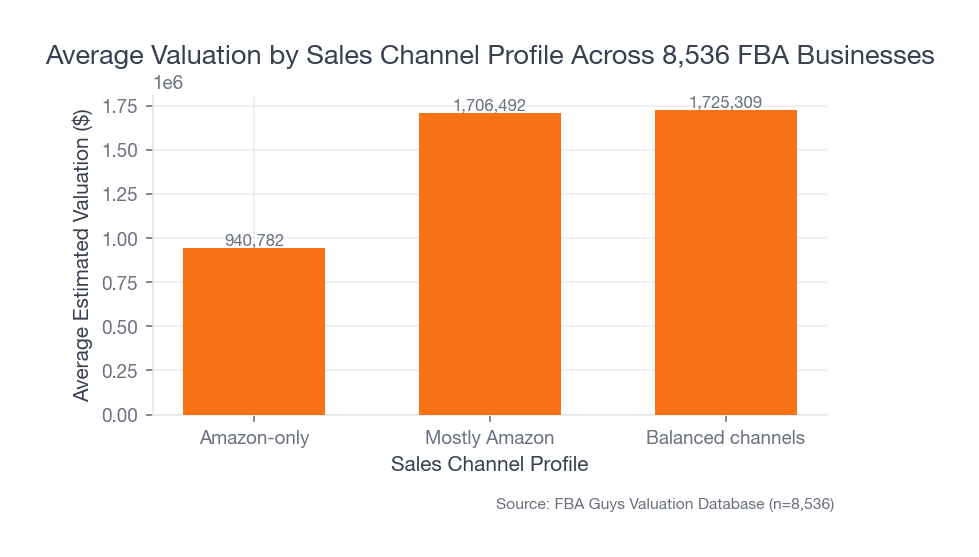
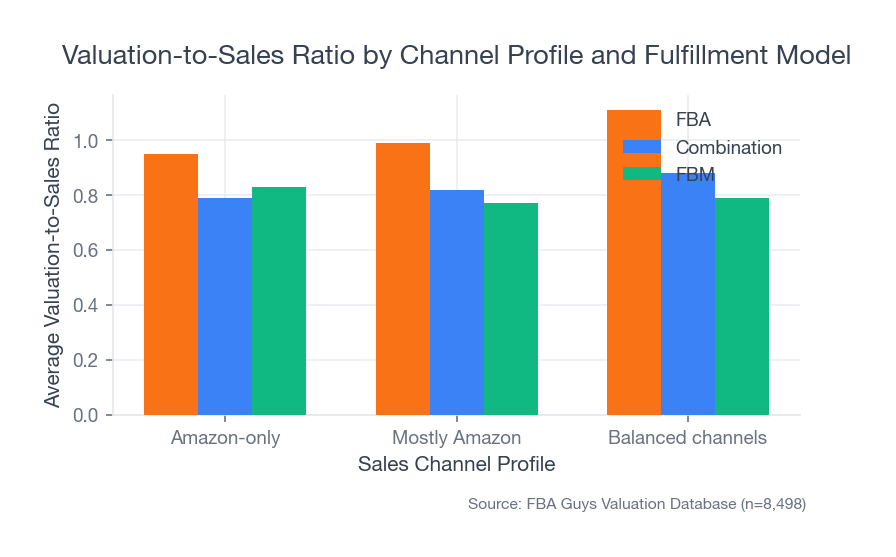
Across 8,536 successful FBA Guys valuations, Amazon-only businesses averaged $940,782 in estimated value. Businesses that described their sales as balanced between Amazon and other channels averaged $1,725,309. That looks like a clean argument for diversification until you split the data by fulfillment model. Balanced-channel businesses that still operated as FBA businesses averaged a 1.11 valuation-to-sales ratio. Balanced-channel businesses using FBM averaged 0.79.
The channel wasn't the whole story. The operating model was doing some quiet work.
 Source: FBA Guys Valuation Database (n=8,536)
What Amazon FBA Multi-Channel Fulfillment Actually Does
MCF is Amazon's off-Amazon fulfillment service. You send inventory to Amazon. A customer orders from another channel. Amazon picks, packs, and ships the order from its fulfillment network.
As of the writing of this article, Amazon describes MCF standard delivery as 3 business days and expedited delivery as 2 business days, click-to-delivery. Amazon also says existing FBA sellers can use their current FBA inventory for MCF orders, with FBA and MCF drawing from a shared inventory pool.
That shared pool is the part that matters.
If you sell on Amazon and your own site, MCF can let one unit of inventory serve both demand streams. You aren't necessarily buying one batch for Amazon, another batch for Shopify, and a third batch for the garage shelf you promised yourself would stay organized this time.
The mechanics are straightforward enough:
- Send inventory to Amazon.
- Connect or create the off-Amazon order.
- Choose the shipping speed and order settings.
- Amazon fulfills the order.
- You handle the customer relationship outside Amazon.
That last line deserves more attention than it usually gets. MCF may move the box, but it doesn't become your customer service department in the way FBA does for Amazon orders. If a customer buys from your site, your site owns that customer experience. Refunds, communication, brand expectations, odd edge cases, and the email from someone asking why the tracking page says one thing while the porch says another.
Small things. Until they aren't.
The Real Decision: Does MCF Reduce Risk Or Add Another Channel To Manage?
The clean version of the MCF pitch is inventory efficiency. One pool. More channels. Less operational drag.
The operator's question is sharper: what risk does this actually reduce?
For many FBA sellers, the obvious risk is channel concentration. If nearly all revenue comes through Amazon, the business depends on one marketplace account, one search environment, one advertising system, one review surface, and one set of policy decisions. A direct-to-consumer channel, retail partner, or outside marketplace can make the business feel less exposed.
Of course, a second channel can also expose the parts of the operation that Amazon had been quietly absorbing.
Amazon listings create the product page. Amazon checkout handles the cart. Amazon customer service catches a large share of the post-order noise on marketplace sales. When the order moves off Amazon, the seller owns more of the experience. The business has to know what was promised, what was shipped, what packaging looked like, what return policy applied, where the tracking number lives, and whether inventory was reserved for Amazon demand or consumed by the off-Amazon order.
This is where MCF gets interesting. It can remove fulfillment labor while still requiring operational judgment.
A simple example: you run a Shopify promotion because your Amazon rank is healthy and you have inventory sitting at FBA. The promotion works. Then Amazon demand jumps at the same time. You didn't create a fulfillment problem. You created an allocation problem.
Nobody puts "allocation problem" in the celebratory Slack message.
The fact is, channel diversification only helps when the business can see inventory clearly enough to make decisions before the channel wins become stockout problems.
That is why this article isn't really about whether MCF is good or bad. It is about when MCF makes the business easier to understand.
What The Valuation Data Says About Channel Diversification
The first pass through the data looked almost too tidy. Amazon-only businesses averaged $940,782 in estimated value. Mostly-Amazon businesses averaged $1,706,492. Balanced-channel businesses averaged $1,725,309.
You can see the appeal. More channels, higher average value.
But the second pass was more useful. Balanced-channel FBA businesses averaged $2,354,361 in estimated value and a 1.11 valuation-to-sales ratio. Amazon-only FBA businesses averaged $888,691 and a 0.95 ratio. That supports a reasonable idea: when sellers can expand beyond Amazon while keeping fulfillment clean, the business may become more valuable and easier to scale.
Then the FBM comparison pulls the reins a bit. Balanced-channel FBM businesses averaged $750,358 in value and a 0.79 valuation-to-sales ratio. Balanced-channel businesses using a combination of FBA and FBM averaged $1,313,513 and a 0.88 ratio.
 Source: FBA Guys Valuation Database (n=8,498)
That doesn't mean FBM is bad. Diversification and fulfillment complexity aren't the same variable.
MCF sits right in the middle of that distinction. A seller can test an off-Amazon channel without immediately building a separate fulfillment operation. The business gets a chance to learn whether demand exists somewhere else while preserving some of the operational simplicity buyers tend to like.
There is a scar in this work that shows up more often than anyone wants to admit: a seller proves that customers will buy off Amazon, then the bookkeeping, inventory records, returns process, and channel reporting become a pile of half-true numbers. Competent people get there. It usually happens because the growth experiment worked before the reporting caught up.
MCF doesn't solve that. It just gives you fewer moving parts while you figure out whether the second channel deserves to exist.
The Small-Catalog Finding Was The One That Changed The Shape Of This Article
We expected larger catalogs to get more from channel diversification. More SKUs, more chances to sell something somewhere else. Reasonable enough.
The more interesting finding was in small catalogs.
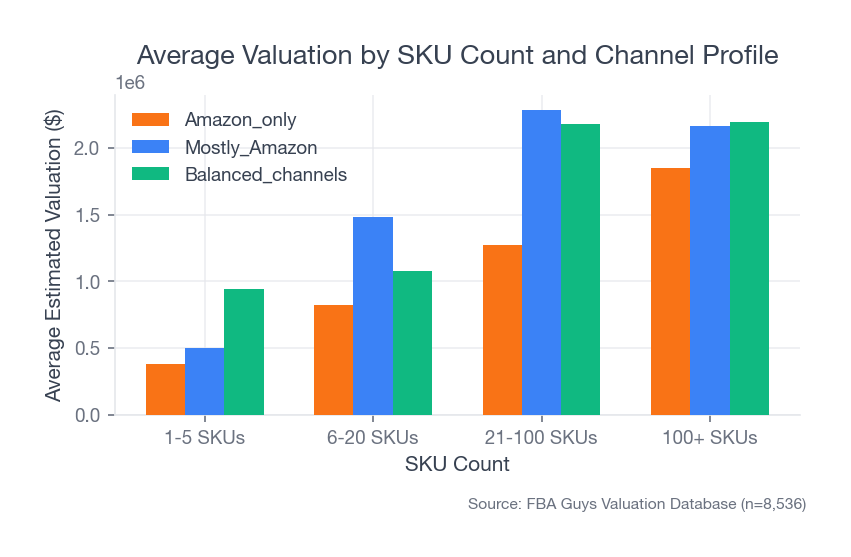
Among businesses with 1-5 SKUs, Amazon-only businesses averaged $379,401 in estimated value. Balanced-channel businesses in the same SKU range averaged $938,261. The sample is smaller, 253 balanced-channel records versus 1,707 Amazon-only records, so this isn't a law. Still, it is quite useful.
 Source: FBA Guys Valuation Database (n=8,536)
A narrow catalog can make MCF easier to test. There are fewer listings to sync, fewer size tiers to price, fewer return reasons to decode, fewer stockout paths to monitor. One hero product and two accessories are much easier to route across Amazon and Shopify than 87 low-volume SKUs with three packaging profiles and a naming convention that made sense only to the person who built the first spreadsheet.
That last detail isn't theoretical. Multi-channel operations have a way of producing tiny naming messes: one SKU in Seller Central, one SKU in Shopify, one shortened SKU in a 3PL export, and one "temporary" Google Sheet column that becomes permanent because nobody wants to break the Zapier connection.
MCF works best when the test is boring enough to measure.
When MCF Makes Sense
MCF is worth a serious look when four conditions are present.
First, your off-Amazon channel has real demand or a credible way to create it. MCF is fulfillment infrastructure. It doesn't create traffic. If your site gets 200 visits a month and most of them are you checking whether the homepage still loads, MCF won't fix the demand problem.
Second, your unit economics survive MCF fees. Amazon says MCF fulfillment fees depend on product size, shipping weight, units per order, and delivery speed. As of the writing of this article, Amazon also lists a fuel and logistics-related surcharge for US MCF fulfillment fees. Check the current rate card before treating any margin model as finished.
This is where our Amazon FBA unit economics guide becomes relevant. The off-Amazon order may avoid Amazon referral fees, but it may add payment processing, app fees, returns handling, customer service time, and MCF fulfillment costs. The math has to follow the order all the way to the customer's door.
Third, your inventory system can tolerate one shared pool. Amazon says FBA and MCF can use the same inventory pool for FBA sellers. That is efficient. It also means your Shopify win can consume inventory that Amazon demand was about to need. The better your FBA inventory management, the less dramatic this becomes.
Fourth, the channel is strategically useful. A DTC site can give you customer data, email capture, bundling options, post-purchase education, and brand control that Amazon doesn't give in the same way. A second marketplace may give incremental sales but fewer relationship benefits. Both can be valid. They aren't the same decision.
When MCF Is A Bad Fit
MCF is a poor fit when the business is already confused.
If inventory counts are shaky, MCF gives the confusion another door. If margins are unclear, it gives the margin model another fee path. If returns are already messy, it gives the customer another place to ask the same question. If the catalog has too many stale SKUs, MCF can distribute the mess faster.
There is also the brand-experience question. Amazon says MCF uses unbranded packaging by default unless it causes longer shipping and delivery times, and eligible sellers can choose a blank-box-only setting. That is helpful. Still, the customer bought from your channel. If the delivery experience feels disconnected from the promise on your site, you own the awkwardness.
Some sellers should use a dedicated 3PL. Heavy customization, kitting that changes often, temperature-sensitive products, unusually fragile items, complicated wholesale routing, or a brand experience that depends on packaging control can all push the decision away from MCF.
And some sellers should stay focused on Amazon for a while.
That can sound timid. It usually isn't. A business with weak Amazon inventory discipline, unclear contribution margin, and thin cash reserves can make itself more fragile by chasing diversification too early. The second channel looks like risk reduction on a slide deck. In the bank account, it can become more inventory, more fees, and more things to reconcile.
How To Test MCF Without Confusing The Business
Start with one product family.
Not the entire catalog. Not every marketplace you can connect by Friday. One product family with clean demand, clean packaging, and enough margin that a small mistake won't turn the test into an autopsy.
Then write down the decision rules before the first order ships:
- Which SKUs are eligible for MCF?
- Which channel gets priority if inventory gets tight?
- What delivery promise will the off-Amazon channel make?
- Who handles customer service?
- What happens when an MCF order is returned?
- How will MCF fees, refunds, and replacement shipments appear in the P&L?
- What result makes the test worth expanding?
This isn't bureaucracy. It is how you keep the test from turning into folklore.
The SOP data in our valuation database is incomplete, so we don't want to overstate it. Still, the direction is hard to ignore. In the records where SOP documentation was captured, balanced-channel businesses with some SOPs averaged $1,853,720 in value. Balanced-channel businesses with no SOPs averaged $795,865.
Documentation doesn't make the channel work. It makes the channel explainable.
The same pattern showed up in supplier redundancy. Balanced-channel businesses with backup vendors averaged $2,023,739 in value. Balanced-channel businesses without backup vendors averaged $1,163,855. If MCF creates more demand paths, your supply side has to be able to breathe.
A good MCF test should feel almost disappointingly contained:
- One product family
- One off-Amazon channel
- One fulfillment speed promise
- One return process
- One weekly review of inventory, fees, refunds, and stockout risk
Give it 60-90 days unless the numbers clearly fail earlier. Look at contribution margin by channel, stockout pressure on Amazon, customer-service load, and repeat purchase behavior. If the test only works when nobody accounts for time, refunds, or inventory tension, it didn't work.
One useful comparison is boring and a little unfair: put the MCF order next to a normal FBA order for the same SKU. What changed in contribution margin? What changed in customer-service time? What changed in inventory availability? The answer may be small. That is fine. Small differences repeated across hundreds of orders are usually where fulfillment strategy stops being a feature choice and starts becoming an operating habit.
How MCF Changes The Sale-Readiness Conversation
If you might sell the business someday, MCF can either help the story or make the story harder to verify.
It helps when the off-Amazon channel shows real demand, clean reporting, and low operational drag. A buyer can understand that. Amazon remains the main engine, while the second channel proves the brand has demand outside Amazon's walls.
It hurts when the second channel exists mostly as a claim. "We have a Shopify store" doesn't say much. What matters is whether orders are flowing, margins are known, returns are tracked, and inventory allocation is controlled.
Buyers tend to trust what can be verified. That is a Playbook-level principle, and it applies here without much decoration. A channel that produces clean reports is an asset. A channel that requires verbal explanation is a homework assignment.
Perhaps the simplest MCF test is this: if someone asked you to explain last month's off-Amazon profit by SKU, could you do it without opening four browser tabs and apologizing for the export?
If yes, you may have a channel.
If no, you may have sales.
Those are different assets.
FAQ
What is Amazon FBA Multi-Channel Fulfillment?
Amazon FBA Multi-Channel Fulfillment is Amazon's service for using inventory in Amazon's fulfillment network to fulfill orders from off-Amazon sales channels. FBA handles Amazon marketplace orders. MCF handles orders from places such as your website, social channels, and other marketplaces.
Can I use my existing FBA inventory for MCF?
Amazon says existing FBA sellers can use current FBA inventory for MCF orders. That shared inventory pool is efficient, but it also makes replenishment discipline more important because off-Amazon orders can consume stock that Amazon demand may need.
Is MCF cheaper than using a 3PL?
Sometimes. The answer depends on product size, shipping weight, units per order, delivery speed, storage, surcharges, return handling, and your need for packaging control. Treat MCF as a live rate-card decision, not a permanent cheap-or-expensive label.
Does MCF make an Amazon business more valuable?
MCF by itself doesn't make a business more valuable. It can support a more valuable business when it helps create a real off-Amazon channel without adding fulfillment complexity that damages margins, inventory control, or transferability.
Should every FBA seller test MCF?
No. Test MCF when you have demand outside Amazon, clean SKU-level economics, and enough inventory visibility to protect the Amazon channel. If the core operation is already hard to reconcile, fix that first.
Curious what your business is worth?
Get a free, instant valuation and see how your Amazon business stacks up.
Get Your Free Valuation