Amazon Seller Account Reactivation: The Account Comes Back Before the Risk Goes Away
The FBA Guys
August 6, 2026

The most tempting moment to stop paying attention is the moment Amazon lets the account sell again.
That is understandable. Orders have paused. Inventory may be sitting. Cash flow may have gone quiet. The seller has spent days or weeks refreshing Seller Central and answering a review team that rarely explains more than it has to explain.
Amazon seller account reactivation means Amazon has restored the account's ability to sell after a deactivation, suspension, or access restriction. It gets the business back online. It doesn't erase the account-health history that led to the deactivation.
For operators, the reactivation notice should start one more job: build the file that explains what happened, what changed, and why the same issue is less likely to come back.
That file matters for future account health. It also matters if the business is ever valued, financed, or sold.
What Amazon Seller Account Reactivation Actually Means
Amazon seller account reactivation is a Seller Central process, not a general business diagnosis.
Amazon's current public help for appealing an account deactivation or listing removal points sellers to Account Health and the Reactivate your account workflow. The live page inside Seller Central is the operating source because Amazon's instructions depend on the policy issue, account status, and documents requested.
In some cases, Amazon may ask for a Plan of Action. In others, it may ask for invoices, identity documents, product-compliance records, proof of delivery, rights-owner correspondence, or an acknowledgment of a policy. The important point is that the reactivation submission should answer the notice Amazon actually sent.
The notice defines the scope.
If Amazon asks for supplier invoices, start with supplier invoices. If it asks for a root cause and prevention steps, answer those directly. If it asks for identity verification, don't bury the requested documents inside a broad story about the business.
Reactivation means Amazon accepted enough of the response, at least for that account status decision. It doesn't mean the underlying event becomes irrelevant.
Reactivation Does Not Close the Account-Health File
Amazon and a future reviewer ask different questions.
Amazon asks whether the account should be allowed to sell. A future buyer, lender, or valuation reviewer asks whether the risk is visible and controlled.
That distinction is easy to miss because the operational pressure disappears first. Once the account is active again, the seller's next priorities are usually shipments, stranded inventory, late supplier updates, customer-service backlog, ads, and cash. The record gets pushed into the same vague memory folder as every other Seller Central fire.
Six months later, that memory is thin.
If a buyer asks what happened, "Amazon reactivated us" isn't much of an answer. It tells them the endpoint. It doesn't tell them the cause, severity, recurrence risk, documents reviewed, or control that changed afterward.
For an FBA business, account health sits inside the Risk Pillar. Amazon controls the selling environment. A reactivated account is better than an inactive account, but the history still needs to be understandable.
What the Valuation Data Shows About Resolved Suspensions
The FBA Guys database has 8,629 successful valuation records. The account-health fields are newer, so the clean account-health subset is much narrower: 481 valid 2026 records have populated Account Health Rating and suspension-history data.
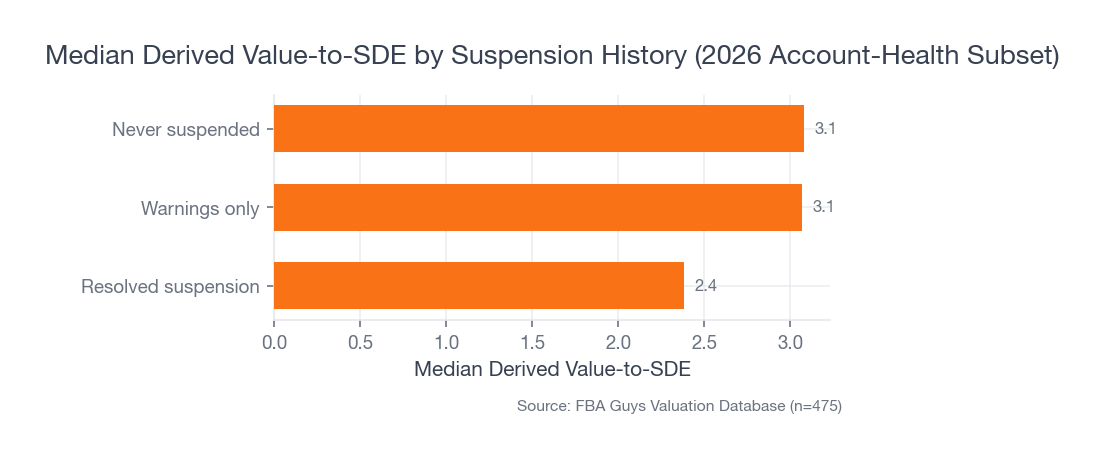
Inside that subset, resolved suspension histories sat lower than warnings-only and never-suspended histories.
Never-suspended histories had a 3.08 median derived value-to-SDE. Warnings-only histories were almost identical at 3.07. Resolved suspension histories were lower at 2.38. Active issues had a 2.22 median, but there were only six valid records, too few for a stable read.
 Source: FBA Guys Valuation Database (n=475)
SDE means seller's discretionary earnings, the owner-operated earnings figure commonly used to value smaller Amazon businesses. Derived value-to-SDE is our calculator-output valuation divided by derived SDE. It is valuation context from submissions, not a closed-deal multiple.
The data doesn't prove the suspension caused the lower value context. We don't know the reason for each deactivation, the appeal quality, the exact reactivation date, whether the account was inactive for two days or two months, or whether Amazon made a bad call.
The data does show that a resolved suspension isn't the same fact as a warning.
That is the useful operating read. A warning can be serious, especially if it repeats or involves a sensitive policy area. But in the current data, warnings-only histories look much closer to never-suspended histories than to resolved suspensions. A resolved suspension deserves its own explanation.
The Reactivation File Should Be Built Before You Move On
The file doesn't have to be complicated. It has to be complete enough that someone who was not there can reconstruct the event.
Save the original deactivation notice, the Account Health page, affected ASINs, SKUs, order IDs, policy names, case IDs, dates, deadlines, and every message from Amazon. Then save the submission record: appeal text, Plan of Action, invoices, photos, shipping documents, product-compliance files, identity records, rights-owner correspondence, or whatever Amazon requested in that case. After reactivation, save the final response and the operating repair.
That last part is where many files stop too early. The appeal may say "we updated our supplier review process." The business file should show the actual process: who reviews the supplier documents, where the invoice is stored, when the ASIN is checked, what happens before a reorder, and when the control gets reviewed again.
For a product-authenticity issue, the file might include:
- Supplier invoice requirements.
- Proof that supplier names, quantities, dates, and products match the ASINs under review.
- A reorder checklist.
- A storage location for authorization letters and invoices.
- A monthly review date for the account-health owner.
For a condition issue, the file might point to receiving, FBA prep, packaging, returns review, or customer-service records. For an intellectual-property claim, it might point to authorization, listing changes, ownership evidence, or rights-owner communication. We covered that evidence path separately in how to handle Amazon intellectual property claims.
The test is practical: could another person run the prevention step next month?
If the answer is yes, the appeal has started to become an operating control. If the answer is no, the business may only have a reinstatement story.
Current Account Health Changes the Meaning of the Old Event
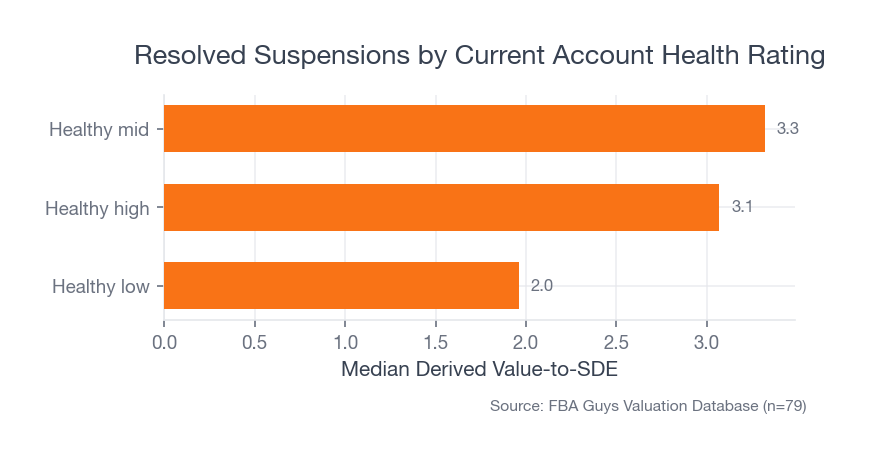
A resolved suspension with weak current account health reads differently from a resolved suspension with clean current account health.
The database points in that direction. Among resolved suspension histories, healthy-low AHR records had a 1.96 median derived value-to-SDE. Healthy-high records were at 3.07. Healthy-mid records were at 3.32, though that bucket had only 12 records, so we wouldn't make much of its exact position above healthy-high.
 Source: FBA Guys Valuation Database (n=79)
The broader point is more durable than the order of those two stronger buckets. Current account health has to support the story that the old issue is controlled.
Amazon's public Account Health FAQ and related help materials describe Account Health as the place sellers monitor performance and policy compliance. The live Seller Central view is the one that matters operationally, because current policy language and program details can change.
For the seller, the question after reactivation is simple:
What would someone see if they opened Account Health today?
Open violations, unresolved warnings, weak seller-fulfilled metrics, suppressed listings, or repeated policy issues can all make an old reactivation harder to explain. A clean current screen doesn't erase the old event, but it helps show that the account didn't keep drifting in the same direction.
If you need the scoring layer first, start with our Amazon Account Health Rating explained guide.
SOPs Are the Prevention Section Made Real
The SOP finding was the most useful part of the data for this article.
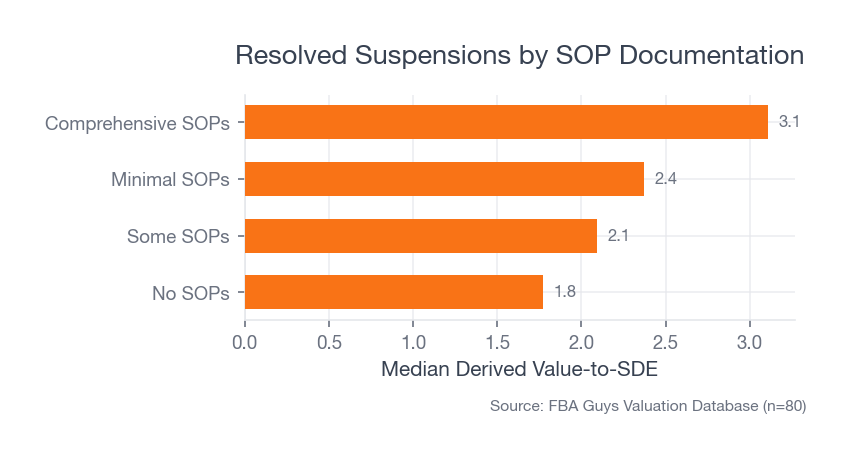
Among resolved suspension histories, comprehensive SOPs had a 3.11 median derived value-to-SDE. Resolved histories with no SOPs had a 1.77 median. Minimal SOPs were at 2.37. Some SOPs were at 2.09.
 Source: FBA Guys Valuation Database (n=80)
We don't know whether SOPs caused that gap. They may travel with larger businesses, cleaner teams, stronger financial documentation, better owners, or older operating histories.
Still, the pattern fits the job after reactivation. A Plan of Action usually has three parts: root cause, corrective action, and prevention. The prevention section is weak if it only lives in an appeal. It becomes stronger when it turns into a repeatable process.
The process doesn't have to be large. A small seller can still keep a weekly Account Health review, an ASIN compliance folder, a supplier-documentation folder, and a named owner for policy notices.
The boring part is the point. A dated SOP makes the prevention claim inspectable.
That also connects with the broader documentation problem buyers care about. The Playbook's diligence logic is plain: confidence comes from records that let someone verify the business without reconstructing the past from memory. An account-health file is one of those records.
What to Do Immediately After Reactivation
The first hour after reactivation is for preservation.
Download or screenshot the Account Health page, the final Amazon response, the case history, and any open issues that remain. Save the appeal text and documents exactly as submitted. If Amazon's message includes any condition for continued selling, copy that into the file.
Then separate the event into three buckets:
- The Amazon record: notices, case IDs, ASINs, documents, responses, and the reactivation message.
- The business repair: supplier controls, listing controls, product-compliance files, return-review steps, customer-service process, or shipping-performance fixes.
- The follow-up record: owner, next review date, what will be checked, and where the evidence will be saved.
That follow-up record is what keeps the file alive. A prevention promise made during an appeal gets stale quickly. A prevention control with a dated review record becomes part of the business.
For broader prevention habits, the Amazon suspension prevention checklist is the better companion piece. This article's narrower point is what to do after the account has already come back.
If Amazon Rejects the Appeal or Asks for More Information
A rejection isn't always a new issue.
Read Amazon's response line by line. If it asks for missing documents, provide those documents. If it says the root cause is incomplete, make the root cause more specific. If it says the corrective actions are insufficient, show what has already changed. If it says the prevention steps are weak, turn the prevention into a named control.
The second submission should answer the gap Amazon identified. It shouldn't become a new broad explanation unless Amazon has changed the scope.
This is especially true for authenticity, related-account, identity, safety, legal, and review-manipulation issues. Those categories can involve trust questions about the seller, not just one ASIN. A vague second appeal can make the file worse.
If the issue involves legal claims, forged-document allegations, safety issues, or related-account identity problems, qualified help may be safer than repeated submissions that guess at the root cause.
Does Account Health Assurance Change This?
Amazon announced Account Health Assurance as a benefit intended to help eligible sellers work with Amazon before certain deactivation events. Amazon's current Account Health Assurance FAQ describes a protected response path for eligible sellers who work with Amazon within the required contact window.
That can matter. If you have Account Health Assurance, the emergency contact process should be part of the account-health SOP. Someone has to answer the phone, reach the right documents, and know who owns the affected ASIN or policy area.
AHA doesn't replace the file.
It doesn't explain an old suspension. It doesn't organize supplier invoices. It doesn't make repeated policy issues harmless. It is a process advantage only if the business is ready to respond with evidence.
How to Explain Reactivation Later
A good explanation is mostly a table of facts.
Date of notice. Policy area. Affected ASINs or orders. Documents requested. Documents submitted. Root cause. Corrective action. Prevention control. Date reactivated. Current Account Health status. Clean-history period afterward.
That is enough for many account-health histories.
The harder cases need more context: recent deactivation, multiple suspensions, review manipulation, forged-document allegations, related-account problems, unresolved IP claims, or safety issues. The industry correction file is blunt here. "Any suspension kills the deal" is too broad, but recent, repeated, or severe events can be highly deal-sensitive.
An older, resolved suspension with a clean record afterward may be explainable. A recent reactivation with weak current Account Health is a different conversation.
The seller's job isn't to make the event sound small. It is to make the event understandable.
What a Buyer or Lender Will Ask Next
A buyer or lender will usually start with the current screen, then move backward.
They may ask for Account Health screenshots, performance notifications, old warning history, suspension history, suppressed listings, open cases, seller-fulfilled metrics, and the exact chain of messages around the reactivation. If there was a product-authenticity issue, they may ask whether supplier invoices match the affected ASINs. If there was an IP claim, they may ask whether the rights owner retracted it, whether the listing changed, or whether the brand has authorization records.
This is the same diligence logic that shows up in broader Amazon business reviews. The buyer is trying to understand what can break after closing. The seller is trying to show which risks are old, which are current, and which now have controls.
The current Account Health screen answers only part of that question.
If the account was reactivated three weeks ago, the reviewer may still treat it as an active diligence issue. If the account was reactivated two years ago and the file shows clean history since then, the conversation is different.
The data can't draw the exact recency line. It doesn't store reactivation dates. Our read is that sellers should handle the file as if the next reviewer will care about four things: severity, recency, recurrence, and control.
That is also why a reactivation file should stay close to the broader diligence folder, not buried in a customer-service folder that no one opens until the next warning.
FAQ
How do I reactivate an Amazon seller account?
Start inside Seller Central. Amazon's current public help points sellers to Account Health and the Reactivate your account workflow. Follow the instructions Amazon gives for the specific deactivation, because the required documents and appeal format can vary by policy issue.
What should be in an Amazon seller account reactivation appeal?
The appeal should answer the notice. Most useful submissions identify the root cause, corrective action already taken, prevention control, and documents Amazon requested. For a fuller appeal structure, see our Amazon seller account suspension appeal guide.
Does reactivation remove a suspension from the account history?
No. Reactivation restores selling access, but the event can remain relevant as account-health history. Save the notice, appeal, documents, Amazon responses, final reactivation message, and prevention control.
Does a resolved suspension reduce Amazon business value?
It can affect valuation context, but it doesn't automatically kill the business. In our 2026 account-health subset, resolved suspension histories had a lower median derived value-to-SDE than warnings-only and never-suspended histories. Recency, severity, recurrence, current Account Health, and documentation all matter.
What should I do after Amazon reactivates my seller account?
Save the complete event file, check whether anything remains open in Account Health, turn the prevention step into an SOP, assign an owner, and schedule a follow-up review. The reactivation notice is the endpoint of the appeal, not the endpoint of the account-health record.
Does Account Health Assurance prevent account deactivation?
Account Health Assurance can help eligible sellers work with Amazon before certain deactivation events under Amazon's current program rules. It doesn't replace account-health monitoring, evidence files, or prevention controls.
Keep the Reactivation File Boring
The best reactivation file isn't dramatic.
It is the notice, the evidence, the appeal, the correction, the control, and the follow-up date.
That is what you will want if the same issue comes back. It is also what you will want if a buyer, lender, or valuation reviewer asks why a resolved suspension should be treated as resolved.
The account came back. The next job is making the account-history file easy to believe.
Curious what your business is worth?
Get a free, instant valuation and see how your Amazon business stacks up.
Get Your Free Valuation