Amazon Product Bundling Strategy: The Bundle Has to Earn Its Own ASIN
The FBA Guys
May 27, 2026

Bundles look like a merchandising idea until the first awkward ASIN shows up in inventory.
One cleanser. One moisturizer. One small applicator. A nice set, maybe. Or a slow-moving box with three replenishment rhythms, one barcode, a margin that only worked in the spreadsheet, and a main image that now has to explain everything in a thumbnail the size of a postage stamp.
An Amazon product bundling strategy should start with one question: does this combination make the customer's decision easier while keeping the economics, policy risk, and inventory behavior cleaner than selling the items separately?
That sounds simple.
It isn't always how bundle ideas are born.
Many bundle ideas start because a seller wants a new ASIN, a higher average order value, or a way around a competitive listing. Those can be useful outcomes. They are poor starting points. The bundle has to deserve its own listing because the products belong together, the use case is obvious, and the business can support the extra operational shape that comes with it.
The data kept pulling us toward that word: shape. Not bundle count. Not novelty. Shape.
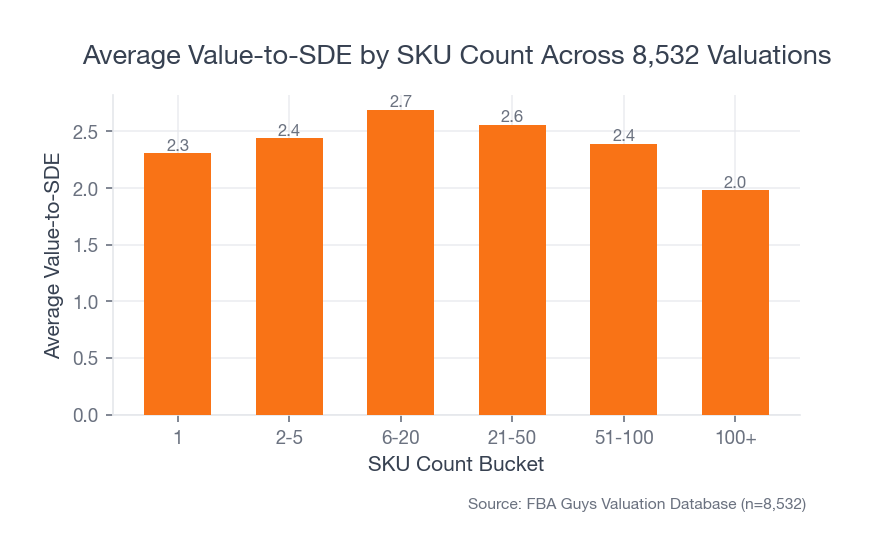
Across 8,532 successful valuations in the FBA Guys database with positive derived SDE, businesses with 6-20 SKUs averaged 2.69 value-to-SDE. One-SKU businesses averaged 2.31. Businesses with more than 100 SKUs averaged 1.98.
The middle was doing something interesting.
 Source: FBA Guys Valuation Database (n=8,532)
That doesn't mean every seller should run out and create 19 bundle ASINs by Friday. Please don't make Friday worse than it already is.
It means the best bundling strategy usually has less to do with clever packaging and more to do with controlled catalog breadth. Enough breadth to reduce dependence on one product. Enough focus that the business still makes sense when you explain it to someone who didn't live inside your Seller Central account for the last three years.
What an Amazon bundle actually is
Amazon's Product Bundling Policy treats a bundle as a new product made from multiple different products sold together as one offering. The items need to be complementary, the listing needs to identify what is included, and the bundle needs its own product identifier. A multipack of the same item is handled differently.
That distinction matters more than it first appears.
If you sell a three-pack of the same sponge, you are dealing with pack quantity. If you sell a sponge, cleaner, and microfiber towel together, you are dealing with a bundle. The second version has a different customer promise. It also has a different compliance surface.
Amazon's policy says the bundle image should show the actual products in the bundle, the title and bullets should identify the components, and the bundle identifier shouldn't be borrowed from one of the individual products. The platform is trying to prevent near-duplicate listings, customer confusion, and bundles that are really just listing games with a ribbon tied around them.
There is a business lesson tucked inside the compliance rule.
A bundle that is hard to describe cleanly is often hard to operate cleanly.
Physical bundles and Virtual Bundles solve different problems
A physical bundle is assembled as one sellable unit before it reaches the customer. You or your supplier put the products together, create the unit, label it properly, and send that unit into the fulfillment path.
A Virtual Bundle works differently. Amazon describes Virtual Bundles as a benefit for Brand Registry and FBA brands that lets sellers group complementary products without physically packaging them together. Amazon's public seller materials describe Virtual Bundle requirements including 2-5 different products, new condition, Brand Registry/FBA eligibility, and a bundle price that is equal to or less than buying the items separately.
The practical difference is inventory commitment.
With a physical bundle, you create a new inventory object. If the bundle is wrong, you may have units trapped in a configuration customers don't want. With a Virtual Bundle, you can test the customer relationship between products with less packaging commitment, assuming you meet Amazon's current eligibility requirements.
There is a little scar here, because this is where a spreadsheet can look far more confident than the operation deserves. The unit margin can look clean because the bundle price is higher. Then one component stocks out, another component keeps selling alone, and the bundle page starts telling you the real dependency structure. The spreadsheet did its job. It just didn't know the warehouse calendar.
For brand owners with eligible products, Virtual Bundles are often the cleaner testing lane. For kits that need custom packaging, gifting presentation, insert cards, or a true manufactured set, physical bundles may still make sense.
Different problems. Different risks.
Start with the job the bundle does
The best bundle ideas usually answer one of four customer jobs.
First, the bundle completes a use case. A yoga mat, blocks, and strap. A seasoning kit built around one recipe style. A replacement filter set that matches a device the customer already owns.
Second, the bundle reduces decision fatigue. The customer doesn't need to compare ten compatible accessories. You did that work for them.
Third, the bundle creates a natural replenishment rhythm. The set runs out together, or close enough that buying it together doesn't create waste.
Fourth, the bundle introduces a secondary product that genuinely belongs next to the hero product.
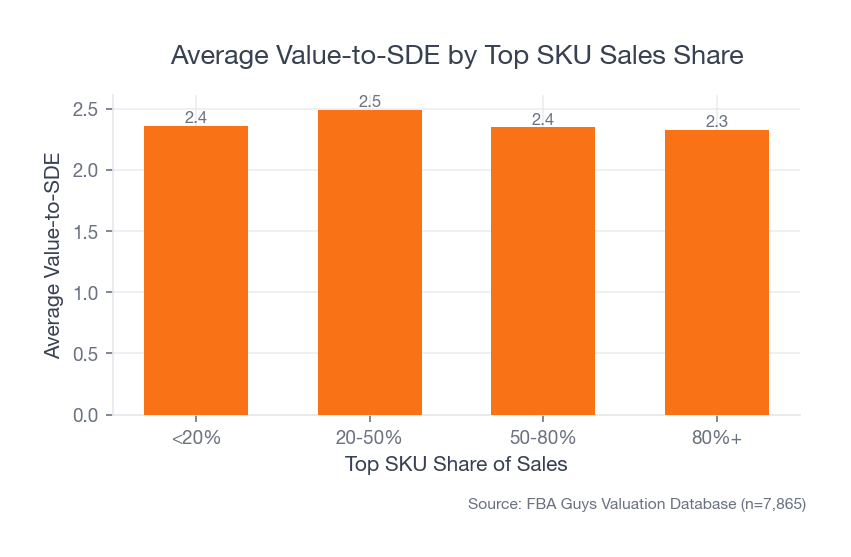
This is where the top-SKU data gets useful. Across the database, businesses where the top SKU accounted for 20-50% of sales averaged 2.49 value-to-SDE, slightly higher than the under-20%, 50-80%, and 80%+ groups. Inside 6-20 SKU catalogs, even businesses with an 80%+ top-SKU share still averaged 2.49.
 Source: FBA Guys Valuation Database (n=7,865)
That was the finding that made the bundle discussion more interesting. A hero product isn't automatically a weakness. Sometimes the hero product is the reason the catalog has coherence.
The question is whether the rest of the catalog supports that hero product or merely orbits it like loose screws in a drawer.
SKU count isn't a trophy
Product bundles can make SKU count feel productive. Every new configuration looks like progress because it creates another listing to optimize, advertise, and measure.
Then the business starts carrying its own cleverness.
In the valuation database, 6-20 SKU businesses averaged 2.69 value-to-SDE. Businesses with 21-50 SKUs were still healthy at 2.56. By 51-100 SKUs, the average fell to 2.39. Above 100 SKUs, it fell to 1.98, even though those businesses had the highest average revenue in the SKU bucket query.
Revenue was not the issue. Complexity was showing up somewhere else.
The database doesn't tell us which businesses used bundles. It does tell us that catalog breadth has a curve. Early breadth seems to help. Excessive breadth starts looking expensive, even when sales are larger.
Bundles can push you down either side of that curve. A few well-chosen bundles can turn one hero product into a more useful buying path. A long list of thin combinations can create new photos, new UPCs, new stranded-inventory risk, new PPC decisions, and new return explanations.
The funny part is that both versions look like "growth" in a weekly update.
Unique products make better bundle candidates
Product uniqueness sharpened the catalog signal.
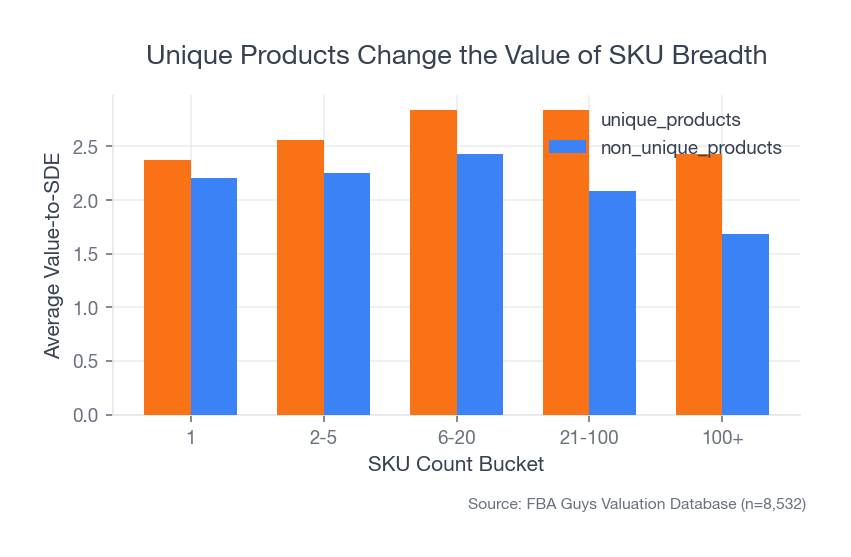
Across 8,532 valuations, unique products averaged 2.67 value-to-SDE. Non-unique products averaged 2.07. The gap stayed visible when we crossed uniqueness with SKU count. In the 6-20 SKU bucket, unique-product businesses averaged 2.84 versus 2.43 for non-unique products. In the 21-100 SKU bucket, unique products averaged 2.84 versus 2.08.
 Source: FBA Guys Valuation Database (n=8,532)
This isn't proof that uniqueness causes a better bundle outcome. The database doesn't measure bundle adoption, bundle conversion, or bundle-level profit.
It does point to the better operating question: can the bundle be defended as a product decision?
A commodity bundle can still work. Paper plates and napkins can belong together. Replacement parts can be practical. A private-label accessory set can save the customer time.
But if the only difference is that you put three common items on a new ASIN and hoped the listing would be harder to compare, the advantage may be thinner than it feels. The bundle has to create a reason for the customer to choose your version, and preferably a reason that survives the next seller copying the idea with a slightly different photo.
Designed-in-house products averaged 2.92 value-to-SDE in our data. Reseller products averaged 1.54.
There is a lot of daylight between those numbers.
The bundle math has to include the boring parts
Bundle math usually starts with component cost and selling price. Fine. Start there. If the contribution view is fuzzy, rebuild it SKU by SKU before you create the bundle. We covered that broader math in Amazon FBA unit economics and contribution margin for Amazon products.
Then keep going.
You need gross margin after the bundle discount, referral fee category treatment, FBA or fulfillment cost, prep and packaging cost, labeling cost, inbound shipping, damaged-unit risk, return handling, and advertising spend. For physical bundles, you also need to decide whether labor happens at the supplier, a 3PL, your own location, or somewhere else in the chain.
If one component has a 90-day lead time and another can be reordered in two weeks, the bundle now inherits the slower rhythm unless you carry extra inventory of one side. That can quietly turn a nice margin idea into a cash timing problem.
Our inventory-burden data keeps showing the same broad pattern in different articles. Businesses with inventory under 15% of derived SDE averaged 2.70 value-to-SDE. Businesses above 300% averaged 1.46.
Bundles can make that worse when the set is built from items with uneven velocity.
To illustrate: say Product A sells steadily, Product B sells in bursts after a promotion, and Product C mostly sells because it is tucked into the bundle. The bundle's blended margin may look acceptable. The operational question is whether Product C is now forcing cash into inventory that wouldn't have earned its place alone.
That is where the phrase "average order value" gets a little too charming. Higher AOV is useful only if the contribution margin and inventory behavior improve with it.
Consumables deserve a separate policy check
Amazon tightened its Product Bundling Policy for certain consumables categories. In an Amazon Seller Forums announcement, Amazon said that effective October 14, 2024, bundles in grocery, pet product, baby product, and health and beauty categories could only be listed when created and offered by the original manufacturer, who must be the brand owner for all items in the bundle.
At the current time, this is one of the easiest places to get overconfident.
The old mental model of "these products go together, therefore we can bundle them" may be too loose for some consumables. If your bundle touches those categories, read the current Amazon policy inside Seller Central before building inventory, buying packaging, or creating a new identifier.
This isn't legal advice. It is simply the part where you check the rule before shrink-wrapping 2,000 units.
A practical testing sequence
The cleanest Amazon product bundling strategy is usually staged.
- Identify the customer job.
- Check whether the items are complementary under Amazon's current policy.
- Confirm whether the category has special restrictions, especially for consumables.
- Decide whether this should be a Virtual Bundle, physical bundle, multipack, variation, or no bundle at all.
- Build contribution margin using the whole bundle path, not just component COGS.
- Check inventory rhythm by component. If this is already messy, fix the operating system first with an Amazon FBA inventory management review.
- Test with the lowest-commitment method available.
- Promote only after the bundle proves it can convert without wrecking margin.
- Document the bundle components, supplier responsibilities, prep instructions, UPC/GTIN records, image files, and policy rationale.
That last step sounds tedious because it is.
It is also the step that keeps the bundle explainable later. If you ever seek a valuation, clean documentation around product setup, supplier process, Brand Registry status, and inventory records makes the business easier to understand. The Playbook's valuation framework puts documentation and transferability in the core pillars for a reason.
A bundle that depends on your memory isn't very transferable.
What to track after launch
Track bundle performance at the unit level. The bundle should have its own contribution-margin view, not just a sales line in a dashboard.
Watch:
- Bundle conversion rate versus the main component ASIN
- Net contribution margin after discount and advertising
- Return rate and return reasons
- Component stockout frequency
- Component sell-through outside the bundle
- TACoS or ad spend effect if the bundle is promoted
- Inventory days of supply for each component
- Customer questions that reveal confusion about what is included
The messy detail is usually in the questions. "Does this include the charger?" "Is the brush full size?" "Can I choose the scent?" These are tiny signals that the listing may be doing too much work after the bundle design already should have made the answer obvious.
Good bundle tracking doesn't only ask whether the bundle sold. It asks what the bundle changed.
Did it increase profit per order? Did it move a slower accessory without discounting the hero product into nonsense? Did it create repeat behavior? Did it introduce a product customers wouldn't have discovered otherwise? Did it make customer service worse?
If the answer is just "it produced more revenue," keep digging.
Where bundles help business value
The strongest bundle strategies can help in three ways.
They can reduce product concentration by building useful attachments around a hero product. They can improve transferability by making the product line easier to understand as a system. They can support growth by giving the next owner tested expansion paths rather than a pile of guesses.
Of course, the same strategy can hurt value when it creates policy exposure, inventory drag, SKU sprawl, or a catalog that only makes sense to the founder.
The fact is, a bundle isn't automatically a better product. It is a new promise.
Promises need margin, compliance, stock discipline, and a reason a customer should care.
FAQ
What is an Amazon product bundling strategy?
An Amazon product bundling strategy is a plan for combining complementary products into a single buying path while protecting margin, compliance, inventory flow, and customer clarity. The bundle should make the purchase easier for the customer and cleaner for the business.
What is the difference between a physical bundle and a Virtual Bundle?
A physical bundle is packaged as one sellable unit before shipment or fulfillment. A Virtual Bundle groups eligible FBA products from a Brand Registry brand into one offer without physically packaging them together, subject to Amazon's current requirements.
Do Amazon bundles need their own UPC?
Amazon's Product Bundling Policy says a bundle needs its own product identifier or manufacturer part number, and the identifier of an individual component shouldn't be used for the whole bundle. Verify the current rule in Seller Central before creating a listing.
Are multipacks the same as bundles?
No. A multipack is multiple units of the same product. A bundle is made from different complementary products sold together as one offering.
Do bundles increase the value of an Amazon business?
Bundles can support Amazon FBA business valuation when they create focused catalog breadth, improve product defensibility, and keep inventory behavior clean. The FBA Guys database doesn't measure bundle adoption directly, so the stronger claim is adjacent: focused SKU breadth, product uniqueness, and controlled inventory burden correlate with healthier value-to-SDE patterns.
Final thought
The best bundle is boring to explain.
These products go together. The customer understands why. The margin survives the discount. The inventory rhythm works. The listing follows the current rules. Someone else could take over the business and understand the logic without opening a 17-tab spreadsheet named "bundle ideas final final."
That is enough ambition for one ASIN.
Curious what your business is worth?
Get a free, instant valuation and see how your Amazon business stacks up.
Get Your Free Valuation