Amazon FBA Dimensional Weight Pricing: How It Actually Changes Your Fees
The FBA Guys
March 19, 2026

Amazon FBA dimensional weight pricing is Amazon's way of charging for the space your product takes up, not just the number on the scale. As of March 19, 2026, Amazon's public FBA cost overview says fulfillment cost is based on product type, size, and shipping weight or dimensional weight, which is a polite way of saying Amazon cares about cube, not just mass, whenever your packaging starts acting bigger than your product economics can comfortably support.
This is one of those fee mechanics sellers ignore right up until a product that felt "light enough" starts producing ugly per-unit economics, and then everybody suddenly wants to have a serious conversation about margin discipline, packaging discipline, and whether the numbers in the old spreadsheet were ever attached to reality in the first place. The box looked harmless. The shipped weight did not. And suddenly the margin you thought you had was something you used to have.
What Amazon FBA dimensional weight pricing actually means
The short version is that if your package is bulky relative to its actual weight, Amazon can price fulfillment around the space it consumes rather than the physical weight alone, which is why a fluffy pet bed, an oversize supplement box, or a bundle with too much presentation packaging can behave like a much heavier item in the fee logic even when the scale says otherwise.
That matters because FBA fee math is layered and annoyingly interconnected. Size tier matters. Shipping weight matters. Dimensional weight can change that shipping weight, and once that input changes you are no longer talking about some tiny side penalty that stays in its own lane. You are talking about a different path through the pricing logic.
Plenty of sellers still talk about dim weight like it's a carrier problem. It isn't only that. It is a packaging and catalog-discipline problem too.
How to calculate dimensional weight before Amazon does
You should calculate this before inventory leaves your hands, not after the fee preview ruins your mood and not after somebody has already committed to a package that looks better in a product photo than it looks in a fee report.
Our dimensional weight calculator uses the standard pre-check most sellers expect:
- Measure the packaged unit, not the naked product.
- Multiply length x width x height.
- Divide by the applicable divisor.
- Round up.
- Compare that result against actual weight.
- The billable weight is whichever number is higher.
For domestic modeling, the tool uses a divisor of 139 with inches and pounds. For international modeling, it uses 5,000 with centimeters and kilograms. If you're working inside Seller Central, still confirm against Amazon's current fee preview, because Amazon changes rules, carriers change rules, and the old spreadsheet someone copied forward three packaging revisions ago is not going to tap you on the shoulder and admit it has been lying.
Here's the kind of example that trips people up. Say your boxed product measures 20" x 14" x 10" and the actual weight is 8 pounds. The volume is 2,800 cubic inches. Divide by 139 and you get 20.14, which rounds to 21 pounds. Your billable weight isn't 8. It's 21.
That is not a small miss.
It is the difference between "light product" thinking and "expensive package" reality.
The easy mistake here is measuring the product and forgetting the packaging. Inserts, void fill, a thicker corrugate spec, a decorative sleeve, or a retail-ready carton can push a unit over the line. Sellers do this to protect conversion or reduce damage. Fair enough. But if you aren't rechecking fee math after the packaging decision, you are basically signing the expense with your eyes half closed.
When dim weight actually changes your billable weight
Dim weight only matters when it beats actual weight. Dense products usually don't care. Bulky, light, air-filled, or over-boxed products care a lot.
That sounds obvious. The practical version is less obvious, because a small packaging tweak can leave the product looking almost identical while still changing the billable-weight math enough to push the unit into a worse cost profile, which is why "we only added a little more protection" sometimes turns into one of those sentences everybody says with a straight face right before the margin report gets weird.
If you want a quick sniff test, ask two questions:
- Is this package taking up more truck space than its scale weight would suggest?
- If I shaved even one inch off one side, would the math change materially?
If the answer to either question is yes, you should model the packaged dimensions immediately.
And if the answer is "I don't know because I'm using old supplier specs," that's your answer.
Why this gets expensive faster than sellers expect
The valuation database doesn't track package dimensions, so we can't honestly tell you how many businesses are losing margin specifically to dimensional-weight re-rating. What it can tell us, and this is still useful, is how little room many sellers have for fee sloppiness before a "small" packaging choice starts acting like a recurring tax on the business.
Across 15,383 valuation records with valid margin data, 45.0% of businesses reported margins under 20%. Another 22.2% landed between 20% and 39%. In other words, a lot of operators are not sitting on luxurious margin cushions where a few avoidable fulfillment-fee dollars disappear without consequence, and that is exactly why dim-weight mistakes deserve more respect than they usually get.
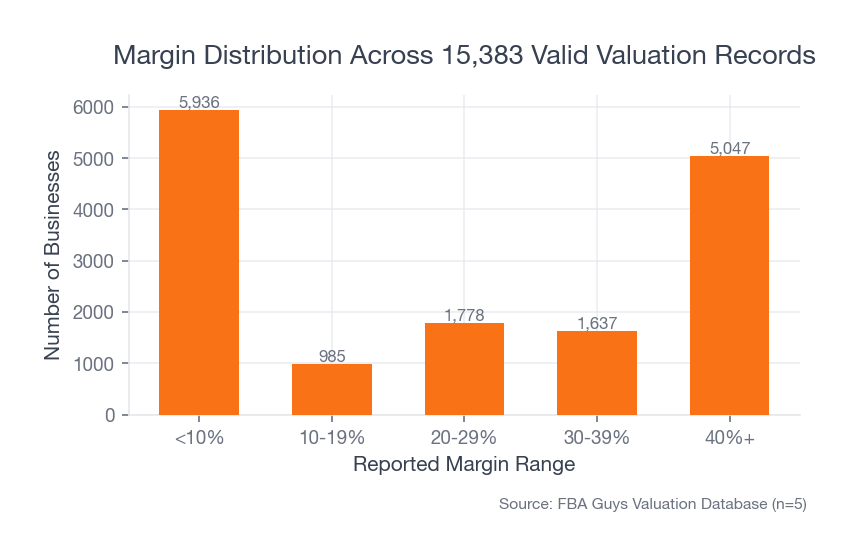 Source: FBA Guys Valuation Database (n=15,383)
Among 10,364 FBA businesses with valid margin data, the average reported margin was 28.7%. Combination-fulfillment businesses averaged 34.4% across 3,019 valuations. That doesn't prove dim weight is the reason for the gap, and it would be sloppy to pretend otherwise. What it does show is that fee discipline matters, because if your business already runs on a middling margin profile, bad packaging math doesn't need to be catastrophic to be painful. It just needs to be repeated.
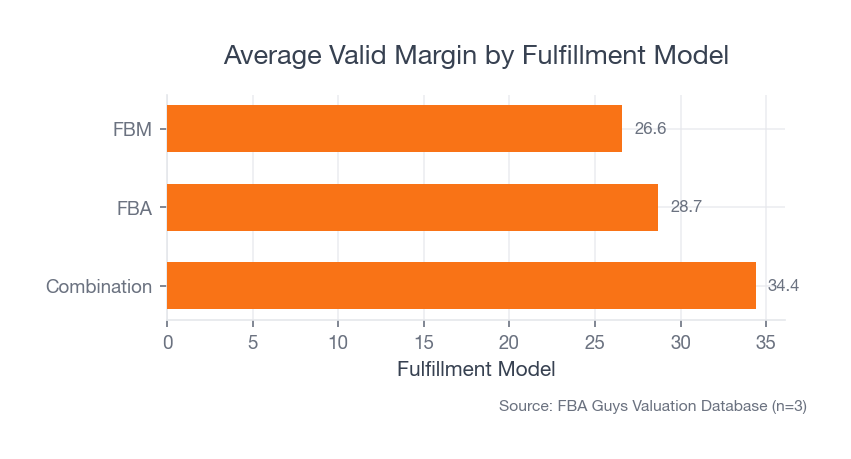 Source: FBA Guys Valuation Database (n=14,331)
This is the part sellers hate.
The problem is usually not one dramatic mistake. It's a small fee leak repeated across hundreds or thousands of units while everyone keeps looking at revenue.
How size tiers and shipping weight feed the pricing logic
Amazon's public fee guidance doesn't present dimensional weight as trivia. It places fulfillment cost on product type, size, and shipping weight or dimensional weight. So the right way to think about Amazon FBA dimensional weight pricing is not "What is the dim-weight fee?" The better question is "How is dim weight changing the shipping-weight input that helps determine what I pay?" If you ask the second question, you usually make better packaging decisions.
That framing matters because sellers often hunt for a single neat fee line. They want one box on the spreadsheet labeled "dim weight penalty." Real life is more annoying than that. Dim weight can change how the unit is treated inside the broader fulfillment-fee logic. That's why two products with similar manufacturing cost can behave very differently once packaging enters the picture.
It also means your packaging team and your finance team should be having the same conversation. Usually they aren't.
How to reduce dimensional-weight pain without creating a returns problem
The lazy answer is "use smaller packaging." Sure. But that can become its own expensive hobby if it increases damage, prep failures, or customer complaints, and then you have managed to solve one cost problem by purchasing a different one.
The better approach is to reduce wasted volume deliberately:
- Re-measure the packaged sellable unit after every packaging change, not just after product redesigns.
- Remove dead air first. Oversized void fill is the classic own goal.
- Test whether a poly bag, slimmer insert, or tighter carton can protect the product without adding useless cube.
- Audit bundled products separately. Bundles are where dimensional-weight math gets weird fast.
- Run the unit through a landed cost calculator too. A package decision that looks harmless in fulfillment may still hurt container efficiency or inbound economics.
Don't trust the catalog dimensions blindly
This section is short because it doesn't need to be long.
Catalog dimensions are often stale, supplier-provided, rounded, or based on the wrong packaging state. Sometimes they are based on the product before the insert changed. Sometimes they are based on the retail box instead of the shipped unit. Sometimes they are just suspiciously tidy in a way that should make any adult uncomfortable. If you are making pricing decisions from dimensions nobody on your team physically verified, you are doing accounting with decorative numbers.
Measure the actual packaged unit. Then measure it again when packaging changes. Boring work. Expensive if skipped.
Dimensional weight pricing is really a margin-control problem
That is the thesis here. Dimensional weight isn't just a shipping concept. It is margin control disguised as packaging math.
If you sell on Amazon long enough, you learn that a lot of ugly economics don't arrive as obvious disasters. They arrive as "close enough" assumptions. Close enough dimensions. Close enough fee forecasts. Close enough packaging. Then the unit economics flatten out, and everyone wants to debate ad spend before they look at the box, which is usually the least flattering possible sequence of events.
Start with the packaged measurements. Run the billable-weight check. Confirm the current fee preview in Amazon. Then compare the result against your target margins with the same seriousness you would apply to gross profit margin or profit-margin math. That's the adult version of Amazon FBA dimensional weight pricing. The rest is just denial with bubble wrap.
FAQ
What is Amazon FBA dimensional weight pricing?
It is Amazon's use of dimensional weight when package size matters more than actual scale weight for fulfillment pricing. If the dimensional-weight result is higher than actual weight, that higher number becomes the one you should worry about, because space-eating packages don't get a discount for being deceptively light.
Does dimensional weight affect all FBA products?
No. Dense products may never feel it. Bulky or over-packaged products feel it quickly. The trigger is not "being in FBA." The trigger is whether package volume pushes billable weight above actual weight, which is why two products with similar sales velocity can have very different fee behavior once packaging enters the conversation.
How do I check dimensional weight before sending inventory?
Measure the fully packaged unit, multiply length x width x height, divide by the relevant divisor, round up, and compare the result to actual weight. Then ask yourself one more question: if this number moved against you, would your margin still look acceptable? Or skip the spreadsheet theater and use the dimensional weight calculator.
What's the most common seller mistake with dim weight?
Using product dimensions instead of packaged dimensions. Close second: trusting old catalog measurements that nobody has re-verified since the packaging changed, which is a surprisingly common way to discover that the box in the warehouse and the numbers in the system have not been on speaking terms for months.
Curious what your business is worth?
Get a free, instant valuation and see how your Amazon business stacks up.
Get Your Free Valuation