Amazon FBA Cash Flow Management: Inventory Is Where the Cash Gets Quiet
The FBA Guys
May 17, 2026

Every Amazon seller has had the month where profit looked fine and the bank account disagreed.
The P&L said the business made money. Seller Central showed sales. The product was moving. Then a supplier invoice came due, Amazon's payout was still a few days away, ads needed funding, and the next reorder couldn't wait politely in the corner.
This is where Amazon FBA cash flow management becomes a real operating discipline. It is not just tracking money in and money out. It is matching inventory purchases, Amazon payouts, advertising spend, debt payments, and owner distributions so the business can keep selling without starving itself.
Among 8,503 FBA valuations in our database with usable sales and inventory fields, the average business carried $150,204 of inventory against $1,477,639 of annual sales. That is 17% of annual sales sitting in inventory. In the subset with usable margin and operating-expense fields, inventory averaged about 70% of estimated annual SDE.
That number made us pause for a minute.
A business can look profitable and still have most of its annual owner benefit tied up in stock, deposits, freight, and the next production run. Cash flow management is the practice of seeing that tension before the bank account sees it for you.
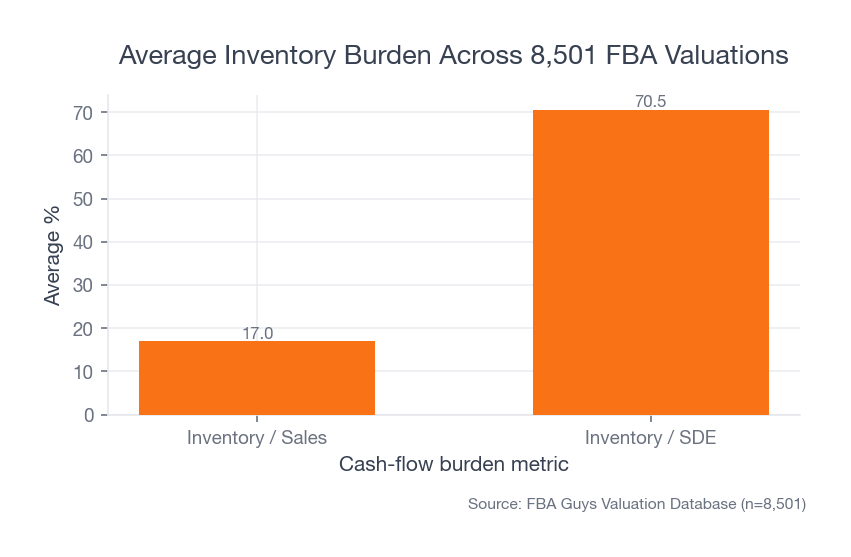 Source: FBA Guys Valuation Database (n=8,501-8,503, depending on metric availability)
Amazon FBA Cash Flow Management Starts With Inventory Timing
Inventory is usually the loudest cash-flow line in an FBA business because it asks for cash before the sale happens.
You pay a supplier. You may pay a deposit first and the balance before shipment. You pay freight, duty, inspection, prep, and placement-related costs. Then the inventory moves into Amazon's network. Sales happen later. Amazon pays after that.
The cash left the business long before the customer clicked Buy Now.
That timing gap is the core problem. Amazon FBA cash flow management means planning around the gap between when cash leaves for inventory and when cash returns through payouts. The gap widens when lead times stretch, minimum order quantities rise, freight gets awkward, or a seller tries to fund too many SKUs at once.
The awkward part is that growth can make this worse.
A slow business has problems, of course. But a growing FBA business can become cash hungry in a way that surprises owners. More sales require more inventory. More inventory requires bigger purchase orders. Bigger purchase orders arrive before the extra profit has had time to accumulate.
That is how a business can grow itself into a cash crunch.
The P&L records profitability over a period. Cash flow has to survive the sequence.
The Cash Conversion Cycle Hides Inside Reorders
The cash conversion cycle is the time between paying for inventory and getting cash back from the sale of that inventory. For an FBA seller, the cycle usually includes supplier payment terms, production time, freight time, receiving time, sell-through time, Amazon's payout timing, and any reserve or delay in the account.
Amazon has good inventory-management tools, and its own inventory management guidance talks about keeping enough stock to meet demand while avoiding overstock and aging inventory. That is useful. It is also only part of the job. Seller Central can help you see when to send inventory; it won't decide how much cash the business can afford to trap in the next order.
That judgment belongs to the operator.
Here is the operator's version of the question: if this reorder goes wrong, what else has to wait?
Payroll? Ads? A loan payment? Owner draw? The launch of a better SKU? A tax payment that was definitely going to be handled later, which is how tax payments become interesting in the bad sense?
Cash conversion cycle sounds like accounting language. In practice it is the difference between a business that can reorder calmly and a business that keeps negotiating with its own calendar.
Watch Inventory Against Sales, Not Just Profit
Inventory-to-sales is a simple ratio:
Current inventory value / trailing 12-month sales
It does not tell the whole story. No single ratio does. A seasonal brand, a long-lead-time product, and a replenishment-heavy consumable can all need different inventory levels. Still, inventory-to-sales is a useful early warning because it shows how much of the business is sitting in stock relative to the sales engine.
In our data, businesses with inventory under 5% of annual sales averaged $1.69M in valuation. The 5-10% group averaged $1.41M. The 10-20% group averaged $1.27M. Once inventory moved into the 20-35% range, average valuation dropped to $816K. At 35% or more, it averaged $338K.
Do not read that as a magic valuation formula. It isn't one. The lower-inventory groups also tend to include stronger, cleaner, faster-moving businesses. The pattern is still worth looking at because valuation buyers notice the same pressure operators feel: inventory-heavy businesses need more cash to keep moving.
There is a quiet practical test here.
If inventory equals 30% of annual sales, the business has to keep a large amount of capital in motion just to stay open. That may be perfectly rational for the category. It may also mean that every owner distribution is borrowing from the next reorder.
This is where Amazon sellers sometimes fool themselves with margin. A 28% net margin sounds healthy. If the business also needs six months of inventory on hand, the owner may not feel that margin in cash until much later.
Profit is the accounting result. Cash is the oxygen.
Fast Turns Give the Business More Choices
The inventory-turnaround cut was one of the cleaner patterns in the data.
Businesses that reported turning inventory every few weeks averaged 10.6% inventory-to-sales. Businesses turning inventory every few months averaged 14.7%. Those holding inventory for several months averaged 24.7%. The year-or-more group averaged 75.8%.
We ran that query more than once because the last number looked almost cartoonish. It held.
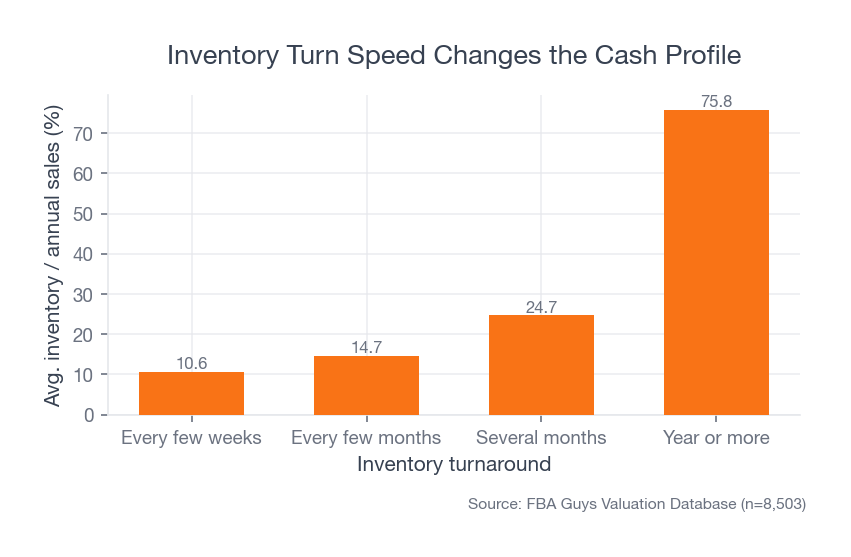 Source: FBA Guys Valuation Database (n=8,503)
Fast turns don't automatically mean a better business. A fragile SKU with fast turns and no margin can still be a headache with a barcode. But faster turns give the business more chances to correct itself. Cash comes back sooner. Reorder errors show up sooner. Demand changes become visible before the warehouse is full of last quarter's confidence.
Slow turns ask for a different temperament.
If your inventory takes several months to turn, the reorder decision has to be more disciplined. Forecasting matters more. Landed cost has to be current. Ad spend cannot be treated as a separate conversation. You need a view of inventory, payables, payouts, and taxes together. This is where a basic Amazon FBA inventory management system becomes a cash-flow tool rather than an operations checklist.
This is a mildly annoying point because it sounds obvious after you say it. Yet many FBA cash-flow problems start with separate spreadsheets that never quite meet each other. One spreadsheet says the SKU is profitable. One says the next order is due. One says cash is tight. None of them says, "This SKU is about to consume the cash we thought was available."
The system has to say that.
Declining Sales Change the Meaning of Normal Inventory
Inventory that was normal during growth can become heavy during decline.
In the valuation data, businesses with revenue that increased a lot averaged 14.3% inventory-to-sales. Increased businesses averaged 15.4%. Stable businesses averaged 18.1%. Declined businesses averaged 22.2%. Declined-a-lot businesses averaged 26.5%.
The inventory number may not have changed much. The sales denominator did.
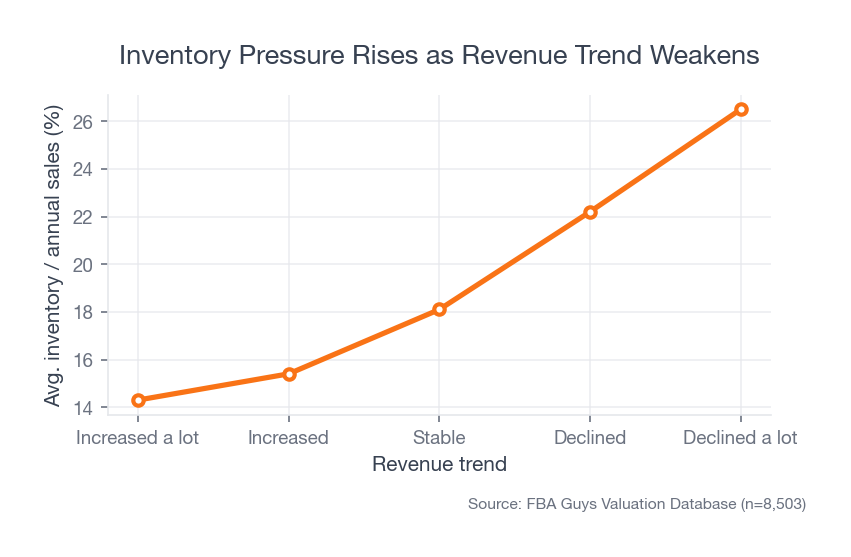 Source: FBA Guys Valuation Database (n=8,503)
This is one of those places where cash flow has a memory. The purchase order was placed when demand looked better. The container arrived into a business that had already cooled. Now the seller has cash sitting in units that are moving more slowly than the forecast assumed.
What happens next?
Usually one of three things. The seller discounts to move inventory, which may protect cash but hurt margin. The seller keeps price intact and waits, which may protect margin but trap cash. Or the seller funds the next move with credit, which can work if the underlying demand is still real and can get ugly if the business is just buying time.
None of those choices is automatically wrong. The mistake is treating them as separate decisions.
A markdown is a cash-flow decision. Holding price is a cash-flow decision. Borrowing to reorder is a cash-flow decision. Cutting ad spend is a cash-flow decision, and sometimes it is the one that makes the cash problem worse because sales rank starts to sag while inventory is already heavy.
This is why a cash-flow review should sit next to the operating review, not after it.
How Much Working Capital Does an Amazon FBA Business Need?
Working capital is the cash needed to operate the business between outflows and inflows. For FBA sellers, it usually means inventory cash, freight and prep costs, advertising float, Amazon payout timing, taxes, payroll or contractor costs, debt service, and a reserve for surprises. Amazon's own seller payments overview is worth reading because payout timing is part of the cash cycle, not an accounting footnote.
The simple planning version looks like this:
- Estimate the cash required for the next full inventory cycle.
- Add freight, duty, prep, and placement-related costs.
- Add advertising and operating expenses for the same period.
- Add taxes, debt service, and owner distributions that will happen before the cash returns.
- Subtract reliable incoming cash during that period.
- Keep a reserve for timing misses.
If you want to model this with your own numbers, use the FBA Guys working capital calculator. The useful question is not just "Can I afford this order?" It is "What does this order prevent me from doing before the cash comes back?"
That second question is where the truth usually lives.
For buyers, working capital matters in a different way. The purchase price is not the full cash requirement. A buyer may need cash for inventory, lead times, minimum order quantities, advertising, and transition risk after close. In larger or more institutional transactions, a working capital peg may define the target level of net working capital delivered with the business.
For smaller deals, the peg may never become a formal fight. The underlying issue still exists. Someone has to fund the inventory required to keep the business alive after the transfer.
This is why excess inventory can become a deal-structure issue. If a business needs $300,000 of normal inventory and has $600,000 on hand, the buyer may not treat the extra $300,000 the same way as normal operating stock. Some of it may be slow-moving. Some may be sellable but cash-heavy. Some may be useful and still create a financing problem.
Inventory has value. It also has timing.
Credit Lines Help, but They Don't Fix Bad Reorder Habits
In our database, businesses with a credit line averaged $1.91M in annual sales and 14.9% inventory-to-sales. Businesses without a credit line averaged $1.00M in annual sales and 19.2% inventory-to-sales.
That does not mean getting a credit line magically improves cash flow. Larger and more mature businesses are more likely to qualify for financing in the first place. The causality is messy.
Still, the pattern makes practical sense. A credit line gives the operator more room to bridge timing gaps. It can help fund inventory before peak season. It can prevent a good reorder from colliding with a temporary payout gap. It can keep ads funded while inventory is in transit.
It can also let a bad habit survive longer.
Debt is useful when the business has a repeatable cash cycle and the line is bridging timing. It is dangerous when the line is hiding weak margin, stale demand, or inventory that should have been marked down two months ago. This is where we would be careful. A seller can feel sophisticated because the business has financing, while the financing is quietly making the operating problem harder to see.
The question is not whether debt is good or bad. The question is whether the borrowed dollar returns on schedule.
If it does, financing can be a tool. If it doesn't, financing becomes a second business model sitting on top of the first one, and that model charges interest.
Build a Cash Flow System Before Growth Starts Lying
A useful FBA cash-flow system does not need to be fancy. It needs to make the timing visible.
At minimum, track these every week:
- Cash on hand
- Amazon receivables and expected payout dates
- Inventory on hand, inbound, and on order
- Open supplier deposits and balances due
- Advertising spend and planned spend
- Taxes, debt payments, payroll, and owner distributions
- Reorder points and lead times by SKU
- A 13-week cash forecast
The 13-week forecast is where the separate pieces start talking to each other. It shows whether the cash low point happens before or after the next payout, whether a reorder collides with a tax payment, and whether the owner draw is actually available or just sitting temporarily in the account on its way to a supplier.
Some sellers resist this because it feels too corporate.
Fine. Call it a cash calendar. The name doesn't matter. The discipline does.
The best version is tied to SKU-level inventory planning. A reorder point calculator can tell you when a SKU needs stock. A working capital model tells you whether the business can fund that reorder without weakening something else. A unit economics view tells you whether the SKU deserves the cash. A settlement-report review keeps Amazon deposits from being mistaken for clean revenue. A weekly dashboard keeps the whole thing from turning into a quarterly surprise.
Amazon's inventory tools can help with stock health, excess inventory, restock planning, and inventory age. Use them. Then put the result into your own cash model, because Seller Central doesn't know what else your bank account has promised.
That last sentence is the whole operating problem.
What Good Cash Flow Management Looks Like
Good cash flow management feels boring from the outside.
The seller knows when the next large supplier payment is due. They know which SKUs are allowed to reorder and which ones have to prove themselves first. They know whether a promotion is creating cash or just buying revenue. They know how much of the bank balance is actually available.
They also know when growth is too expensive.
This is hard to say because growth is the fun part. But some growth consumes more cash than it earns within the planning window that matters. A product can have decent margin, real demand, and still be a poor next use of capital because the order quantity, lead time, and ad support would crowd out better opportunities.
That is not pessimism. It is allocation.
The better operators are not allergic to risk. They just know which risk they are taking. They can look at a purchase order and see the sales upside, the cash low point, the downside case, and the recovery plan in the same view.
That is the standard.
Amazon FBA cash flow management is not about hoarding cash or starving growth. It is about making sure the next dollar is not already spoken for by a decision the business forgot it made six weeks ago.
FAQ
What is Amazon FBA cash flow management?
Amazon FBA cash flow management is the process of planning inventory purchases, Amazon payouts, advertising spend, operating expenses, taxes, debt payments, and owner distributions so the business has enough cash to keep operating through the full inventory cycle.
The inventory cycle is usually the part that bites first. Cash leaves for stock before the sale happens, and the sale turns into spendable cash only after fulfillment and payout timing.
How much working capital does an Amazon FBA business need?
An Amazon FBA business needs enough working capital to fund inventory, freight, prep, advertising, operating expenses, taxes, debt service, and a timing reserve until cash returns from sales. The exact amount depends on lead times, reorder size, sell-through speed, seasonality, and Amazon payout timing.
Among 8,503 FBA valuations we analyzed, average inventory equaled 17% of annual sales and about 70% of estimated annual SDE. That doesn't mean your business needs that exact number. It does show why working capital should be modeled directly instead of guessed.
Why do profitable Amazon sellers run out of cash?
Profitable Amazon sellers can run out of cash because profit is measured over time while cash has to survive the order sequence. A seller may be profitable on paper while cash is tied up in inventory, inbound shipments, ad spend, supplier deposits, or tax obligations.
The business didn't necessarily fail. The timing did.
Should Amazon sellers use a credit line for inventory?
A credit line can help an Amazon seller bridge timing gaps when the cash cycle is predictable and the inventory is likely to convert back into cash on schedule. It becomes risky when debt is used to hide weak demand, stale inventory, or margin that no longer supports the reorder.
The borrowed dollar needs a return date.
What cash-flow metrics should FBA sellers track weekly?
FBA sellers should track cash on hand, expected Amazon payouts, inventory on hand, inbound inventory, open supplier balances, ad spend, taxes, debt service, owner distributions, reorder points, lead times, and a 13-week cash forecast. Inventory-to-sales and inventory-to-SDE are especially useful stress signals.
Curious what your business is worth?
Get a free, instant valuation and see how your Amazon business stacks up.
Get Your Free Valuation