Alibaba Sourcing Tips for Amazon Sellers: Build the Supplier System Before the Reorder Tests It
The FBA Guys
June 7, 2026

Alibaba makes sourcing feel deceptively tidy.
You type in a product, sort through suppliers, compare minimum order quantities, ask for a sample, negotiate a price, and eventually wire money to someone who may be twelve time zones away. The screen makes it feel like shopping. The business that comes after the order feels nothing like shopping.
The best Alibaba sourcing tips for Amazon sellers are really supplier-system tips: choose a product you can specify, vet the factory behind the profile, put quality terms in writing, protect the payment path, build backup suppliers early, and keep the documents Amazon may ask for later.
That is the clean version.
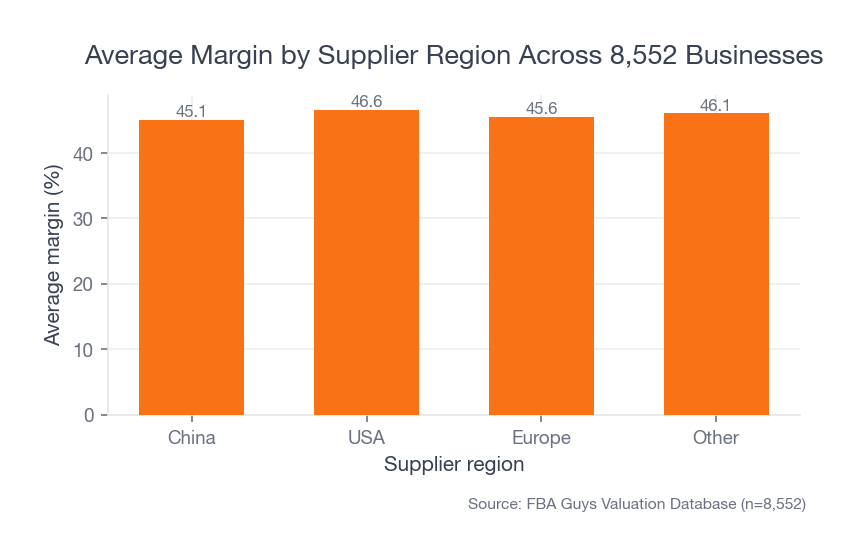
The data version is more interesting. In the FBA Guys valuation database, 3,810 of 8,552 successful valuation records reported China as the vendor location. Those businesses averaged 45.1% margin. U.S.-sourced businesses averaged 46.6%. Europe-sourced businesses averaged 45.6%.
 Source: FBA Guys Valuation Database (n=8,552)
The scar here is that the margin data doesn't give us the neat story a sourcing article usually wants. The cheap-China frame would be easy to write, and it would also miss what the numbers keep pointing toward.
The better question is what happens after you find the supplier.
Alibaba Sourcing Tips for Amazon Sellers Start With the Supplier System
A supplier is a company. A supplier system is the set of records, terms, backups, inspections, samples, purchase orders, invoices, and reorder habits that lets your business keep buying without depending on memory.
That distinction matters more than the platform.
Alibaba can help you find manufacturers, trading companies, wholesalers, and distributors. It can help you request quotes, compare badges, keep messages in one place, use Trade Assurance where available, and find factories that already sell into your category.
Useful.
Alibaba doesn't decide whether the product is safe for Amazon. It doesn't make your invoice acceptable if Amazon asks for proof. It doesn't inspect every unit. It doesn't know whether your packaging claim creates a compliance problem in the U.S., and it certainly doesn't know whether a factory can hold tolerance on the second production run after the first sample looked perfect.
That work belongs to the business.
Our valuation data keeps pulling sourcing toward the same operating point. Among 8,552 successful valuation records, 3,001 businesses reported one supplier. That is 35.1% of the sample. Among those single-supplier businesses, 1,867 had no backup vendor.
One factory. No backup.
That setup may work for a while. It may work for years if the product is simple, the factory is stable, and demand is predictable. But it is still a structure that depends on one relationship staying healthy through holidays, raw-material changes, payment disputes, quality misses, and every reorder you have not placed yet.
Alibaba sourcing should begin with that structure in mind. The first supplier is important. The second supplier, the inspection habit, and the document file are what turn sourcing into something the business can survive.
Choose the Product Before You Choose the Alibaba Supplier
The most expensive sourcing mistake often happens before anyone messages a factory.
You choose a product that is too hard to define.
Some products are straightforward. A stainless-steel mixing bowl still has details, but you can usually specify size, thickness, finish, grade, packaging, carton quantity, and labeling without needing an engineering degree. A baby sleep product, rechargeable device, topical product, heated item, food-contact product, or anything making a performance claim sits in a different world.
What has to be true for this product to be sold safely on Amazon?
That question belongs before the quote request. It affects supplier selection, test reports, labeling, packaging, liability, landed cost, lead time, and whether the product should be sourced from Alibaba at all. If you can't describe the product clearly enough for a factory, an inspector, a freight forwarder, and an Amazon compliance reviewer to understand the same object, you are still early.
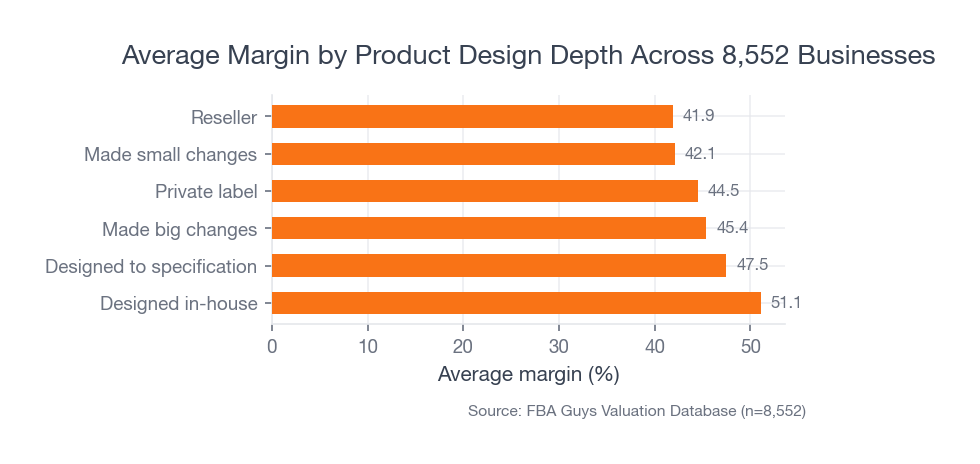
The data gives us a useful nudge here. Designed-in-house products averaged 51.1% margin across 2,198 valuation records. Products designed to specification averaged 47.5% across 1,125 records. Private-label products averaged 44.5% across 1,450 records. Reseller products averaged 41.9% across 1,469 records.
 Source: FBA Guys Valuation Database (n=8,552)
The label "private label" isn't doing much work by itself.
The richer question is whether you are buying a catalog product with a logo, asking for small changes, building to a specification, or designing something the factory has to manufacture around your requirements. Those are different sourcing jobs, even when they all happen inside the same Alibaba message thread.
This is where a simple sourcing brief helps. Before contacting suppliers, write down:
- The exact customer problem the product solves.
- The material, size, finish, color, and packaging requirements.
- Any product claims you plan to make on Amazon.
- Required certifications, test reports, labels, or warnings.
- What can change without hurting the product.
- What can't change under any circumstances.
- The target landed cost, not just the target unit cost.
The last point matters. A supplier quote that looks cheap before freight, duties, inspection, prep, packaging, defect allowance, and Amazon fees may not be cheap inside the actual business.
We shouldn't have to keep relearning that one. And yet the landed-cost file is often where optimism goes to hide.
Vet the Factory, Not Just the Badge
Alibaba badges are signals. They aren't conclusions.
A Verified Supplier badge, Trade Assurance availability, years on Alibaba, transaction history, response rate, and factory videos all tell you something. None of them tells you enough.
You still need to understand who is on the other side of the quote.
Is the company a factory, a trading company, or a hybrid? Does it manufacture the exact category you need, or does it sell anything that can fit inside a container? Can it show production capability, quality-control process, relevant test reports, and export experience for your target market? Does the business name on the Alibaba profile match the business name on invoices, inspection reports, and export documents?
This isn't paperwork theater. It is how you keep the source chain understandable.
Ask for the factory's business license, product catalog, certifications, factory audit reports where available, and references to similar products they have made. Search the company name outside Alibaba. Look for the address. Check whether the certificate belongs to the company quoting you or to some other factory in the supply chain.
Then ask one awkward question early: "Will this order be produced in your factory or subcontracted?"
The answer may be perfectly reasonable. Some suppliers coordinate production across facilities. Some trading companies are excellent. What matters is whether you understand the arrangement well enough to control quality, keep documents aligned, and explain the supply chain if Amazon or a serious operator asks for the record later.
If the supplier gets vague here, slow down.
Put Every Specification in Writing Before You Pay
Alibaba messages can feel detailed right up until there is a dispute.
A good sourcing file needs more than friendly chat. It needs written specifications that can survive being read by someone who wasn't part of the conversation.
At minimum, your purchase order or Trade Assurance order should spell out:
- Product name and model.
- Materials and dimensions.
- Color, finish, and acceptable variance.
- Packaging, inserts, labels, barcodes, carton marks, and FNSKU requirements.
- Required certifications, test reports, or compliance documents.
- Defect definitions.
- Inspection standard and timing.
- Sample approval reference.
- Production lead time.
- Shipping terms, handoff point, and required documents.
- Refund, remake, or replacement terms if the order misses agreed specifications.
The phrase "same as sample" is tempting. It is also thin.
Which sample? The first one with the scratched insert? The second one with the better finish? The pre-production sample photographed under factory lighting? The approved unit you kept in your office? The one your VA accidentally mailed to the photographer?
Use photos. Use measurements. Use tolerances. Use a retained physical sample if the product justifies it. The spec doesn't need to look fancy, but it does need to be specific enough that the supplier, inspector, and operator can all point to the same standard.
This may feel slow on a first order. It is much faster than arguing about whether "matte black" includes the slightly glossy finish that arrives after your inventory plan is already built around the shipment.
Order Samples Like You Are Trying to Break the Product
A sample isn't a souvenir.
It is a test unit, a communication device, and a preview of what the factory thinks "acceptable" means.
Order samples from more than one supplier when the product economics allow it. Pay attention to the boring parts: how quickly the supplier answers technical questions, whether they confirm details or simply say yes, how the sample is packed, whether the label matches the quote, whether the invoice is usable, and whether the sample fails in a way that a customer would notice in three seconds.
Then abuse it a little.
Open and close the lid more times than a normal person would. Wash it. Drop it from counter height if that reflects real use. Pull the zipper. Tug the seam. Charge the battery. Check the smell after it has been sealed in packaging for two days. Give it to someone who didn't read the listing and ask them what they think the product does.
The messy little details are where future returns hide: a label that rubs off, a hinge that sounds cheap, a zipper pull that turns sideways and gets stuck, a gift box that looks fine until a warehouse label covers the only clean face.
None of this replaces formal compliance testing when testing is required.
It does tell you whether the supplier understands the product you are trying to sell.
Use Trade Assurance, Then Do Real Quality Control
Trade Assurance is useful. Use it when the supplier offers it and the order qualifies.
It can help protect payment and provide a process for disputes when order terms aren't met. It also encourages you to keep communication, order terms, and payment inside Alibaba's system, which is exactly where you want the record if something goes wrong.
Honestly, the record discipline may be as valuable as the protection.
If the product spec, packaging requirement, shipment date, and quality standard are written into the order, you have something to inspect against. If the important details live in a WeChat thread, a phone call, and a spreadsheet called "final-final-supplier-notes-v3," you have made the dispute harder before the shipment leaves the factory.
Trade Assurance still isn't quality control.
For meaningful orders, use a pre-shipment inspection. Give the inspector the same specifications you gave the supplier. Define what counts as a critical, major, or minor defect. Decide in advance what failure rate stops the shipment. If the product is regulated, compliance testing is a separate job and should happen before you rely on the product for Amazon revenue.
The first production run is a test of the whole system, not just the product.
Build Backup Suppliers Before You Need Them
This is the section that looked obvious until the revenue buckets made it less obvious.
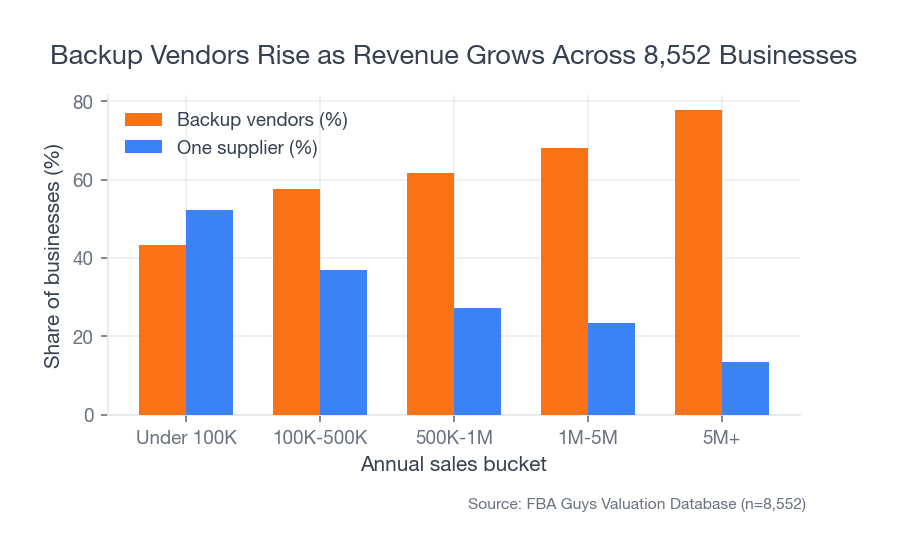
In our valuation database, 58.1% of successful records reported having backup vendors. That means 41.9% didn't. The backup-vendor rate rises with revenue: 43.3% under $100K, 57.6% at $100K-$500K, 61.7% at $500K-$1M, 68.1% at $1M-$5M, and 77.8% above $5M.
 Source: FBA Guys Valuation Database (n=8,552)
The single-vendor rate moves the other way. It falls from 52.3% under $100K to 13.5% above $5M.
There are several ways to read that.
One is that larger businesses can afford better sourcing infrastructure. That is probably true. A seller doing $80,000 a year may not want to sample three factories, pay for inspections, and maintain a second production relationship for a product that is still proving itself.
Another reading is more useful: the business that grows into larger order volume eventually needs a sourcing system that doesn't depend on one factory saying yes.
The fact is, backup suppliers are easier to build when you don't need them yet. You can ask better questions. You can compare samples without panic. You can test a small order. You can keep the primary supplier relationship healthy without secretly hoping nothing changes.
Among China-sourced businesses in the database, 36.9% reported one vendor and 40.6% reported no backup vendor. China-sourced single-supplier businesses averaged $538,093 in sales and 45.5% margin. China-sourced businesses with 2-5 vendors averaged $1,311,352 in sales and 45.1% margin.
The margin barely moved. The sales profile did.
That doesn't prove supplier diversity caused growth. It does suggest the supplier structure changes as the business gets more serious. Maybe the business adds suppliers because it grows. Maybe it grows because the supplier base can handle more complexity. Usually, it is some of both.
A backup supplier doesn't have to receive half your volume. Sometimes the right backup is a qualified second factory with an approved sample, written specs, current pricing, and enough relationship history to take a trial order. Sometimes it is a domestic emergency option with worse unit economics but faster recovery. Sometimes it is a component supplier rather than a finished-goods supplier.
The goal isn't to make every supplier interchangeable. They won't be.
The goal is to know what breaks if the primary supplier misses a shipment, raises MOQ, changes a material, loses a key machine, fails an inspection, or simply stops answering with the same urgency after your deposit clears.
This is also where transferability enters the picture. If someone else had to operate the business, could they understand the supplier base without sitting through your memory of every negotiation?
That is a sourcing question before it is a business risk or valuation question.
Watch MOQ, Lead Time, and Inventory Turn Together
MOQ isn't just a supplier term. It is a cash-flow term.
A factory may offer a better unit price at 5,000 units than 1,000 units. Fine. What does that do to cash? What does it do to storage fees? What does it do to defect exposure? What does it do to your ability to change packaging after the first review pattern starts telling you something?
Inventory turn gives the answer some shape.
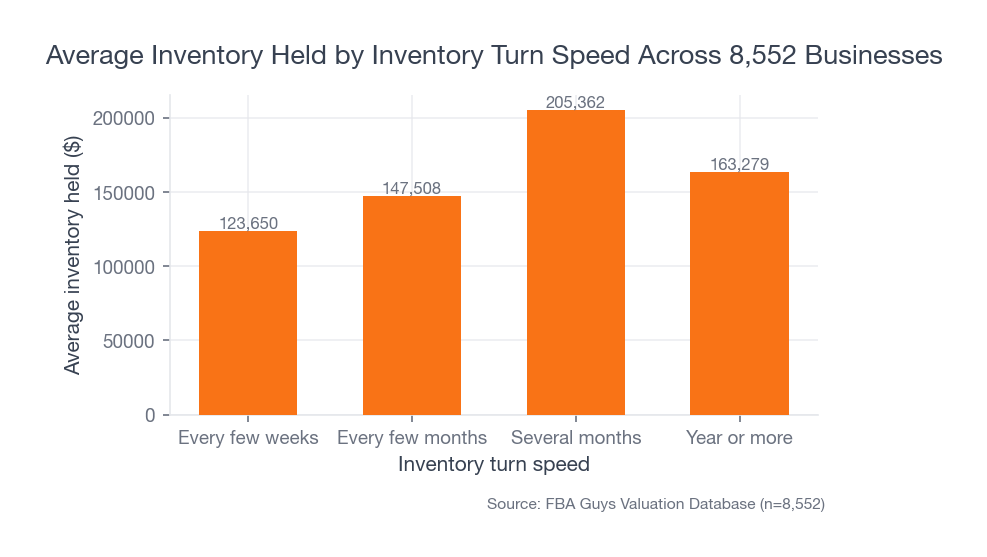
In our database, businesses turning inventory every few weeks averaged $1.71M in sales with $123,650 in inventory. Businesses turning inventory every few months averaged $1.42M in sales with $147,508 in inventory. Businesses taking a year or more averaged $631,365 in sales with $163,279 in inventory.
 Source: FBA Guys Valuation Database (n=8,552)
Slow inventory isn't always bad. Seasonal products, larger products, and long-lead-time products can require heavier inventory positions. But slow turn changes the sourcing decision because every extra production month has to be financed before it becomes revenue.
You can be right on unit cost and still wrong on order size.
The operator's question is simple: how many months of cash are you putting into the bet before the listing has proven reorder behavior?
For a new Alibaba-sourced product, consider negotiating a smaller first production run even if the unit cost is worse. Use that order to validate packaging, defect rate, inbound timing, customer feedback, and actual contribution margin. Once the product proves itself, the larger MOQ discussion becomes less speculative.
The worst version is the seller who buys the "efficient" quantity before the product has earned it.
Keep Amazon Compliance Documents From the First Order
Amazon sourcing documentation is boring until it becomes the only thing that matters.
If Amazon asks for proof that your product is authentic, safe, authorized, properly labeled, or compliant, you don't want to start reconstructing the supply chain from a half-translated invoice and a message thread.
Keep the invoice. Keep the purchase order. Keep proof of payment. Keep shipping documents. Keep inspection reports. Keep test reports. Keep product photos tied to the production run. Keep supplier business information. Keep packaging proofs, label files, barcodes, and any authorization letters.
For regulated or approval-sensitive products, confirm the document requirements before you place the first meaningful order. Amazon's current wholesale sourcing guidance says a product that requires approval may need a manufacturer or distributor invoice, or a brand authorization letter, and it recommends keeping purchase invoices as proof of authenticity and validity.
This is one reason the supplier name has to match the paperwork. If the Alibaba profile, invoice issuer, test report holder, and shipping documents all point to different entities, you may have a legitimate supply chain that still looks messy when reviewed under pressure.
If you are building your own brand, the supplier file should also connect to the brand file: trademark records, packaging proofs, authorization letters, product photos, and any Amazon Brand Registry documentation that helps show who controls the product.
And pressure is a terrible time to explain nuance.
A Practical Alibaba Supplier Checklist for Amazon Sellers
Use this before the first production order:
- Product requirements are written in a sourcing brief.
- Compliance needs are checked before quoting.
- Supplier type is identified: factory, trading company, distributor, or hybrid.
- Business license, audit report, certifications, and capability evidence are saved.
- Product specs are written into the order, not only discussed in chat.
- Sample is approved against measurable criteria.
- Trade Assurance or another protected payment path is used when available.
- Pre-shipment inspection is planned for meaningful order sizes.
- Invoice and purchase records are saved in an Amazon-ready folder.
- Backup supplier search starts before the first supplier becomes critical.
- MOQ and lead time are modeled inside landed cost and cash flow.
- Reorder trigger is based on inventory turn, production time, shipping time, and FBA receiving time.
The checklist will feel excessive for a tiny test order.
That is fine. The point is to build the habit before the habit has to carry a real business.
FAQ
Is Alibaba safe for Amazon FBA sellers?
Alibaba can be a useful sourcing channel for Amazon FBA sellers, but it isn't a safety guarantee. The safer version is to vet the supplier, define the product in writing, use protected payment terms where available, inspect meaningful orders, and keep Amazon-ready documentation from the first purchase.
What should I ask an Alibaba supplier before ordering?
Ask whether they are the factory, a trading company, or a hybrid; whether the order will be produced in their own facility; what certifications or test reports apply; what MOQ and lead time they can support; whether they offer Trade Assurance; what inspection standard they accept; and what happens if the shipment doesn't match the written specification.
Should Amazon sellers use Trade Assurance on Alibaba?
Usually, yes, when the order qualifies and the supplier offers it. Trade Assurance is most useful when the product specs, packaging requirements, shipment date, and remedy terms are written into the order. It gives the dispute process something concrete to inspect.
How many backup suppliers should an Amazon seller have?
For a small test product, one qualified backup may be enough. For a product carrying meaningful revenue, you want at least one backup supplier with an approved sample, current pricing, written specs, and enough relationship history to take a trial order. The point isn't supplier count for its own sake. It is knowing what you can do if the primary supplier misses.
What documents should I keep from an Alibaba order for Amazon?
Keep the purchase order, commercial invoice, proof of payment, shipping documents, inspection reports, test reports, supplier business information, product photos, packaging proofs, label files, barcodes, and any brand authorization or compliance documents. If Amazon asks later, the folder should explain the product without needing your memory.
Build the Supplier File Before the Business Needs It
Alibaba can be a good sourcing channel for Amazon sellers. It can also become a very efficient way to buy inventory you don't fully understand from a supplier you haven't really vetted.
The difference shows up later.
It shows up when the second production run is slightly different from the sample. It shows up when Amazon asks for an invoice. It shows up when MOQ forces too much cash into a product that hasn't proven itself. It shows up when a factory delay turns into a stockout because no backup supplier was ever qualified.
The useful sourcing work is rarely dramatic. It is the dull file work, the written spec, the sample abuse, the inspection standard, the backup quote, the document folder, the landed-cost math, and the reorder calendar.
Alibaba helps you find the supplier.
The business has to build the system.
Curious what your business is worth?
Get a free, instant valuation and see how your Amazon business stacks up.
Get Your Free Valuation