Amazon Used Sold as New Violation: Build the Condition File Before the Appeal
The FBA Guys
July 30, 2026

A used-sold-as-new notice has a way of sounding more personal than most Amazon warnings. You sent new inventory to FBA. The product was listed as New. Then a customer, or Amazon's system, says the unit looked used.
An Amazon used sold as new violation means Amazon has a condition signal that a customer may not have received a product matching a New offer. The response should be built around condition proof: what the buyer received, what condition standard applied, what inventory batch was involved, and what changed so the same issue doesn't repeat.
That is a narrower question than intent. Amazon may be looking at damaged packaging; missing seals; scuffs; customer-return leakage; FBA handling; supplier condition; or a product-page expectation problem. The file you build has to separate those possibilities before you write the response.
What an Amazon used sold as new violation means
Amazon's current condition guidance treats New as a real condition standard. A New product should arrive as a new retail unit, with original packaging, no signs of prior use, and any required seals, accessories, or category-specific requirements intact. If the product is opened, scuffed, stained, lacks a seal, lacks an accessory, or carries signs that another customer handled it, the buyer may read the unit as used even if your spreadsheet says the batch was new.
That is why these violations can feel so messy. The seller may be telling the truth when they say, "We don't sell used inventory." The customer may also be telling the truth when they say, "This looked used when it arrived."
The operating question sits between those two statements. What happened to the unit between supplier, inbound shipment, Amazon handling, customer delivery, return processing, and the complaint?
Current Amazon material on condition guidelines and used-sold-as-new prevention points sellers back to accurate condition selection, inspection, supply-chain validation, and early correction of product-condition issues. That gives you the shape of the response. The appeal or Account Health response isn't the first draft of a defense. It is the last page of an evidence file.
Start with the evidence file, not the appeal script
The phrase "used sold as new" can push sellers into arguing innocence too quickly. That is understandable. It is also usually a weak first move.
Amazon doesn't need a paragraph saying you care about customers. It needs a file that explains the condition failure or the most likely condition signal. The file should let another person trace the unit from source to buyer without needing to believe your memory.
Start with the exact Performance Notification or Account Health notice. Save the ASIN, order ID if Amazon provided one, complaint language, date, marketplace, fulfillment method, and requested action. Then build backward from the unit.
The evidence usually falls into four layers.
First, source proof. This includes supplier invoices, purchase orders, batch records, photos from receiving, and proof that the product was purchased as new. Amazon's current invoice requirements for policy appeals are worth checking before you upload anything.
Second, condition proof. This includes factory-seal requirements, photos of packaging, accessory checklists, quality-control notes, and the inspection standard used before inbound.
Third, fulfillment proof. For FBA, that may include shipment IDs, removal-order notes, bin-check requests or results, return-disposition review, and photos of removed inventory. For FBM, it may include pick-pack photos, the pack standard, carrier record, and return intake notes.
Fourth, control proof. This is where the file becomes more useful than a complaint response. What changed after the notice? Which inventory was quarantined? Who owns the new check? What happens before the next replenishment order goes in?
A sentence saying "we inspect all units" doesn't carry much weight by itself. A receiving checklist for that ASIN is different. It can show the required seal, insert, accessory, lot code, exterior carton condition, and photo standard for the next inbound batch.
The condition system is the part Amazon can actually review.
How to diagnose an Amazon used sold as new violation
The root cause usually sits in one of five places.
The first is supplier condition. The supplier may have shipped open-box, refurbished, incomplete, or previously handled units as if they were new. This is more common in reseller and distributor models because the seller may be relying on another company's condition classification. The file here needs invoices, supplier terms, photos from receiving, and the inspection rule that catches a questionable unit before it goes inbound.
The second is packaging. A product can be unused and still look used if the retail box is crushed, the seal is broken, the insert is wrinkled, or the surface scuffs during transit. For some categories, especially consumables, cosmetics, supplements, liquids, and giftable products, a broken or missing seal can be enough to make the customer doubt the unit.
The third is return leakage. Returned units shouldn't move back into New inventory unless someone deliberately verifies that the condition still qualifies as New. This is easy to say and harder to operate, especially when the product has small accessories, disposable packaging, or seals that can't be restored.
The fourth is fulfillment handling. If you use FBA, the condition issue may involve inbound receiving, warehouse handling, customer return processing, or a bin-level mix-up. That possibility doesn't remove the seller's need to document the original condition of the units. It does change which evidence you pull.
The fifth is listing expectation. The product may be new, but the page may promise a version of the product the current unit doesn't match. A packaging image, accessory bullet, bundle photo, or old insert description can create a condition complaint when the customer receives a different configuration.
The useful move is to choose the most likely cause before writing. If the response says "we will inspect better" while the evidence points to returned-unit leakage, the control doesn't match the failure. If the issue is damaged packaging and the action plan only mentions supplier invoices, the file is proving the wrong thing.
If you use FBA, this is still your file
FBA changes who ships the product to the customer. It doesn't remove your need for condition evidence.
This can feel unfair when the seller believes Amazon handling caused the complaint. The unit may have been inside Amazon's network when the box was crushed, returned, reprocessed, misplaced, or shipped, but your offer condition, inbound inventory quality, packaging standard, supplier documentation, and response file remain part of the review.
If you believe FBA handling contributed, make the claim concrete. Pull the FBA shipment ID, document any bin-check request or result, review removal-order photos if you remove units, compare returned units against the packaging standard, and keep before-inbound photos if you already have them. The file should show what you knew before Amazon received the inventory and what you checked after the complaint.
The FBA Guys database gives useful context here, but it can't prove anything about a specific condition complaint. Across 8,625 successful valuations, FBA-only businesses had a 2.70 median derived value-to-SDE. Combination FBA/FBM businesses had 2.20, and FBM businesses had 1.61.
That doesn't mean FBA prevents product-condition problems. It does suggest something more modest: valuable FBA businesses still need seller-owned documentation for the parts Amazon's fulfillment network doesn't explain.
What the FBA Guys data can say about account-health history
The database doesn't store exact used-sold-as-new complaints. It doesn't store customer text, appeal language, invoice acceptance, bin-check outcomes, reinstatement decisions, or whether Amazon agreed with the seller's root-cause explanation.
The closest useful field is account-history context. If you want the broader score mechanics, our Amazon Account Health Rating guide covers the score as the front page of the account-health file.
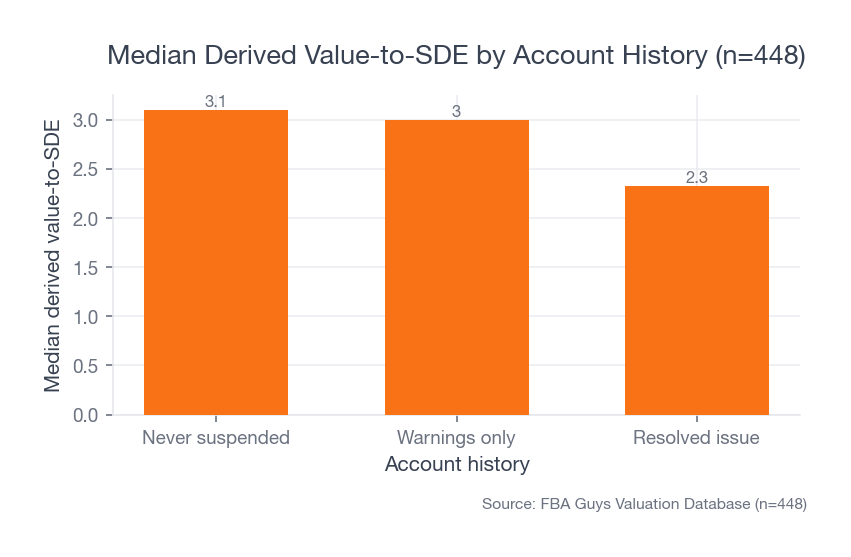
In the 2026 account-health subset, never-suspended records had a 3.09 median derived value-to-SDE across 248 records. Warnings-only records were close at 3.00 across 123 records. Resolved-issue records were lower at 2.33 across 77 records. Active issues had only five records, so we won't use that bucket for interpretation.
 Source: FBA Guys Valuation Database (n=448)
The spread is useful, but only if we keep it in its lane. It doesn't prove that a resolved issue caused lower value. It does suggest that a resolved account-health event remains part of the business file.
The more interesting cut is what surrounds the resolved event. Resolved plus healthy-high Account Health Rating had a 3.10 median derived value-to-SDE across 20 records. Resolved plus healthy-low AHR had 1.93 across 45 records. The event matters, but the current file around the event matters too.
That is the lens we would use for a used-sold-as-new violation. The resolved notice is one fact. The surrounding file is larger: current account health, recurrence history, ASIN controls, source documentation, return handling, and SOPs.
Product-control depth is the underrated part
Used-sold-as-new complaints often sit near chain-of-custody questions. Where did the unit come from? Was it factory sealed? Was the packaging designed for Amazon handling? Could a return enter sellable stock? Does the seller control the product specification, or are they trusting a distributor's condition label?
The product-control data pulled in an interesting direction.
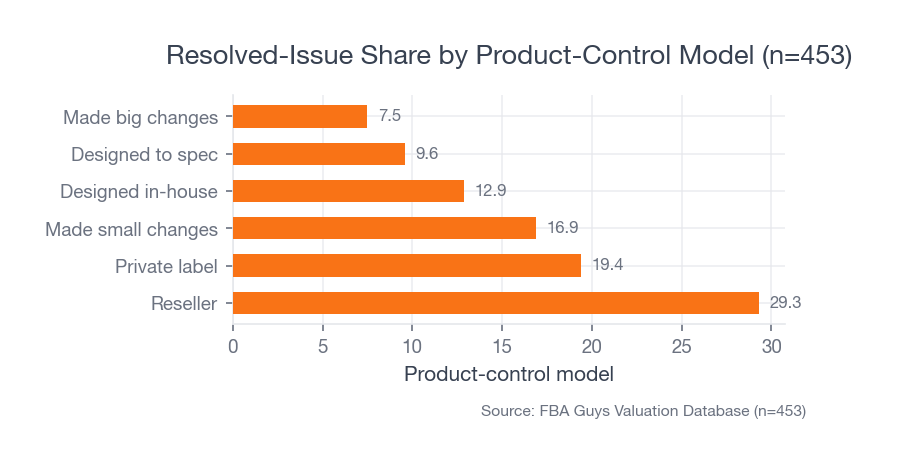
In the 2026 account-health subset, reseller records had a 30.5% resolved-issue share and a 1.65 median derived value-to-SDE. Private-label records had an 18.3% resolved-issue share and a 2.23 median. Designed-in-house records had a 13.0% resolved-issue share and a 3.60 median. Designed-to-specification records had a 10.0% resolved-issue share and a 3.60 median.
 Source: FBA Guys Valuation Database (n=453)
We can't say product design caused the account-history pattern. The database doesn't know that.
The more careful reading is that deeper product control travels with better evidence. If you own the specification, package standard, insert list, supplier QA routine, and receiving checklist, you have more to show when a condition complaint appears. If you are reselling units based on another party's condition label, the file has less room to breathe.
For a used-sold-as-new violation, that distinction is quite practical. A seller with a defined packaging spec can ask whether the seal failed, whether the factory changed the carton, whether Amazon handling damaged the box, or whether returned inventory got mixed back into sellable stock. A reseller may have to spend more of the response proving source condition and chain of custody.
Brand Registry helps with control, not physical condition
Brand Registry can be useful context for an owned-brand seller. It can support ownership, control of the listing, product identity, and the broader file around who controls the ASIN.
It doesn't prove that a specific unit arrived New.
The data shows why the distinction matters. In the 2026 account-health subset, Brand Registry yes records had a 13.3% resolved-issue share and a 3.25 median derived value-to-SDE. Brand Registry no records had a 31.7% resolved-issue share and a 1.84 median.
That is a useful adjacent pattern. It isn't condition proof.
If the complaint is about opened packaging, broken seals, missing accessories, stains, scuffs, or a returned unit, Brand Registry doesn't answer the physical question. The physical question needs photos, invoices, receiving records, package standards, return controls, and inventory handling notes.
This is where a lot of sellers accidentally mix files. Brand control and condition control overlap, but they aren't the same file. Brand Registry can explain who owns and controls the ASIN. The used-sold-as-new response has to explain why the customer should have received a New unit.
The prevention work is mostly boring
The best prevention routine starts before the next shipment.
Create a receiving checklist for the exact ASIN. It should cover packaging state, seal, inserts, accessories, expiration or lot code if relevant, exterior carton damage, and photo evidence for at least a sample of each inbound batch. If the product is fragile, liquid, bundled, giftable, or prone to cosmetic scuffing, the checklist should be stricter than a generic inspection.
Then create a return barrier. Returned units shouldn't drift back into New inventory without a deliberate decision. If you use FBA, review return disposition and removal options for the affected ASIN. Our FBA returns management guide covers the broader return file. If you use FBM, make the receiving person record why a return is sellable as New, sellable as Used, unsellable, or supplier-returnable.
Also check the listing itself. Sometimes the product is new, but the page creates an expectation the shipped unit doesn't meet. The image shows a seal that the manufacturer removed. The bullet says a pouch is included, but the latest production run dropped it. The product page implies retail packaging, while the supplier switched to plain cartons.
Those are condition issues because the buyer receives a unit that doesn't match the promise.
The prevention file should answer one question: if the same complaint arrives next month, can you show what changed?
For many sellers, the most useful change is a simple ASIN-level condition standard. Write down what must be true for that product to be sold as New. Then write down what disqualifies it. Broken exterior seal. Missing tamper band. Crushed retail box. Missing insert. Scratched surface. Accessory bag opened. Lot code missing. Return packaging substituted for retail packaging.
This sounds almost too basic until a complaint arrives. At that point, the operator with a written condition standard can compare the complaint to the actual rule. The operator without one has to reconstruct the standard from memory, supplier emails, photos, and whatever Amazon included in the notice.
The standard also helps when you need to make a hard inventory decision. If 300 units are in FBA and the complaint points to a batch-level packaging defect, a written condition rule helps you decide whether to request removal, inspect a sample, pause replenishment, or keep selling while you investigate. The article can't make that decision for a specific ASIN. The file can make the decision less improvised.
How this reads if you sell the business later
A buyer or lender may not care much about one old warning if it was resolved, isolated, and documented. They will care more if the file is vague, recent, repeated, or tied to weak current Account Health.
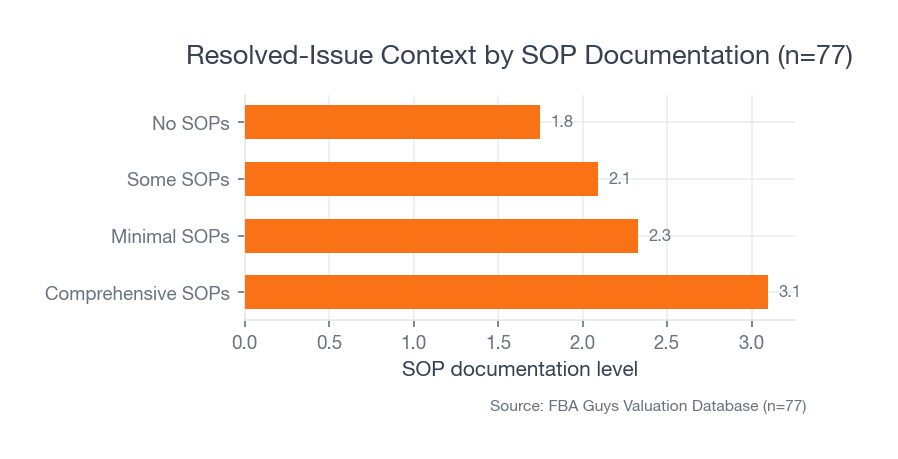
The SOP data is useful here. In the 2026 subset, resolved-issue records with comprehensive SOPs had a 3.10 median derived value-to-SDE across 19 records. Resolved-issue records with no SOPs had 1.75 across 17 records.
 Source: FBA Guys Valuation Database (n=77)
We can't say SOPs caused the difference. We can say a documented operator gives an old account-health event a better file to sit inside.
For a future sale, the question becomes very practical: what happened, when did it happen, how was it resolved, and what evidence shows it didn't become a recurring process problem?
That is why we would keep the used-sold-as-new file even after the ASIN comes back. Save the original notice. Save the response. Save the inventory check. Save photos or removal notes. Save the new receiving checklist and the date it went live. The same evidence-file logic shows up in our Amazon policy violation warnings guide.
The old issue shouldn't require a long story later. It should require a short file.
What the data can't tell you
The FBA Guys database can't tell you whether Amazon will reinstate your ASIN. It can't tell you whether your invoice will be accepted, whether a bin check will support your explanation, whether FBA handling caused the issue, or whether the customer complaint was fair.
It also can't tell whether a used-sold-as-new event was a damaged-packaging problem, returned-unit problem, supplier problem, product-page problem, or customer misunderstanding.
That limit is useful. It keeps the response honest.
There is no universal appeal script hiding in the data. There is a better file to build: condition proof for Amazon now and account-history proof for the business later.
FAQ
Is a used-sold-as-new violation the same as selling counterfeit products?
No. A used-sold-as-new violation is a product-condition issue. A counterfeit or inauthentic complaint is about product authenticity or legitimate sourcing. The evidence can overlap, especially invoices and supplier proof, but the condition file has to show that the unit sold as New actually met the New condition standard.
Can FBA cause a used-sold-as-new complaint?
It can be part of the fact pattern, especially if inventory was damaged, returned, misplaced, or reprocessed inside the fulfillment network. The seller still needs evidence. Pull shipment IDs, return or removal records, bin-check notes where available, and before-inbound condition proof.
Should I remove all inventory after a used-sold-as-new complaint?
Sometimes removal or quarantine is the right move, especially if you don't know whether the affected batch has packaging, seal, or accessory issues. The article can't make that call for a specific ASIN. The practical standard is whether you can verify the remaining inventory meets New condition before more units ship.
Does one used-sold-as-new warning hurt business value?
One resolved, isolated, well-documented event is different from a recent, repeated, or unresolved account-health pattern. In the FBA Guys 2026 account-health subset, resolved-issue histories sat lower than warnings-only or never-suspended histories on median derived value-to-SDE, but stronger current AHR and SOP documentation changed the context around resolved issues.
Curious what your business is worth?
Get a free, instant valuation and see how your Amazon business stacks up.
Get Your Free Valuation