China vs Vietnam Manufacturing for Amazon FBA: Diversification Has to Survive the Reorder
The FBA Guys
June 9, 2026

China vs Vietnam manufacturing sounds like a country decision.
For Amazon FBA, it usually becomes a reorder decision first.
You can move production from China to Vietnam and still end up with the same fragile business: one supplier, unclear specifications, longer lead times than expected, origin documents nobody has collected, and a landed-cost spreadsheet that only works because the bad assumptions are hidden in different cells.
For most Amazon FBA sellers, Vietnam is worth exploring when it lowers total landed-cost volatility or creates a qualified backup source without adding quality, MOQ, lead-time, or documentation problems. The useful question isn't "China or Vietnam?" It is whether the next supplier makes the business easier to operate, easier to document, and less exposed when costs move.
That is less tidy than the comparison keyword wants.
It is also much closer to how the business feels after the first purchase order.
China vs Vietnam Manufacturing for Amazon FBA Starts With Landed Cost
Unit cost gets too much attention because it arrives first.
A supplier quotes $4.10 from China and $4.55 from Vietnam, and the spreadsheet starts arguing before the product has even been tested. Then freight, duties, package changes, inspection cost, defect allowance, payment terms, MOQ, and transit cash all walk into the room, usually at the least convenient time.
What does that do to contribution margin after storage, returns, and Amazon fees?
This is where the comparison gets useful.
China may still have the better component base, tool familiarity, supplier depth, and speed for many Amazon products. Vietnam may reduce tariff exposure for some products, diversify political risk, and give you a second production base in Southeast Asia. Either country can win the math. Either country can also lose it after the invoice looks cheaper.
The correct calculation is landed cost by sellable unit. That means product cost, inland freight, export fees, ocean or air freight, customs duty, Section 301 exposure where applicable, inspection, prep, package work, damage allowance, and Amazon fees all need to land in one view.
If China has a lower ex-factory price but a higher tariff burden, the answer may change. If Vietnam has a lower duty profile but a higher MOQ and longer production learning curve, the answer may change again.
Could you explain that change to a bookkeeper, a customs broker, and the person who has to reorder the SKU six months from now?
The USITC Harmonized Tariff Schedule is where U.S. tariff classifications and duty rates live. China-specific Section 301 actions and exclusions are tracked by USTR. Those sources matter because there is no universal China tariff rate and no universal Vietnam advantage. The HTS code and country of origin do the work.
This is why our Amazon FBA landed cost breakdown and duty and tariff calculator matter more than a supplier quote screenshot.
The supplier quote is a beginning. It isn't the cost.
What would the number look like if the next reorder shipped late, landed during a fee change, and needed an extra inspection before FBA intake?
Vietnam Helps Most When the Product Is Already Specific
Vietnam can be a strong manufacturing option when the product is clear enough to transfer.
That phrase does a lot of work.
If your product is a catalog item with a logo and minor packaging changes, a second-country supplier may be fairly easy to test. If the product depends on tooling, tolerances, component sourcing, material feel, electronics, cosmetic finish, or a factory process that took years to get right, the move is less about country selection and more about operational translation.
What exactly does the factory need to reproduce?
Can it source the same material, match the same finish, pack the same carton, and keep the same customer experience without inheriting three years of factory memory?
A good China-to-Vietnam test starts with the product file, not the supplier search. You need the approved sample, technical drawings or measurements, materials, package specs, label requirements, inspection checklist, defect definitions, test reports, carton marks, barcode rules, and photos of what "acceptable" means.
This isn't paperwork for its own sake. It is how you find out whether the Vietnam quote is really quoting the same product.
A composite from our data patterns: the messy version is a seller who has a beautiful listing, solid reviews, and no clean product spec beyond a folder of supplier messages. The China factory knows what to do because it has been making the product for three years. The Vietnam factory doesn't have that institutional memory. Suddenly the "same" product has a slightly different finish, a box insert that shifts in transit, and a carton layout that creates prep problems at the warehouse.
None of those details sound strategic.
They can still eat the savings.
The fact is, supplier diversification works best when the business already knows what it is buying. Without that record, you aren't comparing China against Vietnam. You are comparing one factory's memory against another factory's interpretation.
Where does the first failure usually show up: defect rate, prep cost, lead time, or customer reviews?
What the Valuation Data Says About Supplier Optionality
The database gave us an irritating answer to this topic.
It wouldn't give us a clean China versus Vietnam valuation comparison.
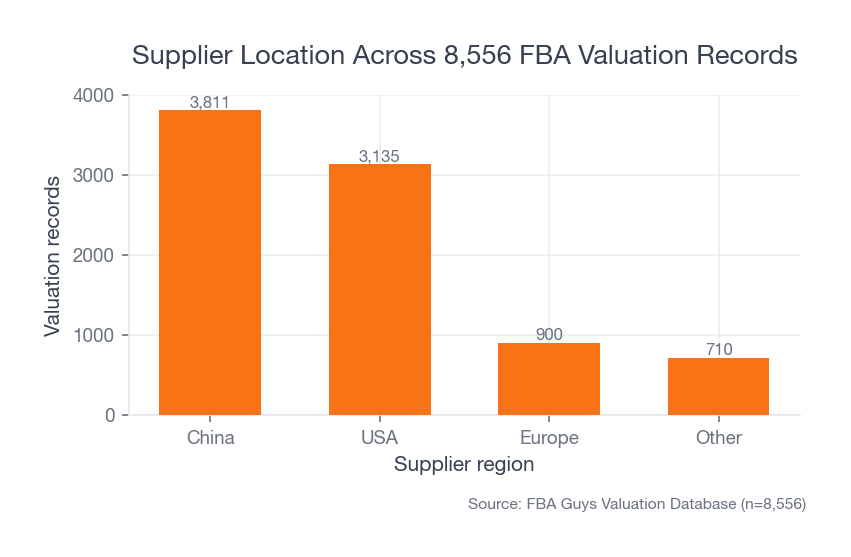
Among 8,556 successful valuation records in the FBA Guys database, 3,811 reported China as the supplier location. That is 44.5% of the sample. Vietnam showed up in 2 records.
 Source: FBA Guys Valuation Database (n=8,556)
Two.
So we aren't going to pretend the data says Vietnam-sourced businesses are worth more than China-sourced businesses. It doesn't. The sample isn't there.
What the database can show is how supplier structure behaves across a large set of Amazon FBA businesses. That is more useful anyway.
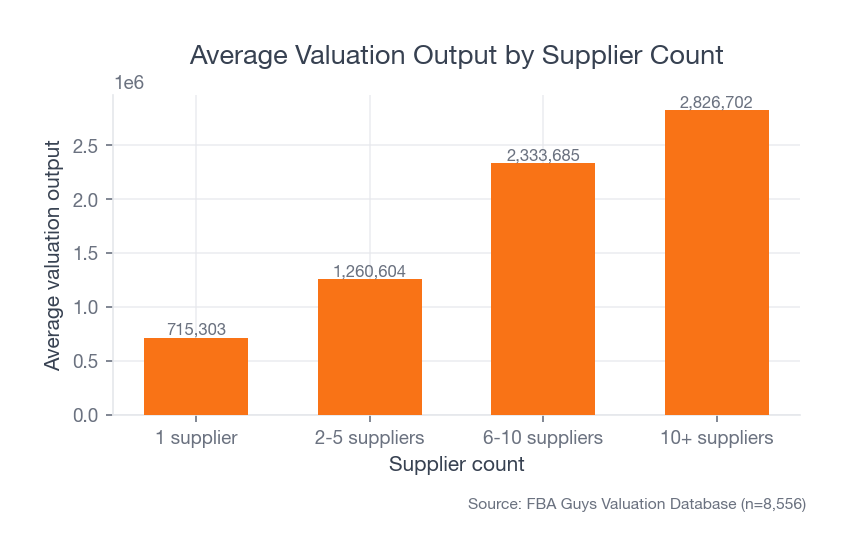
In the dataset, 3,003 records reported one supplier. That is 35.1% of successful valuation records. Another 4,179 records, or 48.8%, reported 2-5 suppliers.
The size difference was noticeable. One-supplier records averaged $688,280 in sales and $715,303 in valuation output. Records with 2-5 suppliers averaged $1,365,124 in sales and $1,260,604 in valuation output.
 Source: FBA Guys Valuation Database (n=8,556)
Supplier count isn't the cause by itself. Bigger businesses can afford better supplier systems, better operators tend to build redundancy, and some categories simply require more vendors. Still, the pattern points to something practical: the move from one supplier to a small supplier base is often the real diversification step.
China versus Vietnam matters inside that frame.
What changed in the business because this supplier exists?
If Vietnam becomes a qualified second source, it can reduce dependence on one country, one factory, one payment relationship, one production calendar, and one set of policy assumptions. If Vietnam becomes a rushed replacement for China with no inspected sample, no backup plan, and no clean spec file, the map changed but the risk may not have.
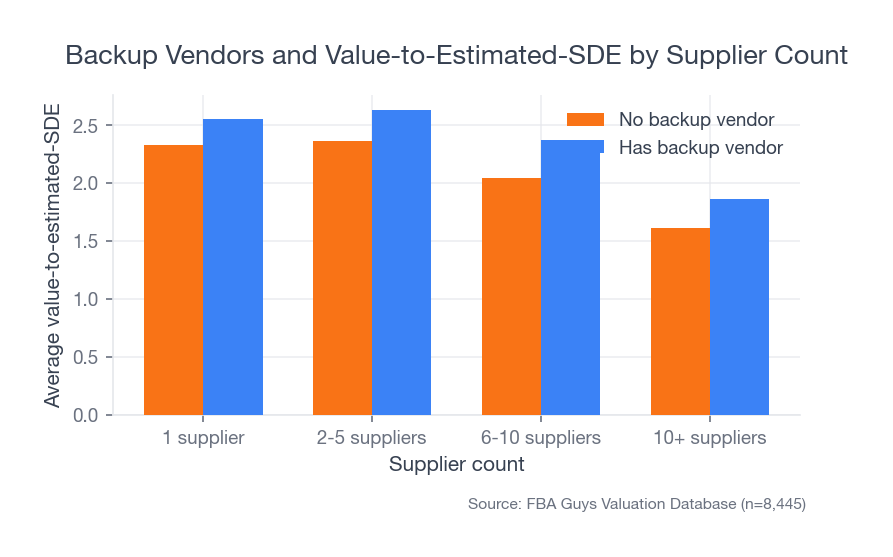
Backup vendor status showed the same direction. Single-supplier records with no backup vendor averaged 2.33 value-to-estimated-SDE under our directional calculation. Single-supplier records with a backup averaged 2.55. Records with 2-5 suppliers averaged 2.36 without backup vendors and 2.63 with backup vendors.
 Source: FBA Guys Valuation Database (n=8,445)
Those aren't closed-sale multiples. They are valuation-output context from the calculator data.
But the signal is hard to ignore. Optionality keeps showing up.
Country of Origin Is a Documentation Problem
"Made in Vietnam" isn't a sticker you get to choose after the shipment is packed.
It is a claim you need to prove.
CBP's country-of-origin rules and marking requirements matter because the country of origin affects marking, duty treatment, and, in some cases, tariff exposure. CBP states that foreign-origin articles entering the United States generally must be marked with the English name of the country of origin unless an exception applies, and its rules of origin guidance is the place to start before you rely on an origin assumption.
This gets awkward when production is split.
Maybe components come from China and final assembly happens in Vietnam. Maybe the packaging changes in Vietnam but the article itself doesn't undergo enough manufacturing there. Maybe a supplier says "Vietnam origin" because the shipment leaves Vietnam, while the customs analysis says something more specific.
That parenthetical detail is where a lot of sourcing optimism goes to die.
You need commercial invoices, packing lists, production records, component invoices where relevant, supplier declarations, photos, inspection reports, and a clear record of what production step creates the finished article. For more complex products, you may need a customs broker or a binding ruling process. A blog post can't replace that.
For an Amazon FBA seller, this documentation matters in two ways.
First, it affects import compliance. Second, it affects transferability. If someone had to understand your supply chain during a sale process, could they follow why the product is marked the way it is, which supplier makes which component, and what costs should be expected on the next reorder?
Could a buyer, a customs broker, or a new operator follow the trail without calling you?
Clean origin files don't make a business exciting.
They make the story easier to verify.
Use Vietnam as a Backup Before You Move the Base
The best Vietnam test may be a backup test.
Typically, before moving your entire product line, qualify one Vietnam supplier for one SKU or one component. Send the actual spec. Order samples. Run an inspection. Land a small batch if the economics allow it. Compare defect rate, carton dimensions, landed cost, cash timing, customer feedback, and reorder communication against the China baseline.
How much cash is stuck in the experiment before you know whether it worked?
If the first batch works, what has to be true before you trust the same supplier with the holiday reorder?
This gives you information without turning the first test into a full operating migration.
There is a quiet benefit here. A backup source changes the conversation with your existing supplier even if you never threaten to move volume. You understand current market pricing better. You know which specs are hard to reproduce. You can see which costs belong to the product and which costs belong to habit.
Among China-sourced records in our database, the backup-vendor pattern was meaningful. China-sourced records without backup vendors averaged $818,742 in sales, $892,995 in valuation output, and 2.41 value-to-estimated-SDE. China-sourced records with backup vendors averaged $1,761,208 in sales, $1,540,891 in valuation output, and 2.64 value-to-estimated-SDE.
Again, correlation only.
The more useful reading is that backup vendors tend to travel with larger, more developed supplier systems. The seller has done the work of identifying alternatives before a tariff change, factory issue, or inventory panic forces the question.
That is the posture Vietnam should often occupy first: a qualified option, not a slogan.
Would you be comfortable reordering from that supplier in peak season?
What Should an Amazon FBA Seller Do Next?
Start with one SKU.
Pick the product where China exposure is real enough to matter and the product record is clean enough to transfer. Then build a comparison that includes:
- China landed cost per sellable unit.
- Vietnam landed cost per sellable unit.
- MOQ and payment terms.
- Production lead time and freight timing.
- Inspection cost and expected defect allowance.
- Packaging and carton-dimension effects on Amazon fees.
- Required test reports, labels, and origin documentation.
- Backup supplier readiness if the first Vietnam supplier fails.
- Cash tied up before the product becomes available for sale.
- Contribution margin after the product is actually in FBA.
Use the same discipline you would use for any product sourcing checklist. The country decision belongs inside the product economics, not floating above them.
If the Vietnam supplier wins on total landed cost, can make the same product, and gives you cleaner risk distribution, test it. If the China supplier still wins after tariff, freight, MOQ, quality, and cash timing are included, keep the China base and use Vietnam as a backup project.
Of course, some sellers will move because they want less China exposure even if the first-order economics are similar. That can be reasonable. Risk has a cost, even when the spreadsheet doesn't assign it a neat line item.
Just don't call the move finished when the purchase order is placed.
The first order proves very little. The reorder tells you whether the new supplier can behave like part of the business.
China vs Vietnam manufacturing for Amazon FBA is really a supplier-optionality decision. Vietnam can be the right answer. China can still be the right answer. The stronger business is the one that can show how the answer was calculated, tested, documented, and made repeatable.
FAQ
Is Vietnam always cheaper than China for Amazon FBA manufacturing?
No. Vietnam may reduce certain tariff exposure for some products, but the actual answer depends on the HTS code, origin analysis, unit cost, freight, MOQ, defect rate, package work, inspection, and cash timing. A cheaper duty profile can disappear quickly if the factory needs a higher MOQ or the first production runs are rough.
Should I move my Amazon product from China to Vietnam because of tariffs?
Move only after the landed-cost math and supplier test support it. For many sellers, the better first step is qualifying a Vietnam backup supplier for one SKU while keeping the China supplier stable. That gives you optionality without turning the first experiment into a full supply-chain migration.
Does Vietnam manufacturing improve business valuation?
The FBA Guys database doesn't support that claim directly. We only have 2 successful valuation records listing Vietnam as supplier location. What the data does show is that supplier optionality and backup-vendor readiness appear alongside stronger valuation-output context.
What documents should I keep if I source from Vietnam?
Keep commercial invoices, packing lists, supplier declarations, production records, product specs, component records where relevant, inspection reports, test reports, carton photos, and origin support. If the product has mixed-country components or meaningful tariff exposure, use a customs broker before you rely on the origin assumption.
Curious what your business is worth?
Get a free, instant valuation and see how your Amazon business stacks up.
Get Your Free Valuation