Amazon A-to-z Claims: How to Prevent the Claim Before It Becomes Account-Health History
The FBA Guys
July 25, 2026

A-to-z claims usually begin before the claim page opens.
The customer message sat too long. The tracking number was technically present but didn't tell a clean delivery story. The refund decision lived in someone's memory. The return was received on Friday, inspected on Monday, and documented on neither day.
To prevent Amazon A-to-z claims, build a seller-fulfilled evidence routine around response time, proof of shipment, return and refund decisions, and claim-response ownership. The claim is the late-stage version of the problem. The prevention work is earlier and more ordinary.
That distinction matters because A-to-z claims can move from customer service into Order Defect Rate, Account Health, and eventually the diligence file a buyer reviews. We can't prove from the FBA Guys database that one prevented A-to-z claim raises valuation. We can see the surrounding pattern: account-history severity, fulfillment method, SOP documentation, and owner workload all show up in the valuation context.
What An A-to-z Claim Actually Measures
An A-to-z Guarantee claim is a customer asking Amazon to investigate a disputed order. In practice, the claim usually sits around one of a few issues: non-delivery, late delivery, damaged or materially different goods, refund friction, or a customer experience the buyer believes wasn't resolved.
For the seller, the claim has two jobs. It decides the customer issue, and it creates a record.
Amazon's current public guidance treats A-to-z claims as part of the customer-service performance system. Claims that aren't denied can count into Order Defect Rate, and Amazon's current ODR target is below 1% over a 60-day period. ODR also includes negative feedback and service-related chargeback claims.
That makes A-to-z prevention different from ordinary support. A refund can be financially annoying. A claim can become account-health history.
The FBA Guys database doesn't store exact A-to-z claim fields. We don't have claim counts, claim reasons, customer-contact timestamps, Buy Shipping use, 72-hour response status, claim appeals, or ODR attribution. So the honest data answer is narrower: A-to-z claims sit next to the account-health and transferability issues that buyers care about, but the database can't isolate the claim itself.
That boundary is useful. It keeps the article from pretending a single metric explains business value.
The Three Clocks That Matter Before A Claim Hits
Amazon's current A-to-z guidance creates several response clocks, and they shouldn't be blended into one vague "answer quickly" rule.
First, buyer messages need a fast owner. Amazon's Buyer-Seller Messaging guidance has a 24-hour response expectation during weekends and holidays too, and auto-responders don't count as valid responses.
Second, A-to-z prevention and Buy Shipping protection both create a 48-hour customer-response context. Amazon's public prevention language tells sellers to respond to customers within 48 hours. The Fulfilled by Merchant page also says A-to-z claim protection through Buy Shipping depends on three practical facts: the seller bought the label through Amazon Buy Shipping, the carrier first scan shows on-time shipment, and the seller responded to customer inquiries in Buyer-Seller Messaging within 48 hours.
Third, once Amazon asks for information on a claim, the claim file has its own deadline. Amazon's current claim-response help language says that if the seller doesn't respond to an information request within 72 hours, Amazon may grant the claim in the customer's favor, which can affect ODR.
Those are three queues:
- Customer messages.
- Shipping and delivery evidence.
- Amazon claim requests.
A seller who treats them as one inbox is relying on memory at exactly the wrong moment. The operating routine should say who owns each queue, who backs them up, where the evidence sits, and when the next review happens.
The timing also changes the tone of the work. A 24-hour buyer message is still a customer-service moment. A 48-hour delivery or refund issue is a prevention moment. A 72-hour Amazon information request is already a claim-defense moment. The same person can own all three, but the SOP shouldn't treat them as the same task.
This is why "we answer fast" isn't enough. A seller needs to know what kind of answer is due. Sometimes the answer is a customer message. Sometimes it is a refund. Sometimes it is a tracking record, a carrier case number, or a screenshot that shows the customer selected a specific variation.
Where A-to-z Exposure Shows Up In The Data
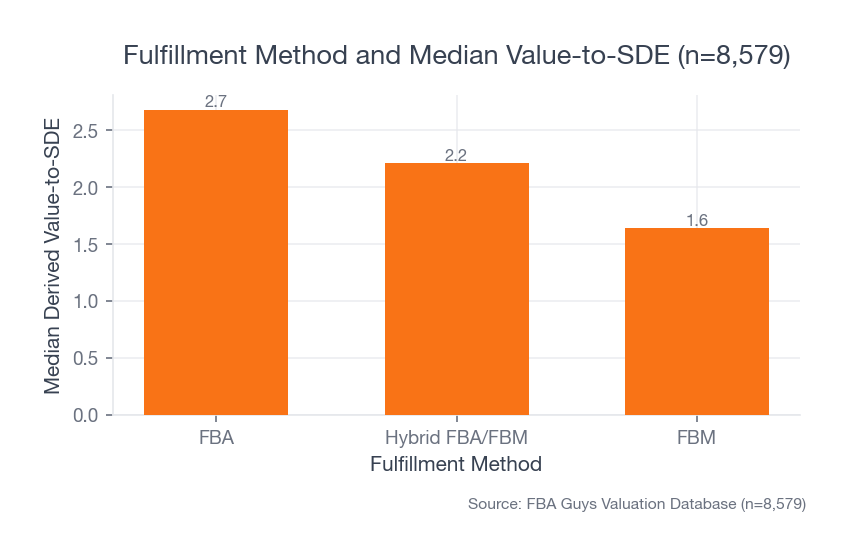
The valuation database doesn't measure A-to-z claims directly, but fulfillment method gives useful context.
Among 8,579 successful valuations with usable calculated SDE and derived value-to-SDE ratios between 0.5 and 10, FBA records had a 2.68 median derived value-to-SDE across 6,209 records. Hybrid FBA/FBM records had a 2.21 median across 1,990 records. FBM records had a 1.64 median across 380 records.
 Source: FBA Guys Valuation Database (n=8,579)
This doesn't prove that A-to-z claims caused the gap. It does show why the hybrid lane deserves attention. A mostly FBA business can still create seller-fulfilled exposure through backup offers during stockouts, local warehouse orders, oversized items, replacement-part shipments, or emergency fulfillment changes.
The fulfillment label in the seller's head matters less than the promise on the order. If the customer sees a seller-fulfilled delivery promise, the seller needs the evidence routine for that order.
There is a second reason to care about hybrid operations. They can make the business look cleaner than the process actually is. FBA handles most customer service for FBA orders. Then one FBM order goes sideways, and the team discovers that the seller-fulfilled process hasn't been practiced in months.
That is a process problem before it is a claim problem.
Build The A-to-z Prevention File Before The Claim
The best prevention file starts with the order promise.
For delivery claims, the file should show the ship-by date, ship date, carrier, service, tracking number plus first carrier scan, delivery scan or proof of attempted delivery, and any carrier case number. If Buy Shipping is part of the protection strategy, the file should show that the label was purchased through Amazon Buy Shipping and that the shipment met the timing requirements. This is close to the same evidence discipline behind late shipment rate improvement: the promise and the scan need to tell the same story.
For return and refund issues, the file should show the return authorization, return tracking, delivered-back date, item-condition notes, photos where appropriate, refund decision, refund date, and refund amount.
For item-not-as-described issues, the file should connect the listing promise to the customer complaint. Save the listing screenshot, variation selected, product condition, message trail, return notes, and any product photos. If the product changed over time, save the version record. Buyers and Amazon investigators both struggle with claims where the seller can't show what the customer actually bought.
For customer messages, save the response trail. The goal is to show that the seller responded inside the relevant window, answered the actual problem, and took the next operational step.
The file should be boring enough that someone else can read it in three minutes.
That last sentence is a useful test. If the evidence file needs the owner to explain it live, it is still mostly memory. A buyer, operations manager, or account-health reviewer should be able to open the order file and see the sequence without asking the owner to reconstruct the week.
There is also a separate Customer Service by Amazon question. Amazon's current public page says Customer Service by Amazon can handle post-order inquiries for self-fulfilled orders, with exceptions such as invoice and product-customization queries. It also says Amazon may reach out to the seller in special circumstances and that sellers should respond to Case Log requests within 24 hours. That means CSBA can change the customer-service queue, but it doesn't remove the need for a seller-side evidence file.
If Amazon handles the customer conversation and later asks the seller for help, the seller still needs the same order facts: promise, shipment, return, refund, product condition, and decision owner.
How A-to-z Claims Become Account-Health History
Account-health history is where the prevention work becomes diligence context.
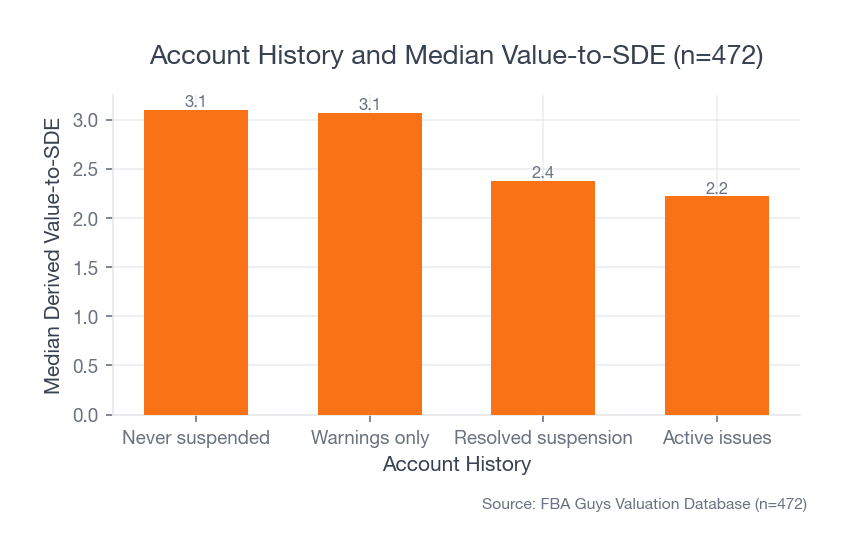
In 472 records with populated suspension history and usable calculated SDE, never-suspended businesses had a 3.10 median derived value-to-SDE across 256 records. Warnings-only records were close at 3.07 across 130. Resolved suspensions sat lower at 2.38 across 80. Active issues had only six records, too small for much interpretation, with a 2.22 median.
 Source: FBA Guys Valuation Database (n=472)
The interesting part is the gap between warnings-only and resolved suspensions. Warnings-only records looked much closer to never-suspended records than to resolved-suspension records. Our read is cautious: fixing the issue before it becomes durable account-health history is a different diligence fact from explaining a resolved suspension later.
That doesn't make every warning harmless. It also doesn't mean every resolved suspension is fatal. It means the record matters.
If an A-to-z claim is prevented, the issue may remain a customer-service incident. If it becomes an ODR defect or a suspension-related record, the future buyer has to understand what happened, why it happened, how it was fixed, and whether the same process is still active.
That is why the prevention file and the account-health file should be connected. The claim record shouldn't live only in a customer-service inbox. It should feed the monthly account-health review.
This is the part sellers sometimes underestimate during calm months. Account-health history is much easier to explain when the file was built at the time of the issue. A claim from six months ago with a dated timeline, screenshots, carrier evidence, refund notes, and a process change reads differently from a claim the owner has to explain from memory.
We don't know exactly how buyers would price a single A-to-z claim. The database can't answer that. The more defensible read is that unexplained account-health ambiguity is the issue to avoid.
Why SOPs Matter More Than The Script
Sellers often want the perfect response script. The script is the easiest part to copy and the easiest part to misuse.
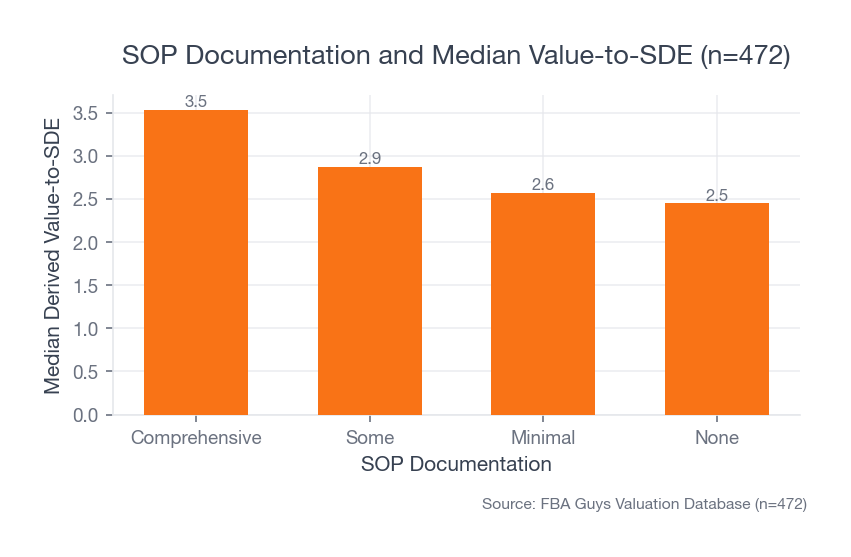
The stronger asset is the SOP behind the response. In the populated SOP subset of the FBA Guys database, comprehensive SOP records had a 3.53 median derived value-to-SDE across 155 records. Some SOP documentation had a 2.87 median across 127. Minimal SOP documentation had a 2.57 median across 67. No SOP documentation had a 2.45 median across 123.
 Source: FBA Guys Valuation Database (n=472)
Again, this is adjacent context. The database can't say an A-to-z SOP created that difference. It can say comprehensive SOP documentation travels with stronger valuation context in this subset.
A good A-to-z SOP has six sections:
- Message queue: owner, backup owner, weekend coverage, response standard, and escalation trigger.
- Delivery evidence: Buy Shipping status, carrier tracking record, carrier scan, delivery proof, and carrier case record.
- Return/refund decision: return received date, item condition, photo rules, refund authority, and refund timestamp.
- Claim response: where claims appear, who responds, what evidence goes in, and how the deadline is tracked.
- ODR review: weekly review of A-to-z claims, negative feedback, and chargebacks.
- Account-health file: monthly export or screenshot, issue log, resolution notes, and owner signoff.
That may sound like too much structure for a small operation. But the workload data points in the same direction. Records with under 5 owner hours per week had a 2.70 median derived value-to-SDE across 2,800 records. Records with 40+ owner hours had a 1.90 median across 734.
We can't connect that directly to A-to-z claims. We can say that owner-dependent processes make transferability harder. If only the owner knows which customer gets refunded, which carrier case matters, and which Amazon notification deserves immediate attention, the business is carrying a memory risk.
There is a practical buyer question hiding inside that workload data: what breaks when the owner stops answering the inbox?
If the answer is "nothing, because the team follows the file," the business has a cleaner transfer story. If the answer is "the owner knows how to handle it," the buyer has to price the work, train for it, or accept the risk that account-health issues will be handled differently after the sale.
If A Claim Already Exists
When a claim already exists, slow down enough to answer the claim that was actually filed.
Start with the claim type. Is Amazon asking about delivery, item condition, refund status, return handling, or a communication issue? Then build the timeline from the order record instead of from memory.
For a delivery claim, the timeline should include order date, ship-by date, ship date, carrier first scan, carrier events, delivery or attempted delivery, buyer messages, and any carrier contact. For an item condition claim, include the listing promise, product version, return photos, inspection notes, and refund decision. For a refund claim, include return received date, refund date, refund amount, and any policy basis for the decision.
Then answer Amazon's specific request inside the stated window. A long response with missing evidence is weaker than a short response that names the order, attaches the record, and explains the timeline in sequence.
If the evidence is thin, own the operational fix internally. The immediate claim may still need a refund or resolution. The bigger business issue is why the file was thin when the question arrived.
After the claim is closed, save the outcome in the account-health file even if Amazon denies the claim or funds the refund. Future review works better when the resolved issues are visible too. A clean record of a denied claim can be useful because it shows the process worked and the customer-service issue didn't become a defect.
Amazon A-to-z Claims: How To Prevent The Repeat Pattern
The repeat pattern is usually visible before the claim count moves.
Look for the same carrier with late scans. Look for FBM offers turned on during FBA stockouts without a separate message owner. Look for return inspections that happen only when the owner is free. Look for customer messages that ask the same question because the listing details, tracking details, or return instructions are unclear.
A monthly A-to-z prevention review can be simple:
- Pull buyer messages with delivery, return, refund, damaged, defective, and not-received language.
- Pull A-to-z claims, chargebacks, negative feedback, and ODR changes.
- Match each issue to the order timeline.
- Identify whether the cause was promise, fulfillment, product condition, communication, refund timing, or documentation.
- Assign one process change.
- Save the review in the account-health file.
This is where the data changed our read. The most useful prevention work is the routine that keeps a customer-service incident from becoming account-history ambiguity.
The review should be small enough to happen every month. If it turns into a dashboard project, it will drift. A spreadsheet with order ID, issue type, source, owner, evidence status, customer outcome, Amazon outcome, and process change is enough for most sellers.
The first month may feel tedious because the file has to be built from scattered places. By the third month, patterns usually start to show: a carrier, a SKU, a warehouse cutoff, a return-inspection delay, or a message template that creates a second question instead of resolving the first.
FAQ
What is the best way to prevent Amazon A-to-z claims?
Prevent Amazon A-to-z claims through fast resolution of buyer issues before the customer asks Amazon to investigate and through a complete order file. The file should include response history, carrier tracking evidence, delivery evidence, return status, refund decisions, and any Amazon claim-response record.
Do A-to-z claims always count against ODR?
No. Amazon's current public guidance ties ODR impact to claims that aren't denied or where the seller is found responsible. The exact treatment depends on the claim and Amazon's decision, so sellers should verify the live Seller Central guidance and monitor the Account Health page.
Does Buy Shipping prevent A-to-z claims?
Buy Shipping can improve protection for delivery-related A-to-z claims when the seller meets Amazon's current conditions. The label alone isn't enough. Amazon's public FBM page also points to on-time shipment by carrier first scan and customer-response timing.
Should I refund every customer before they file a claim?
No universal rule works. The better routine is to make the refund decision quickly, document the reason, and respond inside the relevant window. Some cases should be refunded. Some should be represented with delivery or product evidence. The important part is that the decision shouldn't depend on the owner reconstructing the order from memory.
The Practical End Point
The A-to-z claim page is a poor place to design the process.
By then, the clock is running and the evidence either exists or it doesn't. The useful work happens earlier: delivery promise, carrier scan, customer response, return record, refund decision, and account-health review.
For a seller, that routine can reduce the odds that a support issue becomes an account-health record. For a buyer, it shows whether the customer-service process transfers with the business.
That is the part the valuation database can support only indirectly. The data can't see the A-to-z claim. It can see the company around it.
Curious what your business is worth?
Get a free, instant valuation and see how your Amazon business stacks up.
Get Your Free Valuation