Amazon Seller Feedback vs Product Reviews: Same Stars, Different Risk
The FBA Guys
May 23, 2026

Amazon gives sellers two public trust signals that look similar enough to cause trouble.
One lives on the product detail page. The other lives on the seller profile and inside Feedback Manager. They both use stars. They both can make a seller nervous when they move the wrong direction. They don't measure the same thing.
Amazon seller feedback measures the buying experience with the seller: reliability, fulfillment, customer service, and the order experience. Product reviews measure the product itself: quality, usefulness, fit, function, and whether the thing did what the buyer expected it to do.
That distinction sounds small until a buyer is looking at your business.
If the product review profile is weak, the listing has a trust problem. If seller feedback is weak, the operation has a reliability problem. If both are weak, the buyer starts wondering how much of the revenue depends on Amazon tolerating friction that should have been fixed already.
What Seller Feedback Actually Measures
Seller feedback is attached to the seller's performance in a transaction.
Did the order arrive as expected? Was the seller reliable? Did the fulfillment experience create a problem? Did customer service make the customer feel stranded after the purchase?
For FBA sellers, this can feel a little odd. Amazon handles fulfillment and customer service for FBA orders, so a shipping complaint may be more about Amazon's side of the transaction than yours. As of the writing of this article, Amazon's seller-policy guidance says negative feedback related to Amazon fulfillment or customer service may be removed, but the workflow and criteria still matter. You handle that inside Feedback Manager.
The messy detail here is that customers don't care about Amazon's internal taxonomy. A buyer who received a dented box, then opened a leaking bottle, may leave the complaint wherever the interface lets them type. The sentence might be half product review, half delivery complaint, and fully annoying.
That is where sellers get into trouble. They treat every negative public comment as the same species.
It isn't.
Seller feedback belongs to the seller account. Product reviews belong to the ASIN. If you are evaluating risk, preparing for diligence, or trying to clean up a profile before a sale, the first job is sorting the complaint into the right bucket.
What Product Reviews Actually Measure
Amazon describes Customer Product Reviews as reviews customers write about products sold on Amazon, with ratings that appear on the product detail page. They help shoppers decide whether the product deserves the click, the cart, and the repeat order.
A product review can talk about size, durability, flavor, packaging, instructions, smell, color, battery life, stitching, missing parts, or the small plastic latch that breaks after the third use. Some of those complaints are boring. Some are business-critical.
Amazon's Customer Reviews tool currently lets eligible Brand Registry representatives with Professional selling accounts track product reviews, respond to certain customer concerns, and report reviews that violate Amazon's guidelines. That is useful. It also creates a temptation to think of reviews as a support inbox.
They are more than that.
A review profile is a public record of product-market fit. It is imperfect, noisy, and sometimes unfair, of course. Still, it is one of the few places where the market speaks in public without asking the seller for permission.
For a buyer, that matters.
The Data Says Review Depth Matters More Than a Perfect Score
We looked at the FBA Guys valuation database for product-review signals because it gives us a way to separate gut feel from pattern.
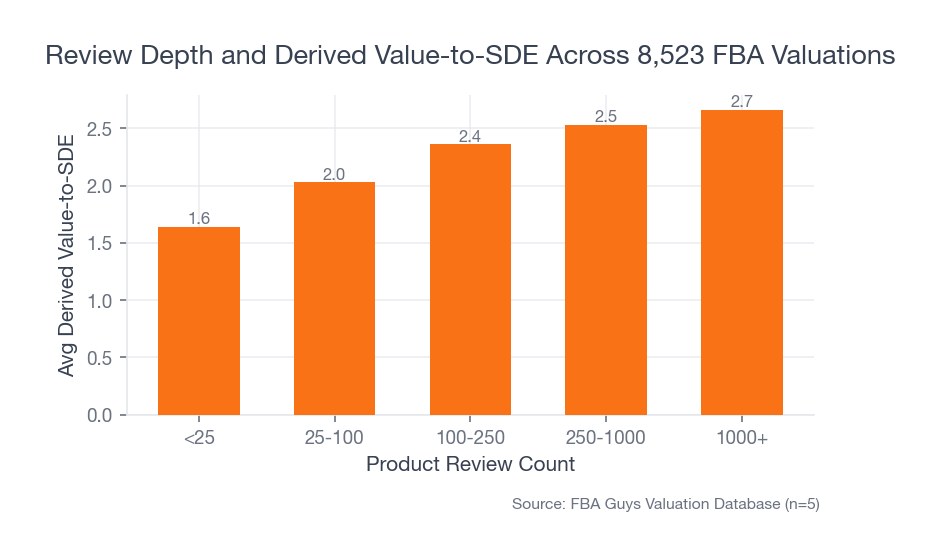
Across 8,523 valuations with usable review-count data, average derived value-to-SDE moved steadily upward with review depth. Businesses with fewer than 25 reviews averaged 1.64. Businesses with 25 to 100 reviews averaged 2.03. The 100 to 250 bucket averaged 2.36. The 250 to 1,000 bucket averaged 2.53. The 1,000-plus bucket averaged 2.66.
 Source: FBA Guys Valuation Database (n=8,523)
That doesn't mean reviews caused the higher valuation. Larger, more seasoned products naturally collect more reviews. Stronger operators may also have better listings, better inventory discipline, and cleaner brands. The review count is wrapped around a lot of other things.
Still, the direction is hard to ignore.
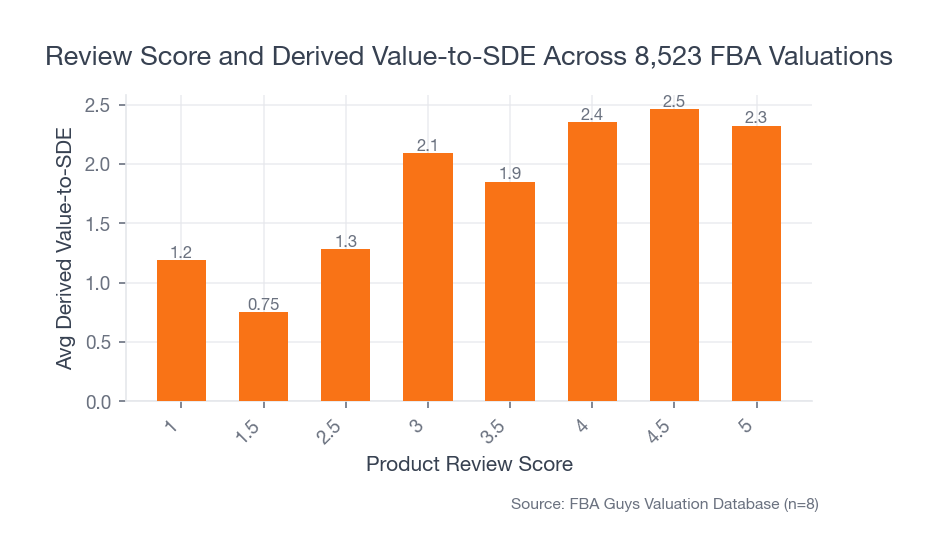
What surprised us more was the star-score pattern. A 5.0 rating didn't produce the strongest average derived value-to-SDE. The 4.5-star bucket averaged 2.46 across 5,526 valuations, while the 5.0 bucket averaged 2.32 across 1,808 valuations.
 Source: FBA Guys Valuation Database (n=8,523)
That makes intuitive sense after you sit with it for a minute. A 5.0 can be excellent. It can also be thin. A 4.5 with hundreds or thousands of reviews may look more seasoned than a perfect score sitting on a shallow review base.
Perfect is pretty. Depth is harder to fake.
If you are still building that first layer of review depth, our article on the Amazon Vine program for new products is a useful companion.
Negative Product Reviews Still Show Up in the Valuation Context
The negative-review field produced the most useful tension in the data.
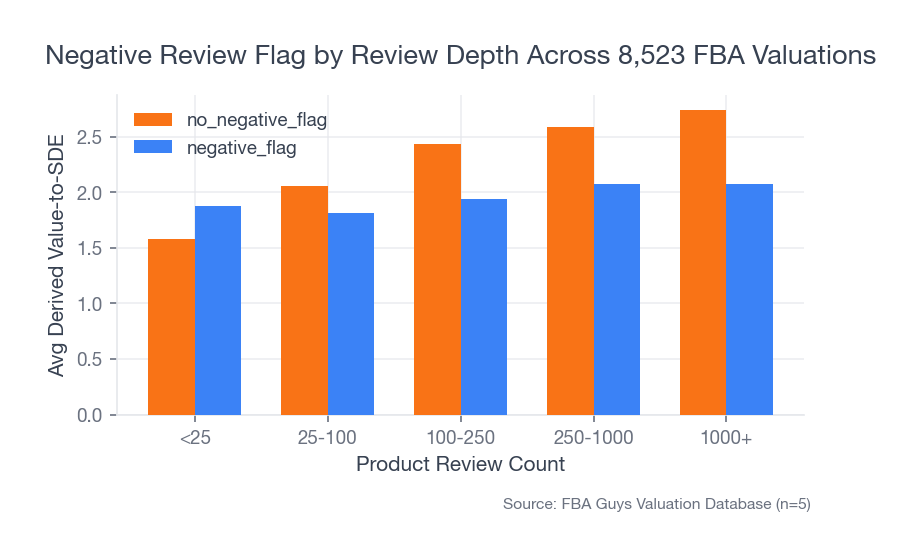
Businesses without a negative-review flag averaged 2.47 derived value-to-SDE across 7,424 valuations. Businesses with a negative-review flag averaged 1.99 across 1,099 valuations.
Here is the odd part: the negative-review group had higher average sales, about $2.23 million versus $1.37 million.
So the issue wasn't small businesses being punished because they lacked scale. The larger businesses with negative-review flags still showed a lower average derived value-to-SDE.
 Source: FBA Guys Valuation Database (n=8,523)
There are several possible reasons. Negative reviews can point to product defects, expectation gaps, weak listing copy, bad packaging, support drag, or a SKU that sells well because advertising is carrying something the product experience hasn't earned. The database doesn't tell us which of those explanations is true for a given business.
The pattern is enough to make the review profile worth reading.
This is also where seller feedback and product reviews start to touch without becoming the same thing. A product review may reveal a product defect. Seller feedback may reveal a fulfillment or communication problem. Both can lower confidence, but they lower it through different doors.
What to Do When Feedback and Reviews Get Crossed
Start with classification.
If the comment is about product quality, function, usefulness, fit, taste, durability, or whether the product matched the listing, treat it as a product-review issue. Work the product, listing, packaging, instructions, and expectation-setting. For image and listing expectation issues, start with the mechanics in Amazon main image requirements and best practices and Amazon A+ Content examples and tips.
If the comment is about shipping, delivery, customer service, order handling, communication, or seller reliability, treat it as seller feedback. Work the order-experience side and use Feedback Manager where Amazon's criteria apply.
If the comment blends both, slow down. A complaint that says "arrived late and broke after one use" is doing two jobs. You may have a fulfillment issue and a product issue. The fact that Amazon puts it in one text box doesn't make it one business problem.
For product reviews, the operating question is: what does this tell us about the SKU? For seller feedback, the operating question is: what does this tell us about the account or fulfillment process?
Those questions lead to different fixes.
The Removal Trap
The fastest way to waste an afternoon is to treat removal as the strategy.
Some feedback should be challenged. If the whole seller-feedback comment is actually a product review, or if the comment fits Amazon's current removal or strike-through criteria, use the official workflow. Same with product reviews that violate Amazon's community rules. Report the issue through the right channel and keep the record.
Then get back to the business.
Most of the work is slower and less satisfying. You read the one-star reviews by SKU. You tag the complaints. You separate "arrived damaged" from "broke after two uses" from "instructions made no sense" from "thought it came with batteries." Then you decide which of those are listing problems, product problems, packaging problems, or customer-service problems.
No one enjoys that spreadsheet.
The reality is that buyers like boring evidence. A short record showing the complaint, the cause, the fix, and the date tells a cleaner story than a seller saying the bad comments were unfair.
A complex reputation system would be overkill for this. The useful habit is keeping the comment attached to the part of the business that can actually fix it.
Open a monthly sheet and give each issue four fields: where it appeared, what the customer was really describing, who owns the fix, and whether it repeated. A comment about "cheap plastic" belongs with the product or supplier. A comment about a crushed package may belong with FBA, prep, carton strength, or the carrier. A comment about no response after a refund request belongs with the seller account, even if the product was fine.
What happens when the comment touches two things?
Split it. If the buyer says the item arrived late and the handle snapped on the first use, you have an order-experience issue and a product issue. Treating it as one generic negative review feels efficient for about four seconds, then it starts hiding the useful part of the complaint.
There is also a compliance reason to keep the habit boring. Amazon's review rules leave very little room for clever outreach, especially when the customer has already left a negative review. If your process starts with "how do we make this comment go away," you are already pointed in the riskiest direction. If your process starts with "what did this customer actually experience," you have a better shot at improving the business without turning a small complaint into a policy problem.
Which Signal Matters More to a Buyer?
Product reviews typically get attention first because they are attached to the thing being sold.
A buyer can look at the listing and see the review count, star rating, and review texture in a few minutes. They can scan one-star reviews and ask whether the complaints are isolated, old, or part of the product's DNA. They can compare review depth to the competitors sitting on the same search page.
Seller feedback comes in differently. It belongs to the seller account and the transaction experience. It is closer to account health, customer-service discipline, and operational cleanliness. That is why review manipulation and account-health issues sit inside buyer diligence, not just inside marketing cleanup. We cover that broader risk lens in Amazon FBA business risks buyers need to verify.
The fact is, a buyer doesn't need these signals to say the same thing. They need them to make sense together.
A strong product-review profile with sloppy seller feedback creates one kind of question: is the product good but the operation loose? Strong seller feedback with weak product reviews creates another: is the seller reliable but the product underpowered? Weakness in both places is where diligence gets uncomfortable.
If you are preparing an Amazon business for sale, don't lump the two together in a vanity metric called "reputation." Build two working files. One for product-review issues by SKU. One for seller-feedback and account-experience issues by order pattern.
Boring? Yes.
Also useful.
FAQ
Does seller feedback show up on the product detail page?
Seller feedback is tied to the seller profile and Feedback Manager, while product reviews appear on the product detail page. A shopper may see both in different parts of the buying journey, but they are separate signals.
Can Amazon remove negative seller feedback?
Sometimes, under limited criteria. As of the writing of this article, Amazon's seller-facing guidance points sellers to Feedback Manager for feedback removal requests, and certain FBA fulfillment comments may be removed or struck through. Don't build an operating process around removal. Build it around prevention.
Can Amazon remove negative product reviews?
Amazon generally removes product reviews only when they violate its guidelines or are otherwise ineligible. A seller can't simply remove a review because it is negative, and Amazon's product-review policy materials prohibit asking reviewers to change or remove a review. If the review is valid and painful, the useful work is usually in the product, the listing, or the expectation being set before purchase.
Which matters more for valuation: seller feedback or product reviews?
Product reviews are easier to see and showed clearer patterns in the FBA Guys database. Seller feedback matters as an operational and account-quality signal. A buyer will usually care about both, but for different reasons.
Curious what your business is worth?
Get a free, instant valuation and see how your Amazon business stacks up.
Get Your Free Valuation