Amazon FBA Minimum Order Quantity Negotiation: Protect Cash Before You Chase the Price Break
The FBA Guys
June 12, 2026

The supplier's MOQ can look like a purchasing detail until the purchase order starts making decisions for the rest of the business.
Amazon FBA minimum order quantity negotiation is the process of getting supplier order terms that fit your demand, cash position, inspection needs, and Amazon compliance requirements. The useful goal is broader than a lower MOQ. It is an order size and payment structure that lets you stay in stock without trapping too much cash in inventory.
That distinction matters because a better unit price can still be a worse order.
The FBA Guys valuation database doesn't store MOQ terms directly. We can't see the supplier's quoted minimum, deposit schedule, split-shipment offer, or inspection clause. What we can see is the shape around MOQ: inventory burden, supplier count, backup-vendor readiness, credit-line use, inventory turn, and product-design depth.
Those adjacent signals point in the same direction: MOQ negotiation should start with cash exposure.
What Amazon FBA minimum order quantity negotiation should protect
The first negotiation isn't always the number on the MOQ line. Sometimes it is the order shape around that number.
If the supplier wants 2,000 units, ask what that actually means. Does it mean 2,000 finished units shipped at once? Could the supplier produce the full run but release it in two shipments? Could you approve one color, one bundle, or one packaging format first? Could the first order be smaller at a higher unit cost, with the price break starting on reorder?
Those are different cash decisions.
For an Amazon seller, MOQ should protect four things:
- Cash that has to survive freight, duty, prep, Amazon fees, and the next reorder.
- Quality control before the final balance is paid.
- Reorder timing so you don't stock out while proving demand.
- Documentation that someone else could use to run the next purchase order.
Price still belongs in the conversation. Of course it does. But if price is the only variable, the supplier gets to make the conversation narrow. MOQ gives you more to negotiate than quantity alone. For the broader supplier-term frame, see our guide to Amazon FBA supplier negotiation tactics.
Why MOQ is a cash-flow decision before it is a unit-cost decision
The unit-cost discount is easy to see. The cash tied up behind it is quieter.
Say a supplier offers $6.40 per unit at 800 units or $5.90 at 1,600 units. The second quote saves $0.50 per unit. It also requires nearly twice the inventory cash before you have twice the sales proof. If the SKU turns quickly and the margin is solid, that may be fine. If the SKU takes longer than expected, the discount becomes a very small reward for a much larger cash commitment.
The valuation data is useful here because it shows how inventory burden travels with business quality signals.
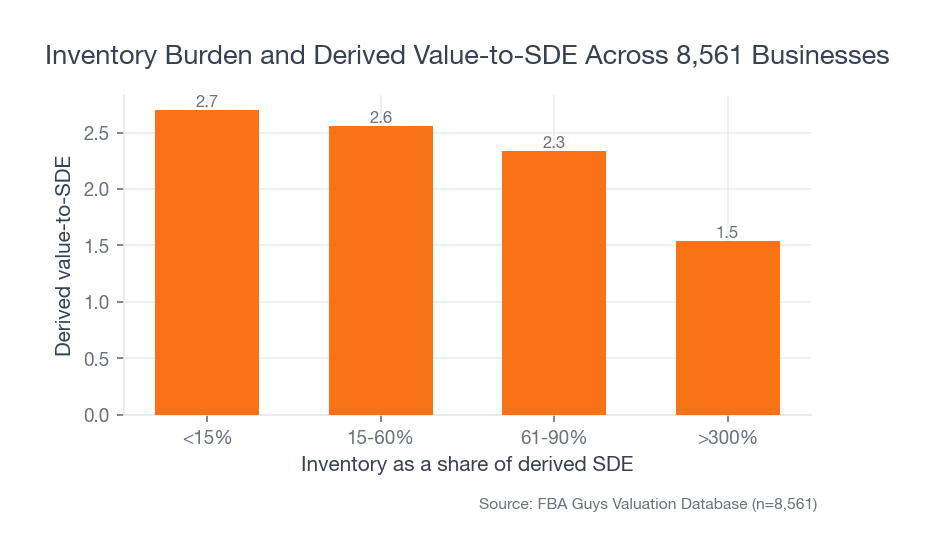
Across 8,561 usable FBA Guys valuation records, businesses with inventory below 15% of derived SDE averaged 2.70 derived value-to-SDE. Their average inventory was $45,698. Businesses with inventory above 300% of derived SDE averaged 1.54 derived value-to-SDE. Their average inventory was $305,266.
 Source: FBA Guys Valuation Database (n=8,561)
That doesn't prove MOQ caused the gap. We don't know why inventory was high in each record. It could have been a launch, a seasonal buy, a supplier minimum, a freight delay, a slow-moving SKU, or an accounting cleanup.
But the pattern is too large to ignore. Heavy inventory burden changes how much room the business has to be wrong.
The middle of the distribution supports the same read. The 15-60% inventory-to-SDE group averaged 2.56 derived value-to-SDE. The 61-90% group averaged 2.34. The heavier the inventory burden got, the less attractive the valuation context became.
For MOQ negotiation, the practical question is plain: how much cash can this SKU hold before it starts crowding out the rest of the business?
Use inventory-to-SDE to set your real MOQ ceiling
Sales are a weak ceiling for MOQ because sales don't tell you what the business keeps.
SDE is the better pressure test. In a simplified Amazon context, SDE is the earnings an owner-operated business produces after cost of goods and operating expenses, with owner add-backs considered separately. It is the number buyers use more often than revenue when valuing smaller owner-operated businesses.
Before accepting a supplier's MOQ, translate the order into an inventory-to-SDE decision:
- Estimate landed cost per unit.
- Multiply it by the MOQ.
- Add inspection, freight, duty, prep, and Amazon inbound costs.
- Estimate how many months the order will take to sell through.
- Compare the cash required with monthly gross profit and monthly SDE.
- Ask what happens if the sell-through takes twice as long as expected.
The last question is the useful one. It turns the MOQ from a supplier quote into a stress test.
If the order only works when your best-case forecast is right, the MOQ is probably too large. A strong reorder plan should have room for slower ranking recovery, Amazon receiving delays, a weaker ad month, or a batch that needs extra inspection work.
This is also where a lower unit cost can mislead you. A discount that improves gross margin by two points may still be a poor trade if it locks six months of cash into one SKU. If you need the full unit-economics path, start with the Amazon FBA landed cost breakdown before you approve the order.
Supplier optionality helps, until complexity takes over
The supplier-count data has a shape worth paying attention to.
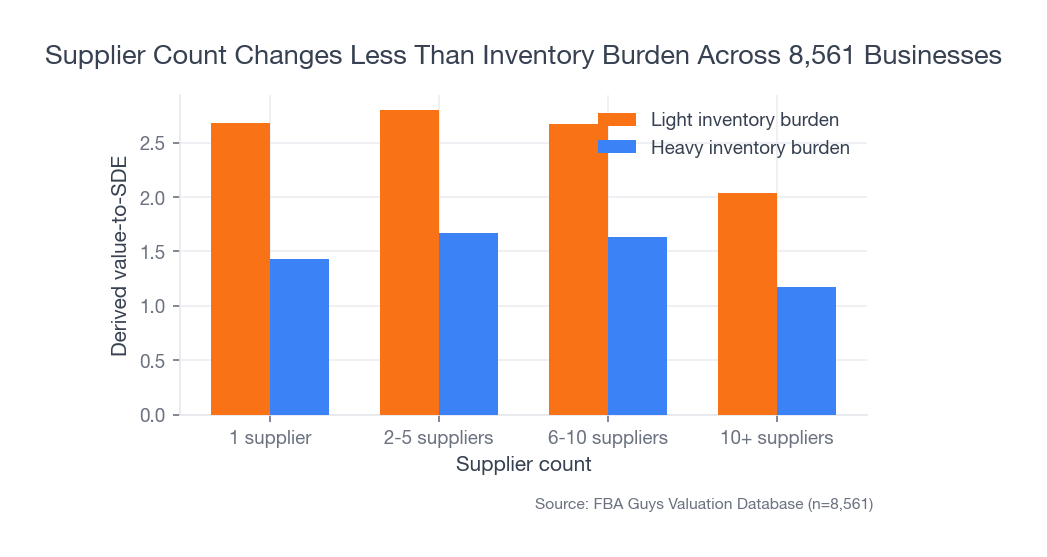
One-supplier businesses averaged 2.39 derived value-to-SDE across 3,007 records. Businesses with 2-5 suppliers averaged 2.53 across 4,179 records. The 6-10 supplier group averaged 2.30, and the combined 10+ group averaged 1.79.
The useful read is that some optionality appears helpful, while too much supplier spread may carry its own complexity.
For MOQ negotiation, 2-5 suppliers can mean you have enough market information to know whether a quote is reasonable. You can compare MOQ, lead time, material assumptions, package requirements, inspection tolerance, sample cost, and payment schedule. You also have somewhere else to go if the first supplier's terms don't fit your cash model.
But supplier optionality doesn't make a bad inventory decision good.
In the 2-5 supplier band, businesses below 15% inventory-to-SDE averaged 2.80 derived value-to-SDE. The same supplier band above 300% inventory-to-SDE averaged 1.67. That gap matters more than the supplier-count label.
 Source: FBA Guys Valuation Database (n=8,561)
The supplier system helps you ask better questions. The order still has to fit the business.
Use backup suppliers to learn the market
Backup suppliers are useful because they turn a supplier's default answer into market information.
In the FBA Guys data, backup-vendor businesses averaged 2.50 derived value-to-SDE across 4,975 records. No-backup businesses averaged 2.28 across 3,586 records. Backup-vendor readiness also becomes more common as businesses scale: it rises from 43.4% under $100K in annual sales to 77.8% above $5M.
That doesn't mean adding a supplier name to a spreadsheet creates value. A backup supplier can be sampled, quoted, production-ready, or just researched. The database doesn't tell us which.
For MOQ negotiation, the real value is the comparison. If three suppliers quote similar MOQs for the same specification, the minimum may be tied to genuine production economics. If one supplier insists on 3,000 units and another can do 800 with a higher first-order price, you have a different decision.
Use backup suppliers to learn:
- Whether the MOQ is a factory requirement or a default sales term.
- What price breaks are actually available.
- Whether smaller runs are possible with fewer variants.
- Whether lead time changes at lower quantity.
- Whether inspection and payment terms differ by supplier.
Bluffing with a fake alternative is fragile. A real alternative gives you a way to walk away from terms that don't fit. That same comparison discipline belongs earlier in sourcing, which is why the Amazon FBA product sourcing checklist starts with product proof and supplier files before reorders get expensive.
Payment terms can help, but they don't change sell-through
Payment timing matters because Amazon inventory has a long cash gap.
You may pay a deposit before production, the balance before release, freight before receiving, duty before clearance, prep before shipment, and Amazon fees after sale. The customer may buy weeks or months after the first cash left your account. A supplier's MOQ sits inside that whole cycle.
Payment terms can make a larger MOQ easier to carry. Useful terms might include a smaller deposit, balance after inspection, split shipment, supplier-held finished goods, or a reorder commitment tied to first-batch performance.
The data gives a helpful boundary. Businesses with a credit line averaged 2.60 derived value-to-SDE, compared with 2.19 for businesses without one. Financing readiness travels with stronger business context overall.
Still, in the >300% inventory-to-SDE bucket, credit-line businesses averaged 1.71 derived value-to-SDE. No-credit-line businesses in that same heavy-inventory bucket averaged 1.37. The credit line appears helpful, but heavy inventory still shows up as heavy inventory.
Our read: use payment terms to match cash timing to proof. Don't use them to justify an order size the SKU hasn't earned. The cash-cycle side of that decision is covered more fully in Amazon FBA cash flow management.
Product specs give you more to negotiate than quantity
A product spec gives the MOQ conversation more handles.
If you are buying a generic catalog item, the supplier conversation often collapses into quantity, price, package requirements, and freight. If you have a defined product spec, you can negotiate around materials, tolerances, component substitutions, test reports, package strength, labels, inspection points, defect allowances, and future version changes.
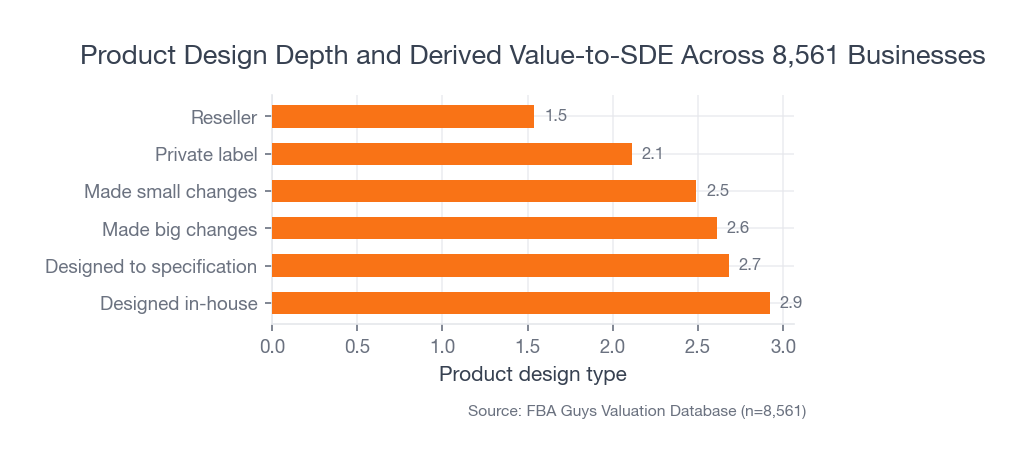
The database doesn't show whether sellers carried spec sheets into the supplier conversation. It does show a strong product-design pattern. Designed-in-house products averaged 51.1% margin and 2.92 derived value-to-SDE across 2,200 records. Designed-to-specification products averaged 47.5% and 2.68 across 1,125 records. Private-label products averaged 44.5% and 2.11. Reseller products averaged 42.0% and 1.54.
 Source: FBA Guys Valuation Database (n=8,561)
That pattern shouldn't be turned into a simple cause-and-effect claim. The more likely reading is that businesses with more product control tend to have more room to define supplier requirements and defend margin.
For MOQ negotiation, that means your spec file is part of the leverage. A supplier may resist a lower MOQ on a complicated product, but a clear spec also lets you ask for phased production, sample approval, and inspection rights with more precision.
Put Amazon requirements into the supplier conversation early
An MOQ is only useful if the units can actually be sold through Amazon.
Current Amazon requirements vary by product and category, so verify the active requirements in Seller Central and Amazon-owned materials before committing to production. Some products need category approval, compliance documents, safety testing, dangerous-goods review, invoice support, special labels, or package changes.
The supplier doesn't need a long lecture about your Amazon account. They do need the requirements that affect the purchase order.
That can include:
- Unit packaging and suffocation labels.
- FNSKU or barcode requirements.
- Carton limits and shipment labels.
- Test reports or compliance certificates.
- Country-of-origin marking.
- Invoice details that support authenticity or approval reviews.
- Packaging that survives FBA handling and customer delivery.
Amazon's Revenue Calculator can help estimate fulfillment economics. Amazon's Manage Your Compliance tools can help with current compliance-document workflows. Neither replaces SKU-level margin work or product-specific Seller Central checks.
A lower MOQ on the wrong packaging or missing document doesn't solve the problem you were trying to solve.
What should go into the supplier record?
The supplier record should be boring enough that someone else could run the next reorder.
At minimum, keep the product version, approved sample reference, quantity, unit cost, payment schedule, production timeline, inspection terms, defect policy, package requirements, labels, shipment terms, destination, required documents, and reorder price breaks in one place.
This matters for transferability. Manufacturer relationships, costs, and terms need to carry forward to a new owner. If a future buyer has to reconstruct supplier economics from email threads, perceived risk rises.
It also matters before you ever sell. The next time you reorder, you can compare what happened against what you thought you negotiated: actual lead time, actual landed cost, actual defect rate, actual receiving delay, and actual sell-through. Our Amazon FBA inventory management best practices guide covers that reorder discipline from the inventory side.
The supplier file becomes a memory aid for the business.
Amazon FBA MOQ negotiation checklist
Use this before accepting a supplier's minimum order quantity:
- Convert the MOQ into landed cash, not just factory cost.
- Estimate months of supply at current sales velocity.
- Compare the order value with monthly gross profit and monthly SDE.
- Run a slower-sell-through case before approving the order.
- Ask for a smaller first run at a higher unit cost.
- Ask whether the full MOQ can be split across shipments.
- Reduce first-order variants if variant complexity is driving MOQ.
- Tie final payment to inspection or sample approval where possible.
- Get at least one backup supplier quote for the same specification.
- Document the approved product version and packaging.
- Confirm Amazon category, labels, compliance, and invoice requirements.
- Record the reorder terms so the next purchase order doesn't start from memory.
The checklist is deliberately cash-heavy. MOQ negotiation that ignores cash flow tends to become a unit-cost negotiation, and unit cost is only one part of the order.
What the data can't tell us
The data can't tell us the supplier conversation.
We don't know the actual MOQ in any valuation record. We don't know the deposit, payment timing, inspection clause, tooling ownership, defect allowance, or whether the seller had another quote in hand. We also don't know whether high inventory came from supplier MOQ, slow sales, seasonal buys, launch plans, freight delay, or a temporary stockout recovery order.
That limitation is useful. It keeps the analysis honest.
The data can show the shape of adjacent issues. Heavy inventory burden sits near weaker derived value-to-SDE. Supplier optionality and backup vendors sit near stronger valuation context. Product-design depth sits near stronger margin and value context. Those patterns suggest where a seller should be careful when negotiating MOQ.
FAQ
What is MOQ in Amazon FBA?
MOQ means minimum order quantity. It is the smallest order a supplier is willing to produce or sell under a given set of terms. For an Amazon FBA seller, MOQ affects cash flow, storage planning, reorder timing, and how much product must be proven before the next order.
How do you negotiate a lower MOQ with a supplier?
Ask for a smaller first run, fewer variants, a higher first-order unit cost, split production, split shipment, or a reorder commitment after the first batch sells through. The stronger ask gives the supplier a reason to say yes while protecting your cash.
Should I accept a higher MOQ for a lower unit cost?
Accept it only if the cash, sell-through, margin, and reorder timing still work under a slower sales case. If the order needs your best-case forecast to be right, the lower unit cost may not be worth the inventory risk.
Can a backup supplier help with MOQ negotiation?
Yes, if the backup supplier gives you real market information. A second quote helps you understand whether the first supplier's MOQ is normal, negotiable, or tied to a specific production constraint.
Conclusion
Amazon FBA minimum order quantity negotiation works best when the first question is about cash, not price.
The supplier's MOQ is only one number in the order. The more useful number is how much cash the order ties up relative to what the business earns. Once that ceiling is clear, the negotiation gets more practical: smaller first run, split shipment, better payment timing, inspection before balance, fewer variants, cleaner specs, and backup supplier quotes.
We don't know which MOQ terms sit behind the valuation records. We do know heavy inventory burden shows up differently from lighter inventory burden, and the gap is large enough to respect.
The better purchase order is the one your cash flow can survive.
Curious what your business is worth?
Get a free, instant valuation and see how your Amazon business stacks up.
Get Your Free Valuation