Amazon FBA Inspection Companies Comparison: Match the Inspector to the Risk
The FBA Guys
June 13, 2026

The factory inspection report feels simple until the defect photos sit next to the purchase order and you have to decide whether to pay the balance.
An Amazon FBA inspection companies comparison should start with the risk in the shipment. The best provider for a low-risk reorder may be a poor fit for a regulated product, a new factory, or a custom product that needs testing and documentation support.
That makes the comparison less tidy, but more useful. The FBA Guys valuation database doesn't store inspection-company usage, defect rates, lab results, failed inspection counts, or provider names. We can't say QIMA, V-Trust, TradeAider, HQTS, AQF, SGS, Intertek, or Bureau Veritas produces better FBA business outcomes.
What we can see is the supplier system around inspection: supplier count, backup-vendor readiness, product-design depth, inventory burden, and derived valuation context. Those signals point toward a practical answer. Pick the inspection company after you know what the inspection has to prove.
What an Amazon FBA inspection company actually checks
A normal Amazon FBA inspection company checks whether the shipment matches your order and is ready to move into Amazon's fulfillment system.
The basic list usually covers order count, workmanship, visible defects, package condition, label accuracy, carton marks, barcode or FNSKU placement, product dimensions, basic function, and the product-specific requirements you give the inspector. Some providers also offer during-production inspections, container-loading checks, factory audits, product testing, or compliance documentation support. If the product spec itself is still thin, start with the broader Amazon FBA product sourcing checklist before you book the inspection.
The last phrase matters: requirements you give the inspector.
An inspector can't inspect against a spec that doesn't exist. If the purchase order only says "black silicone spatula" and the approved sample has ten unrecorded details, the report will be thinner than it looks. The provider may be competent and the inspection may still miss the thing you cared about.
For a repeat reorder, the inspection may only need to answer a narrow question: did the factory make the same goods, in the right quantity, with acceptable defects and Amazon-ready prep?
For a first production run, a new factory, a designed product, or a regulated product, the question gets wider. You may need a checklist built from the product spec, an inspector who knows the category, a lab test, or an Amazon-approved testing, inspection, and certification provider if Seller Central requires that path.
Ask for a sample report before you book. A good sample report shows more than a pass/fail result. It shows the sample size, defect categories, photos, measurements, package checks, label checks, and the exact instruction that each result is being tested against. If the sample report could have been written for almost any product, your own checklist has to do more work.
The useful comparison: match the company to the risk
Provider pages are useful for understanding what each company claims to offer. They don't prove outcomes.
Use this comparison as a fit screen, not a ranking. The rows are grouped by the kind of problem the seller is trying to solve.
| Provider or provider type | Better fit when | Watch before booking |
|---|---|---|
| QIMA | You want a broad inspection platform with FBA inspection, pre-shipment inspection, testing options, and online reporting. | Confirm category expertise, country coverage, cost, and whether you need testing beyond visual inspection. |
| V-Trust | You are sourcing in China or nearby markets and want factory inspection services such as pre-shipment inspection, during-production inspection, audits, or loading supervision. | Confirm current Amazon-specific checklist depth and whether lab or compliance work is needed separately. |
| TradeAider | You want FBA-focused checks around quantity, product quality, defects, packaging, labeling, and app-style inspection visibility. | Confirm whether the service is a standard inspection, AQL inspection, or something deeper for higher-risk products. |
| AQF | You want an FBA checklist around labels, packaging, wrapping, cartons, barcodes, and special-approval checks. | Confirm current coverage, report format, and whether testing or regulatory documentation is separate. |
| HQTS | You need inspection plus testing or Amazon Direct Validation support for certain product categories. | Confirm the exact marketplace, category, TIC requirement, and lab scope before assuming one service covers all needs. |
| Bureau Veritas, SGS, Intertek | You are dealing with compliance, regulated categories, testing, certification, or enterprise-grade inspection needs. | These may be more capability than a small low-risk reorder needs. Confirm route, timing, and whether Amazon requires an approved TIC workflow. |
This is why "best inspection company" is usually the wrong first question. The better question is: what would make this shipment expensive if it were wrong?
If the answer is a mislabeled carton, a basic FBA inspection may be enough. If the answer is a noncompliant children's product, a basic inspection report won't carry the same weight as the right testing and validation path. If the answer is a supplier quietly changing a component, the provider needs a product spec and test method strong enough to catch that change.
There is also a timing question. Pre-shipment inspection is late enough to see most of the finished order, but late enough that a failure can create a hard conversation with the factory. During-production inspection is earlier, which can help if the expensive failure is material, finish, assembly method, or package construction. Container-loading supervision is narrower. It tells you more about what went into the container than whether the product itself was made correctly.
What the FBA Guys data says about supplier systems
The supplier-count data has a shape worth paying attention to.
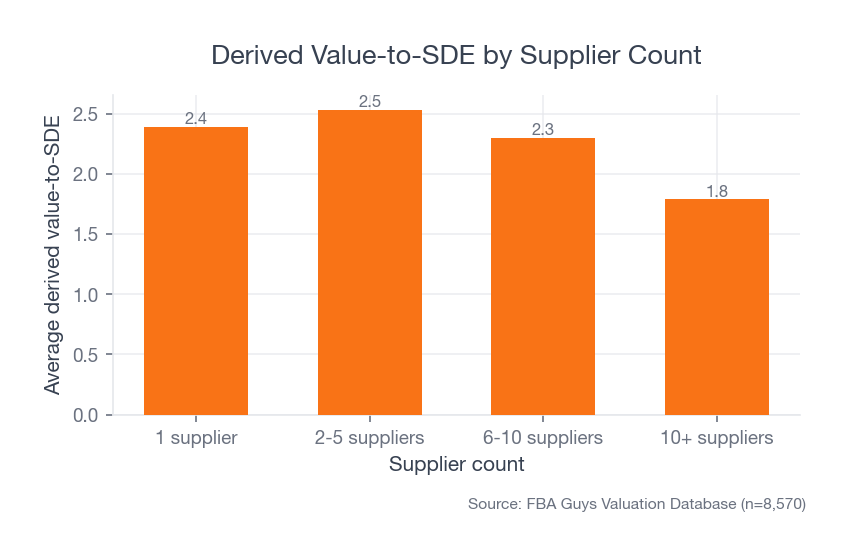
Across 8,570 successful valuation records with positive derived SDE, one-supplier businesses averaged 2.39 derived value-to-SDE. The 2-5 supplier group averaged 2.53. The 6-10 supplier group averaged 2.30, and the more-than-10 supplier group averaged 1.78.
 Source: FBA Guys Valuation Database (n=8,570)
Derived value-to-SDE is a directional valuation proxy: estimated valuation divided by derived seller's discretionary earnings. SDE is the earnings base buyers usually use for owner-operated businesses.
The more likely reading is that the second supplier matters more than the sixth. Some supplier optionality appears helpful. Supplier sprawl starts to look like complexity.
Product-design depth adds another layer. Designed-in-house products averaged 51.1% margin and 2.92 derived value-to-SDE across 2,204 records. Designed-to-specification products averaged 47.5% margin and 2.68. Private-label products averaged 44.5% margin and 2.11. Reseller records averaged 42.0% margin and 1.54.
That doesn't mean every seller should design a product from scratch. Custom products bring tooling questions, test requirements, revision control, and slower development. The useful inspection read is simpler: the more specific the product, the more specific the inspection has to be. A reseller order may need order-match and package checks. A designed product needs tolerances, material confirmation, function tests, and change-control discipline.
Backup vendors add another layer. Businesses with backup vendors averaged 2.50 derived value-to-SDE across 4,982 records. Businesses without backup vendors averaged 2.28 across 3,588 records. Inside the 2-5 supplier group, backup-vendor records averaged 2.62, compared with 2.35 without backups. The same supplier-system logic shows up in our guide to Amazon FBA supplier negotiation tactics.
That doesn't prove backup vendors cause higher valuation. We don't know whether those businesses were better because of backup vendors, better documentation, better product maturity, more cash, stronger operators, or all of those at once.
For inspection, the useful interpretation is narrower. A backup supplier only becomes useful when you can compare suppliers against the same product spec and defect standard. If Factory A gets inspected against one checklist and Factory B gets inspected against another, you don't have much of a comparison.
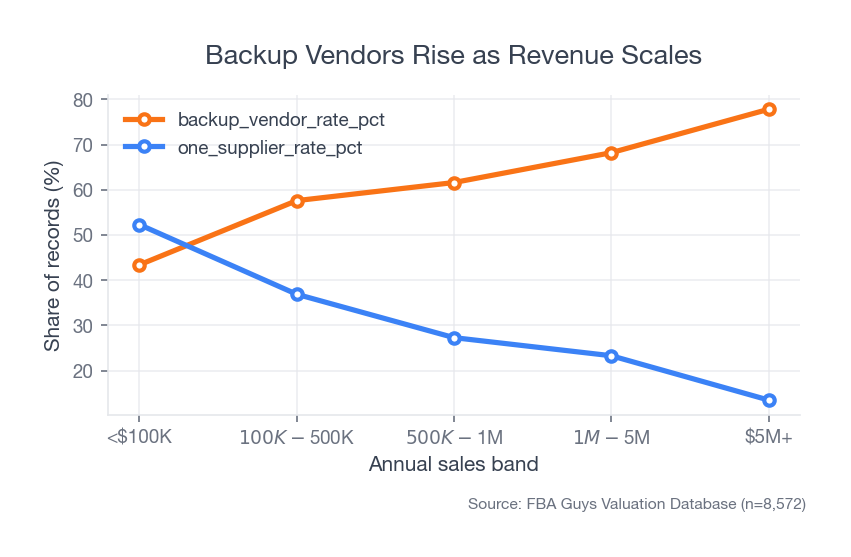
The same pattern appears with scale. Under $100K in annual sales, 43.4% of businesses had backup vendors and 52.3% had one supplier. Above $5M, 77.8% had backup vendors and only 13.5% had one supplier.
Larger businesses appear more likely to formalize supplier alternatives. Inspection can help smaller businesses build that discipline earlier, but only if the checklist is specific enough to reuse. If you are still finding or qualifying suppliers, the Alibaba sourcing tips for Amazon sellers piece covers the supplier-file side of that work.
 Source: FBA Guys Valuation Database (n=8,572)
Use inventory risk to decide how deep the inspection goes
Inspection gets more consequential as inventory gets heavier.
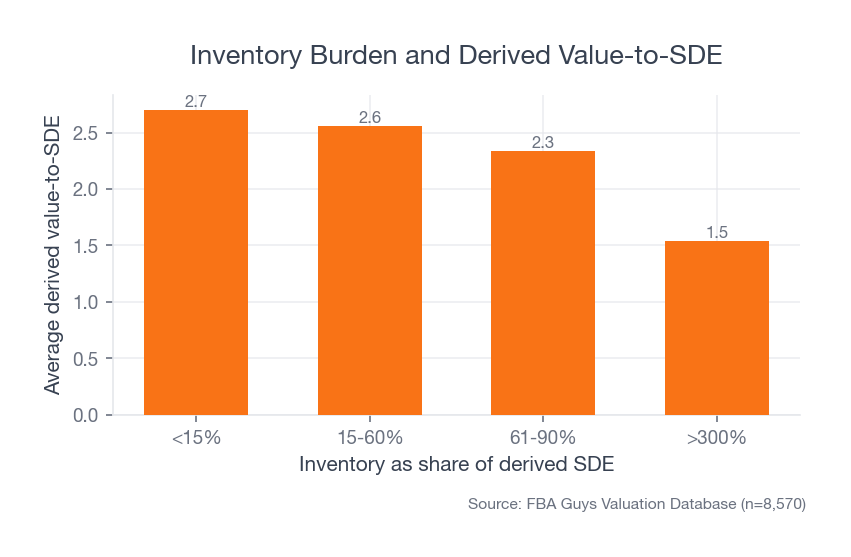
In the FBA Guys data, businesses with inventory below 15% of derived SDE averaged 2.70 derived value-to-SDE across 2,429 records. Businesses with inventory above 300% of derived SDE averaged 1.54 across 1,423 records.
 Source: FBA Guys Valuation Database (n=8,570)
This is an inventory-risk statistic more than an inspection statistic.
Still, it changes the inspection decision. A $4,000 reorder for a familiar, nonregulated product can survive a thinner inspection process. A $70,000 production run that ties up months of cash deserves a more serious control point before the final balance is paid and the shipment leaves the factory.
Inside the 2-5 supplier group, the same inventory burden shows up. Businesses below 15% inventory-to-SDE averaged 2.80 derived value-to-SDE. Businesses above 300% averaged 1.67.
Our read is that inspection should be scaled to the cash exposure in the batch. The larger the inventory commitment, the less satisfying a generic pass/fail report becomes. That is the same cash-exposure problem behind Amazon FBA minimum order quantity negotiation and the Amazon FBA landed cost breakdown.
What to send before the inspection
The inspection company needs a working file before the inspector arrives.
Send the purchase order, approved sample photos, product spec, material requirements, dimensions and tolerances, package dielines, insert requirements, barcode and FNSKU instructions, carton label requirements, marketplace destination, defect definitions, acceptable quality limit if you use one, function tests, accessory list, and any Amazon compliance notes tied to the product.
If the product has regulatory exposure, add the test reports, certificates, model numbers, ASINs, GTINs, brand name, and any compliance request from Seller Central. Amazon's Manage Your Compliance dashboard is built around product-specific documentation requests, so the document set has to match the current request rather than a template from the last product.
The report should let you make a shipping and payment decision. "Passed" is useful only if you know what was tested.
When to use a TIC provider instead of a normal inspection
Use a normal inspection company when the question is physical shipment quality.
Use a lab when the question is safety, material, chemical, electrical, battery, toy, cosmetic, food-contact, or another regulatory issue.
Use an Amazon-approved TIC provider when Amazon's current process requires validation through that route for the product or category. Bureau Veritas and HQTS both describe Amazon Direct Validation support on their pages. Amazon also points sellers to product-specific compliance workflows inside Seller Central.
This is where sellers can accidentally buy the wrong service. A pre-shipment inspection can tell you the label is present. It may not prove the product satisfies the underlying safety standard. A lab report may prove a material or safety requirement. It may not tell you whether the factory packed the cartons correctly for FBA.
For some products, you need both.
FAQ
Which Amazon FBA inspection company is best?
There isn't one best company for every shipment. For simple reorders, compare FBA checklist depth, factory coverage, report quality, and speed. For regulated products, start with Amazon's current compliance requirement and make sure the provider can support testing or TIC validation if needed.
Is pre-shipment inspection enough for Amazon FBA?
Pre-shipment inspection is often enough for ordinary quality checks, quantity checks, package checks, and label checks. It isn't enough when the real risk is regulatory compliance, product safety, lab testing, or Amazon Direct Validation.
Should I inspect every order?
Our read is that first runs, new suppliers, high-cash orders, customized products, and regulated products deserve inspection. Low-risk repeat orders may move to periodic inspection after the supplier has a clean history, but the decision should be tied to defect history and cash exposure.
What should I ask before hiring an inspection company?
Ask for a sample report, category experience, inspector coverage near the factory, FBA checklist details, lab or test capability, report schedule, photo depth, defect classification, and whether they can inspect against your own product spec.
Curious what your business is worth?
Get a free, instant valuation and see how your Amazon business stacks up.
Get Your Free Valuation