Growth Doesn't Buy Back a Margin Problem
The FBA Guys
July 23, 2026
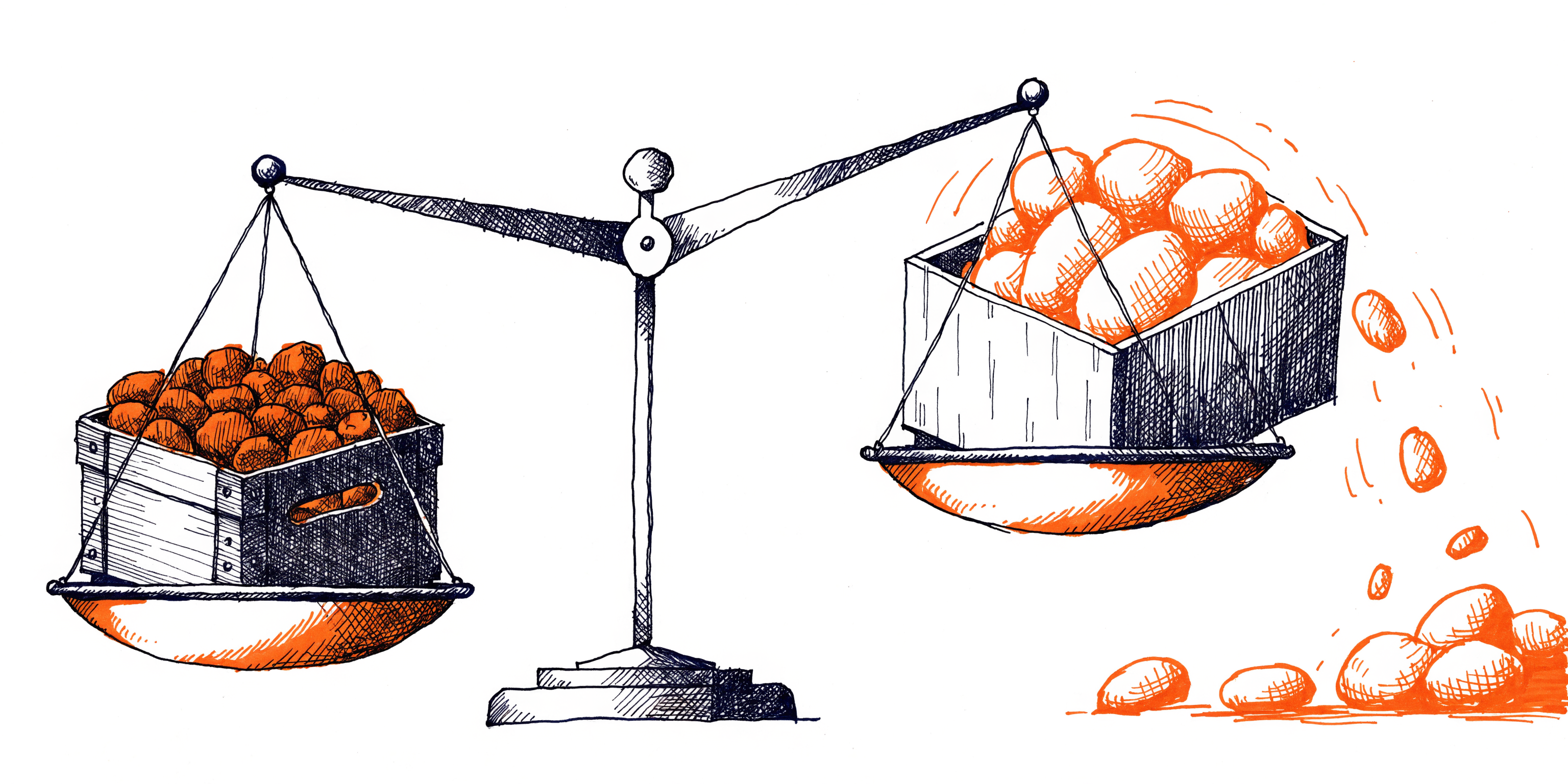
Take two FBA businesses, both worth roughly $243,000 a year in Seller's Discretionary Earnings, or SDE, the profit measure buyers use to price an owner-operated business. One has a 45% margin and sales that fell over the past year. The other has a 15% margin and sales that are climbing. Which one estimates higher?
The declining, high-margin business wins. Comfortably.
Same Size, Different Direction
Among 8,604 qualified valuations in the FBA Guys database, businesses with margins of 40% or better and declining revenue average a 2.14x multiple. Businesses with margins under 20% and growing revenue average 1.999x. Both groups sit at almost the same average SDE, $242,564 versus $244,737, so the gap isn't a size effect wearing a margin costume. It shows up at the median too: 2.125x against 1.95x.
What happens to that gap as the businesses get bigger is the part worth sitting with. Split both groups by SDE band and the margin advantage does not hold steady across sizes.
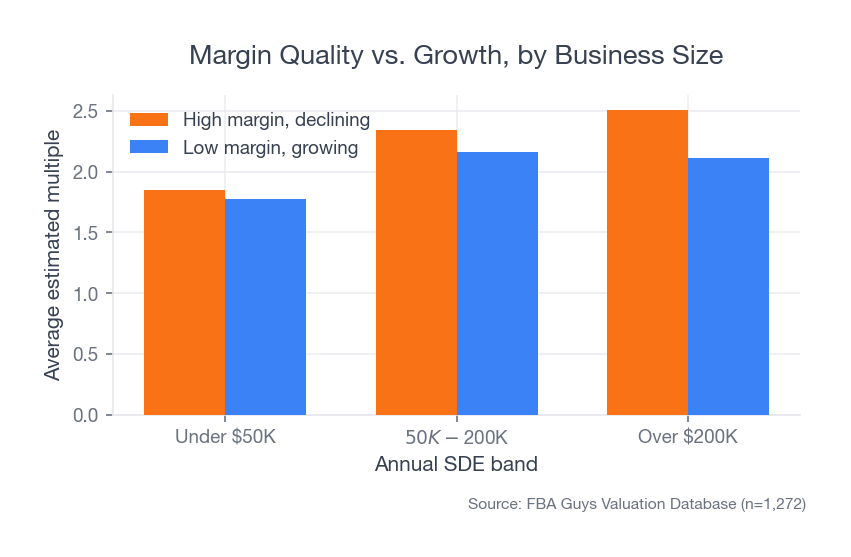 Source: FBA Guys Valuation Database (n=8,604)
Under $50,000 in SDE, the two groups are close: 1.849x for the high-margin decliners against 1.772x for the low-margin growers, a gap of 0.077x. In the $50,000 to $200,000 band, the gap widens to 0.181x. Above $200,000 in SDE, it's 0.394x, nearly half a turn on the multiple. A buyer writing a bigger check appears to weight margin quality more heavily than a buyer writing a small one, or the businesses that clear that size threshold with strong margins are carrying other advantages the form doesn't capture directly.
The Threshold Where the Gap Almost Disappears
Look at how many businesses in each group cross the 3x mark and the two groups land almost on top of each other: 22.1% of the high-margin decliners hit 3x or better, against 22.2% of the low-margin growers. A tenth of a point apart.
That doesn't contradict the average gap. It's explained by where the rest of each group sits. The low-margin-growing businesses have a heavier low tail: 39.0% land under 1.5x, against 30.2% for the high-margin decliners. Both groups produce roughly the same share of standout businesses. The difference is what happens to everyone else. A margin problem drags more of the group toward the bottom than a growth problem does.
What We Don't Know
The database records what a business was valued at, not why a buyer would pay that number. We can't fully separate two explanations here: that buyers price margin quality directly as a signal of resilience, or that businesses with strong margins also tend to carry other traits our form doesn't ask about (cleaner supplier terms, less price competition, a defensible niche) that happen to travel alongside high margin. The size-widening pattern is consistent with either story, and we don't have a clean way to isolate which one is doing the work.
What It Means
For a seller weighing where to put next quarter's effort, the businesses in our data that are declining but hold a 40%+ margin outvalue growing businesses running under 20%, and the advantage only gets bigger as the business scales toward a bigger check. Fixing margin looks like the higher-leverage move, at least by the size where a bigger buyer pool starts paying attention.
A buyer reading this the other direction should treat a low margin as a harder problem to underwrite than it might first appear, particularly on a growing business where the top-line trend can make the margin issue easy to overlook. The data doesn't say growth is worthless. It says a margin problem doesn't get cheaper to fix just because revenue is moving up.
Curious what your business is worth?
Get a free, instant valuation and see how your Amazon business stacks up.
Get Your Free Valuation