FBA Multiples by Marketplace: What the UK and Canada Discount Looks Like in the Data
The FBA Guys
June 17, 2026

The FBA Guys database holds 7,699 qualified valuation records — businesses with positive margins, computable seller earnings, and an estimated value. Of those, 5,899 list the United States as their main marketplace, 1,374 list the United Kingdom, and 207 list Canada.
Line them up by average estimated multiple and the gap is immediate: US businesses average 2.61x seller's discretionary earnings (SDE, the earnings figure buyers typically use for owner-operated businesses — roughly, net profit before adding back the owner's compensation and any one-time expenses). UK businesses average 2.13x. Canadian businesses average 1.96x.
The first question is whether that's a size story. US businesses in this dataset are larger on average than UK or Canadian businesses. If bigger businesses naturally get higher multiples, the gap might just be a size artifact.
It doesn't disappear when you control for size.
The size-controlled comparison
Among businesses with SDE between $50,000 and $300,000 — 2,459 US records, 590 UK records, and 102 Canadian records — the gap holds. US businesses in this band average 2.66x. UK businesses average 2.18x. Canadian businesses average 2.10x.
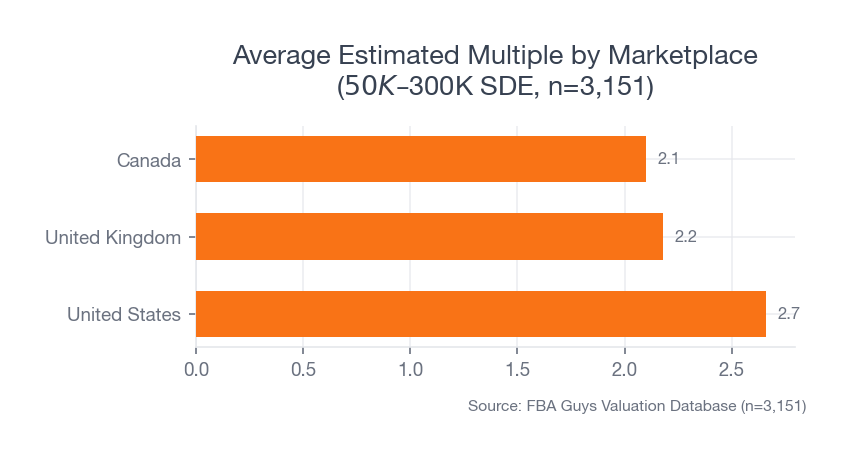 Source: FBA Guys Valuation Database (n=3,151)
In this same range, just under half of US businesses (49.8%) estimate at 3x or better. In the UK, 22.9% do. In Canada, 21.6%.
The gap persists at larger SDE levels too. Among businesses earning $300,000 to $600,000 per year, US businesses average 2.71x and UK businesses average 2.33x. Above $600,000, US businesses average 2.91x and UK businesses average 2.37x. It isn't smaller businesses pulling down the UK average.
The growth-rate cut
A second explanation: US businesses might just be growing faster. Buyers pay more for growth, so a US pool that skews toward growing businesses would show a higher average multiple for reasons that have nothing to do with the marketplace itself.
To check, we isolated businesses reporting stable revenue — flat sales, not growing. Among stable-revenue businesses in the $50,000 to $300,000 SDE range, the gap persists: US stable businesses average 2.67x (n=601), UK stable businesses average 2.03x (n=131). The gap is actually slightly wider when growth is removed, not narrower.
The marketplace premium isn't a growth-rate artifact.
What the gap means in dollars
At the midpoint of the $50,000 to $300,000 SDE range, a business earning $200,000 per year estimates at roughly $532,000 on the US marketplace and $436,000 on the UK marketplace. That's approximately $96,000 in estimated valuation on the same underlying earnings, at the same margin, in the same product category.
At $300,000 in annual SDE — the high end of this band — the gap is approximately $144,000.
What might be driving it
We don't know for certain. The more likely reading is that buyers price marketplace liquidity and exit-path availability, not just the earnings. US FBA businesses draw from a deeper buyer pool: more search funds, more PE-backed acquirers, and broader SBA loan eligibility that creates financing optionality for buyers who might not otherwise have the capital. A UK or Canadian buyer market is narrower, and that compression shows up in the multiple.
There's also a practical consideration for buyers considering UK or Canadian businesses: the international transfer of an Amazon seller account and the continuation of supplier relationships adds operational complexity that US-to-US transactions don't carry in the same way.
What this means for sellers
For sellers on UK or Canadian marketplaces: the gap is structural. It doesn't reverse by improving the business. A UK business with strong margins, multiple suppliers, and documented SOPs will still estimate lower than a comparable US peer. Understanding this matters for timing an exit and setting realistic valuation expectations.
It also affects when to act. If a UK seller is considering building toward an exit, the marketplace premium question is worth factoring in before making long-term operational investments that don't address the underlying discount.
What this means for buyers
UK and Canadian FBA businesses with strong operational profiles are priced lower than comparable US businesses. Whether that discount reflects genuine transaction risk — fewer financing options, narrower exit paths — or represents an asymmetric opportunity depends on the buyer's access to capital and their confidence in the acquisition process.
What we don't know
The database doesn't capture whether a business sells on multiple marketplaces simultaneously. A US business that also sells on Amazon UK is counted in the US group; a UK seller who has expanded to the US marketplace is counted in the UK group. That limits our ability to separate primary marketplace from marketplace-mix effects.
We also don't know whether the gap is stable over time. Recent platform changes, the Amazon fee stack in 2026, and shifts in international buyer activity could all move it. This snapshot is from current database inputs and doesn't carry a time series.
Curious what your business is worth?
Get a free, instant valuation and see how your Amazon business stacks up.
Get Your Free Valuation