FBA Multiples by Business Size: The Premium Is Almost All One Early Step
The FBA Guys
June 18, 2026
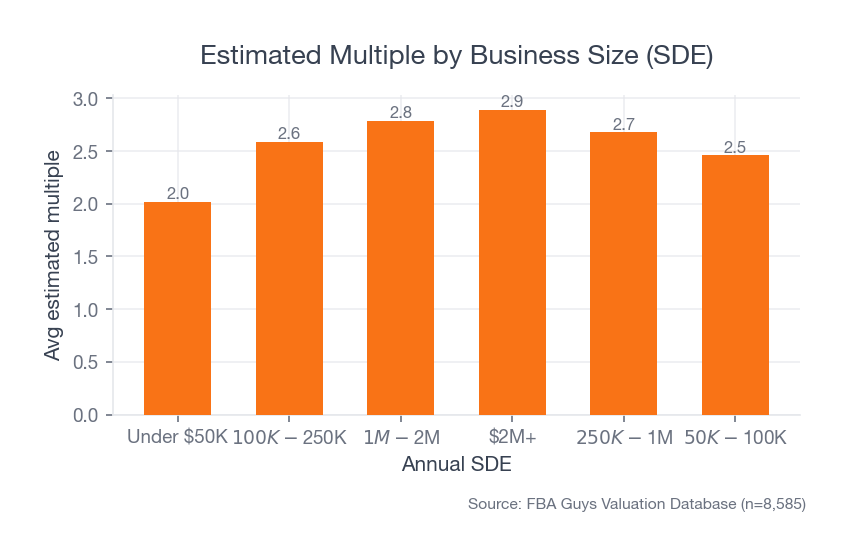
Bigger FBA businesses get higher multiples. That part is true, and it shows up cleanly across 8,585 valuations in our database: businesses earning under $100,000 a year in SDE average a 2.16x estimated multiple, and businesses earning over $2 million average 2.89x.
SDE is seller's discretionary earnings, the profit figure buyers use for owner-operated businesses: roughly net profit with the owner's pay and any one-time costs added back.
The interesting part is the shape of that climb. It isn't a steady ramp where every step up in size buys another slice of multiple. Almost the whole premium is captured in one early jump, and the rest of the range is close to flat.
Line the businesses up by size. Under $100,000 in SDE the average is 2.16x. Cross into the $100,000 to $250,000 band and it jumps to 2.59x. From there the climb nearly stalls: $250,000 to $1 million averages about 2.68x, $1 million to $2 million averages 2.79x, and even past $2 million the average is 2.89x. The first step is +0.43x. The entire rest of the climb, from $100,000 all the way past $2 million, adds about +0.30x.
 Source: FBA Guys Valuation Database (n=8,585)
Look closer and the line is lower and sharper than the bands suggest. The businesses under $50,000 in SDE average just 2.02x, and they are the single largest group in the database, 3,075 of them. Clear $50,000 and the average is already 2.45x. More than half of every business we value, 51.5%, earns under $100,000 a year, so this is the part of the curve most sellers are actually standing on.
The obvious suspicion is that this is really a margin or growth story in disguise. Smaller businesses might run thinner margins, or the bigger ones might be growing faster, and either could carry the multiple along with it. Neither holds up. Hold margin constant, among businesses with margins between 40% and 60%, and the step survives: the under-$100,000 group averages 2.27x and the $100,000 to $250,000 group averages 2.75x, then the curve goes flat again at 2.81x, 2.73x, and 2.81x as size keeps rising. Restrict it instead to businesses with stable, non-growing revenue and the same shape appears: 2.21x under $100,000, 2.58x just above the line, flat after that.
What the step costs a seller is concrete. A business earning around $48,000 in SDE estimates near 2.0x, or about $96,000. The same business at around $60,000 in SDE estimates near 2.45x, or about $147,000. The extra $12,000 of annual profit is associated with roughly $50,000 of estimated value, and most of that comes from the multiple stepping up rather than from the earnings themselves.
Why the line sits where it does is the part we can't settle from this data. These are our model's estimates, not recorded sale prices, and the model may weight size directly, so some of this shape is built into the estimate. Our read of the rest is about deal economics, not business quality. At very small deal sizes the buyer pool thins, the fixed cost of diligence eats a larger share of a small purchase, financing minimums start to exclude buyers, and a tiny business tends to read as more dependent on its owner. None of that means a $45,000 business is run worse than a $450,000 one. It means fewer buyers will bother, and the ones who do pay less for the same dollar of earnings.
For a seller sitting under $50,000 in SDE and weighing whether to grow before a sale, that reframes the question. Our read is that the highest-leverage move isn't getting big, it's clearing the line into territory a normal buyer will finance and take seriously. For a buyer, the $100,000 to $250,000 band is the quietly interesting one: the multiple already sits most of the way to where the $2 million businesses land, while the prices are a fraction of theirs.
Curious what your business is worth?
Get a free, instant valuation and see how your Amazon business stacks up.
Get Your Free Valuation