How to Calculate SDE for an Amazon Business: The Formula Is Easy. The Discipline Is Not.
The FBA Guys
April 3, 2026

How to Calculate SDE for an Amazon Business: The Formula Is Easy. The Discipline Is Not.
Most Amazon sellers do not struggle with the SDE formula. They struggle with what they are willing to admit before they use it.
To calculate SDE for an Amazon business, start with trailing-twelve-month net income, add back one owner's compensation, legitimate one-time costs, and owner-specific expenses that will not carry forward, then pressure-test the result against accrual accounting and documentation.
That is the method. The difficult part is whether the starting number is clean enough, and whether the add-backs are real enough, to survive somebody else's review.
What counts as discretionary? What is merely inconvenient? What is a bookkeeping problem pretending to be an add-back?
Those questions matter because buyers are usually paying for earnings they believe, not earnings that were explained with a lot of confidence.
What SDE Is Actually Measuring
SDE, seller's discretionary earnings, is the amount one working owner can reasonably pull from the business in a year once the normal costs of running it are accounted for.
That sounds simple. Amazon books usually are not.
Revenue is noisy. Net income is blunt. SDE normalizes the picture by asking what belongs to the business and what belongs to the current owner. If you skip that second question, you are not calculating SDE. You are renaming net income.
The fact is, that is where the metric gets mishandled. Sellers often treat SDE like a cleaner synonym for profit. It is not. It is a normalized earnings number built on judgment, support, and quite a bit of restraint. If you want the broader explainer version first, Seller's Discretionary Earnings Explained walks through what the metric is doing underneath the formula.
How to Calculate SDE for an Amazon Business Starts With the Right Time Window
Do not start with the last pretty month.
Use trailing-twelve-month net income. The Playbook is explicit about that because short windows distort seasonality and multi-year averages can blur the current business trend. In Amazon, freight timing, inventory receipts, and promotional cycles make that distortion rather obvious.
One month looks terrific. The next one looks like the business forgot how to make money. Neither one deserves to become your base number on its own.
If your P&L is not monthly and trailing-twelve-month ready, your SDE figure is already on thin ice.
The Add-Back Schedule Is Where the Value Moves
The formula still fits on one line:
Net Income + Add-Backs = SDE
Easy to write. Expensive to rush.
Owner salary is usually the first obvious add-back. One-time legal cleanup can qualify. A genuine owner perk can qualify. The Playbook's warning here matters because it is not small: 10-30% of discretionary earnings can come from add-backs when the review is done thoroughly and honestly.
That does not turn every annoying expense into an add-back.
If the expense will keep showing up for the next owner, it is typically an operating cost. Advertising is not an add-back because you are tired of paying it. Product-launch spend is not automatically an add-back if the brand depends on regular launches. A premium office is not a perk if the team actually uses the space. And if your books have a line called "Amazon Misc" wobbling between $400 and $1,200 every month, nobody is going to assume it hides a beautifully categorized owner benefit. They are going to assume you stopped sorting.
Here is a simplified illustration:
- Trailing-twelve-month net income:
$185,000 - One owner's salary:
$80,000 - One-time legal cleanup:
$12,000 - Personal travel booked through the business:
$9,000 - Adjusted SDE:
$286,000
Simple enough.
Now the harder question. Could somebody else read those four lines, ask for support, and still believe them? If the answer is no, the schedule is weaker than it looks. If you want to test different versions quickly, the SDE calculator is useful for the arithmetic. It is not a substitute for the judgment calls.
Fix Accrual Before You Congratulate the Number
This is the part sellers skip because add-backs feel more rewarding.
You find a few personal expenses. You clean up owner payroll. You feel productive. Meanwhile the starting net income is still wrong because the books are cash-basis and the inventory timing is making one month absurdly heavy and the next one suspiciously light.
For an inventory business, that is backwards. If the accounting method is distorting earnings, the add-back schedule is working on top of a bad foundation.
The Playbook is direct on this. Accrual accounting is the right frame for inventory-heavy businesses because it matches cost recognition to the period when product actually sells. Cash accounting does not. It makes a business look weaker when inventory lands and cleaner than it should when that inventory sells through later.
One example in the Playbook shows a ~$92,429 gain in SDE after flipping the books from cash to accrual. At a 3.2x multiple, that works out to roughly $295,772.80 in value moving before anyone debates a single add-back.
That is why this keeps irritating us. Sellers want the upside of SDE without doing the bookkeeping work that makes SDE worth trusting.
For an hour the number can look broken. Freight bill. Inventory purchase. Margin that suddenly looks like it fell down the stairs. Then you slow down and realize the business may be fine. The accounting is what is lumpy.
Different problem. Much cheaper problem, if you catch it early. If you need the longer accounting version, accrual or cash accounting when selling your Amazon business is the right next read.
What Trustworthy SDE Looks Like in the Data
Our valuation database does not track line-item add-back categories, so it cannot rank owner travel against legal cleanup or tell you whether cashback points beat conference spend on the median schedule. Pretending otherwise would be sloppy.
What it can show is what tends to happen when earnings look cleaner and more believable.
Across 8,401 positive-SDE valuations with positive valuation estimates, businesses under $50K in SDE averaged a 2.02x implied multiple. Businesses over $1M averaged 2.82x.
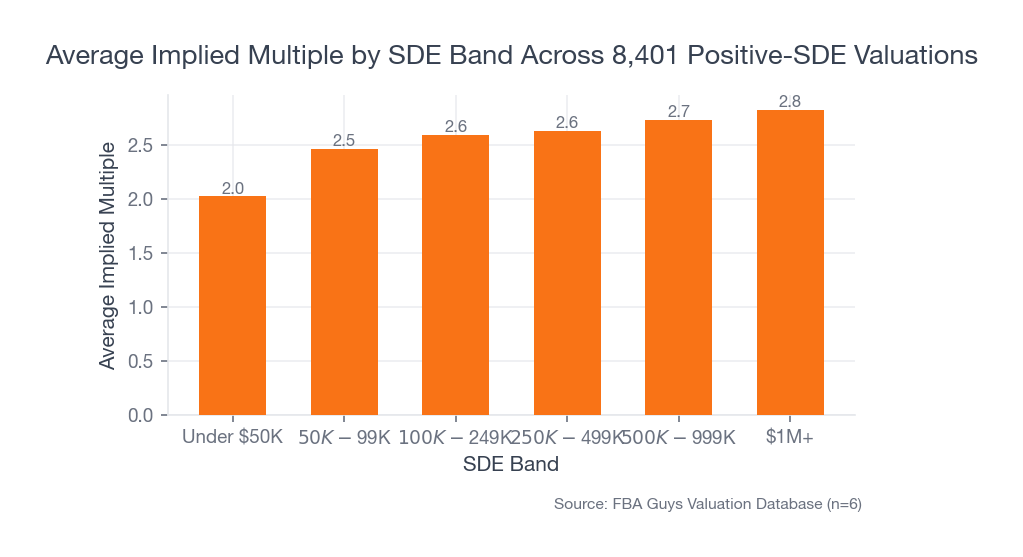 Source: FBA Guys Valuation Database (n=8,401)
That is not just a size story.
It is also a trust story. Stronger earnings usually arrive with stronger margin, better documentation, and fewer reasons for a buyer to discount the number. The business is not only making more money. It is making money in a way that survives contact with scrutiny.
The margin data says the same thing from a different angle. Businesses in the lowest gross-margin band averaged $164,927 in SDE and a 1.57x implied multiple. Businesses above 40% gross margin averaged $564,559 in SDE and 2.57x.
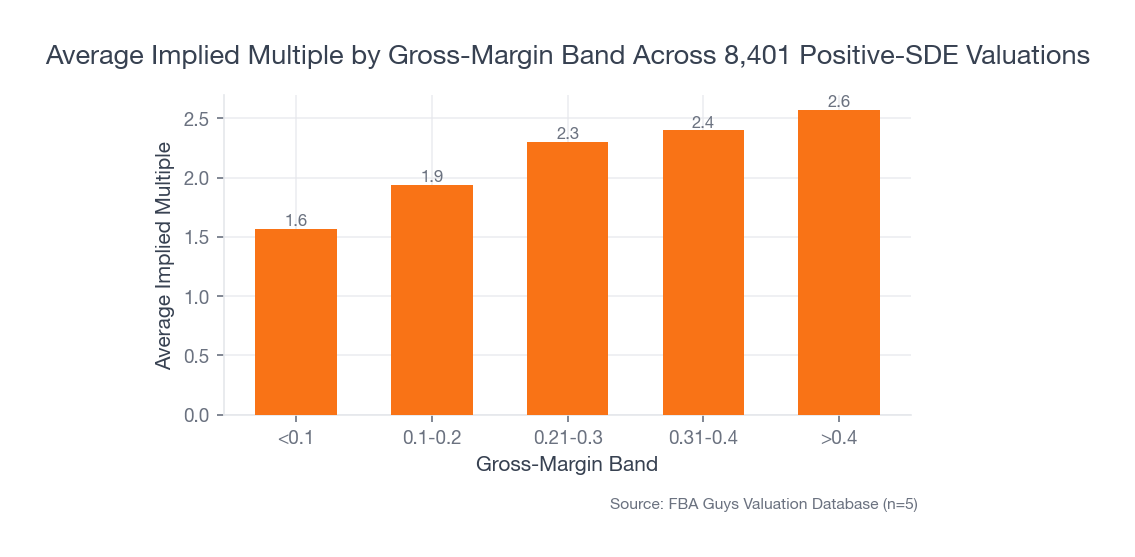 Source: FBA Guys Valuation Database (n=8,401)
And then there is the revenue burden behind the number. In the under-$50K SDE band, businesses in our data needed 6.16x revenue, on average, to produce one dollar of SDE. Above $500K, that ratio falls to 3.48x. Same metric. Very different operating reality.
That is why tutorial posts that stop at arithmetic feel bloodless. The formula can be identical while the economic meaning is completely different.
Documentation Still Changes the Conversation
The database does not audit bookkeeping systems directly. We should keep that line clean.
But it does offer useful documentation proxies. Among businesses with separate structure plus tax returns, average SDE was $601,935 and the implied multiple was 2.75x. In the commingled and no-returns group, average SDE was $193,738 and the implied multiple was 1.97x.
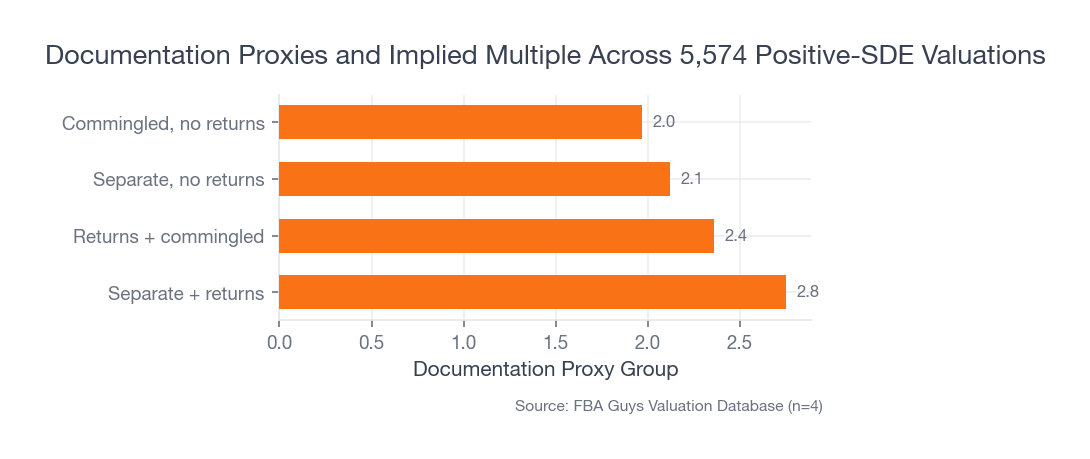 Source: FBA Guys Valuation Database (n=5,574)
That does not prove the first group had perfect books and the second group did not.
It does support the broader point. Cleaner support tends to travel with more trusted earnings, and more trusted earnings tend to hold value better. For a simpler warm-up metric, gross margin is still useful. It just is not enough on its own.
When SDE Stops Being the Right Lens
Later than people think.
For most owner-operated Amazon businesses, SDE is still the right first number because owner compensation and owner perks are part of the economics. EBITDA becomes more useful when management payroll is already embedded and the business runs more like an operating company than an owner job.
Short section, on purpose. The acronym switch matters less than getting the earnings number right in the first place.
How to Calculate SDE for an Amazon Business Without Lying to Yourself
If you want the working checklist, use this:
- Pull a monthly trailing-twelve-month P&L.
- Make sure inventory-heavy periods are reflected on accrual, not cash.
- Start with actual net income, not a favorite slice of it.
- Add back one owner's compensation.
- Add back legitimate one-time and owner-specific costs that will not carry forward.
- Remove anything the next owner will probably keep paying.
- Keep support for every judgment call.
- Ask whether the final number matches the economic reality of the business.
That last step is where people either get serious or start storytelling.
If the business depends on one owner working sixty hours a week, a buyer is not going to give you a full salary add-back without adjusting for replacement labor. If the schedule only works after a ten-minute monologue, it probably doesn't work. If the books are still cash-basis and inventory timing is all over the place, the calculator is not your bottleneck.
It is the accounting.
FAQ
Can SDE be higher than net income?
Yes. It often should be in an owner-operated Amazon business because legitimate owner-specific and non-recurring expenses are still sitting inside net income.
Are ad spend or launch costs valid add-backs?
Usually not. If the business regularly needs that spend to maintain sales or keep launching products, that is operating cost, not discretionary owner benefit.
Should I calculate SDE from cash-basis books if that is all I have today?
You can start there to see the shape of the problem, but for inventory-heavy businesses you should not stop there. Cash-basis books can make the earnings number look worse or better for timing reasons that have nothing to do with actual business performance.
Is SDE the same as business value?
No. SDE is the earnings base. Value comes after a multiple is applied, and the multiple moves with risk, growth, transferability, margin quality, and documentation.
Why do buyers push so hard on documentation if the math looks right?
Because math without support is just a polite guess. If they cannot trace the number, they will discount the number.
Curious what your business is worth?
Get a free, instant valuation and see how your Amazon business stacks up.
Get Your Free Valuation