Amazon FBA Accounting Basics: The Numbers Need to Mean Something
The FBA Guys
April 4, 2026

Amazon FBA accounting basics sound like the kind of topic you postpone until the business is bigger, more stable, or somehow more deserving of adult financial habits.
Then someone asks for a valuation, opens the P&L, and the whole room starts staring at the freight line like it owes them money, because the revenue looks fine, the margin looks arguable, and nobody is quite sure whether the business is underperforming or just being described badly.
That is usually the moment sellers realize accounting basics were never really about bookkeeping. They were about whether the business can explain itself when another person starts asking uncomfortable questions.
The basics themselves are not mysterious. Separate financials. Accrual logic where inventory timing matters. A real monthly P&L. Tax returns you can produce quickly. Add-backs documented well enough that another adult can follow them without a guided tour. That is the foundation. Everything more advanced sits on top of it.
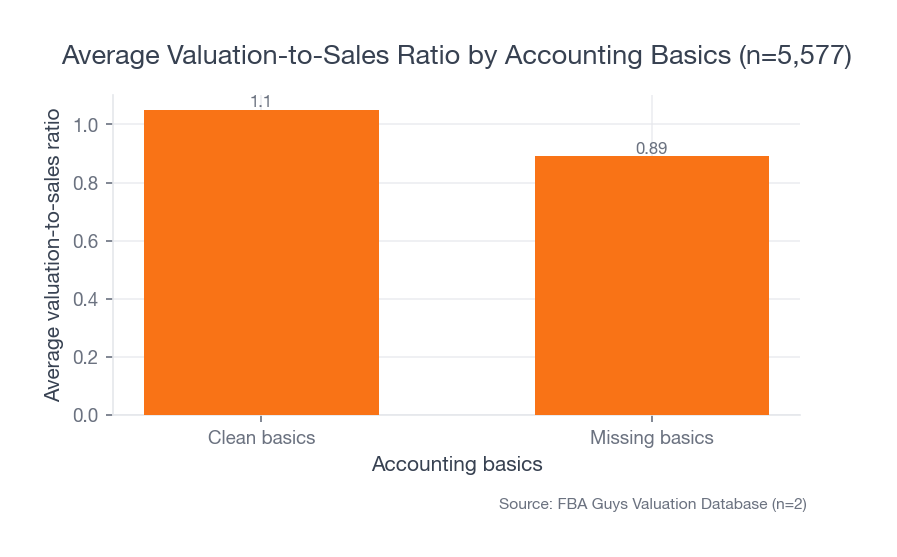
Our valuation database makes the point rather bluntly. Among 5,577 valuations where sellers answered both tax-return and co-mingling questions, the businesses with the clean basics in place averaged a 1.05 valuation-to-sales ratio. Businesses missing one of those basics averaged 0.89. That gap is not an accounting aesthetic. It is what happens when the business is easier to trust.
And trust is the whole game here.
What Amazon FBA accounting basics actually include
You do not need a heroic finance stack to get the basics right.
You need five things.
- Separate accounts for the business, rather than one checking account pretending to be three businesses and a family budget.
- A monthly profit and loss statement that reflects reality, not whatever happened to clear the bank that month.
- Inventory and freight handled on accrual logic, because FBA businesses buy now and sell later.
- Tax returns and financial statements that can be produced without a scavenger hunt.
- Add-backs tracked with enough detail that a buyer, lender, or advisor can understand what is truly discretionary and what absolutely carries forward.
That is not glamorous. Of course it isn't.
But these are the basics because each one solves a very specific credibility problem. Separate accounts tell the next person where the business begins and ends, monthly statements tell you whether margin is actually improving or whether cash timing is flattering you for a few weeks, and tax returns plus add-back support tell a lender you are not improvising the story after the fact because the bank balance got scary and now everybody is trying to reverse-engineer what "normal" earnings should have been.
If the business cannot tell a clean story in numbers, the business becomes harder to finance, harder to diligence, and harder to value confidently.
Separate the business before you optimize the business
This is the first basic because it poisons everything downstream when it is wrong, and because almost every other accounting improvement becomes slower once the boundaries of the business are blurry.
The phrase you want to avoid is "we run a few things through that account." What does "a few things" ever mean in practice? Usually it means one account is carrying software, reimbursements, a card charge from a trade show dinner, a supplier deposit for a different brand, and something a spouse needed reimbursed because it was easier than moving money around properly.
That sentence sounds harmless until someone tries to reconstruct your margins, identify your inventory funding, and figure out whether that $1,240 line item labeled "Amazon Misc" was storage, reimbursements, software, or your phone bill because someone grabbed the wrong card again. Sellers do this constantly, not maliciously, usually because they are moving fast and the business works anyway, which is exactly why the habit sticks around longer than it should.
Until it doesn't.
In the valuation data, 6,855 sellers reported isolated business financials, while 1,369 reported co-mingled financials. That is not a fringe mistake. It is common enough that the calculator itself treats co-mingling as a meaningful risk factor, and the site language is explicit about why: co-mingled financials become a due-diligence problem. Once the books mix personal life, multiple brands, or side ventures into the same flow, every later question gets harder. Which expenses truly belong to this business? Which cash withdrawals were owner distributions? Which ad spend actually supported the ASINs the buyer is evaluating? You can answer those questions eventually, perhaps, but the answer starts costing more time and more confidence than it should.
The more interesting number is what happens when you combine separation with tax-return readiness. In the 5,577-record subset where both signals are present, the businesses with clean basics in place averaged a 1.05 valuation-to-sales ratio. The businesses missing one of those basics averaged 0.89.
 Source: FBA Guys Valuation Database (n=5,577)
That does not prove accounting alone caused the whole difference. It would be silly to claim that, because cleaner books usually travel with better operators, stronger controls, and businesses that have already matured past a few avoidable mistakes.
What it does show is that basic financial discipline tends to travel with stronger outcomes. The business is legible, the owner usually knows what belongs where, and the buyer or lender spends less time wondering whether the numbers are soft. That matters because diligence is not just an audit of the past. It is a test of whether the next person can operate the thing without inheriting a fog machine.
And that last part matters more than sellers like to admit.
Related reading if you want the valuation layer after the bookkeeping layer: Amazon FBA Business Valuation: How Much Is Your Business Worth?
Why accrual matters more than most sellers think
Cash accounting feels intuitive because your bank account is visible. FBA economics are not. That gap is where a lot of otherwise competent sellers get themselves into trouble.
You can pay for freight in April, receive inventory in May, sell through it in June and July, and still look at April's bank activity as if it describes April's operating performance. It doesn't. It describes the timing of cash movement.
This is where a lot of Amazon sellers start lying to themselves without meaning to. The month looks bad because freight hit early. The next month looks great because no freight hit at all. Then someone annualizes the "great" month, decides margin expanded, and starts making decisions on a number that was never measuring the business cleanly in the first place. What is the metric actually measuring in that moment? Not operating performance. Just timing.
The Playbook hits this hard for a reason. If you don't track inventory and freight on accrual logic, you can depress SDE, misread margin, and eventually misprice the business. One of the examples in the book uses $24,000 in freight for four months of inventory. Booked on a cash basis just before listing, that single timing mistake drags SDE down by $24,000. On the right accrual treatment, three quarters of that spend belongs in future periods. The business value moves because the accounting finally matches the operating reality, and that is the real point here: accrual is not a fancier way to do accounting. It is a better way to describe what period the economics actually belong to.
This is the part sellers resist because accrual sounds like a bigger-company concern. It isn't. If you carry inventory, buy freight in chunks, and sell over time, you are already living in accrual economics whether your books admit it or not. The books can either reflect that reality or blur it. They can't do both.
For a deeper treatment of the accounting-method choice itself, read Accrual or Cash Accounting When Selling Your Amazon Business?
The monthly P&L habit that keeps you out of trouble
A real monthly P&L is not just a report you print when taxes are due. It is the operating dashboard that tells you whether the business is getting healthier, wobblier, or simply noisier, which sounds like a small distinction until you realize how many bad decisions get made because noise was mistaken for trend.
What should it do? It should separate revenue, COGS, freight treatment, ad spend, software, payroll, owner's compensation, and the weird one-off expenses that otherwise end up buried in "miscellaneous." It should reconcile with your bank accounts and credit cards. And it should arrive often enough that you still remember what the ugly line items were for, because memory is a terrible accounting system and somehow sellers keep trying to use it as one.
That last point sounds small. It is not.
The fact is, accounting gets dramatically harder once every answer starts with, "I think that charge was from late summer."
A monthly close gives you context while the context still exists. You can identify the return spike. You can see when TACoS fell because demand weakened, not because advertising suddenly got more efficient. You can catch the product launch costs before they smear across the year and make the whole business look less profitable than it really was. You can also spot the ugly practical stuff that never survives a year-end reconstruction cleanly: inventory write-downs, inbound freight that landed in the wrong period, software subscriptions that kept stacking after a tool should have been killed, and the contractor spend that started as a one-off fix but quietly became permanent.
And if you eventually want a valuation, financing, or a sale, monthly statements let you show the business as a sequence rather than a blur.
That changes the conversation.
If you want to tighten the reporting side of that habit, this companion article helps: Amazon Seller Profit and Loss Statement: The Monthly View Matters More Than the Annual Total
Tax returns, add-backs, and SBA readiness
Tax returns are not the whole accounting story. But they are one of the first signs that a story exists at all, because a seller who can produce tax returns quickly usually has at least some discipline underneath the surface.
In the valuation data, 4,649 sellers reported tax returns available and 929 reported no tax returns. Again, a meaningful minority still shows up without this basic documentation in hand. The practical issue is not that tax returns are magical. It is that tax returns, clean books, and separated accounts usually travel together. When they do not, the next person reading the business starts wondering what else is missing, delayed, or reconstructed from memory.
And lenders care about that combination a lot.
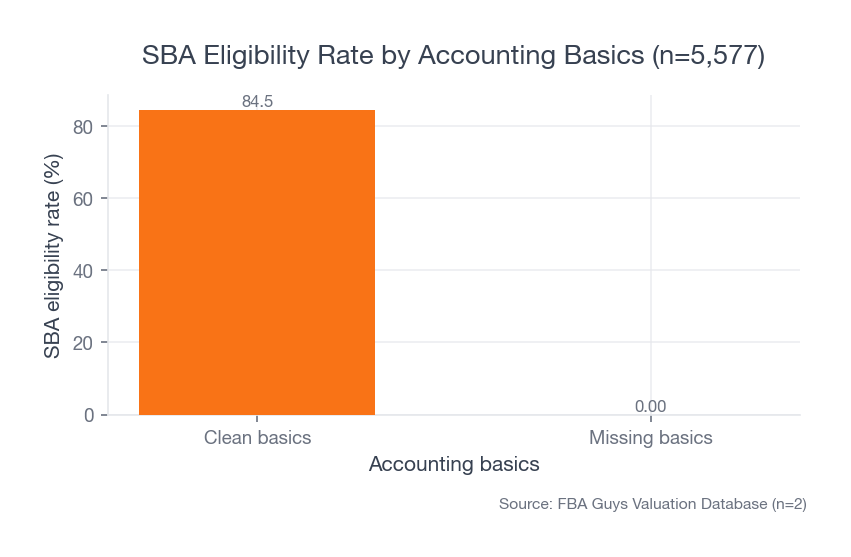
Among the 3,753 businesses in our dataset that had tax returns available and isolated financials, 84.5% scored as SBA eligible in the calculator logic. Among the 1,824 missing one of those basics, the rate was 0.0%.
 Source: FBA Guys Valuation Database (n=5,577)
That is a brutal split. Why does it matter so much? Because financing conversations are not really about whether the seller feels organized. They are about whether the lender can underwrite a business whose earnings and boundaries make sense on paper.
You can interpret it two ways. The optimistic interpretation is that the basics are fixable. The less comfortable interpretation is that plenty of sellers are still treating accounting as cleanup work for later, even though later is exactly when financing options narrow, price gets debated harder, and everyone suddenly expects a clear explanation for choices that were never documented properly when they happened.
Add-backs sit in the same bucket. You do not want to discover them for the first time when someone is already diligencing the business. Owner salary, one-time cleanup projects, personal expenses run through the company, and temporary duplicate software stacks can all matter. But they only help if they are documented clearly enough to separate what was discretionary from what truly carries forward, and that usually means the seller has been keeping cleaner records long before the exit conversation started.
Clean books do not mean low taxes or some perfectly polished CPA fantasy. They mean another person can understand your earnings without needing to forgive your process.
If margin interpretation is still fuzzy, read How to Calculate Amazon FBA Profit Margin Without Fooling Yourself
A simple accounting stack for Amazon sellers
This does not need to become an ERP project, and if you are already feeling that objection rise in your throat, good, because most sellers do not need a grand implementation plan here.
For most Amazon sellers, the basic stack is rather plain:
- One business entity, one business checking account, and dedicated credit cards for business spend.
- A bookkeeping system that can produce monthly P&Ls, balance sheets, and cash flow statements.
- A monthly close cadence, with bank and credit-card reconciliation.
- Inventory and freight treatment that follows accrual logic rather than pure cash timing.
- A clean folder for tax returns, monthly statements, and add-back support.
That is enough to make the numbers usable. Is it elegant? Not especially. Is it enough to keep you from making margin decisions on bad timing and memory-driven categories? Usually, yes.
Then you build from there. Maybe class tracking by brand. Maybe cleaner contribution margin reporting by SKU family. Maybe better inventory valuation rules. But that is the second layer. Too many sellers chase dashboards before they have a trustworthy ledger. It is backwards, and it keeps happening because dashboards feel strategic while bookkeeping feels like chores.
If you want one practical rule, use this one: don't let any month close with a mystery category you would be embarrassed to explain out loud six months later.
That sounds obvious. It also kills a surprising amount of future confusion.
Where this gets expensive
The expensive part is not hiring a bookkeeper. The expensive part is believing you saved money by waiting. Sellers often frame this as thrift or scrappiness, but that is not usually what it is. More often it is avoidance with a decent story attached to it.
The Playbook tells the same story from different angles over and over. Sellers put off proper bookkeeping, assume they can clean it up later, and eventually discover the cleanup is slower, more expensive, and more damaging than doing it correctly in the first place. Sometimes the problem is an inexperienced bookkeeper. Sometimes it is the owner. Sometimes it is a business that grew too quickly for the reporting discipline underneath it. Same ending. What looked manageable month to month turns into a reconstruction project right when the numbers need to be least arguable.
The business becomes harder to interpret.
And when the numbers feel arguable, price gets arguable too.
FAQ
Do Amazon FBA sellers need accrual accounting?
If you carry inventory and freight across periods, yes, you at least need accrual logic in your internal reporting. Otherwise a cash-heavy month can make the business look weaker or stronger than it actually is. Could you survive for a while on cash-basis intuition? Sure. But why would you want to drive the business that way once the numbers start affecting pricing, planning, and financing?
What is the difference between bookkeeping and accounting for an Amazon seller?
Bookkeeping is the recording layer. Accounting is the interpretation layer. For Amazon FBA accounting basics, you need both. Clean entry without accurate treatment still gives you misleading numbers, and elegant interpretation without disciplined entry usually collapses back into guessing.
Can I do Amazon FBA accounting myself?
You can, especially early. The real question is whether you can do it consistently, monthly, and on accrual logic while the business is growing. Many sellers can for a while. Fewer can once inventory, freight, ad spend, and add-backs start stacking up, because the work stops being data entry and starts becoming judgment.
Are tax returns enough to prove my books are clean?
No. They help. They do not replace monthly statements, reconciliations, or separated accounts. Tax returns are one signal. They are not the whole operating picture, and sellers get in trouble when they treat a filed return as proof that the internal reporting underneath it must also be decision-ready.
Conclusion
Amazon FBA accounting basics are not advanced finance.
They are the minimum set of habits that make the business believable: separate financials, monthly P&Ls, accrual treatment where inventory timing matters, available tax returns, and documented add-backs. If you get those right, you are not just cleaning up the books. You are giving the business a cleaner operating signal and a more credible valuation story.
That is why these basics matter. They make your numbers mean something.
Curious what your business is worth?
Get a free, instant valuation and see how your Amazon business stacks up.
Get Your Free Valuation