Amazon Peak Season Inventory Planning: The Rush Starts Earlier Than the Orders
The FBA Guys
June 3, 2026

Every peak season inventory plan has a moment where the spreadsheet looks calm and the business doesn't.
The supplier says production is fine, the freight forwarder says there is still time, and Seller Central is still showing a reasonable sell-through rate. Then one SKU starts moving three days faster than expected, Amazon check-in takes longer than the last shipment, and the reorder point you trusted in July looks a little too polite for October.
Amazon peak season inventory planning is the process of deciding how much inventory to order, when to order it, where to stage it, and which SKUs deserve cash before demand spikes. The useful plan protects sales rank and cash at the same time.
Which one usually gets less attention?
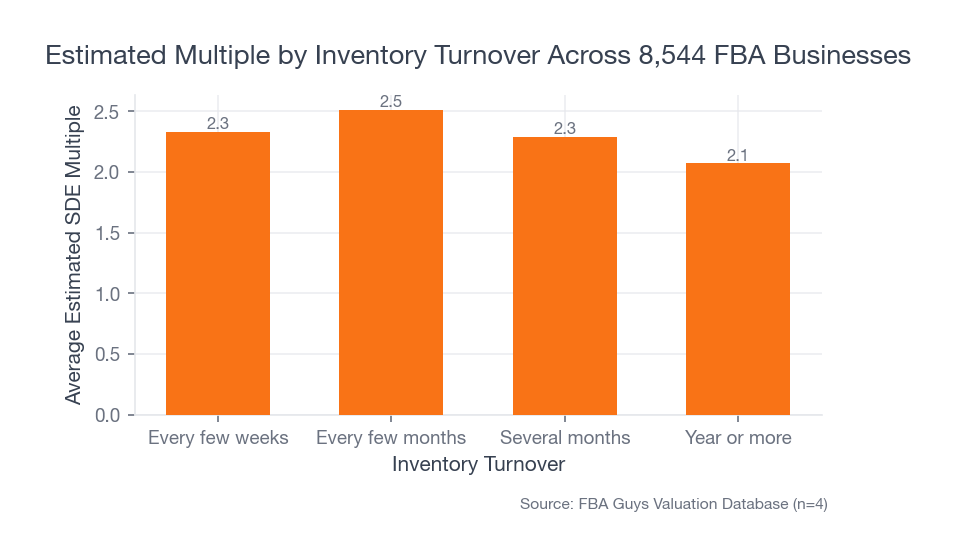
Among 8,546 successful valuations in our database, the strongest inventory pattern wasn't "more inventory is safer." Businesses turning inventory every few months averaged a 2.51x estimated SDE multiple, businesses turning every few weeks averaged 2.33x, and businesses sitting on year-or-more inventory averaged 2.07x. The data kept pointing to a middle.
 Source: FBA Guys Valuation Database (n=8,544)
What Amazon Peak Season Inventory Planning Is Actually Solving
Peak season planning is usually treated like a demand forecast, and of course demand matters. It just doesn't carry the whole job.
The real planning question is this: how much cash can you put into inventory before the business starts becoming harder to operate, harder to explain, and harder to value?
FBA creates a strange operating tension. Too little inventory creates stockouts, ranking pressure, slower delivery promises, low-inventory-level fee exposure for some products, and ugly revenue gaps in the period when demand should be easiest to capture, while too much inventory creates storage costs, aged inventory exposure, capacity pressure, stale cash, and the unpleasant feeling of watching a pallet of last season's optimism age in a fulfillment center.
Both errors can look rational at the time.
If you run lean, you can point to cash discipline, and if you overbuy, you can point to sales protection. The problem is that peak season punishes the lazy version of both: lean without a real reorder model is just hope with a smaller balance sheet, and overbuying without SKU-level judgment is fear wearing a forecast costume.
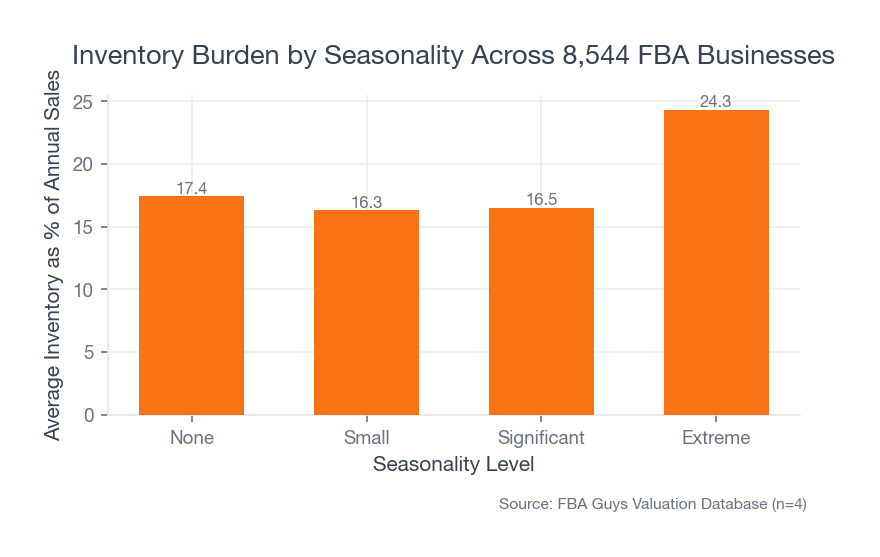
In our data, extreme seasonality is rare. Only 232 of 8,546 successful valuation records fall into that bucket, about 2.7%, but those businesses carried inventory equal to 24.3% of annual sales on average compared with 17.4% for non-seasonal businesses. The valuation output moved too: extreme-seasonality businesses averaged a 2.26x estimated SDE multiple, compared with 2.42x for non-seasonal businesses.
 Source: FBA Guys Valuation Database (n=8,544)
This doesn't mean seasonal businesses are bad. Many seasonal brands are excellent, and some are much cleaner than year-round brands with sloppy SKU discipline. It does mean the capital cycle has to be visible because a buyer, lender, or serious operator will want to know where the cash goes before the sales arrive.
What does that mean for the plan?
It means your peak season inventory plan needs to show its work. It should name the lead time, the safety stock, the reorder point, the cash requirement, the FBA capacity assumption, and the fallback if Amazon or the supplier moves slower than expected.
The plan isn't finished when the order quantity is calculated. It is finished when you can explain why that quantity belongs in the business.
Start With Lead Time, Not the Sales Target
Sales targets are loud, and lead times are quiet enough to cause more damage.
A good Amazon FBA inventory planning process starts with the actual replenishment clock: supplier production time, quality inspection, freight booking, transit, customs, drayage, 3PL prep if you use one, FBA receiving, and transfer time inside Amazon's network.
If you import from Asia and the full path is twelve weeks, a September stockout was probably created in June or July. It just waited until September to introduce itself.
This is where peak season gets a little unfair. The sales curve accelerates at the exact moment the replenishment system becomes less forgiving, and a box that would have been a boring operational detail in March becomes the thing standing between you and a top-selling week.
So build the calendar backward.
Start with the first date you need inventory sellable, not merely shipped, then subtract every step in the chain and add a buffer where the step has historically varied. Use your own receiving history where possible. If your last three FBA shipments took 9, 14, and 21 days from delivery to sellable, don't plan around 9 because it makes the spreadsheet feel better.
Honestly, this is where a lot of peak plans get too tidy.
The PO spreadsheet has its order date, the shipment plan has its created date, and the supplier has a production promise. Then someone adds "Amazon receiving" as one line, as if it were a light switch, when it is really a process with enough variance to make a clean reorder model look smug.
The reorder point formula is simple:
Reorder point = average daily sales x lead time in days + safety stock
The difficult part is choosing inputs that still hold up when the business is under pressure.
Average daily sales shouldn't be the trailing 30-day number if the next 60 days behave nothing like the last 30. For peak season, use a seasonal sales rate by SKU, then pull prior year sales, current year trend, ad plans, ranking changes, coupon plans, Lightning Deal timing, Subscribe and Save behavior, and the messy little product events that never fit cleanly into a formula.
The fact is, some SKUs have memories.
They sell differently after Prime Day, after the first cold weekend, and after the main image was changed in August and the CVR finally stopped limping. Can a formula handle that? Yes, if you feed it honest inputs. It becomes dangerous when last month's average is used as a proxy for next month's demand.
Build the Reorder Point Before the Calendar Gets Loud
Peak season is a terrible time to invent your inventory rules, so build them before the calendar starts making decisions for you.
At a minimum, each important SKU needs five numbers:
- Average daily sales for the relevant season
- Full replenishment lead time
- Safety stock
- Reorder point
- Cash required to place the next order
The cash number belongs in the same model as the unit number.
That sounds obvious, and it is often missing.
An inventory plan that tells you to order 4,800 units without showing the deposit, freight, duty, prep, inbound placement, and storage implications isn't a plan. It is a unit count, and during peak season, unit counts can make you feel operationally prepared while the bank account is quietly being drafted into service.
This is especially true for FBA sellers because inventory doesn't hit the P&L the way cash leaves the business. If you track inventory on an accrual basis, the cost should flow through COGS as units sell, while cash leaves earlier and the business can be profitable while still feeling squeezed because the next order has to be funded before the prior order has finished turning.
That timing gap is where peak season gets expensive.
Use a cash calendar next to the reorder model. For each SKU, mark:
- Deposit due date
- Balance due date
- Freight payment date
- Expected FBA receiving window
- Expected sales window
- Amazon payout timing
The model will look a little less elegant, which is fine.
We would rather see a seller notice a cash crunch in a model than discover it when the supplier asks for the balance and the Amazon payout is still eleven days away.
Separate Hero SKUs, Supporting SKUs, and Seasonal Bets
What happens if every SKU gets the same planning treatment?
Treating every SKU equally is one of the easiest ways to make peak inventory planning look more precise than it is, because the spreadsheet starts acting as if a hero SKU, a slow accessory, and an unproven seasonal bundle deserve the same amount of attention.
The database gives a useful nudge here. One-SKU businesses carried inventory equal to 26.2% of annual sales on average and averaged a 2.31x estimated multiple, while businesses with 6-20 SKUs carried 16.4% and averaged 2.69x. Then the 21+ SKU group fell back to a 2.24x average multiple, which makes the middle look productive again.
That doesn't mean every seller should rush to 12 SKUs. SKU count isn't magic, but it does suggest that concentration and sprawl create different inventory problems.
Hero SKUs deserve the most precise planning. A hero SKU is a product that drives a large share of revenue, profit, or ranking momentum, so if it stocks out in November, the business feels it, and if it overbuys, the cash effect is also meaningful. These SKUs need SKU-level demand curves, supplier confirmations, backup shipment paths, and a weekly review rhythm as peak approaches.
Supporting SKUs need a different posture. They matter, but they don't deserve the same cash priority as the hero SKU. For these, the plan may be to maintain enough inventory to avoid avoidable stockouts without chasing every upside scenario.
Seasonal bets are different again, and this is where discipline earns its keep. A seasonal bundle, giftable variation, or new color can make sense, but it can also become the inventory equivalent of buying a tuxedo for a wedding you may not be invited to. The forecast might be right; the MOQ might also be too large, the ad test too thin, or the remaining January demand too weak.
For seasonal bets, cap the downside before celebrating the upside. Decide the maximum cash you are willing to trap in that SKU, then decide what you will do if it misses the window. Outlet? Coupon? Removal? Bundle into a slower evergreen product? Give that answer before the PO is placed.
Use Amazon's FBA Constraints as Planning Inputs
As of 2026, Amazon inventory planning is not just your internal forecast. Amazon's systems also shape how much inventory you can send, where it sits, how quickly it becomes sellable, and what it costs to hold.
Amazon's public FBA materials point sellers toward the FBA Inventory tool, Inventory Performance Index, restock recommendations, aged inventory tools, and capacity monitoring. The useful takeaway isn't that Amazon has tools. The useful takeaway is that your peak season plan should treat those tools as constraints.
The Inventory Performance Index, or IPI, is Amazon's inventory-efficiency score for FBA sellers with a Professional selling plan. Amazon says the score can be affected by too much inventory, too little inventory, stranded inventory, sell-through, and the ability to keep popular items in stock, which is a pretty accurate description of the peak season trap.
Amazon has also described FBA capacity limits as monthly capacity limits measured in cubic feet, with estimated limits for future months. Those capacity limits can be influenced by IPI score, sales forecasts, shipment lead time, and fulfillment-center capacity.
So the planning question becomes practical: do you have enough capacity for the units you intend to send, and are those units the ones that deserve the space?
Capacity measured in cubic feet is a useful annoyance because it forces bulky products to confess. A lightweight oversized product can absorb more operational capacity than its unit count suggests, so if you plan only in units, you may miss the space problem until the shipment workflow starts arguing back.
Storage cost matters too. Amazon's FBA materials describe monthly storage, aged inventory costs after inventory has sat in fulfillment centers for more than 181 days, removal and disposal costs, and inbound placement service. Should those be a footnote in peak planning? No. They are part of the cost of choosing one inventory posture over another.
AWD, or Amazon Warehousing and Distribution, may belong in the conversation for some sellers. Amazon presents AWD as a bulk storage and distribution option with auto-replenishment into FBA and no seasonal surcharges on the public page we reviewed. For the right product, that can turn one giant FBA decision into a staged replenishment decision.
Use the tool if it solves the actual constraint. Don't use it because the acronym sounds like strategy.
The Stockout Penalty Shows Up in Valuation Data
The stockout data was less subtle, which was almost a relief after the turnover comparison.
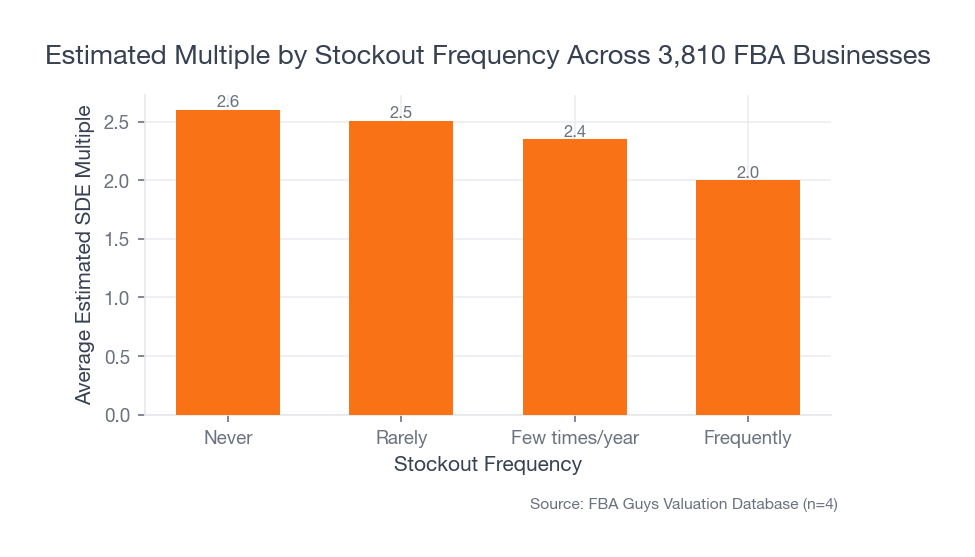
Businesses that reported never stocking out averaged a 2.60x estimated SDE multiple, businesses that rarely stocked out averaged 2.51x, businesses stocking out a few times per year averaged 2.35x, and frequent stockouts averaged 2.00x.
 Source: FBA Guys Valuation Database (n=3,810)
There are limits to this data. The stockout field is self-reported, the "way too often" bucket is small and noisy, and we wouldn't use it to build a universal rule.
Still, what is the operating pattern underneath it?
Stockouts interrupt the sales record. They can create ranking pressure, complicate advertising reads, and make trailing results less clean. They also raise a buyer's natural question: if this business is performing well now, how much better would it have looked if the inventory system had kept up?
That question matters because FBA businesses are usually valued on Seller's Discretionary Earnings, or SDE. SDE is the profit stream available to one owner-operator after adding back legitimate owner benefits and one-time expenses, and the multiple applied to SDE depends partly on risk, transferability, documentation, and growth quality.
Inventory touches all four.
Stockouts affect growth quality, excess inventory affects cash and working capital, poor landed cost tracking affects documentation, and supplier fragility affects risk. A strong peak plan doesn't guarantee a better multiple, but a sloppy one can leave fingerprints everywhere a buyer is likely to look.
The part that made us slow down was the turnover result.
If the data had simply said faster turnover wins, the article would be easier to write and less useful. It didn't. The every-few-months group averaged the strongest multiple in the inventory-turn comparison, while the fastest group looked good operationally but not best, and the slowest group was clearly weaker.
That is the middle again: enough inventory rhythm to keep the account fed, enough restraint to keep inventory from becoming the business.
Backup Vendors Are a Peak Season Inventory Tool
Backup vendors usually get discussed as a due diligence item. They are more useful than that, especially before a seasonal demand curve starts pulling on the supply chain.
In our database, businesses with backup vendors carried inventory equal to 15.3% of annual sales on average and averaged a 2.50x estimated multiple, while businesses without backup vendors carried 19.2% and averaged 2.28x.
Some of that gap may be business quality, since operators with backup vendors may also be stronger operators in other ways. Still, the planning implication is quite practical.
If your only supplier misses the production slot, your only real response is to order earlier, order more, pay more for speed, or accept stockout risk. All four options cost something.
A qualified backup vendor changes the shape of the problem. It may let you split production, get a second quote when peak pricing gets silly, or order less fear inventory because the fallback isn't imaginary.
Fear inventory is the inventory you buy because you don't trust the system.
Sometimes fear is earned. If your supplier has missed two of the last four ship dates, the plan should reflect that, and if your freight path has been unstable, build the buffer. If the only reason you are adding another 2,000 units is because no one knows what else to do, the planning process is telling you something.
Find the constraint, then fix the constraint if you can.
A 90/60/30-Day Peak Inventory Plan
The simplest useful peak plan starts 90 days before the season, though import-heavy businesses often need to start earlier because the real calendar is production plus freight plus Amazon receiving, not whatever date appears on the holiday promotion plan.
At 90 days, confirm the forecast and the supply chain. What has to be true for the forecast to happen?
This is where you separate SKUs into three buckets: protect, maintain, and test. Protect SKUs are the products that must stay in stock, maintain SKUs need enough coverage to avoid unnecessary damage, and test SKUs get capped cash. Pull last year's daily sales by SKU, adjust for current trend, and decide whether the current ad plan changes the demand curve.
Then confirm supplier capacity. Don't ask whether the supplier can "handle Q4"; ask for production slot dates, material availability, packaging lead time, inspection timing, and the latest date the goods can leave and still meet your sellable-by target.
At 60 days, lock the cash and logistics plan, because this is where a lot of businesses feel the season before they see it.
Deposits, balances, freight, prep, and Amazon inbound costs start bunching together. Update the cash calendar, check capacity, and decide whether any inventory should sit at a 3PL, AWD, or another staging point instead of going straight into FBA.
Also decide what won't be replenished.
This deserves its own line because it is emotionally annoying. A SKU can be profitable and still not deserve peak-season cash, and a slow seller with decent margin may be fine in April and a distraction in November. If it competes with a hero SKU for cash, warehouse attention, or Amazon capacity, it has to earn its place.
At 30 days, manage exceptions. Which variance can actually hurt the business?
You shouldn't still be building the plan. You should be watching variances: actual daily sales versus forecast, Amazon receiving time, stranded inventory, sell-through, ad efficiency, and any shipment that is drifting. Review the SKUs that would hurt most if they stocked out, then review the inventory that would hurt most if it didn't sell.
This is also the point where tidy plans become human plans. Someone is waiting on a carton label correction, a supplier is trying to substitute packaging, and a shipment says delivered while Seller Central is taking its time. The operator who already knows the priority order can make decisions quickly.
What Peak Inventory Planning Changes in a Valuation
Most operators think about peak inventory planning because they want to avoid stockouts and capture sales. Fair enough, but valuation adds a second lens.
For valuation, the planning record matters almost as much as the result.
If you ever sell the business, inventory will show up in several places. It appears on the balance sheet, affects cash flow, affects SDE if COGS and landed cost aren't tracked cleanly, and may be paid for separately at closing as good, sellable inventory at landed cost. If inventory is excessive relative to the purchase price, it can also create deal-structure friction.
That last point gets missed.
A business can have valuable inventory and still create a working capital problem for the next owner. If three months of good inventory is normal and the business is carrying nine months, someone has to fund the gap, and that can affect negotiations, seller notes, or buyer appetite.
Peak season makes this more visible because the balance sheet swells before the revenue line catches up. Clean operators can explain that swell, show why the inventory exists, name which SKUs it supports, estimate when it should turn, and tie it back to prior seasonal demand.
Messy operators hand over a spreadsheet with round-number guesses and a tab named "Q4 maybe."
We shouldn't have to keep saying this, but the books need to show landed cost correctly. Freight belongs in the cost of the inventory it helped land, and inventory purchases shouldn't make one month look terrible simply because cash left before the units sold. Monthly accrual accounting gives the business a fighting chance of being understood.
Good peak inventory planning does not remove seasonality. It makes seasonality legible.
FAQ
When should Amazon sellers start peak season inventory planning?
For import-heavy FBA businesses, start at least 90 days before the inventory needs to be sellable, and often earlier. Work backward from the sellable-by date using supplier production, freight, customs, prep, FBA receiving, and internal Amazon transfer time, then ask the awkward question: which step has betrayed you before?
How much safety stock should I carry for Amazon peak season?
Safety stock should be based on demand volatility and lead-time variability by SKU. A hero SKU with uneven seasonal demand needs a different buffer than a slow supporting SKU, and the formula only works if the inputs are honest: safety stock plus average daily seasonal sales multiplied by replenishment lead time.
Should I send all peak inventory directly to FBA?
Not always. Direct-to-FBA can make sense for fast-moving SKUs with available capacity and clear demand, but bulky products, uncertain seasonal bets, or large replenishment orders may need a 3PL, AWD, or another staging option so you don't make one giant Amazon receiving decision do all the work.
Does excess inventory hurt an Amazon business valuation?
It can. Good, sellable inventory often has value, but excess inventory ties up buyer capital and can create deal-structure friction. Inventory records, landed cost tracking, aging reports, and SKU-level sell-through help separate useful inventory from cash drag, which is exactly the distinction a buyer will want to see.
Conclusion
Amazon peak season inventory planning rewards the operator who can hold two ideas at once: you need enough inventory to protect the season, and you need enough restraint to keep the season from swallowing the business.
The database doesn't point toward starving FBA or stuffing it. It points toward flow. The every-few-months turnover group looked strongest in the valuation data, frequent stockouts looked expensive, year-or-more inventory looked weaker, and backup vendors showed up as a cash and risk advantage, not just a supply-chain footnote.
That is the plan: build the calendar backward, put cash next to units, separate SKUs by role, treat Amazon's capacity and storage rules as real constraints, and keep the inventory record clean enough that someone else could understand it.
Peak season will still get loud.
The plan should already know what matters.
Curious what your business is worth?
Get a free, instant valuation and see how your Amazon business stacks up.
Get Your Free Valuation