Amazon FBA Low Inventory Level Fee: The Fee Is About Stockouts, but the Business Problem Is Balance
The FBA Guys
May 11, 2026

Amazon has been turning inventory discipline into a fee schedule.
That isn't a complaint. It is where the FBA model has been moving. Storage fees push against inventory that sits too long. Inbound placement fees push against messy replenishment decisions. The Amazon FBA low inventory level fee pushes from the other side: if covered FBA inventory runs too thin relative to recent demand, Amazon can charge an added fulfillment fee.
The practical answer is simple enough. The Amazon FBA low inventory level fee is a per-unit fee that may apply when both short-term and long-term historical days of supply fall below Amazon's threshold. As of Amazon's current public guidance, the threshold is 28 days of supply, and the fee is tied to the product's size tier and historical supply position.
The useful answer is messier.
The fee is trying to keep Amazon's fulfillment network from becoming a last-minute panic machine. Your business has a different job: keeping enough inventory to avoid stockouts without dragging too much cash into slow-moving shelves. Related problems. Different math.
What the Amazon FBA low inventory level fee is
The Amazon FBA low inventory level fee is an added FBA fulfillment charge for covered products that are chronically understocked compared with recent sales.
Amazon uses historical days of supply, which is a way of asking how many days your current inventory could support recent demand. Amazon looks at a short-term period and a longer-term period. If both are below the threshold, the fee can apply.
For sellers, the mechanics matter because the fee is charged when units sell. It doesn't arrive as a separate philosophical lecture about inventory planning. It shows up in the economics of an order, next to the ordinary FBA fees that already make the unit margin less pleasant than the product page makes it look.
There are exemptions and edge cases, and they change. New parent ASINs have had a grace period. Auto-replenished products have had policy treatment worth checking. Amazon's current FBA fee guidance should be checked inside Seller Central before you change buying rules. Assessment details can vary by current fee-cycle rules, so look at the SKU/FNSKU level instead of relying only on a blended parent-ASIN inventory view. One version of "available" can hide another version that is quietly running out.
Check Seller Central before repricing, over-ordering, or changing replenishment rules. Fee policies are living documents.
How Amazon calculates the fee
Amazon's calculation starts with historical days of supply.
In plain language, Amazon compares available FBA inventory with recent shipped units. A product with 120 units available and demand running around 10 units per day has roughly 12 days of supply. The exact Seller Central calculation can include Amazon's own trailing windows, and the fee table depends on size tier and the days-of-supply bucket.
The important part is the double trigger. The fee is aimed at products that look understocked in both the short view and the long view.
That is a sensible network rule. A temporary spike can happen. A shipment can miss a receiving window. Prime Day can make a normal replenishment plan look silly for a few days. Amazon's two-window method is supposed to separate a temporary wobble from a pattern.
Of course, a sensible network rule can still be irritating at the SKU level.
If your SKU is already tight on margin, a low-inventory fee can turn a product that looked acceptable into one that has to be repriced, replenished faster, or retired. If the SKU is an important traffic driver, the answer may be to carry more inventory and accept the cash drag. If it is a marginal SKU that only works when everything goes perfectly, the fee is useful information.
What our valuation data says about stockouts
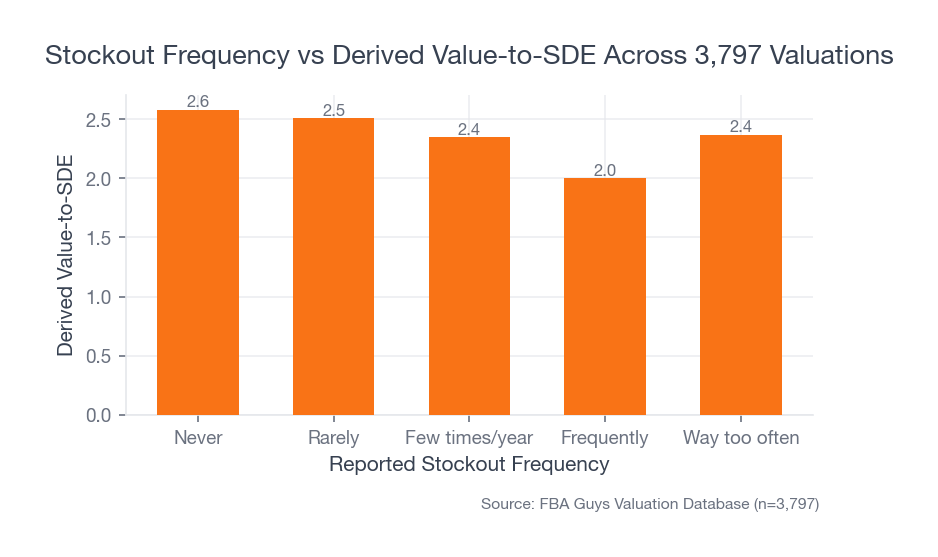
The fee points at something real. Businesses that stock out frequently tend to look weaker in the valuation data.
Among successful FBA Guys valuation records with enough financial data to calculate a derived value-to-SDE ratio, businesses that never reported stockouts averaged 2.58. Businesses that reported frequent stockouts averaged 2.00.
 Source: FBA Guys Valuation Database (n=3,797)
That gap is not proof that the Amazon low inventory level fee caused lower value. The database doesn't track that fee directly. It does suggest that unreliable inventory availability tends to show up as an operating-quality signal.
That makes intuitive sense. Stockouts interrupt rank, ad learning, subscribe-and-save behavior, organic momentum, and buyer confidence in the story of the business. The P&L may show revenue. Seller Central may show recovery. The business still had a period where demand existed and inventory didn't.
The fact is, a stockout isn't just a missed sale. It is a broken promise to the algorithm, the customer, and sometimes the buyer who is trying to understand whether the business can be transferred without babysitting.
The fee can make the business overcorrect
Here is where the data gets more interesting.
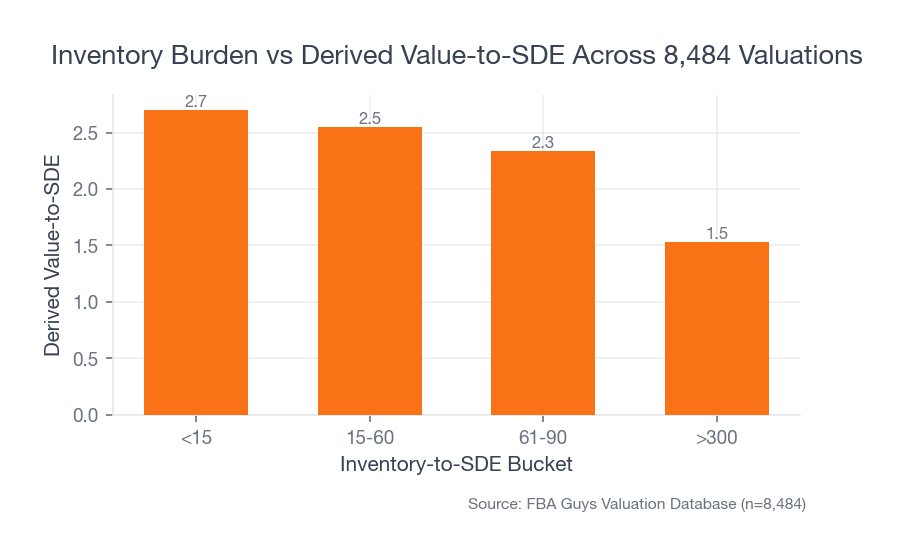
The strongest valuation signal in this topic was inventory burden.
Businesses in the lightest inventory-to-SDE bucket averaged a 2.70 derived value-to-SDE ratio. Businesses in the heaviest bucket averaged 1.53. That is a much larger spread than the stockout-frequency result.
 Source: FBA Guys Valuation Database (n=8,484)
This is the tension the fee table doesn't show you. Carry too little inventory and Amazon may charge the low-inventory-level fee while your sales history gets choppy. Carry too much inventory and your capital gets buried in units that may take months to turn back into cash.
We saw the same shape in turn speed. Businesses with inventory turning every few months averaged 2.51 derived value-to-SDE. Businesses whose inventory turned in a year or more averaged 2.06, even though that slow-turn group had the highest average gross margin in the turn-speed query.
That result is easy to miss. High product margin can make slow inventory feel disciplined. It can also hide the fact that the business needs too much cash tied up for too long.
There is a very ordinary version of this problem: a replenishment spreadsheet with one clean reorder point and three ugly tabs nobody wants to explain. One tab has old packaging. One has a supplier MOQ that only makes sense at last year's sales velocity. One has a row called "hold for promo" that has been holding for seven months.
Nothing dramatic. Just cash sitting still.
How to avoid the fee without building a swollen inventory position
Start with days of supply by SKU/FNSKU, not by how comfortable the warehouse number feels.
Granular fee assessment makes blended inventory views less useful. A parent ASIN can look fine while one fulfillment-network identity is thin. If you have multiple pack sizes, label changes, commingled/non-commingled inventory, or separate FNSKUs for operational reasons, the detail matters.
Then separate three decisions:
- The minimum stock needed to avoid chronic low-supply status.
- The reorder point needed to survive supplier lead time and Amazon receiving time.
- The maximum inventory level that still makes sense for cash flow.
The third line keeps the fee from bullying the whole business.
If a SKU needs 45 days of supply to avoid fee risk but the supplier lead time is 75 days and Amazon receiving adds another awkward stretch, the problem may be MOQ, freight timing, placement decisions, or a product whose sales velocity no longer supports the operating structure around it.
This is where unit economics have to include working capital. A unit that earns margin only when the business carries too much inventory is not as attractive as the gross margin line suggests.
What to watch in Seller Central
Watch the fee preview, historical days of supply, excess inventory, sell-through, and restock recommendations together.
Do not let any one dashboard widget become the replenishment strategy. Amazon's tools are useful, but they are written from Amazon's network perspective. Your business has to care about margin, cash conversion, financing cost, storage exposure, and the next order you have to place before the current one has fully turned back into cash.
For most sellers, the weekly review is enough:
- Which SKUs or FNSKUs are below the low-inventory threshold?
- Which SKUs are close to the threshold but have unstable demand?
- Which products are avoiding the fee only because too much inventory is sitting still?
- Which inbound shipments are likely to arrive too late to protect the next 30 days?
- Which SKUs deserve a price, ad, or reorder change before another automatic PO?
One odd benefit of the fee is that it forces a cleaner conversation. If the SKU is worth protecting, protect it. If it is too weak to justify the capital, the fee didn't create the weakness.
For more fee work, pair this review with how to reduce Amazon FBA fees and how to value inventory for Amazon FBA.
FAQ
What is the Amazon FBA low inventory level fee?
The Amazon FBA low inventory level fee is an added FBA fulfillment fee for covered products when Amazon calculates that your short-term and long-term historical days of supply are both too low.
Does the low inventory level fee apply to every FBA product?
No. Amazon's policy includes eligibility rules, exemptions, and transitional treatment that can change by fee cycle. Check Seller Central for the current rule set before making a SKU-level decision.
Should I carry more inventory just to avoid the fee?
Sometimes. The better question is whether the SKU earns enough after all fees, storage, freight, and working-capital drag to deserve the extra inventory. The valuation data suggests that chronic stockouts hurt, but heavy inventory burden can hurt more.
Can the fee affect business value?
The fee itself is usually too small to drive valuation by itself. The behavior behind it can matter. Frequent stockouts, weak replenishment discipline, and excessive inventory burden all make the business harder to trust.
Bottom line
The Amazon FBA low inventory level fee is worth managing. It is not worth letting the fee table become the operating brain of the business.
Keep enough inventory to protect sales velocity. Keep little enough that cash keeps moving. That middle band is where the fee starts being useful, because it tells you which SKUs need attention without pretending every SKU deserves the same answer.
Curious what your business is worth?
Get a free, instant valuation and see how your Amazon business stacks up.
Get Your Free Valuation