Amazon FBA Storage Fees Monthly vs Long-Term: The Real Problem Starts When Storage Becomes the Strategy
The FBA Guys
March 25, 2026

Amazon FBA storage fees monthly vs long-term are not the same cost wearing two different labels, and if you treat them that way you will almost always react to the visible bill instead of the uglier inventory behavior creating it. Monthly storage is the ordinary rent you pay for using FBA space. Long-term exposure starts when inventory sits long enough that Amazon begins charging aged-inventory fees on top of that baseline carrying cost, and by then the real issue usually isn't the fee itself. It is the fact that the inventory plan has already drifted far enough off course for Amazon to notice it too.
That is the whole argument, but it takes a little work to say it cleanly.
Amazon's public FBA page currently says standard-size inventory storage costs $0.78 per cubic foot from January through September and $2.40 from October through December. Oversize inventory is listed at $0.56 and $1.40 across those same periods. The same page says aged inventory is charged monthly once items sit more than 181 days, and search-surfaced Amazon guidance posted in Seller Forums on January 16, 2026 describes the surcharge stepping up by age bucket, with 181 to 210 day inventory at $0.50 per cubic foot and 211 to 240 day inventory at $1.00. So what changes when you move from monthly storage to long-term storage? Amazon stops charging only for space and starts charging for how long you needed that space.
That is a different accusation.
Amazon FBA storage fees monthly vs long-term: what actually changes
The mechanical explanation is simple enough that it lulls people into thinking the business explanation is simple too.
Monthly storage fees are based on the daily average cubic-foot volume your inventory occupies in Amazon's network. If you are using warehouse space, you pay rent for warehouse space. Q4 gets more expensive because space gets scarcer and more valuable when everyone suddenly wants the same shelves at the same time. Nothing mysterious there.
Aged inventory is different. Amazon's current public language says the fee applies monthly once items sit more than 181 days, which means the conversation is no longer just about how much room the product takes up. It is about how long your forecast has been wrong, how long your replenishment assumptions have remained emotionally attached to a SKU that didn't earn them, and how long the business has been carrying inventory that keeps asking for patience instead of cashing out.
That distinction matters because sellers often flatten the whole topic into seasonal pricing. They talk as if Q4 storage is the painful part and everything else is just overhead. It isn't, at least not if you care about what the inventory is doing to the business. Q4 makes storage more expensive. Aged inventory tells you the SKU has stopped moving at a pace the business can defend.
Two different problems. One deserves a calculator. The other deserves a decision.
Monthly storage is carrying cost. Long-term storage is a warning light
Think about what the monthly fee is measuring. Amazon is charging for space. Fair enough. If your inventory turns in a sane rhythm, supports the margin, and stays inside a reorder cycle that actually belongs to the category, monthly storage is part of the cost stack, just like packaging, prep, and the other unglamorous things that come with letting Amazon do the warehousing.
Now think about what aged inventory is measuring. Amazon is charging because that space has stopped turning over in a healthy rhythm for the network. Same warehouse. Different accusation. The fee says, in effect, that you didn't just store the product. You parked it.
Our valuation database cannot see Amazon's exact aged-fee buckets, so we didn't pretend it could. What it can see is inventory speed across 8,374 successful valuations, and that is enough to make the business point rather clearly. In that sample, 31.5% of businesses turned inventory every few weeks, 49.3% every few months, 16.1% took several months, and 3.2% took a year or more. Most businesses live in the first two buckets. Good. That is where you would hope a healthy catalog spends most of its life.
The more revealing number is what happens to inventory months of sales as turnover slows. Businesses in the every_few_weeks bucket carried an average of 1.28 months of sales in inventory. Every_few_months averaged 1.77 months. Several_months rose to 2.91. Year_or_more jumped to 9.01. What should you call a business that needs roughly nine months of sales sitting on the shelf before the inventory clears? Efficient isn't the first word that comes to mind.
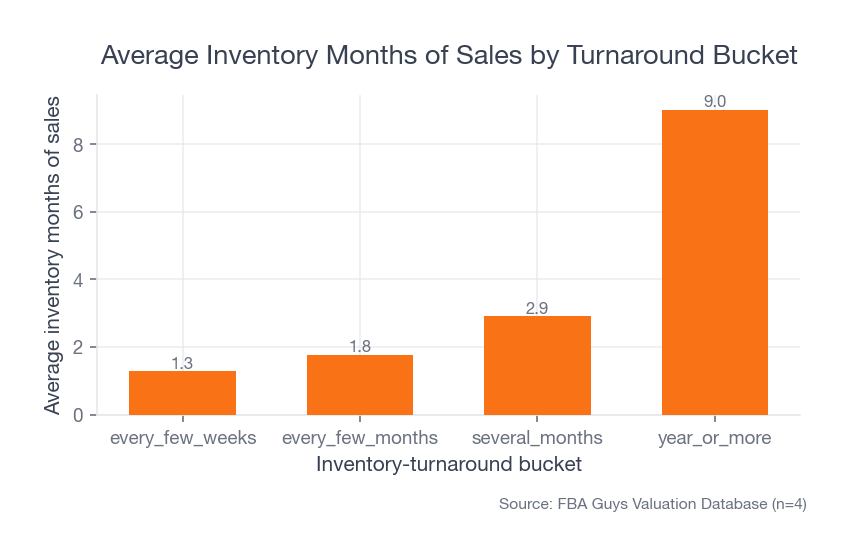 Source: FBA Guys Valuation Database (8,374 valuations grouped by turnaround bucket)
At that point, the storage bill is not the disease. It is one symptom in a much uglier operating picture. Cash is trapped. Forecasting gets less trustworthy. Reorder decisions stop feeling like planning and start feeling like damage control. The storage report is simply the first document rude enough to say it out loud.
The breakeven math most sellers skip
Most sellers compare monthly storage with long-term storage as if they are choosing between two boxes on a fee card. That is too tidy to be useful. The better question is this: how much profit does the unit still have to preserve before holding it longer is rational, and how much of that profit is real rather than imagined?
Start with a stripped-down frame:
expected retained contribution from holding the unit
minus monthly storage cost
minus aged-inventory surcharge risk
minus likely markdown needed to clear it later
minus the cash cost of keeping that money trapped in inventory
If that answer is still comfortably positive, holding can make sense. If the answer only works when the product sells at full price, with no extra storage months, no markdown, no ugly return behavior, and no chance that you will need to clear the backlog later with a promotion you currently do not want to think about, you do not have a durable inventory position. You have a spreadsheet behaving politely because nobody has asked it the rude questions yet.
Here is a simplified composite from the kinds of tradeoffs this topic keeps producing. A product sells for $34 and contributes about $9 before extra storage exposure. The per-unit storage footprint looks harmless, which is exactly why sellers underestimate it. The inventory is about to cross 181 days, and the realistic markdown needed to clear stale units later probably sits in the $3 to $5 range. What does the team usually fixate on? The storage line. What actually does the damage? The markdown, the slower cash conversion, and the quiet fact that the business already had six months to prove this inventory belonged there.
That is why a storage-fee calculator is useful but never sufficient. You still have to decide whether you are paying to hold healthy stock a little longer or paying to avoid admitting that the sell-through assumption changed three months ago.
Why high margins still get punished when inventory sits
This was the best finding in the memo because it ruins a lazy comfort story that sellers love. You might expect the slowest inventory businesses to have the weakest margins, which would make the whole topic pleasantly straightforward. The database kept showing something more irritating than that. The slowest bucket actually reported the highest average margin.
Businesses turning inventory every few weeks averaged a 45.8% margin and a 2.33x SDE multiple. Businesses turning every few months averaged a 44.7% margin and a 2.50x multiple. Businesses sitting in several_months averaged a 46.5% margin and 2.28x. The year_or_more bucket averaged a 53.5% margin and only 2.05x. We ran that twice because the first read feels backward, and honestly we wanted it to be backward because the cleaner story is that low margin creates the whole problem. It doesn't.
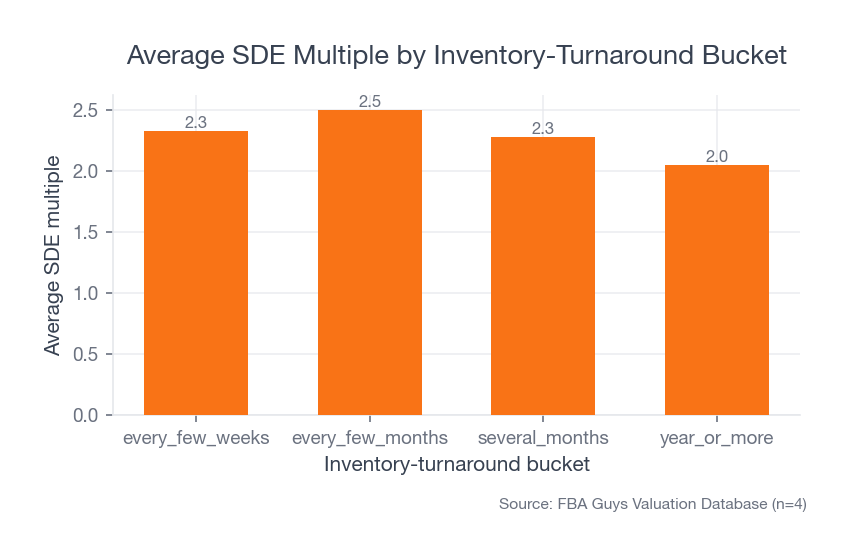 Source: FBA Guys Valuation Database (8,374 valuations grouped by turnaround bucket)
Why would a higher-margin group still get punished? Because buyers are not buying margin percentage alone. They are buying the reliability of turning working capital back into cash without having to invent a heroic interpretation every quarter. A business that needs roughly nine months of sales sitting in inventory can still look mathematically attractive on paper. It also looks slower, stickier, and easier to fool yourself about, especially when the margin percentage is flattering enough to keep everyone calm longer than they should stay calm.
That is the real bridge back to storage fees. Sellers often talk about long-term storage as if it were an expensive warehouse problem. Buyers read it more like an inventory-discipline problem, because that is usually what it becomes once the inventory has been sitting long enough for the fee schedule to change.
Margin still matters, of course. Across the full database, businesses under 10% margin averaged 1.60x SDE while businesses above 50% margin averaged 2.58x. So no, this is not an argument that margin is fake or overrated. It is a narrower point, and rather a more annoying one. Good unit economics do not give you a free pass to warehouse weak inventory indefinitely.
There is a nasty version of this mistake that shows up in real operator behavior all the time. The team keeps telling itself the SKU is fine because the margin is fine. Meanwhile the inventory sits. The storage report gets ruder. Somebody decides the answer is to wait for seasonality, or for a coupon push, or for one more reorder cycle to prove the product still has life in it. Then the eventual markdown lands like some great betrayal, even though the inventory had been hinting at the outcome for months. The fact is, stale inventory often looks better in percentage terms than it feels in cash terms. That is exactly why it hangs around so long.
How to reduce Amazon storage fees without making the business smaller
You do not solve this by panicking every time the storage report sounds judgmental. You solve it by separating normal carrying cost from inventory failure, which sounds obvious until you notice how many decisions get made as if every storage dollar were equally offensive.
First, keep monthly storage in proportion. If the SKU turns predictably, supports its margin, and fits the reorder cadence of the category, monthly storage is part of the business. Boring. Fine. Move on. There is no prize for treating ordinary warehousing cost like a moral failure.
Second, watch age alongside sell-through. A unit crossing 181 days is not just a fee event. It is a signal that forecast quality, reorder timing, listing health, price discipline, or all four need attention. Which one is it in your case? That is the operator's question worth asking before the aged-inventory report turns into a monthly recurring lecture.
Third, use the ugly levers early. Cut the reorder before you cut the price. Trim the inbound shipment before the aged-inventory report starts naming your mistakes. Tighten the assumptions before you start flattering them. Waiting for the fee to become painful enough is a strange management system, because by the time it feels expensive you have usually already missed the cheaper intervention.
Fourth, check the full unit-economics stack rather than treating storage in isolation. A SKU can survive a few extra months of storage if contribution margin is healthy, demand is credible, and the capital tied up there is not preventing better inventory from landing. It cannot survive forever on the argument that the storage fee looked small in one monthly report. If the surrounding math still feels muddy, this is where our guides to how to calculate Amazon FBA profit margin and contribution margin for Amazon products become more useful than staring harder at the storage tab.
Fifth, keep your tools in the right order. Calculators are great at pricing the visible line item. They are much worse at confessing whether the inventory strategy underneath the line item still deserves trust. You have to do that part yourself.
So what should sellers actually compare?
Compare monthly storage with the profit preserved by waiting. Compare aged-inventory risk with the markdown risk you are postponing. Compare the cash trapped in that SKU with what the same cash could do in a product that still earns the right to be reordered. Why do so many teams skip that broader comparison? Because the fee card is cleaner than the inventory story, and clean stories are easier to defend in meetings.
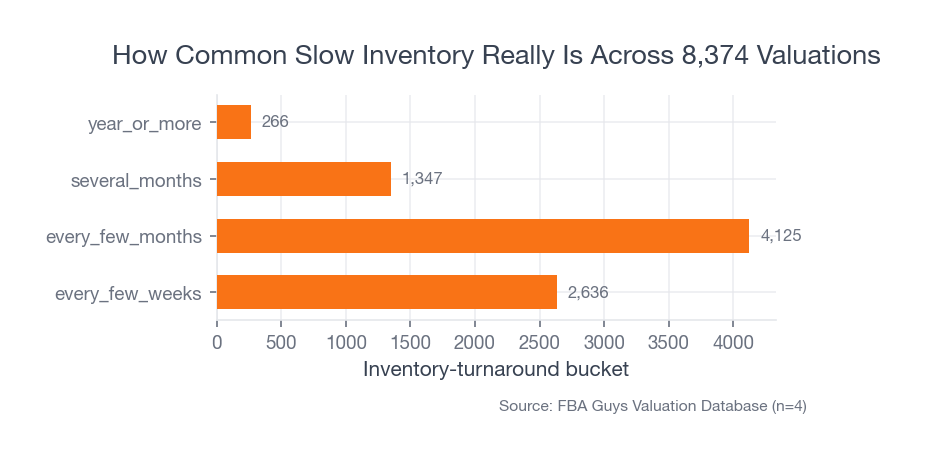 Source: FBA Guys Valuation Database (8,374 valuations grouped by turnaround bucket)
That is the comparison that matters. Not monthly versus long-term as two sterile fee labels. Space versus time. Rent versus stagnation. One cost belongs to using FBA. The other one usually means the inventory strategy has already drifted off course and is now billing you for the privilege.
FAQ
Are long-term storage fees still a separate Amazon charge?
As of the writing of this article, Amazon's public materials frame the issue as aged inventory charged monthly on items stored more than 181 days. Sellers still say "long-term storage fees" because the old label stuck, and honestly it will probably keep sticking for a while because it is easier to say than "the point where Amazon starts pricing my inventory denial more aggressively."
Are monthly storage fees always a problem?
No. Monthly storage is normal if the inventory is moving on a sane cycle. The problem starts when storage cost stops being ordinary carrying cost and starts becoming evidence that the SKU has overstayed its welcome.
Should you remove inventory before it hits 181 days?
Sometimes. Not automatically. If the product still has healthy contribution, credible demand, and a realistic near-term sell-through path, holding can make sense. If the math only works because you refuse to mark down stale inventory, you already know what is happening, even if the spreadsheet is still trying to be diplomatic.
Does slow inventory hurt valuation even when margins are good?
Yes. In our valuation database, the year_or_more bucket posted the highest average margin at 53.5% and still the lowest average SDE multiple at 2.05x among the main turnover groups. Buyers like margin. They still dislike cash that refuses to come back.
Is this mostly a Q4 problem?
No. Q4 raises the rent, which certainly gets your attention, but the deeper issue is inventory age and sell-through discipline. A catalog can be perfectly capable of paying higher seasonal storage and still be healthy. It can also be bleeding from slow inventory long before Q4 arrives.
Curious what your business is worth?
Get a free, instant valuation and see how your Amazon business stacks up.
Get Your Free Valuation