Amazon FBA Inbound Placement Fee Explained: The Fee Is Small Until It Moves Into Every Unit
The FBA Guys
May 7, 2026
Amazon made one logistics question much harder to ignore: where should your inventory go before it gets close to the buyer?
For years, a lot of sellers treated inbound shipping as the unglamorous part of FBA. Get cartons to Amazon, keep stock available, and move on to the problems customers actually notice. The inbound placement fee changed the shape of that sentence because Amazon now prices part of the network-distribution work more visibly.
The Amazon FBA inbound placement fee is a per-unit fee Amazon can charge when it receives your FBA inventory at fewer inbound locations and then distributes that inventory across its fulfillment network. As of the writing of this article, the fee depends on product size, weight, inbound location, and which shipment split option Amazon offers or you select.
That sounds like a shipping detail, and in the moment it often feels like one. What else would you call a fee that appears while you are building a shipment plan?
The better answer is unit economics, because this fee moves into the cost of the unit before the customer ever sees the listing, and those costs have a habit of showing up later under less friendly names. Every time.
What the Inbound Placement Fee Is Actually Charging For
FBA has always required inventory to be spread across a fulfillment network. The customer in Phoenix, the customer in Boston, and the customer in a small town two hours from the nearest major airport all want fast delivery. Amazon's network has to decide where inventory should sit before those orders happen.
The inbound placement service fee is Amazon charging for part of that placement work when the seller chooses, or is offered, a shipment plan that sends inventory to fewer inbound locations.
In plain English: you can often do more of the splitting work yourself, or pay Amazon to do more of it after receiving.
That is the operational trade, while the financial trade is less tidy because convenience and margin rarely show up on the same line. Usually. A placement fee that looks like a few cents on a shipment screen can become a meaningful line in landed cost if the SKU already lives on thin margin, ships frequently, or moves in enough volume that pennies stop behaving like pennies.
The Current Shipment Split Options
As of the writing of this article, Amazon's public seller-forum guidance describes three broad placement paths.
Minimal shipment splits usually means sending inventory to the fewest inbound locations, often one location, and paying a placement fee. It is easier operationally because the shipment plan is simpler, and the bill shows up per unit where it can quietly follow every reorder.
Amazon-optimized shipment splits can carry no placement fee when the shipment qualifies. The trade is that you send inventory to multiple inbound locations. Amazon's forum guidance describes this as generally requiring at least five identical cartons or pallets per item, with the same quantity and item mix.
Partial shipment splits now sit in a narrower lane, since Amazon's 2025 guidance says partial shipment splits are no longer available for standard-size products in shipping plans created on or after February 20, 2025, while large bulky inventory can still have a reduced-fee partial split option.
There is one awkward detail in all of this: you don't always get the same options every time. Product type, quantity, existing network inventory, customer demand, and fulfillment center capacity can affect what Seller Central shows you. Where does that leave the operator? The decision gets made inside real shipment plans, with real cartons, usually when someone already wants to be done.
Why a Small Per-Unit Fee Deserves a Bigger Conversation
The FBA Guys database has 8,458 successful valuation submissions, and 6,098 of those were FBA-only businesses while another 1,957 used a combination of FBA and FBM.
So this isn't a fringe issue for anyone whose business uses FBA, or even partly depends on it, because the placement decision is sitting inside a cost structure that already has very little patience for fuzzy math.
The more interesting pattern is margin, since 870 businesses in the database reported margins below 20%. That includes 110 under 10%, 303 between 10-14%, and 457 between 15-19%.
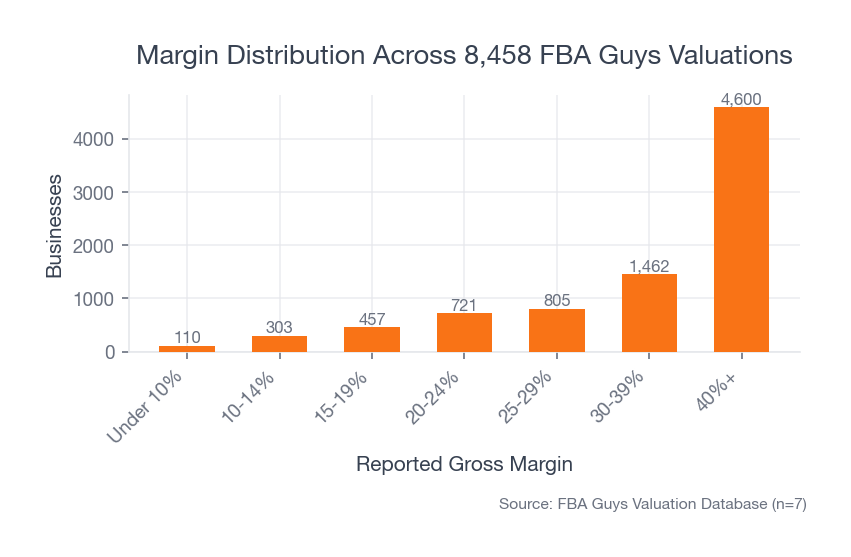 Source: FBA Guys Valuation Database (n=8,458)
For those businesses, inbound placement is not a philosophical argument about Amazon fees. It sits next to the same margin questions covered in what good profit margin looks like for Amazon FBA. It is another cost that has to survive contact with contribution margin. A $0.25 unit fee behaves differently inside a $9 accessory with a 16% margin than it does inside a $49 product with real pricing power.
This is where the fee becomes annoying in the useful sense. What does it cost to get this unit available for sale, and where did that cost actually enter the business? A good operator was already asking that question, and the placement fee makes the answer harder to leave vague because Seller Central is putting a number in front of you.
The Inventory Burden Nobody Sees on the Shipment Screen
Shipment plans make the decision feel immediate: one option costs more, one option creates more splits, and Seller Central is waiting for you to pick one while the rest of the day is already behind schedule.
The balance sheet is less patient, and it wants to know whether the choice protected cash, protected margin, protected speed, or merely made Tuesday afternoon easier.
In our database, 1,341 businesses carried inventory equal to 50-99% of estimated annual gross profit. Another 750 carried inventory at 100% or more of annual gross profit. That doesn't mean those businesses were bad, because inventory-heavy businesses can be perfectly healthy, but it does mean inbound decisions can sit inside a much larger cash-flow machine.
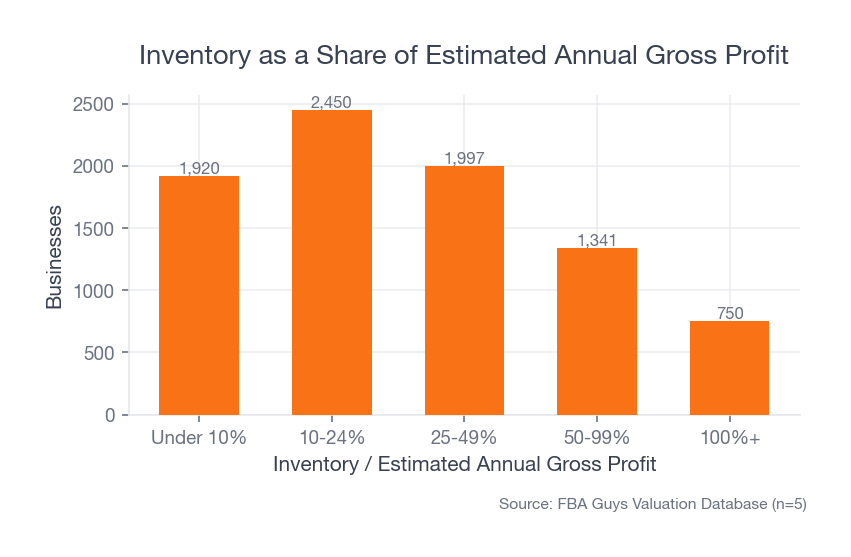 Source: FBA Guys Valuation Database (n=8,458)
If splitting shipments lowers the placement fee but adds handling, carton prep, freight coordination, or receiving delays, the cheapest fee line may not be the cheapest business decision. If minimal splits keep the operation sane but add permanent unit cost, that cost has to go into landed cost. Not the mental version you remember when pricing feels tight. The actual one your P&L has to absorb.
The fact is, this fee is easiest to misunderstand when it is treated as a shipping charge instead of a product-level economic input.
How to Decide Whether to Pay It or Split Around It
Start at SKU level, because catalog averages hide too much. For each meaningful SKU, write down the placement fee shown in Send to Amazon, the inbound freight cost, prep or 3PL handling, expected units per carton, and gross margin after referral and FBA fulfillment fees. Then look at the difference between the shipment options Amazon is offering.
The operator's question is simple: what does the fee buy you, and would you still buy that thing if Amazon presented it as a separate service?
Sometimes it buys simplicity: one receiving point, fewer split shipments, less coordination, and a lower chance that one carton goes wandering while the rest of the plan waits. For a small seller without a warehouse process, that may be worth more than the fee.
Sometimes it buys nothing useful, especially if your supplier or 3PL can prepare five identical cartons per ASIN mix without drama and Amazon-optimized splits are the cleaner economic choice. You take more operational work upstream and keep the unit cost out of the P&L.
Why does the right answer keep changing by SKU? That is the irritating part of the fee. A high-margin hero product may absorb minimal split fees without much damage. A low-margin variation with fragile rank might need every cent protected. A bulky SKU may live under different rules from a small standard item.
One neat policy answer will usually be too neat.
A Quick Landed-Cost Treatment
Treat the inbound placement fee like landed cost, then make the spreadsheet prove the SKU still works.
If you are calculating landed cost, add placement fees alongside product cost, duty, freight, prep, labeling, and inbound shipping. If the fee varies by shipment plan, use the plan you actually choose. If you are modeling future orders, use a conservative estimate and update it after real shipment data comes in.
A simplified unit view should carry the full trip: product cost, freight, duties, prep, labeling, carton work, 3PL handling, inbound shipping, the FBA inbound placement fee, referral fees, fulfillment fees, storage, returns, advertising, and the other little costs that never look little once they become permanent.
The placement fee belongs before you declare the SKU healthy. If it enters the spreadsheet after the product launch, it usually enters as disappointment, and honestly that is a lousy way to learn what the product really earns. Not ideal.
A Side Door: AWD, AGL, and Seller Managed Placement
This section doesn't fit perfectly in a clean explainer, which is exactly why it belongs here.
Amazon has been building more inbound pathways around the same problem. Amazon Warehousing and Distribution, Amazon Global Logistics, and Seller Managed Placement all change where inventory is positioned and who handles which part of the distribution job.
Amazon's Seller Managed Placement material says eligible sellers can split shipment at origin across five U.S. regions and avoid inbound placement service fees, with requirements around China-to-U.S. shipments and at least five cartons containing the same unit quantity and ASIN mix.
That won't fit every seller, but it may fit the exact kind of seller that already has freight volume, supplier coordination, and enough repeatable carton structure to make the work boring.
What is boring worth when it removes a recurring fee from the unit economics?
What Changed for 2026
Amazon's 2026 seller-forum guidance says inbound placement service fees increased by approximately $0.05 per unit effective January 15, 2026. That number doesn't look dramatic on its own, and you shouldn't pretend it is.
It becomes more interesting when it lands on a catalog that already has referral fees, FBA fulfillment fees, storage fees, return costs, ad spend, and freight volatility stacked on top of each other.
The fee also changed after Amazon had already adjusted the placement options in 2025, including removing partial shipment splits for standard-size products in shipping plans created on or after February 20, 2025.
Why does the timeline matter? Older advice can be stale before the SOP owner notices. If an article, SOP, or 3PL checklist still assumes last year's placement options, it may be giving you a workflow Amazon no longer offers for your product.
What We Would Put in the SOP
For an FBA operator, this should become a recurring shipment-planning check rather than a one-time research project.
The SOP doesn't need to be dramatic: capture the placement options shown in Send to Amazon, record the fee per unit by SKU and shipment plan, then compare minimal split, optimized split, and any eligible partial or managed placement path. Add the selected fee to landed cost, then review whether carton configuration can qualify for a lower-fee or no-fee option next shipment.
When should you re-check it, and how often is enough? Start after Amazon fee updates, new ASIN launches, packaging changes, supplier changes, or any shift in carton configuration that makes last month's workflow less reliable than it looks.
The messy detail is usually carton sameness, because one mixed carton that was convenient at the factory can be expensive later when it breaks eligibility for a cleaner placement option, and nobody wants a margin problem that started as a packing shortcut.
FAQ
What is the Amazon FBA inbound placement fee?
It is a per-unit fee Amazon can charge when your FBA shipment is sent to fewer inbound locations and Amazon handles more of the distribution across its fulfillment network.
Can you avoid the inbound placement fee?
Sometimes you can avoid it. Amazon-optimized shipment splits can be no-fee when the shipment qualifies, and certain managed placement or logistics paths may avoid the fee. The trade is more shipment splitting, stricter carton requirements, or a different inbound workflow.
Is the fee the same for every product?
No, the fee is not the same for every product. As of the writing of this article, it varies by product size, weight, location, and shipment option, so Seller Central's actual shipment plan is the number to use for that shipment. Don't let an old average sneak into a live shipment decision.
Should the fee be included in landed cost?
Yes, the fee belongs in landed cost if it is part of getting the unit available for sale through FBA, and it should sit inside unit economics before you trust the margin. Leaving it out makes margin look cleaner than the business actually is, which means the spreadsheet won't warn you until the cash already moved.
Conclusion
The inbound placement fee is not the largest fee in FBA. That is partly why it deserves attention from anyone who cares about the actual margin left after the product reaches FBA.
Large fees get noticed, while small fees get normalized and then spread across every unit, every reorder, every margin calculation, and every SKU decision until the business quietly accepts a lower profit profile.
The better habit is dull and effective: check the shipment options, record the per-unit fee, decide whether the operational simplicity is worth it, and put the cost where it belongs. That is where the fee belongs: inside the unit economics, before it has a chance to become a monthly surprise.
Curious what your business is worth?
Get a free, instant valuation and see how your Amazon business stacks up.
Get Your Free Valuation