What Is a Good Profit Margin for Amazon FBA? Good Starts Earlier Than Sellers Think
The FBA Guys
March 30, 2026

Every Amazon seller wants a clean benchmark. Just give me the number. Tell me whether 22% is weak, whether 38% is respectable, whether 50% means I built something special.
Fair enough. That is a reasonable thing to want from a benchmark article.
In our database of 8,387 successful FBA valuations, the average business posted a 45.6% gross margin and a 36.9% SDE margin. So if the question is "what is a good profit margin for Amazon FBA," the short answer is this: around 30% to 40% gross margin is usually healthy enough to stop looking fragile, 40%+ is strong, and the more important benchmark is how much of that number survives into SDE margin once the business behaves like a real operating company.
That last part matters because buyers do not price a business off the prettiest gross-margin screenshot in Seller Central. They price the earnings that remain after the recurring mess has already shown up.
The Short Benchmark
If you only want the compact version, use this:
- Under 20% gross margin: usually tight enough that a lot has to go right
- 20% to 29%: workable, but still easy to stress
- 30% to 39%: healthy for many FBA businesses
- 40%+: strong
That is the gross-margin answer.
The ownership answer is different. A good SDE margin for an Amazon FBA business is often 20% to 30%. Strong starts around 30%+. Under 10% is where the business starts feeling like one bad quarter could knock the story over.
That may sound unsatisfying if you came looking for one clean percentage, but that is usually how real benchmarks work. You aren't benchmarking a static product. You're benchmarking a business that buys inventory on one schedule, pays ads on another, carries people and software on a third, and then tries to pretend those moving parts can all be summarized by one neat margin line.
Why 40% Gross Margin Is Only the Start
Sellers love the 40% line because it feels decisive. It is high enough to brag about and low enough to feel attainable. The database says it matters. It also says sellers tend to stop thinking too early once they cross it.
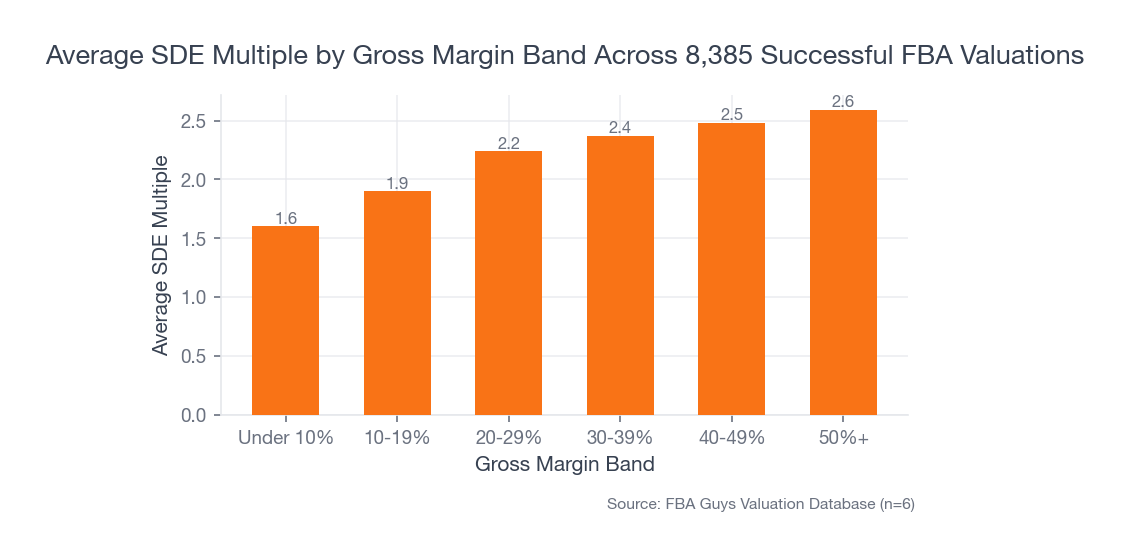
Among successful valuations in our dataset, businesses under 10% gross margin averaged just a 5.1% SDE margin and a 1.60x average SDE multiple. At 20% to 29% gross margin, the average SDE margin reached 19.8% and the average multiple moved up to 2.24x. At 30% to 39%, average SDE margin climbed to 27.2% and the multiple reached 2.37x.
That is the useful part of the climb. The business starts looking harder to break.
Above that, the gains are still real but less dramatic. Businesses in the 40% to 49% band averaged a 34.2% SDE margin and a 2.48x multiple. The 50%+ group averaged 55.3% SDE margin and a 2.59x multiple.
So yes, 40%+ gross margin is good. It is plainly good. What it is not is a magic line that settles valuation on its own.
 Source: FBA Guys Valuation Database (n=8,385)
If you need the formula underneath this benchmark, our earlier guide on how to calculate Amazon FBA profit margin walks through the mechanics. This piece is about what the finished number actually means.
The Better Benchmark Is SDE Margin
This is where the conversation usually gets more honest.
Gross margin tells you what is left after product cost. SDE margin means Seller's Discretionary Earnings margin, or the share of revenue left for one owner after recurring operating expense is accounted for and the business is viewed the way a buyer would view it. That is the number that starts to tell you whether the business merely looks attractive or actually throws off durable owner earnings.
The distribution here is cleaner than most sellers expect. In our successful-valuation dataset, 456 businesses sat below 10% SDE margin. They averaged a 1.65x multiple. Another 1,601 businesses landed between 10% and 19% and averaged 2.12x. Once the business reached a 20% to 29% SDE margin, the average multiple rose to 2.43x. At 30% to 39%, it held at 2.46x. At 40%+, it reached 2.60x.
That is why a broad gross-margin benchmark only gets you halfway there. A business can post a respectable gross margin and still run soft because the operating structure keeps eating the part that matters.
We keep seeing the same mistake in these conversations. The seller says the margin is good. What they really mean is the product margin is good. The buyer is asking a different question. How much of that survives after ads, people, software, prep, freight cleanup, bookkeeping mistakes, and the other recurring habits of the business stop pretending to be temporary?
That difference sounds small until you put it in percentage points. Businesses in the 20% to 29% SDE-margin band averaged a 33.4% gross margin. Businesses in the 30% to 39% SDE band averaged a 42.4% gross margin. That jump is not cosmetic. It is the difference between a business that can absorb normal noise and one that has to keep hoping nothing expensive happens this month.
It also changes the tone of the conversation you should be having with yourself. Are you trying to prove that the catalog is profitable on paper, or are you trying to understand what you can actually take out of the business after it has paid for its real habits? Those are not the same question, and if you mix them up, you can spend months admiring a margin benchmark that never really belonged to your business in the first place.
For a benchmark question, then, the best answer is two-part:
- Good gross margin for Amazon FBA is often around 30% to 40%
- Good SDE margin is often around 20% to 30%, with 30%+ looking strong
That is a much more useful answer than pretending one percentage handles everything.
If you want the ownership-level version of that math, the SDE calculator is the better next click than another round of category benchmarking.
How Scale Changes the Benchmark
Smaller businesses usually look prettier on margin than larger ones. That is not because the small ones are always better. They are often just carrying less complexity.
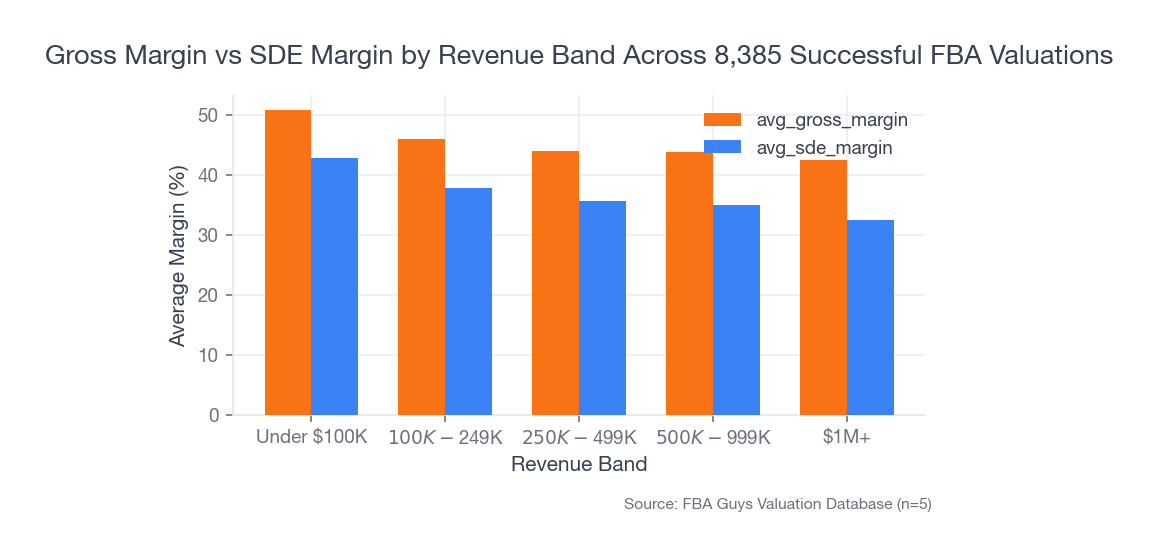
Businesses under $100K in annual revenue averaged a 50.8% gross margin and a 42.8% SDE margin in our dataset. The $100K to $249K group averaged 45.9% and 37.8%. By the time the business crossed $1M in annual revenue, the averages had compressed to 42.4% gross margin and 32.4% SDE margin.
That should change how you read the benchmark.
If a small business is sitting at 52% gross margin, that is nice. If a seven-figure business is sitting at 42% while carrying more people, more inventory, and a bigger ad bill, that can also be very nice. It may even be harder to achieve.
This is one reason benchmark articles go wrong so often. They hand the same number to everyone. A seller doing $80K and a seller doing $2M are not dealing with the same cost structure, the same operational sprawl, or the same tolerance for slippage.
If you're running a larger FBA business, that matters more than most benchmark articles admit. The cleaner question isn't "why don't we look like the tiny operators?" It is "after we pay for the staff, systems, and inventory load this size requires, are we still keeping enough of the margin to make the business feel durable?"
 Source: FBA Guys Valuation Database (n=8,385)
Category Helps. It Just Doesn't Settle It.
Category still matters.
Among single-category businesses in our database, Beauty averaged a 51.9% gross margin and a 41.3% SDE margin. Health & Personal Care averaged 49.1% and 39.8%. Pet Supplies and Grocery & Gourmet Food both averaged 43.1% gross margin, though Pet Supplies kept more of it as SDE.
Useful context. Not a verdict.
If your real question is category-by-category benchmarking, we already broke that out in Amazon FBA profit margin by category. For this keyword, category belongs in the background. The real benchmark still lives in what the business keeps.
The Weird Cases Are Usually Expense Stories
This is the section sellers tend to skip because it is less flattering than a category benchmark.
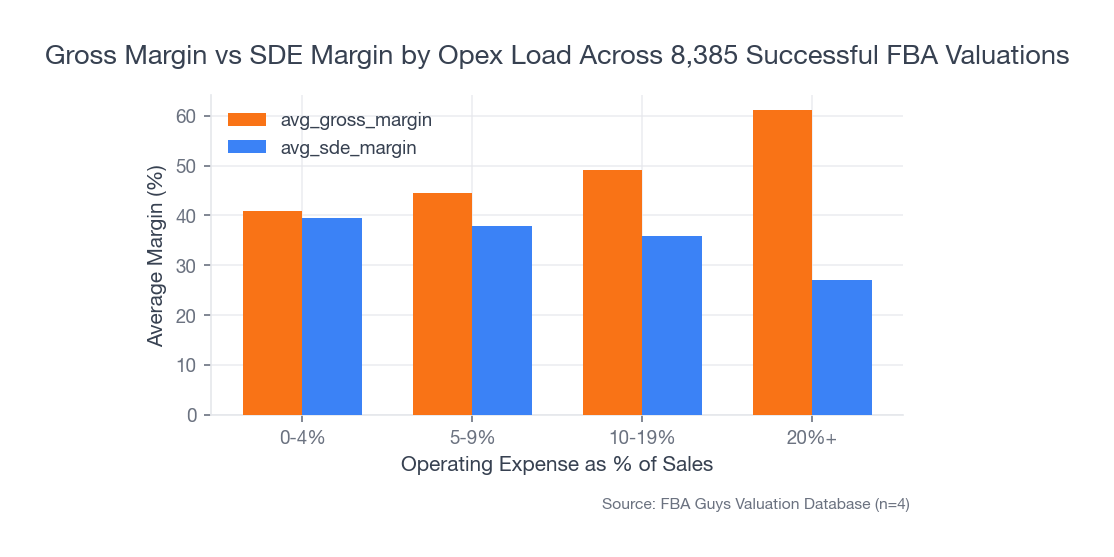
Among businesses where operating expense consumed just 0% to 4% of sales, average gross margin was 40.9% and average SDE margin was 39.4%. Clean. Tight. Very little leaked out between the headline number and the owner-earnings number.
Now look at the other end.
Businesses with operating expense at 20%+ of sales averaged a much prettier 61.2% gross margin. They also averaged only 27.1% SDE margin.
That is the trap. A seller can point to a fantastic gross margin and still be running a business whose owner earnings look merely decent once the recurring drag is admitted.
There is a related pattern in inventory speed too. Businesses turning inventory every few weeks averaged a 45.8% gross margin and a 38.5% SDE margin. Businesses holding inventory for a year or more averaged a much higher 53.5% gross margin but only a 42.4% SDE margin and a weaker 2.05x multiple. High headline margin plus slow-moving inventory is not the clean win people want it to be.
For an hour, that kind of business can look fantastic in a spreadsheet. Then someone starts asking how much cash is trapped in old stock, how dependable the demand really is, and whether the margin is high because the product is strong or because the inventory is not moving fast enough to expose the problem yet.
That is why "good" has to include some judgment about how the margin is being earned.
 Source: FBA Guys Valuation Database (n=8,385)
How to Benchmark Your Own Business Without Lying to Yourself
Start with gross margin because it is the easiest benchmark to calculate. If you are under 20%, assume the business is carrying very little room for error. If you are around 30% to 40%, you are in healthier territory. If you are above 40%, good. Keep going.
Then calculate SDE margin.
That second step is where a lot of fake comfort dies, which is useful. A business with 44% gross margin and 16% SDE margin is not in the same shape as a business with 44% gross margin and 31% SDE margin. They do not deserve the same story, even though a superficial benchmark article might hand them one.
So when you benchmark your own numbers, don't stop at the first flattering line. Ask what category you're in, certainly. Ask how your scale changes the target, yes. Then ask the harder question: once the business pays for the recurring things it really can't dodge, what is left? If you don't like that answer, good. That means you've found the real work.
Because that is what you're really trying to learn, isn't it? You aren't asking whether the business can produce one attractive screenshot on a Tuesday afternoon. You're asking whether the economics still hold once the ordinary headaches arrive, once the reorder comes in a little high, once ad costs drift, once a team member gets added, once an inventory mistake has to be cleaned up instead of ignored for another month. If the margin only looks good while everything stays unusually tidy, it isn't a very sturdy definition of good.
So if you want the practical answer to "what is a good profit margin for Amazon FBA," use this:
- Gross margin below 20% is usually weak
- Gross margin around 30% to 40% is often healthy
- Gross margin above 40% is strong
- SDE margin around 20% to 30% is healthy
- SDE margin above 30% is strong
After that, stop admiring the benchmark and start reading the business.
For current Amazon selling and fee mechanics, use Amazon's own seller pricing documentation. Static fee assumptions age badly.
FAQ
What is a good gross margin for Amazon FBA?
For many FBA businesses, 30% to 40% gross margin is healthy and 40%+ is strong. The exact benchmark changes with category, scale, and how much operating expense the business carries.
What is a good net profit margin for Amazon FBA?
If by net profit you mean the owner-earnings version of the business, a 20% to 30% SDE margin is often healthy and 30%+ is strong in our dataset. Under 10% is where the business starts feeling brittle.
Is 40% profit margin good for Amazon FBA?
Yes, if you mean gross margin. It is a strong number. It still does not finish the conversation unless a good share of it survives into SDE margin.
Why can a high-margin Amazon business still feel mediocre?
Because gross margin can stay high while recurring operating expense eats the owner earnings. That is why buyers keep asking what remains after the business pays for its real habits.
Curious what your business is worth?
Get a free, instant valuation and see how your Amazon business stacks up.
Get Your Free Valuation