Amazon FBA Fulfillment Fee Breakdown: The Fee Table Is the Easy Part
The FBA Guys
March 28, 2026
Amazon FBA fulfillment fee breakdown articles usually start by throwing a table at you: size tier, shipping weight, apparel exceptions, Low-Price FBA, maybe a reminder that storage exists too if the writer is feeling especially thorough.
That is all true. It is also incomplete in exactly the way that gets sellers in trouble.
If you want the direct answer, Amazon FBA fulfillment fees are the per-unit pick, pack, ship, and basic customer-service charges Amazon assigns based mainly on size tier and shipping weight, with separate rate treatment for a few product classes and programs. As of 2026, that part is straightforward enough to estimate.
The part sellers keep getting wrong is what the fee does after it lands in the model. It changes which SKUs still deserve shelf space. It changes whether a reorder still makes sense. It changes how much inventory you can afford to carry without lying to yourself about margin. And once it does that, it stops being a fee question and starts being a business-quality question.
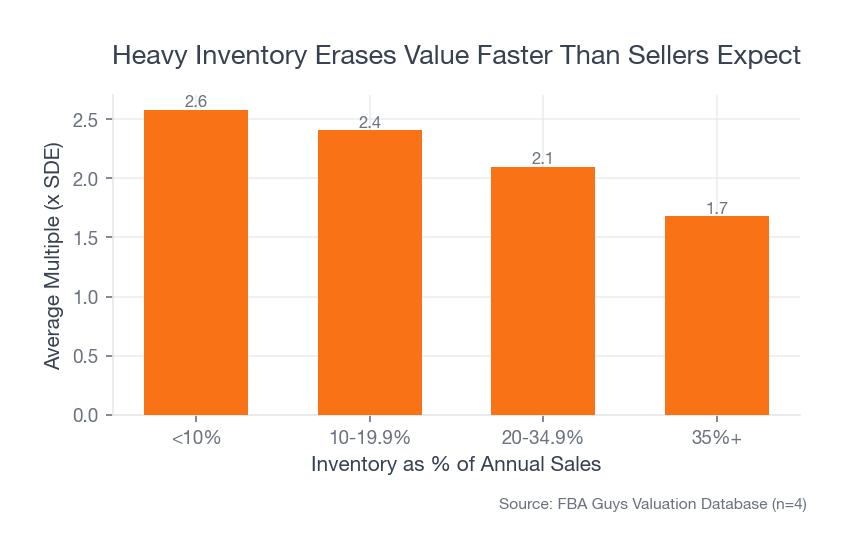
That distinction matters more than it sounds, because across 8,382 successful valuations in the FBA Guys database, businesses carrying inventory below 10% of annual sales averaged a 2.58x multiple while businesses carrying inventory at 35% or more of annual sales averaged 1.68x, and the ugly part is that the heaviest-inventory group still averaged 53.5% gross margin. So yes, you can look profitable and still be building a worse business.
That is why a useful Amazon FBA fulfillment fee breakdown should do two jobs at once. It should show you what Amazon is charging. Then it should show you how that charge changes the economics of the product once you stack it next to shipping weight, reorder timing, catalog breadth, and the bad habit sellers have of treating per-unit economics like the whole story.
What an Amazon FBA fulfillment fee actually includes
At the simplest level, the fulfillment fee is the charge Amazon takes to store the unit in a pickable location, pick it when it sells, pack it, ship it to the customer, handle baseline customer service, and process the ordinary order-fulfillment side of the transaction. It is a per-unit operational fee. It is not your whole Amazon cost stack. Amazon's FBA pricing overview is useful for checking the current public framework, but it still will not tell you whether the SKU deserves more capital.
That last sentence should not need repeating, but here we are.
An Amazon FBA fulfillment fee breakdown makes more sense when you separate the major cost buckets:
- Referral fee. This is the category-based selling fee tied to the sale price.
- Fulfillment fee. This is the per-unit fee based mainly on size tier and shipping weight.
- Monthly storage fee. This depends on cubic-foot storage use, size tier, and season.
- Inbound placement and related inbound logistics costs. These show up when Amazon distributes your inventory through its network.
- Extra operational costs that are not Amazon line items but behave like fee consequences anyway: prep, labeling, repacks, slower turns, stranded inventory, and more working capital tied up than the SKU deserves.
Sellers mix these together constantly. They say "our FBA fee went up" when what they really mean is "the all-in cost to keep this product alive got worse." Sometimes the base fulfillment fee did move. Sometimes the packaging changed and pushed shipping weight into a different bracket. Sometimes the SKU stayed in the same bracket, but the margin was thin enough that a small change exposed a business that was already weaker than the spreadsheet admitted.
That is the first useful distinction: Amazon charges a fee, but your P&L absorbs a chain reaction.
How Amazon decides your Amazon FBA fulfillment fee
Amazon's public FBA pricing framework is not mysterious. The core inputs are size tier and shipping weight. Shipping weight is generally derived from unit weight or dimensional weight, depending on the product. There are also separate public tables or treatment paths for things like apparel and Low-Price FBA.
So if you only came here for the mechanical answer, here it is:
- Measure the packaged product the way Amazon will classify it.
- Confirm the size tier.
- Confirm the shipping weight Amazon will bill against.
- Check whether the ASIN falls into a special program or exception bucket.
- Run the number through Amazon's calculator before you trust your own spreadsheet.
That is the boring part. Necessary, yes, but still boring.
The reason sellers still get blindsided is that they stop there. They think the job is complete once they have matched the unit to the right fee cell. But the same product can be "correctly classified" and still be a bad FBA unit. That happens when a small fee increase lands on a product with too little contribution margin, too much packaging waste, too much reorder friction, or too much inventory already parked in the system.
A lot of operators also talk about shipping weight as if it were a minor technicality. It is not. Shipping weight is one of those details that feels administrative until it starts deciding whether the item belongs in FBA at all. If you are near a threshold, one bad packaging decision can cost more than the line itself suggests because it changes every future unit, not just the next one. That is also why Amazon FBA dimensional weight pricing tends to become part of the same conversation whether you planned for it or not.
There is also a second trap. Sellers obsess over the rate table while refusing to decide what the product is for. Is the product supposed to be a margin engine? A ranking support item? A bundle anchor? A low-price acquisition tool? If you do not know the job of the SKU, then the fee analysis is usually theater. You are not evaluating a product. You are just pricing a box.
The fee table is not the full problem
This is where most Amazon FBA fulfillment fee breakdown posts lose the plot.
A fee table tells you the cost of one fulfilled order. It does not tell you what repeated fee pressure does to the structure of the business. It does not tell you whether the SKU forces you into heavier inventory positions. It does not tell you whether your reorder cadence becomes too twitchy. It does not tell you whether your catalog becomes wider in a way buyers actually like, or just wider in a way your ops team quietly hates.
Across the FBA Guys valuation dataset, margin bands do exactly what you would expect, but more sharply than many sellers behave:
- Businesses below 10% gross margin averaged a 1.54x multiple.
- At 10-19% margin, the average rose to 1.90x.
- At 20-29%, it reached 2.24x.
- At 30-39%, it was 2.37x.
- At 40% and above, it climbed to 2.57x.
The obvious reading is "higher margin is better." Fine. The more useful reading is that fulfillment-fee mistakes are dangerous because they can push a decent SKU into a weaker valuation band faster than the operator notices. Nobody wakes up saying, "Today we are going to sabotage the business with eight bad cost assumptions." They wake up saying, "It is only another dollar," or "The product still throws off cash," or "We will make it up on volume."
Then the fee stack keeps nibbling, the reorder gets larger because lead times are annoying, the packaging is not fixed because the product is still selling, and the margin report keeps saying things are acceptable because the top line still looks clean enough. Suddenly you are working inside a worse business while talking like you are still inside the old one.
The punchline is not that every fulfillment fee increase is catastrophic. It is that a lot of sellers only react when the pain is obvious, and by then the business has already adapted in expensive ways.
The inventory patterns that make fulfillment fees hurt more
This is the long section because it is where the real damage shows up, and pretending otherwise is how sellers end up doing "healthy" math on a business that has already become stiff and expensive.
When sellers talk about fulfillment fees, they usually stay at the unit level. That is understandable. Amazon charges per unit, and per-unit changes are easy to model. But buyers do not buy units. They buy systems. They buy the way inventory moves through the system, the amount of cash the system traps, and the likelihood that the operator actually understands what is happening inside it.
That is why the strongest data point for this article is not a fee table at all. It is inventory load.
Among 8,382 successful valuations, businesses with inventory below 10% of annual sales averaged a 2.58x multiple. At 10-19.9%, the average slipped to 2.41x. At 20-34.9%, it dropped to 2.10x. At 35% or more of annual sales trapped in inventory, the average fell again to 1.68x.
Read that again because the collapse is not subtle.
 Source: FBA Guys Valuation Database (n=8,382)
The part that should bother sellers is that the heaviest-inventory bucket still averaged 53.5% margin. So this is not a clean morality tale where only bad businesses suffer. Some of these businesses still look healthy in the shallow ways operators like to defend. Gross margin looks solid. Sales may still be respectable. The product might even have a loyal reorder pattern.
But the inventory shape is telling a different story. Too much cash is parked. Too much flexibility is gone. Too much future decision-making is already spoken for.
That is where fulfillment fees become more than a line item. If a fee increase means you now need a larger MOQ to keep landed economics tolerable, or you need to push more units into FBA to preserve your inbound rhythm, the fee is no longer just reducing contribution margin. It is changing how much capital the product demands from the rest of the business.
And buyers notice that, even if they do not describe it with your exact spreadsheet labels, because they can still see the stiffness in the business.
There is another pattern here that is even more interesting because it contradicts the lazy version of "faster turns are always better." They are not.
Businesses turning inventory every few months averaged a 2.50x multiple. Businesses turning every few weeks averaged 2.33x. Several-month turns averaged 2.28x, and year-or-more turns averaged 2.06x.
That middle bucket keeps winning, which is not what the simplistic version of the story would predict.
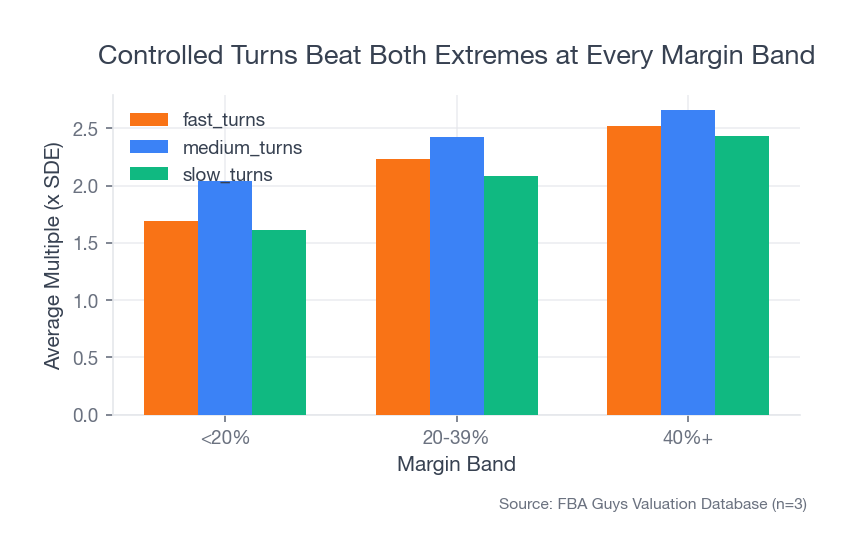
We ran the comparison again by margin band to make sure it was not a fluke. Same basic story. In sub-20% margin businesses, medium turns averaged 2.04x versus 1.69x for fast turns and 1.61x for slow turns. In the 20-39% margin band, medium turns averaged 2.42x versus 2.23x and 2.08x. In the 40%+ group, medium turns still led at 2.66x.
 Source: FBA Guys Valuation Database (margin-band comparison)
That does not mean slow inventory is secretly fine. It means the healthiest operating posture is often controlled replenishment, not frantic replenishment. A seller who is constantly sprinting inventory back into FBA might be avoiding stockouts, but they may also be living with fee pressure, fragile planning, and too little room for mistakes. On the other side, the seller carrying a year of inventory has solved the wrong problem and created three new ones.
This is where a lot of "Amazon FBA fulfillment fee breakdown" discussions become unintentionally dishonest. They pretend the right answer is to minimize the fee. That is not the right answer. The right answer is to understand what fee level your replenishment model can survive without turning the business into a cash trap.
There is a scar here that shows up in real businesses all the time: the product that still looks like a winner because its screenshot math was done six months ago. Sales were good. The margin was healthy enough. The reorder went in. Then packaging changed, placement got uglier, storage got fatter, and nobody wanted to be the person to admit the SKU should shrink or die because the top line still felt emotionally persuasive.
That is not incompetence. It is just a very normal way operators get trapped by yesterday's assumptions.
More SKUs do not automatically make fulfillment fees safer
Sellers often respond to fee pressure by widening the catalog. Sometimes that works. Sometimes it is just panic in spreadsheet form.
The valuation data has a useful curve here:
- Businesses with 1-5 SKUs averaged a 2.40x multiple.
- 6-20 SKUs improved to 2.68x.
- 21-50 SKUs held at 2.56x.
- 51+ SKUs dropped to 2.08x.
The second cluster matters more than the fifth cluster. Again.
That pattern is not saying catalog breadth is bad. It is saying moderate breadth tends to look healthier than hyper-sprawl. A small portfolio gives you some protection from single-product fragility. Fine. But once the catalog gets big enough, you start paying in other ways: more replenishment paths, more packaging variation, more fee exposure, more cases where an item technically survives but no longer deserves the operational attention it consumes.
This matters for fulfillment-fee analysis because sellers love to justify weak units by saying the portfolio absorbs them. Maybe. But portfolios do not absorb weak units for free. They absorb them by becoming harder to operate.
There is also a psychological problem. Big catalogs make it easier to hide bad decisions because no one SKU looks fatal. You can lose discipline one unremarkable ASIN at a time.
That is why we would rather see a business with a cleaner 6-20 SKU core than a heroic 90-SKU story held together by stale assumptions and a lot of internal optimism.
Where sellers misread low-price FBA and lighter products
Low-price FBA and lighter products are where people get weirdly overconfident.
The argument usually goes like this: the product is small, the fulfillment fee looks manageable, the ASP is low enough to move volume, and therefore the economics must be fine if conversion holds. That logic misses the point twice.
First, low-price products leave less room for being wrong. A one-dollar miss on a premium item is annoying. A one-dollar miss on a low-priced SKU can be the whole argument.
Second, small products invite sloppy thinking because they feel operationally harmless. But a product can be physically small and still be economically demanding. Maybe reorder frequency is too aggressive. Maybe returns are quietly ugly. Maybe the item earns a sale but does not earn the working capital it keeps consuming. Maybe you are using volume to disguise that the SKU is only healthy when every assumption is perfectly behaved.
That is why lighter items should not be treated as automatically safer. They are safer only if the full contribution picture still works after referral fees, fulfillment, storage exposure, freight, prep, and ad spend. If you need the broader import-side layer, that is the point where Amazon FBA landed cost breakdown matters more than another glance at the fee table.
To illustrate: a lightweight ASIN with thin margin can look wonderful in a fee calculator because the fulfillment fee appears tame relative to sale price. Then the operator realizes the product requires denser replenishment, heavier ad dependence, and more inventory babysitting than expected. The fee itself was not the lie. The conclusion drawn from the fee was.
Short version: do not confuse "cheap to fulfill" with "good to scale."
How to estimate the real per-unit cost before you reorder
Here is the version that actually helps.
Before a reorder, calculate the unit with these layers in order:
- Product cost.
- Freight and landed import cost.
- Amazon referral fee.
- Amazon fulfillment fee.
- Storage exposure, not just current monthly storage.
- Ad spend required to move the unit at the pace your model assumes.
- Expected return leakage, discounting, or disposal risk if the reorder lingers.
Then do one thing most sellers avoid: test the unit under a slightly worse reality than the one you want to believe.
What if the package tips into a higher shipping-weight outcome? What if turns slow by a month? What if ad cost climbs? What if you need to carry a little more inventory because inbound timing gets less cooperative?
If the SKU only works in the happy-path version, it does not work. It is just waiting for an excuse.
This is also the right place to use calculators without becoming dependent on them. The Amazon revenue calculator is useful. A landed-cost calculator is useful. A dimensional-weight calculator is useful. None of them are the final answer on their own. They are instruments. They do not make the decision for you.
The decision is whether the SKU deserves more capital.
Different question entirely.
FAQ
What is included in an Amazon FBA fulfillment fee?
The fulfillment fee is the per-unit charge for pick, pack, ship, and basic order handling through FBA. It is separate from referral fees, storage, inbound placement, and the non-Amazon operating costs that often decide whether the SKU is actually worth keeping, which is why a lot of sellers think they have done the cost analysis when they have really only priced one layer of it. If you are still mixing up storage and fulfillment, read Amazon FBA storage fees monthly vs long-term next.
How does Amazon calculate FBA fulfillment fees?
Mainly by size tier and shipping weight, with some separate program or category treatment layered on top. That is why the dimensions and packaged weight matter so much. A product is not just "small." It is small according to Amazon's measurement logic, which is a more expensive distinction when you get it wrong.
Is the fulfillment fee the biggest FBA cost?
Sometimes no. More often it is the most visible cost, not the largest one. Storage, inbound placement, freight, ad spend, and inventory drag can do more damage to the business than the headline per-unit fulfillment fee if the SKU is already marginal.
How often should you recheck your FBA fee assumptions?
Any time packaging changes, size-tier risk changes, sale price changes, margins tighten, or reorder cadence shifts. In practice, that means more often than most sellers do it. Definitely before a large reorder. Definitely before you convince yourself that a weak product is still "basically fine."
Conclusion: a real Amazon FBA fulfillment fee breakdown ends with a decision
The useful version of an Amazon FBA fulfillment fee breakdown is not "here is the table, good luck." It is "here is the fee, here is what that fee does to the SKU, and here is whether the SKU still deserves inventory," because the decision is the thing that makes the math matter. If the next question in your head is whether the unit still clears the rest of your economics, the natural follow-up is how to calculate Amazon FBA profit margin.
That is the difference between bookkeeping and operating.
Amazon's fee logic is annoying, but it is not impossible to understand. The harder part is being honest about what happens when that logic hits a thin-margin product, a bloated reorder, or a catalog that has gotten wider than the business can carry cleanly. The businesses that handle that well do not just estimate a fulfillment fee. They make cleaner decisions earlier.
That is usually what the better multiple was paying for.
Curious what your business is worth?
Get a free, instant valuation and see how your Amazon business stacks up.
Get Your Free Valuation